

Casting Lines for Future Tournaments
August 12, 2016
By Jack Roberts
MHSAA Executive Director
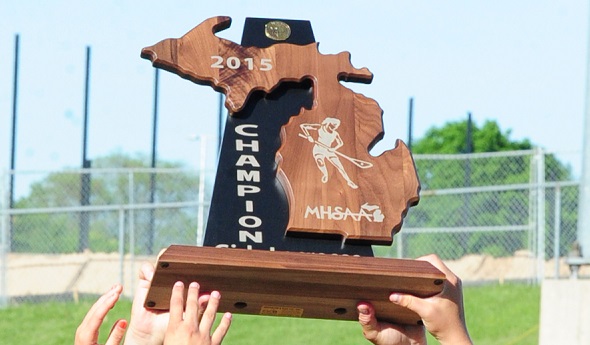
The MHSAA is best known to the public for the tournaments it conducts to conclude the fall, winter and spring seasons each school year.
These tournaments, the first and largest program of the MHSAA, have survived the Vietnam War, the Korean conflict and two World Wars. They have survived the technology bubble, the housing collapse, the energy crisis and the Great Depression.
MHSAA tournaments existed at the dawn of aviation and at the time of our nation’s lunar landing. Popes, presidents and governors have changed and changed again and again, and MHSAA tournaments roll on year after year.
But the sense of tradition and permanence and inevitability of MHSAA tournaments doesn’t dissuade us from asking questions about our tournaments, even some of the most basic questions. Here are two.
Question #1
I have long been and will always be an advocate for a Ryder Cup format for the MHSAA Golf Finals, and a team tennis approach to the MHSAA Tennis Finals; but 90 years of tradition is hard to overcome. Might this be a more exciting format? Could it be co-ed? Could it reverse the decline in boys tennis participation, and increase girls golf participation? Wouldn’t it be fun to try?
Periodically, the International Olympic Committee requires each of the designated Olympic sports to defend its status, to state its case why the sport should remain a part of the Olympic program. Then, after a series or votes that retain one sport at a time, the IOC drops the sport that makes the weakest case. It does so to make room for one of the previously unlisted sports that makes the best case for inclusion.
This would appear to keep the existing Olympic sports on their toes, and to keep the Olympic movement fresh and reflective of modern trends in sports.
While I would not enjoy the controversy, I can see the potential for some positive results if the MHSAA were to invoke the same policy for determining the 14 tournaments it will provide for girls and the 14 for boys.
This might cause us to consider more deeply what a high school sport should look like, or at least what an MHSAA tournament sport should stand for.
On the one hand, we might be inclined to drop tournaments for those sports that involve mostly non-faculty coaches and non-school venues, or require cooperative programs to generate enough participants to support a team, or resort almost entirely to non-school funding, or cater to individuals more than teams.
Or perhaps this process would cause policymakers to forget traditional thinking and ask: “In this day and age, should we shake off traditional notions of sport and consider more where modern kids are coming from?” That might mean fewer team sports and more individual sports, more “extreme” sports like snowboarding and skateboarding, and more lifetime sports, meaning not just golf and tennis and running sports, but also fishing and even shooting sports.
Currently, MHSAA policy states that the MHSAA will consider sponsorship of a tournament series for any sport which 64 member schools conduct on an interscholastic basis as a result of action by the governing boards of those schools.
Should the only question be how many schools sponsor a sport, or must an activity also have certain qualities and/or avoid certain “defects?” What should an MHSAA tournament sport look like and stand for?
Question #2
Bristling from criticism that his association is a money-grabbing exploiter of children, my counterpart in another state said, “If we were running our programs just to make money, we would do very many things very differently.” I knew exactly what he meant.
Because we care about the health and welfare of students, because we mean what we say that the athletic program needs to maximize the ways it enhances the school experience while minimizing academic conflicts, and because we try to model our claim that no sport is a minor sport when it comes to its potential to teach young people life lessons, we operate our programs in ways that make promoters, marketers and business entrepreneurs laugh, cry or cringe.
If money were the only object, we would seed and select sites to assure the teams that attracted the most spectators had the best chance to advance in our tournaments, regardless of the travel for any team or its fan base. If money were the only object, we would never schedule two tournaments to overlap and compete for public attention, much less tolerate three or four overlapping events. If money were the only object, we would allow signage like NASCAR events and promotions like minor league baseball games.
Those approaches to event sponsorship may not be all wrong; they’re just not all right for us. And we will live with the consequences of our belief system.
During a typical school year, more than 20 percent of the MHSAA’s 2,097 District, Regional and Final tournaments lose money. Not a single site in golf, skiing or tennis makes a single penny. In no sport did every District, Regional and Final site have revenue in excess of direct expenses.
In fact, in only three sports – boys and girls basketball and football – is revenue so much greater than direct expenses overall that it helps to pay for all the other tournaments in which the MHSAA invests.
That’s right: invests. When we present our budget to our board, we talk about the MHSAA’s investment in providing tournament opportunities in all those sports and all those places that cannot sustain the cost of those events on their own. How much is this investment worth to students, schools and society?
These two are core questions that require our focus far in advance of talk about scheduling, site selection, seeding and the myriad matters that too often hijack our time and attention.
Wagner Transforming Kalkaska Into Lake Michigan Conference Challenger
By
Tom Spencer
Special for MHSAA.com
October 6, 2023
Figuratively speaking, there is a new boys soccer sheriff in the Lake Michigan Conference. And Kalkaska is making big changes in the league’s competitiveness and results.
 The Blazers are 11-5-4 overall and have shown to be a formidable challenger for perennial champion Elk Rapids.
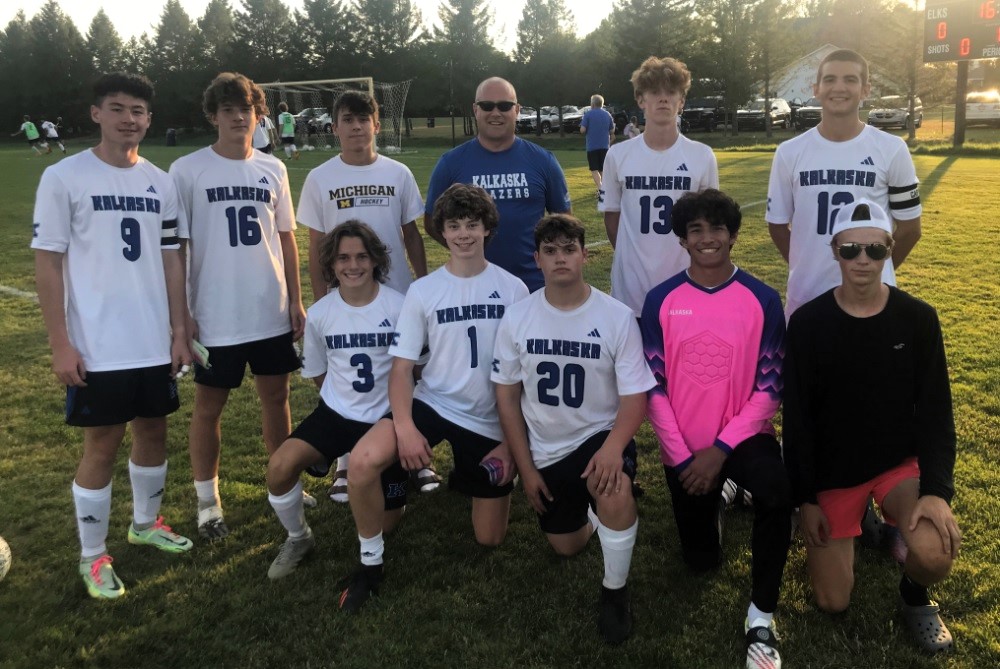
They are coached by a sheriff, literally — actually the undersheriff of Kalkaska County. David Wagner II took over the Blazers program four years ago, inheriting a team that went winless the year before.
This week they almost stopped Elk Rapids from clinching its 17th title in the league’s 21 years of existence. The Blazers ended up falling only 1-0 to the Elks after suffering a 2-1 loss earlier in the season, giving up two penalty kick goals.
The challenge by the new sheriff is welcomed by the league, especially Nate Plum, now in is 16th season at the helm of Elk Rapids. When Plum first took over the Elks, they usually played conference games with their junior varsity squad and the varsity team took on as many strong nonconference teams as they could schedule.
The Blazers had been an easy win for Lake Michigan Conference teams, often the victim of the MHSAA goal-differential rule.
All that has changed with Kalkaska producing high scorers like Cooper Swikoski last year and Wagner taking over, Plum noted.
“You can see kids that have been in that program the last four years and they get on the ball and they can move it, putting you in difficult spots,” Plum said. “They have been dangerous this year.
“They have been consistently harder to play,” he continued. “Dave sees the game the right way at the high school level as another avenue besides school to teach boys lessons — he’s a class act.”
Kalkaska earned two wins in Wagner’s first season, which was also his son Tripp’s first in high school soccer. The Blazers earned four wins the next year and 10 last fall.
Coach Wagner points more to life’s lessons than wins though and keeps soccer in perspective as just a game as he faces the challenges in his professional life.
Wagner came to Northern Michigan in 2002 as a deputy in Kalkaska County. He worked as a corrections officer, road patrol deputy, Traverse Narcotics Team officer, member of the emergency response team, road patrol sergeant and dispatch sergeant before being named undersheriff in 2018.
“To be honest with you, I don’t even look at our record – I don’t get hung up on it,” Wagner said. “I think boys soccer is very important, but from my line of work it’s a boys soccer game.
“I put in it in perspective,” he continued. “I am just trying to make these kids hopefully a little better adults.”
The Blazers have been led by strong defense, in particular in the middle of the field and at goal.
Adam Williams in normally the first line of defense with Ryan Perry playing more back. And then stellar goalkeeper Kayden Dueweke-Gonzales wraps things up. He has four shutouts this season.
“The defenders can’t pile up stats,” Wagner pointed out. “They are our rock.”
The three seniors leading the defense are among the six Blazers seniors who started playing soccer around the age of 5 under Wagner, who was their youth coach in Kalkaska for nine years before taking over the high school program. The rest of the Blazers seniors started playing for Wagner at 10 years of age.
Wagner had hopes the boys would have a different coach in high school but found himself needing to step into the vacancy. His seniors all played their last game at home Thursday on Senior Night, earning a 2-2 tie with Grayling.
Senior Night provided Wagner a nice chance to go down memory road.
“I had to dig up some old pictures for Senior Night because they wanted to do the young pictures and the current pictures,” he said.
Jose Saez is leading the team scoring with 11 goals and two assists. Tripp Wagner is next with six goals and six assists. Cade Ponstien has eight goals and two assists.
“Kalkaska has guys on the field that make a difference,” Plum said. “They definitely started to compete at higher level last year and an even higher level this year making the game extra difficult, and it made the conference even better — we can only hope that continues.”
 Wagner, though, knows the Blazers will have to get stronger to wrestle the league crown away from the previous champions. The list includes Charlevoix and Harbors Springs along with Elks’ title accomplishments.
“We’re still not at the level of the Elks or the Traverse City teams,” Wagner acknowledged. “At least we’re in the running for competitiveness.”
Wagner grew up playing soccer in the Kalamazoo area and became a soccer referee while he was in college at Ferris State. He is viewed by many referees and former coaches as the best referee Northern Michigan has ever seen.
He started high school refereeing in Northern Michigan 20 years ago and achieved national referee certification in the United States Soccer Referee Association.
Wagner has noticed a lot more disparity among high school soccer teams in the north than the south of Michigan. For example, he had never refereed a game ending in a mercy before moving north.
He’s also noticed many of the same referees on the pitch today he worked with two decades ago.
“It’s aging,” he said with a laugh. “But it is the coaches and parents’ fault. (Potential referees) stop and ask themselves, ‘Why would I want to go out there?’
“I have utmost respect for all the officials – even the ones I don’t agree with,” he continued. “At the end of the day, it is always about the kids.”
Jerry Grieve, a retired forester and veteran soccer referee, is one of many referees who recall working with Wagner as an official. He is also the father of three former Kalkaska athletes and graduates — Abigail, 2005, Paul, 2007, and Alex, 2009.
Grieve is extremely proud of Wagner’s affiliation and success with the Blazers.
“I first met Undersheriff Dave Wagner more than 20 years ago at a Cadillac/TC Central game, in which he was the center. “I have always thought he was the best soccer referee I have ever officiated with.
“And in the past few years he has been the coach of the Kalkaska high school boys team and they are the highest-quality team I have yet to see from that school,” Grieve continued. “But more importantly, as coach he has always treated referees with dignity and poise — which is a great teaching moment for his players.”
Kalkaska will now try to continue its growing success in the playoffs.
“It’s just one day at a time,” Wagner said of the Blazers’ motto. “We are not a soccer super powerhouse up here yet.
“I do like talking about giving credit to the team – they deserve it.”
The Blazers will travel to Cheboygan for the first round of the postseason. They will have to win that game and knock off the winner of Grayling/Boyne City in the second round to earn a possible rematch with Elk Rapids. The Elk have a first-round bye as the top seed and then play the winner of Kingsford and Iron Mountain.
 Tom Spencer is a longtime MHSAA-registered basketball and soccer official, and former softball and baseball official, and he also has coached in the northern Lower Peninsula area. He previously has written for the Saginaw News, Bay County Sports Page and Midland Daily News. He can be reached at [email protected] with story ideas for Manistee, Wexford, Missaukee, Roscommon, Ogemaw, Iosco, Alcona, Oscoda, Crawford, Kalkaska, Grand Traverse, Benzie, Leelanau, Antrim, Otsego, Montmorency, Alpena, Presque Isle, Cheboygan, Charlevoix and Emmet counties.
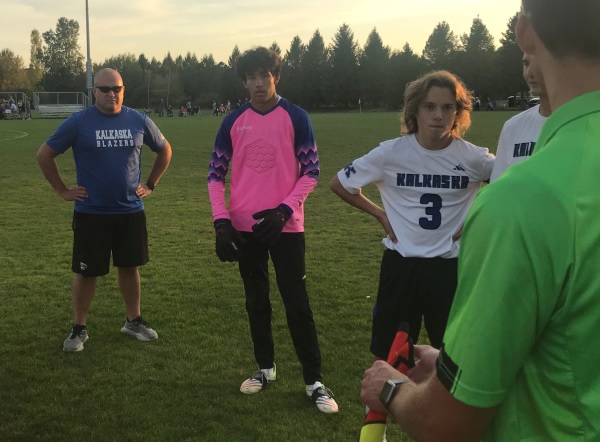
PHOTOS (Top) Kalkaska coach David Wagner II stands among his many seniors last week. (Middle) Wagner and his players meet with an official for the coin flip before playing Elk Rapids. (Photos by Tom Spencer.)