

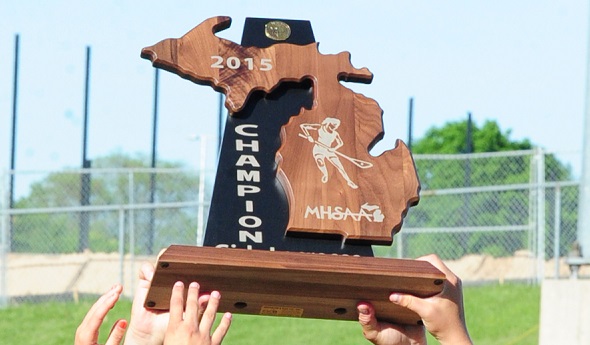
Casting Lines for Future Tournaments
August 12, 2016
By Jack Roberts
MHSAA Executive Director
The MHSAA is best known to the public for the tournaments it conducts to conclude the fall, winter and spring seasons each school year.
These tournaments, the first and largest program of the MHSAA, have survived the Vietnam War, the Korean conflict and two World Wars. They have survived the technology bubble, the housing collapse, the energy crisis and the Great Depression.
MHSAA tournaments existed at the dawn of aviation and at the time of our nation’s lunar landing. Popes, presidents and governors have changed and changed again and again, and MHSAA tournaments roll on year after year.
But the sense of tradition and permanence and inevitability of MHSAA tournaments doesn’t dissuade us from asking questions about our tournaments, even some of the most basic questions. Here are two.
Question #1
I have long been and will always be an advocate for a Ryder Cup format for the MHSAA Golf Finals, and a team tennis approach to the MHSAA Tennis Finals; but 90 years of tradition is hard to overcome. Might this be a more exciting format? Could it be co-ed? Could it reverse the decline in boys tennis participation, and increase girls golf participation? Wouldn’t it be fun to try?
Periodically, the International Olympic Committee requires each of the designated Olympic sports to defend its status, to state its case why the sport should remain a part of the Olympic program. Then, after a series or votes that retain one sport at a time, the IOC drops the sport that makes the weakest case. It does so to make room for one of the previously unlisted sports that makes the best case for inclusion.
This would appear to keep the existing Olympic sports on their toes, and to keep the Olympic movement fresh and reflective of modern trends in sports.
While I would not enjoy the controversy, I can see the potential for some positive results if the MHSAA were to invoke the same policy for determining the 14 tournaments it will provide for girls and the 14 for boys.
This might cause us to consider more deeply what a high school sport should look like, or at least what an MHSAA tournament sport should stand for.
On the one hand, we might be inclined to drop tournaments for those sports that involve mostly non-faculty coaches and non-school venues, or require cooperative programs to generate enough participants to support a team, or resort almost entirely to non-school funding, or cater to individuals more than teams.
Or perhaps this process would cause policymakers to forget traditional thinking and ask: “In this day and age, should we shake off traditional notions of sport and consider more where modern kids are coming from?” That might mean fewer team sports and more individual sports, more “extreme” sports like snowboarding and skateboarding, and more lifetime sports, meaning not just golf and tennis and running sports, but also fishing and even shooting sports.
Currently, MHSAA policy states that the MHSAA will consider sponsorship of a tournament series for any sport which 64 member schools conduct on an interscholastic basis as a result of action by the governing boards of those schools.
Should the only question be how many schools sponsor a sport, or must an activity also have certain qualities and/or avoid certain “defects?” What should an MHSAA tournament sport look like and stand for?
Question #2
Bristling from criticism that his association is a money-grabbing exploiter of children, my counterpart in another state said, “If we were running our programs just to make money, we would do very many things very differently.” I knew exactly what he meant.
Because we care about the health and welfare of students, because we mean what we say that the athletic program needs to maximize the ways it enhances the school experience while minimizing academic conflicts, and because we try to model our claim that no sport is a minor sport when it comes to its potential to teach young people life lessons, we operate our programs in ways that make promoters, marketers and business entrepreneurs laugh, cry or cringe.
If money were the only object, we would seed and select sites to assure the teams that attracted the most spectators had the best chance to advance in our tournaments, regardless of the travel for any team or its fan base. If money were the only object, we would never schedule two tournaments to overlap and compete for public attention, much less tolerate three or four overlapping events. If money were the only object, we would allow signage like NASCAR events and promotions like minor league baseball games.
Those approaches to event sponsorship may not be all wrong; they’re just not all right for us. And we will live with the consequences of our belief system.
During a typical school year, more than 20 percent of the MHSAA’s 2,097 District, Regional and Final tournaments lose money. Not a single site in golf, skiing or tennis makes a single penny. In no sport did every District, Regional and Final site have revenue in excess of direct expenses.
In fact, in only three sports – boys and girls basketball and football – is revenue so much greater than direct expenses overall that it helps to pay for all the other tournaments in which the MHSAA invests.
That’s right: invests. When we present our budget to our board, we talk about the MHSAA’s investment in providing tournament opportunities in all those sports and all those places that cannot sustain the cost of those events on their own. How much is this investment worth to students, schools and society?
These two are core questions that require our focus far in advance of talk about scheduling, site selection, seeding and the myriad matters that too often hijack our time and attention.
Long-Pursued Goals Becoming Expectations for Much-Improved Kearsley
By
Paul Costanzo
Special for MHSAA.com
August 30, 2023
Lucas Groulx could see this coming.
 During his freshman year, when the goal some nights for Flint Kearsley boys soccer was “don’t get mercied,” Groulx knew there were better times ahead.
Much better.
With a 4-1 start to this season, those wins already eclipsing the total from the entire fall of 2021, it looks like he’s being proved correct.
“It doesn’t really surprise me at all,” the junior center back said. “I knew from the get-go that the guys I was playing with are really good. I could definitely see that (success coming) later on down the road.”
It’s still very early, and nobody at Kearsley is hanging a banner. The goals of winning a District championship and finishing among the top three in the Flint Metro League still require plenty of work.
But the feeling is different now. There’s no longer just hope that all of that is possible. It’s becoming an expectation.
“We don’t want to just be in games; we need to win those games,” Kearsley coach Art Moody said. “All those next steps that we talked about, we set those goals and we set them up three years ago. Midway through last season, that’s when the corner was turned. That’s when it was like, ‘OK, we can compete.’ Getting double-digit wins, that was a big deal for the program. Now, it’s like, that’s not even a question anymore. We’re doing way better than that now.”
 Moody, who has won three MHSAA Finals championships coaching the Flint Powers Catholic girls program, is entering his third season at Kearsley.
In his first year, the team won just one regular-season game, but made a run to the District Final.
Year 2 saw the Hornets go 10-11, another major step forward.
The majority of that team was coming back this fall, including top scorers Caden Saxton and Tony Romero. Saxton, a senior, holds the school record for goals in a season (24) and career (52).
The back four, led by Groulx and classmate Saul Granados, returned intact, along with holding midfielder Danny Sanson and goalkeeper Aiden Tipton. All six received some form of all-league honors in the Metro.
And for many of the returning players, their experience playing together goes well beyond high school. Saxton’s father Keith, who is the school’s athletic director and Moody’s assistant, coached many of the current Hornets as kids on the MESA Sharks, a local travel team.
“We were all bonded,” Sanson, a senior, said. “We were pretty much family to each other since we were growing up playing with one another.”
That’s all led to the thought within the program that this is the year to truly make a mark and put Kearsley boys soccer on the map.
This season opened with four lopsided victories, and then a surprise from the Michigan High School Soccer Coaches Association: The Hornets were listed in the Division 2 rankings, coming in at No. 12.
 “It felt incredible,” Sanson said. “I didn’t even expect that, to be honest. It was an incredible feeling for all of us. We were all so proud.”
Even Groulx, who had faith all along, had to get some extra confirmation on this development.
“When I first saw it, I honestly didn’t know if it was true or not,” he said. “Then it really kind of dawned on us that we need to set a new standard here at Kearsley. It’s definitely going to push us to try and excel and just play better overall.”
Rankings are often downplayed by coaches and players, even if they’re typically well aware of them.
But Moody, who consistently sees his Powers girls near the top of the list in their division, was OK with letting his players soak this one in a bit.
“I made that comment that we got recognized at the state level, and that’s something that’s never happened to Kearsley,” he said. “I told them it’s not because of your record. You get recognized if coaches say your name. You get recognized if coaches are saying, ‘That’s someone to watch out for.’”
Of course, celebrating the ranking has a limit, and while the Hornets dropped their first match after its release – a 3-2 loss against Lake Fenton – they’ve decided to use that recognition to further fuel them to achieve their true goals.
“I feel like it motivates us to be better, but it also puts a little bit of pressure on us,” Sanson said. “We have to keep our standards high and just be doing the best we can every time we go out on the field. We’ve gotta bring it. Bring it, bring it, bring it.”
 Paul Costanzo served as a sportswriter at The Port Huron Times Herald from 2006-15, including three years as lead sportswriter, and prior to that as sports editor at the Hillsdale Daily News from 2005-06. He can be reached at [email protected] with story ideas for Genesee, Lapeer, St. Clair, Sanilac, Huron, Tuscola, Saginaw, Bay, Arenac, Midland and Gladwin counties.
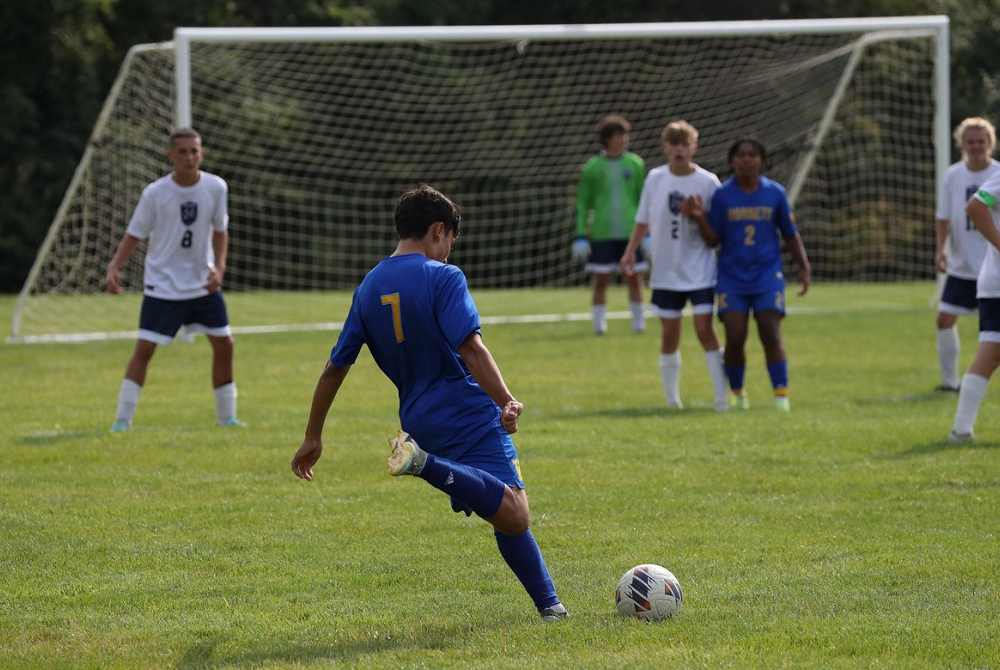
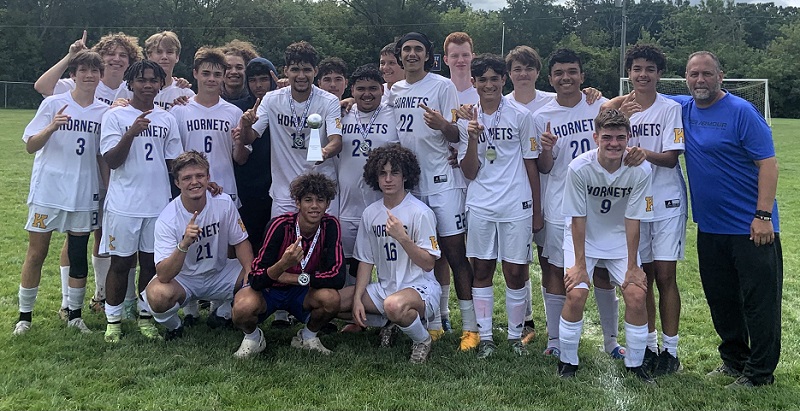
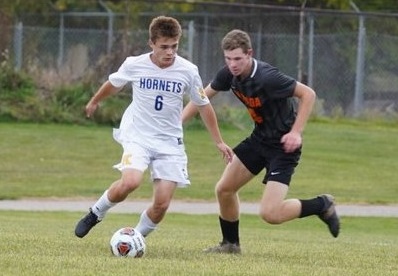
PHOTOS (Top) Kearsley’s Carlos Granados (7) steps into a kick during a game against Durand on Aug 21. (Middle) The team celebrates its Hornet Invitational championship Saturday after defeating Birch Run and Saginaw Nouvel. (Below) Caden Saxton (6) makes his move during last season's game against Armada. (Photos courtesy of the Flint Kearsley athletic department.)