

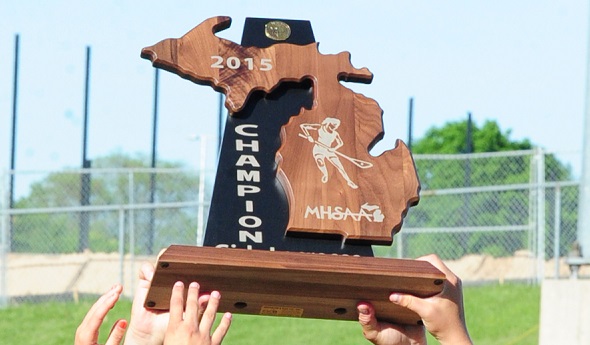
Casting Lines for Future Tournaments
August 12, 2016
By Jack Roberts
MHSAA Executive Director
The MHSAA is best known to the public for the tournaments it conducts to conclude the fall, winter and spring seasons each school year.
These tournaments, the first and largest program of the MHSAA, have survived the Vietnam War, the Korean conflict and two World Wars. They have survived the technology bubble, the housing collapse, the energy crisis and the Great Depression.
MHSAA tournaments existed at the dawn of aviation and at the time of our nation’s lunar landing. Popes, presidents and governors have changed and changed again and again, and MHSAA tournaments roll on year after year.
But the sense of tradition and permanence and inevitability of MHSAA tournaments doesn’t dissuade us from asking questions about our tournaments, even some of the most basic questions. Here are two.
Question #1
I have long been and will always be an advocate for a Ryder Cup format for the MHSAA Golf Finals, and a team tennis approach to the MHSAA Tennis Finals; but 90 years of tradition is hard to overcome. Might this be a more exciting format? Could it be co-ed? Could it reverse the decline in boys tennis participation, and increase girls golf participation? Wouldn’t it be fun to try?
Periodically, the International Olympic Committee requires each of the designated Olympic sports to defend its status, to state its case why the sport should remain a part of the Olympic program. Then, after a series or votes that retain one sport at a time, the IOC drops the sport that makes the weakest case. It does so to make room for one of the previously unlisted sports that makes the best case for inclusion.
This would appear to keep the existing Olympic sports on their toes, and to keep the Olympic movement fresh and reflective of modern trends in sports.
While I would not enjoy the controversy, I can see the potential for some positive results if the MHSAA were to invoke the same policy for determining the 14 tournaments it will provide for girls and the 14 for boys.
This might cause us to consider more deeply what a high school sport should look like, or at least what an MHSAA tournament sport should stand for.
On the one hand, we might be inclined to drop tournaments for those sports that involve mostly non-faculty coaches and non-school venues, or require cooperative programs to generate enough participants to support a team, or resort almost entirely to non-school funding, or cater to individuals more than teams.
Or perhaps this process would cause policymakers to forget traditional thinking and ask: “In this day and age, should we shake off traditional notions of sport and consider more where modern kids are coming from?” That might mean fewer team sports and more individual sports, more “extreme” sports like snowboarding and skateboarding, and more lifetime sports, meaning not just golf and tennis and running sports, but also fishing and even shooting sports.
Currently, MHSAA policy states that the MHSAA will consider sponsorship of a tournament series for any sport which 64 member schools conduct on an interscholastic basis as a result of action by the governing boards of those schools.
Should the only question be how many schools sponsor a sport, or must an activity also have certain qualities and/or avoid certain “defects?” What should an MHSAA tournament sport look like and stand for?
Question #2
Bristling from criticism that his association is a money-grabbing exploiter of children, my counterpart in another state said, “If we were running our programs just to make money, we would do very many things very differently.” I knew exactly what he meant.
Because we care about the health and welfare of students, because we mean what we say that the athletic program needs to maximize the ways it enhances the school experience while minimizing academic conflicts, and because we try to model our claim that no sport is a minor sport when it comes to its potential to teach young people life lessons, we operate our programs in ways that make promoters, marketers and business entrepreneurs laugh, cry or cringe.
If money were the only object, we would seed and select sites to assure the teams that attracted the most spectators had the best chance to advance in our tournaments, regardless of the travel for any team or its fan base. If money were the only object, we would never schedule two tournaments to overlap and compete for public attention, much less tolerate three or four overlapping events. If money were the only object, we would allow signage like NASCAR events and promotions like minor league baseball games.
Those approaches to event sponsorship may not be all wrong; they’re just not all right for us. And we will live with the consequences of our belief system.
During a typical school year, more than 20 percent of the MHSAA’s 2,097 District, Regional and Final tournaments lose money. Not a single site in golf, skiing or tennis makes a single penny. In no sport did every District, Regional and Final site have revenue in excess of direct expenses.
In fact, in only three sports – boys and girls basketball and football – is revenue so much greater than direct expenses overall that it helps to pay for all the other tournaments in which the MHSAA invests.
That’s right: invests. When we present our budget to our board, we talk about the MHSAA’s investment in providing tournament opportunities in all those sports and all those places that cannot sustain the cost of those events on their own. How much is this investment worth to students, schools and society?
These two are core questions that require our focus far in advance of talk about scheduling, site selection, seeding and the myriad matters that too often hijack our time and attention.
Brogan Finishes School Sports Career by Teaching Lesson in Perspective
By
Geoff Kimmerly
MHSAA.com senior editor
June 22, 2023
Baylor Brogan admittedly broke down for a moment or two. Who could blame him? Six months of unpredictable lows and highs to finish his senior year of high school sports had just taken another unexpected dive.
 In December, the Lansing Christian senior tore his right ACL playing basketball, ending his hoops season after it had just started. Nine months of anticipated recovery were expected to wipe out his entire golf season too – and after he’d finished eighth in Lower Peninsula Division 4 as a junior in helping the Pilgrims to their first team Finals championship.
But wait. Brogan made it back to the golf course in mid-May after just five months. He played one practice round, and the next day finished fifth individually at his team’s Regional at Ella Sharp Park in Jackson, advancing to the MHSAA Final as the third of three individual qualifiers.
His recovery was remarkable. The story just kept getting better. And if he would have gone on to win the Finals championship two weeks ago, or even place top-10 again, the ending would have been extraordinary.
Instead, he faced another completely unscriptable scenario – but the difficult decision he made launched the latest dip into the highest of notes as he ended his Pilgrims career.
Brogan headed to Battle Creek’s Bedford Valley for the weekend of June 9-10 to finish off his comeback. He thought he’d shot a 79 during Friday’s first round that tied him for 13th – well within range of a potential top-five finish. In golf, playing partners keep track of each other’s scores – and after Brogan’s group finished its 18 holes, he and his partners that round attested to what had been counted on their scorecards, and Brogan figured that was it until Saturday.
But there was a problem.
As he and his two coaches talked through the round after, they realized what had been reported for hole No. 15 was incorrect. It should have included another stroke. His total score should have been 80.
And yet, no one would have known except for those three. But that wouldn’t have sat well with Brogan or his coaches. As soon as they realized the mistake, they contacted the tournament director and rules official.
“For him to say, ‘Hey Coach, I just want to do the right thing,’ and knowing the right thing would potentially DQ you,” Pilgrims head coach Jason Block explained, “I just said, ‘Hey, we’re a Christian school. We have Jesus to answer to.’ I just think putting our heads on the pillow at night knowing we made the right decision for us felt good, and he agreed with that.”
Brogan figured they would just put in the lower score – after all, it was a stroke worse, and the other competitors couldn’t be mad about that. But because Brogan had already attested to the 79 – and by his own admission should have been monitoring his card after every hole while his round was being played – by rule he was disqualified and would have no score for the first round of play.
“When my head coach called me and told me, that’s when the sadness … I definitely cried a little bit,” Brogan said.
But here’s why his weekend will be recalled down the road as the games go on and others every once in a long while find themselves in a similar spot.
Brogan could have gotten angry. He could have blamed his coaches, or his partners, or anyone else supporting him on the course that day for not catching the mistake. He could have questioned the rule, called the disqualification unfair. He could have thrown a fit, made a scene. This was the last event of his high school career, and after he’d already battled back just to get here.
 Instead, he chose grace. He just went back out and played. He would no longer have a chance to place with a two-round score, but also by rule he could still finish the weekend with Saturday’s 18 holes.
“To get DQ’d senior year was kind of a bummer. But in the end it didn’t really matter that much, because they let me play, and my name was still on the leaderboard,” Brogan said. “That’s really all I cared about, is that I could go out and even though it wouldn’t count if I did well, I still wanted to go out and compete. Because that’s what I missed so much from being injured, and that’s all I wanted to do – is still play.
“I just went back out to the range that night. They said I could still play. That was the one thing I could be grateful for. I just went back out and practiced again, and woke up at 6 a.m. the next morning to go play.”
It’s guaranteed Brogan will be sure to monitor every hole on his scorecard as his golf career continues at Wheaton College (Ill.) these next few years. But like his coach, Brogan credited his faith for guiding how he managed this situation. There was an unintentional mishap, and it happens. He needed to accept it and report it, and that’s how he approached it.
Still, Brogan now would have to fill people in on what happened – and that seemed worst of all.
So he sent a group text to his team. Then he waited for his parents to get home from a date night – and they definitely were curious because Block had texted them how sorry he was about the tough news. They had no idea what that meant until Baylor explained – and they told him how proud they were of him for making the right decision.
Brogan’s dad Eric then texted the rest of the family – Baylor is eighth oldest of 10 siblings – and others who had been supporting him. That helped a lot. And the next day, Brogan went out and shot an 80 – a pretty big personal win after missing all but a few weeks of a season, and after the disappointment of the evening before.
“As a coach, he missed the whole season, he comes back like he comes back, and then to have this happen, it would have been very easy to go, ‘Man, can we just forget about it? Can we just not say anything?’” Block said.
But that was never a conversation.
Now, about the hat.
During a spring break trip to Florida six years ago, Brogan and his grandfather Dr. George Bettman were on the golf course. Brogan hadn’t really started playing golf at that point, but he accompanied his grandpa as Bettman shot below his age – 90.
A week later, Dr. Bettman died. Sometime after that, as the family was looking through some of his things, Brogan found the hat. It was way too big for Brogan at that point, but by junior year he was able to wear it with a washcloth lining the inside to make it fit more snugly.
There aren’t a lot of straw hats to be found at Michigan high school golf events, so it’s definitely been something of a Brogan signature as well as a reminder of his grandpa.
“It’s his hat, and I feel like he would love seeing me have some success in golf,” Brogan said, “and probably love even more that I would turn myself in for a mistake.”
 Geoff Kimmerly joined the MHSAA in Sept. 2011 after 12 years as Prep Sports Editor of the Lansing State Journal. He is a senior editor of MHSAA.com's editorial content and has served as MHSAA Communications Director since January 2021. Contact him at [email protected] with story ideas for the Barry, Eaton, Ingham, Livingston, Ionia, Clinton, Shiawassee, Gratiot, Isabella, Clare and Montcalm counties.
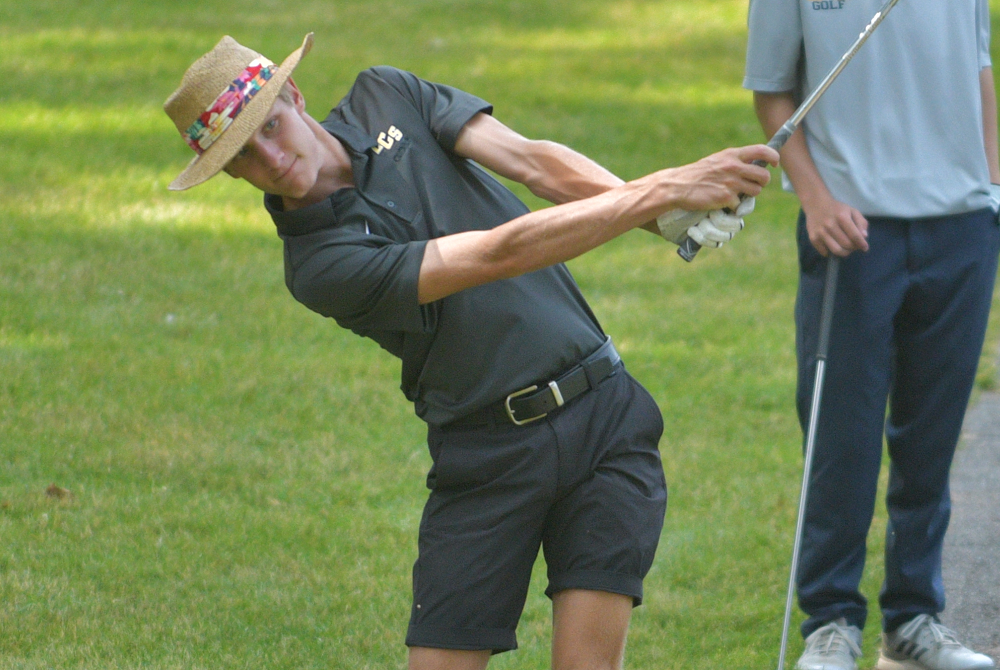
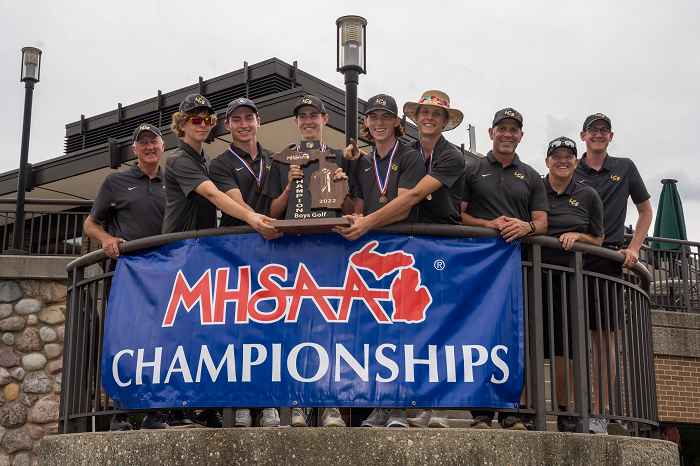
PHOTOS (Top) Lansing Christian's Baylor Brogan follows an approach shot during the LPD4 Final at Bedford Valley. (Middle) Brogan, in the straw hat, celebrates his team's 2022 championship. (Click for more from High School Sports Scene.)