

Casting Lines for Future Tournaments
August 12, 2016
By Jack Roberts
MHSAA Executive Director
The MHSAA is best known to the public for the tournaments it conducts to conclude the fall, winter and spring seasons each school year.
These tournaments, the first and largest program of the MHSAA, have survived the Vietnam War, the Korean conflict and two World Wars. They have survived the technology bubble, the housing collapse, the energy crisis and the Great Depression.
MHSAA tournaments existed at the dawn of aviation and at the time of our nation’s lunar landing. Popes, presidents and governors have changed and changed again and again, and MHSAA tournaments roll on year after year.
But the sense of tradition and permanence and inevitability of MHSAA tournaments doesn’t dissuade us from asking questions about our tournaments, even some of the most basic questions. Here are two.
Question #1
I have long been and will always be an advocate for a Ryder Cup format for the MHSAA Golf Finals, and a team tennis approach to the MHSAA Tennis Finals; but 90 years of tradition is hard to overcome. Might this be a more exciting format? Could it be co-ed? Could it reverse the decline in boys tennis participation, and increase girls golf participation? Wouldn’t it be fun to try?
Periodically, the International Olympic Committee requires each of the designated Olympic sports to defend its status, to state its case why the sport should remain a part of the Olympic program. Then, after a series or votes that retain one sport at a time, the IOC drops the sport that makes the weakest case. It does so to make room for one of the previously unlisted sports that makes the best case for inclusion.
This would appear to keep the existing Olympic sports on their toes, and to keep the Olympic movement fresh and reflective of modern trends in sports.
While I would not enjoy the controversy, I can see the potential for some positive results if the MHSAA were to invoke the same policy for determining the 14 tournaments it will provide for girls and the 14 for boys.
This might cause us to consider more deeply what a high school sport should look like, or at least what an MHSAA tournament sport should stand for.
On the one hand, we might be inclined to drop tournaments for those sports that involve mostly non-faculty coaches and non-school venues, or require cooperative programs to generate enough participants to support a team, or resort almost entirely to non-school funding, or cater to individuals more than teams.
Or perhaps this process would cause policymakers to forget traditional thinking and ask: “In this day and age, should we shake off traditional notions of sport and consider more where modern kids are coming from?” That might mean fewer team sports and more individual sports, more “extreme” sports like snowboarding and skateboarding, and more lifetime sports, meaning not just golf and tennis and running sports, but also fishing and even shooting sports.
Currently, MHSAA policy states that the MHSAA will consider sponsorship of a tournament series for any sport which 64 member schools conduct on an interscholastic basis as a result of action by the governing boards of those schools.
Should the only question be how many schools sponsor a sport, or must an activity also have certain qualities and/or avoid certain “defects?” What should an MHSAA tournament sport look like and stand for?
Question #2
Bristling from criticism that his association is a money-grabbing exploiter of children, my counterpart in another state said, “If we were running our programs just to make money, we would do very many things very differently.” I knew exactly what he meant.
Because we care about the health and welfare of students, because we mean what we say that the athletic program needs to maximize the ways it enhances the school experience while minimizing academic conflicts, and because we try to model our claim that no sport is a minor sport when it comes to its potential to teach young people life lessons, we operate our programs in ways that make promoters, marketers and business entrepreneurs laugh, cry or cringe.
If money were the only object, we would seed and select sites to assure the teams that attracted the most spectators had the best chance to advance in our tournaments, regardless of the travel for any team or its fan base. If money were the only object, we would never schedule two tournaments to overlap and compete for public attention, much less tolerate three or four overlapping events. If money were the only object, we would allow signage like NASCAR events and promotions like minor league baseball games.
Those approaches to event sponsorship may not be all wrong; they’re just not all right for us. And we will live with the consequences of our belief system.
During a typical school year, more than 20 percent of the MHSAA’s 2,097 District, Regional and Final tournaments lose money. Not a single site in golf, skiing or tennis makes a single penny. In no sport did every District, Regional and Final site have revenue in excess of direct expenses.
In fact, in only three sports – boys and girls basketball and football – is revenue so much greater than direct expenses overall that it helps to pay for all the other tournaments in which the MHSAA invests.
That’s right: invests. When we present our budget to our board, we talk about the MHSAA’s investment in providing tournament opportunities in all those sports and all those places that cannot sustain the cost of those events on their own. How much is this investment worth to students, schools and society?
These two are core questions that require our focus far in advance of talk about scheduling, site selection, seeding and the myriad matters that too often hijack our time and attention.
1975 Class D Football Film Finds Way Back to MHSAA for All to Enjoy Again
By
John Johnson
MHSAA Communications Director emeritus
April 11, 2023
Chasing history was one of the most enjoyable parts of serving at the MHSAA for nearly 34 years. Researching information, but especially what I considered for a long time to be talking to the “old guys” (now I’m one of them) and soaking up their verbal histories of our games.
It also involved chasing down old photos, broadcasts and game films – especially those which preceded our more modern video era beginning in the 1990s.
When I arrived at the MHSAA in 1987, there was a shelf of old 16mm film canisters of an assortment of Boys Basketball Finals from the 1950s to the 70s – certainly not a complete set. The Association would shoot some game action from each quarter and the trophy presentations. They’d be sent out to the participating schools to show to the students (I remember watching a Mt. Pleasant Sacred Heart game in 1967 when I was in fifth grade). Some would find their way back to the office – most would not.
Will Robinson, the legendary Detroit Public School League coach who led Pershing High School to the league’s first MHSAA titles (in 1967 and 1970) after a district-imposed hiatus from 1931-61 from statewide tournaments, would pull my chain every time we saw each other about those games featuring Spencer Haywood and Ralph Simpson, among others. We never found them.
So it became a project to try and track down as many old game films of state championships as we could.
Any conversation with someone with a history tone always included a question about the whereabouts of a game film or video. One of those recently bore fruit.
When Crystal Falls Forest Park played in the 8-Player Football Finals at the Superior Dome in Marquette back in 2017, I spent a lot of time talking with living legend Bill Santilli, who led the Trojans to the Class D crown in the very first year of the tournament in 1975, and who would later coach the school to a second state title (2007) and serve as athletic director. He said he had a box on his desk collecting dust that he didn’t know what to do with – that box contained an old video tape from that game.
I uttered four little words – “Send It To Me.”
 After a while the tape arrived in East Lansing, and I got our video production friends at When We Were Young Productions/Rush Media in Wisconsin on it. This winter, they found someone who could convert it and sent me a file that was recently posted to the MHSAASPORTS Channel on YouTube. You can watch the Trojans play Flint Holy Rosary by Clicking Here or watching above.
There are all kinds of old game films/videos and artifacts in attics, closets, garages, etc., in every town. Two of our Muskegon historians – Ron Pesch, the MHSAA’s history guy; and the old broadcaster, Jim Moyes, who called games on the radio for years in the Port City – can tell stories of their own about discoveries they have made. Moyes found all kinds of mementos while working on his book on the history of high school track & field in Michigan, and sitting with Ron at this year’s Girls Basketball Finals, he told a story of finding the mother lode of photographs from one of his other historical passions – silent film star Buster Keaton – who spent ten summers in the Actor’s Colony in Muskegon.
Pesch found a listing for Eleanor Keaton, Buster’s widow, using a telephone book (remember those?), made a phone call and shortly thereafter, on a vacation to California, was in her living room where he was loaned a photo album and family scrapbook containing all kinds of images from their time in Muskegon. Many of those images appear in a soon-to-be-released documentary, while the album and scrapbook now reside in the Academy of Motion Picture Arts and Sciences library in Beverly Hills, Calif. You can preview the film by Clicking Here.
So if you think you have something of a state championship that could be utilized on a bigger platform and enjoyed by everyone, drop a note to [email protected]. If something needs to be converted to a more modern format, you’ll get a copy back, and the footage will be eventually viewable on the MHSAA’s YouTube channel.
To help guide your search, think in the following terms:
► Just about anything before 1990. But there are gaps during the 90s that need to be filled as well.
► Only Championship games and Semifinal games, unless something momentous occurred (like Richie Jordan’s 60-point game for Fennville against Bridgman in a Regional Semifinal in 1965, which is still an all-time tournament single-game record for boys basketball).
► For a list of what’s in the MHSAA archives prior to 2000 – Click Here. A long-term project is to get all of the games on the list and up to about 2010 uploaded to the YouTube channel. Most games from 2013-14 on can be viewed on the NFHS Network, and some games between 2010 and 2013 are available for purchase as DVDs from PrepFilms.com.
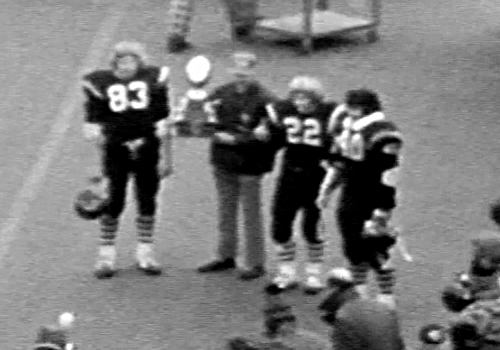
PHOTO Posing with the championship trophy after the 1975 Class D Football Final are (left to right): Forest Park tight end Bryan LaChapelle, quarterback Richard Mettlach, head coach Dick Mettlach and running back Bill Santilli.