

Casting Lines for Future Tournaments
August 12, 2016
By Jack Roberts
MHSAA Executive Director
The MHSAA is best known to the public for the tournaments it conducts to conclude the fall, winter and spring seasons each school year.
These tournaments, the first and largest program of the MHSAA, have survived the Vietnam War, the Korean conflict and two World Wars. They have survived the technology bubble, the housing collapse, the energy crisis and the Great Depression.
MHSAA tournaments existed at the dawn of aviation and at the time of our nation’s lunar landing. Popes, presidents and governors have changed and changed again and again, and MHSAA tournaments roll on year after year.
But the sense of tradition and permanence and inevitability of MHSAA tournaments doesn’t dissuade us from asking questions about our tournaments, even some of the most basic questions. Here are two.
Question #1
I have long been and will always be an advocate for a Ryder Cup format for the MHSAA Golf Finals, and a team tennis approach to the MHSAA Tennis Finals; but 90 years of tradition is hard to overcome. Might this be a more exciting format? Could it be co-ed? Could it reverse the decline in boys tennis participation, and increase girls golf participation? Wouldn’t it be fun to try?
Periodically, the International Olympic Committee requires each of the designated Olympic sports to defend its status, to state its case why the sport should remain a part of the Olympic program. Then, after a series or votes that retain one sport at a time, the IOC drops the sport that makes the weakest case. It does so to make room for one of the previously unlisted sports that makes the best case for inclusion.
This would appear to keep the existing Olympic sports on their toes, and to keep the Olympic movement fresh and reflective of modern trends in sports.
While I would not enjoy the controversy, I can see the potential for some positive results if the MHSAA were to invoke the same policy for determining the 14 tournaments it will provide for girls and the 14 for boys.
This might cause us to consider more deeply what a high school sport should look like, or at least what an MHSAA tournament sport should stand for.
On the one hand, we might be inclined to drop tournaments for those sports that involve mostly non-faculty coaches and non-school venues, or require cooperative programs to generate enough participants to support a team, or resort almost entirely to non-school funding, or cater to individuals more than teams.
Or perhaps this process would cause policymakers to forget traditional thinking and ask: “In this day and age, should we shake off traditional notions of sport and consider more where modern kids are coming from?” That might mean fewer team sports and more individual sports, more “extreme” sports like snowboarding and skateboarding, and more lifetime sports, meaning not just golf and tennis and running sports, but also fishing and even shooting sports.
Currently, MHSAA policy states that the MHSAA will consider sponsorship of a tournament series for any sport which 64 member schools conduct on an interscholastic basis as a result of action by the governing boards of those schools.
Should the only question be how many schools sponsor a sport, or must an activity also have certain qualities and/or avoid certain “defects?” What should an MHSAA tournament sport look like and stand for?
Question #2
Bristling from criticism that his association is a money-grabbing exploiter of children, my counterpart in another state said, “If we were running our programs just to make money, we would do very many things very differently.” I knew exactly what he meant.
Because we care about the health and welfare of students, because we mean what we say that the athletic program needs to maximize the ways it enhances the school experience while minimizing academic conflicts, and because we try to model our claim that no sport is a minor sport when it comes to its potential to teach young people life lessons, we operate our programs in ways that make promoters, marketers and business entrepreneurs laugh, cry or cringe.
If money were the only object, we would seed and select sites to assure the teams that attracted the most spectators had the best chance to advance in our tournaments, regardless of the travel for any team or its fan base. If money were the only object, we would never schedule two tournaments to overlap and compete for public attention, much less tolerate three or four overlapping events. If money were the only object, we would allow signage like NASCAR events and promotions like minor league baseball games.
Those approaches to event sponsorship may not be all wrong; they’re just not all right for us. And we will live with the consequences of our belief system.
During a typical school year, more than 20 percent of the MHSAA’s 2,097 District, Regional and Final tournaments lose money. Not a single site in golf, skiing or tennis makes a single penny. In no sport did every District, Regional and Final site have revenue in excess of direct expenses.
In fact, in only three sports – boys and girls basketball and football – is revenue so much greater than direct expenses overall that it helps to pay for all the other tournaments in which the MHSAA invests.
That’s right: invests. When we present our budget to our board, we talk about the MHSAA’s investment in providing tournament opportunities in all those sports and all those places that cannot sustain the cost of those events on their own. How much is this investment worth to students, schools and society?
These two are core questions that require our focus far in advance of talk about scheduling, site selection, seeding and the myriad matters that too often hijack our time and attention.
Energy, Competition, Moments & More Continue to Spark Unity Coach Soodsma
By
Steve Vedder
Special for MHSAA.com
February 15, 2023
HUDSONVILLE – The pep band is blaring the school fight song, the boisterous crowd of a couple of thousand fans has long grown weary waiting for the opening tip-off, and the antsy players are crowded behind the locker room doors ready to spring like a pack of lions.
It's like the scene from the epic basketball movie "Hoosiers" where coach Norman Dale pauses before entering a rollicking and packed Friday night gymnasium to mutter to himself, "Welcome to Indiana basketball."
Scott Soodsma not only grasps the significance of that scene firsthand, it's why after four decades he still loves coaching.
"The fierce competition, the band, your heart pounding like a dog – it's still like it was 30 years ago," said Soodsma, the Hudsonville Unity Christian coach and dean of West Michigan basketball coaches in his 41st season of a run that’s included two states and three schools.
"How does it get any better than that? I'm always telling the kids to live for the moment. You can't replace all that; I still get the shivers. I've had so many moments like that."
Among those highlight moments are being one of just three Michigan coaches to win both girls and boys MHSAA Finals championships (Paul Cook of Lansing Eastern boys/Lansing Catholic girls and Johnny Jones of Lansing Everett were the others), and the moment he claims is easily No. 1 on his all-time personal list: coaching his daughter Amber as part of the 2006 Class B champ. Unity Christian also won a 2019 boys state title. He also won a third Finals championship with the boys at McBain Northern Michigan Christian.
Soodsma, 63, admits there have been myriad changes in coaching basketball since his first season at North Dakota's James Valley Christian High School in 1983 and coming to Unity Christian in 1993. For starters, players are bigger and stronger and are more schooled in the game through AAU and offseason programs. In addition, the influence of parents – for better or worse – has increased dramatically. As for the on-court game, Soodsma unabashedly admits he at first fought the institution of the 3-point shot. And the emphasis on winning has definitely only increased pressure on many coaches.
Soodsma, a member of the Basketball Coaches Association of Michigan Hall of Fame who ranks ninth on the state's all-time boys wins list with 635, said he's adapted to the times. He wants to win as much as he ever has, still broods for days after losses and still considers himself receptive to the changing Xs and Os aspect of coaching.
But where his booming voice routinely used to resonate loudly into the middle sections of the Unity Christian bleachers, most of those comments now are only audible to fans perched in the first couple rows of the stands. Which is probably a good thing, Soodsma adds sheepishly.
 Coaching, he readily contends, is still coaching – and winning still heads the list of priorities. He does add one disclaimer, however, in terms of winning. Whereas it used to be about a young coach building a resume through wins, it's now about what winning can do for today's teenager athlete. An old-school coach? Yeah, probably. But one who has learned much about himself, players and parents after 41 years.
"I've learned to enjoy the kids more; I'm definitely a different kind of person in the ’90s as opposed to now in the 2000s," he said. "I am a stubborn man, and it took a long time (to change). But winning? Oh, yeah. I've never backed down. The winning and losing hasn't changed, and I make no excuses that I still want to win."
Which is then strange, perhaps, that he doesn't list being just one of two coaches to win Finals titles in both girls and boys basketball as the zenith of coaching for 41 seasons. That honor goes to having his daughter, who went on to a stellar career at Dort College, on the state championship club.
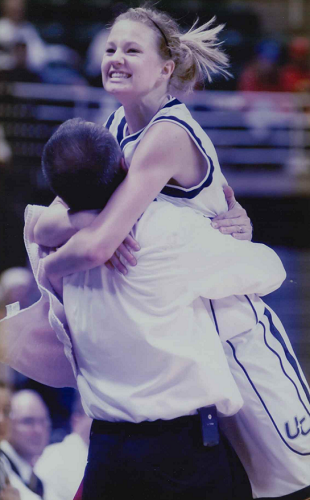
"It's not that big of a deal," he said of being on the bench for what likely will never happen again as boys and girls basketball are now in the same season. "To me it's not an accomplishment I would rank (at the top). I'm just being honest. Winning a state title with Amber, and the picture I have of her and me in my office, that's the best."
How well has Soodsma adapted his coaching style over the years? Two people in a position to know offer their own opinions on the topic, including 22-year assistant Bruce Capel and Randy Oosterheert, who with son Rylan are the only father/son combination that Soodsma has coached.
"Scott has always been vocal on the sidelines as a coach. As I sit in the stands and watch as a spectator, same Scott," said Randy Oosterheert who played for Soodsma in 1992-93 and 1993-94 and whose son is a current Unity Christian player. "I will say that my son and I agree, if you do something wrong on the floor, he is the first person to greet you on the sidelines and point out your failure. However, if you do good, he is the first person to greet you on the sidelines and tell you good job.
"The latter is done at a little lower decibel level than the offense, and those with a watchful eye from up in the stands unfortunately (don’t) get to hear the praise, only the punishment. Scott is obviously very competitive, then and now. He expects a lot but gives a lot."
As far as the competitive side, Capel hasn’t seen much of a difference over their two decades together.
"Certainly, coaching is a lot different in how you approach kids from more than 20 years ago," he said. "There's a difference in society and you have to change with it, and he's done that. I don't think it's as much life and death with Scott anymore. But in terms of winning, I haven't seen that go away."
It's a coin flip as for how much longer Soodsma will be directing traffic from the sidelines. He broke into the top 10 among the all-time winningest boys coaches in Michigan history by passing Warren De La Salle's Bernie Holowicki and Ray Lauwers of Morley Stanwood last season. Next on the list is Big Rapids' Kent Ingles (644). When you factor in Soodsma's win total as both boys and girls coach, the 742-and-counting combined wins rank eighth in state history.
He does admit the desire to spend more time with wife Mary, the longtime away scorekeeper for the program, and 11 grandkids scattered from Denver to Seattle to San Diego. Retirement could strike when this season ends in March, or it could still be several Marches away. But when the end comes he anticipates making a contented transition from arguing with officials, coming to an "understanding" with parents and devising new Xs and Os. Soon, he mused, will come time for much-anticipated passions such as hunting, fishing and pickleball.
"For the first time I've contemplated it," he said. "There are a lot of things I'd like to do. I'm not a basketball junkie."
That may be true. But it'll still be tough to surrender those noisy pep bands, bright gymnasium lights and the din of Friday night crowds.
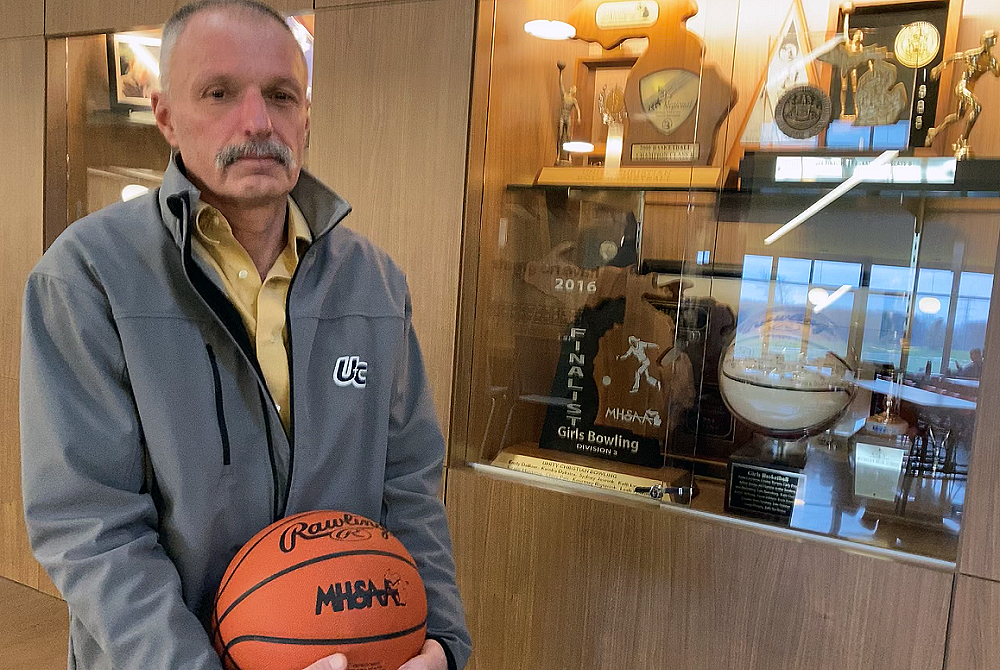
PHOTOS (Top) Hudsonville Unity Christian boys basketball coach Scott Soodsma stands in front of a portion of the school’s trophy case, which he’s helped fill over decades coaching basketball. (Middle) Soodsma and daughter Amber embrace during their team’s 2006 Class B Final victory. (Top photo by Steve Vedder. Middle photo courtesy of the Soodsma family.)