

Casting Lines for Future Tournaments
August 12, 2016
By Jack Roberts
MHSAA Executive Director
The MHSAA is best known to the public for the tournaments it conducts to conclude the fall, winter and spring seasons each school year.
These tournaments, the first and largest program of the MHSAA, have survived the Vietnam War, the Korean conflict and two World Wars. They have survived the technology bubble, the housing collapse, the energy crisis and the Great Depression.
MHSAA tournaments existed at the dawn of aviation and at the time of our nation’s lunar landing. Popes, presidents and governors have changed and changed again and again, and MHSAA tournaments roll on year after year.
But the sense of tradition and permanence and inevitability of MHSAA tournaments doesn’t dissuade us from asking questions about our tournaments, even some of the most basic questions. Here are two.
Question #1
I have long been and will always be an advocate for a Ryder Cup format for the MHSAA Golf Finals, and a team tennis approach to the MHSAA Tennis Finals; but 90 years of tradition is hard to overcome. Might this be a more exciting format? Could it be co-ed? Could it reverse the decline in boys tennis participation, and increase girls golf participation? Wouldn’t it be fun to try?
Periodically, the International Olympic Committee requires each of the designated Olympic sports to defend its status, to state its case why the sport should remain a part of the Olympic program. Then, after a series or votes that retain one sport at a time, the IOC drops the sport that makes the weakest case. It does so to make room for one of the previously unlisted sports that makes the best case for inclusion.
This would appear to keep the existing Olympic sports on their toes, and to keep the Olympic movement fresh and reflective of modern trends in sports.
While I would not enjoy the controversy, I can see the potential for some positive results if the MHSAA were to invoke the same policy for determining the 14 tournaments it will provide for girls and the 14 for boys.
This might cause us to consider more deeply what a high school sport should look like, or at least what an MHSAA tournament sport should stand for.
On the one hand, we might be inclined to drop tournaments for those sports that involve mostly non-faculty coaches and non-school venues, or require cooperative programs to generate enough participants to support a team, or resort almost entirely to non-school funding, or cater to individuals more than teams.
Or perhaps this process would cause policymakers to forget traditional thinking and ask: “In this day and age, should we shake off traditional notions of sport and consider more where modern kids are coming from?” That might mean fewer team sports and more individual sports, more “extreme” sports like snowboarding and skateboarding, and more lifetime sports, meaning not just golf and tennis and running sports, but also fishing and even shooting sports.
Currently, MHSAA policy states that the MHSAA will consider sponsorship of a tournament series for any sport which 64 member schools conduct on an interscholastic basis as a result of action by the governing boards of those schools.
Should the only question be how many schools sponsor a sport, or must an activity also have certain qualities and/or avoid certain “defects?” What should an MHSAA tournament sport look like and stand for?
Question #2
Bristling from criticism that his association is a money-grabbing exploiter of children, my counterpart in another state said, “If we were running our programs just to make money, we would do very many things very differently.” I knew exactly what he meant.
Because we care about the health and welfare of students, because we mean what we say that the athletic program needs to maximize the ways it enhances the school experience while minimizing academic conflicts, and because we try to model our claim that no sport is a minor sport when it comes to its potential to teach young people life lessons, we operate our programs in ways that make promoters, marketers and business entrepreneurs laugh, cry or cringe.
If money were the only object, we would seed and select sites to assure the teams that attracted the most spectators had the best chance to advance in our tournaments, regardless of the travel for any team or its fan base. If money were the only object, we would never schedule two tournaments to overlap and compete for public attention, much less tolerate three or four overlapping events. If money were the only object, we would allow signage like NASCAR events and promotions like minor league baseball games.
Those approaches to event sponsorship may not be all wrong; they’re just not all right for us. And we will live with the consequences of our belief system.
During a typical school year, more than 20 percent of the MHSAA’s 2,097 District, Regional and Final tournaments lose money. Not a single site in golf, skiing or tennis makes a single penny. In no sport did every District, Regional and Final site have revenue in excess of direct expenses.
In fact, in only three sports – boys and girls basketball and football – is revenue so much greater than direct expenses overall that it helps to pay for all the other tournaments in which the MHSAA invests.
That’s right: invests. When we present our budget to our board, we talk about the MHSAA’s investment in providing tournament opportunities in all those sports and all those places that cannot sustain the cost of those events on their own. How much is this investment worth to students, schools and society?
These two are core questions that require our focus far in advance of talk about scheduling, site selection, seeding and the myriad matters that too often hijack our time and attention.
Fast-Building Fowlerville Bowling Program Growing Into Striking Success
By
Geoff Kimmerly
MHSAA.com senior editor
January 26, 2023
HOWELL – The Fowlerville bowling program started with a question.
 Brent Wood was an eighth grader, bowling in the local rec department junior high league, when he saw the Howell High School team practicing a few lanes over one afternoon. He’d enjoyed bowling with his family growing up, but what grabbed his attention that day was the friendly atmosphere at the Highlanders’ practice – everyone seemed to be having fun.
So he asked his mom Denise, a speech therapist in the Fowlerville district, why their school didn’t have a team too.
She went to athletic director Brian Osborn for the answer, and it was a pretty simple one – the athletic department hadn’t been able to find a coach to start one up.
“I’m the kind of mom that if my kid wants it, I’ll see how I can make it happen,” Denise Wood said. “And when Brent is driven by something, I know he’ll do well at it.”
Denise Wood figured out how to bring high school bowling to Fowlerville – and then some.
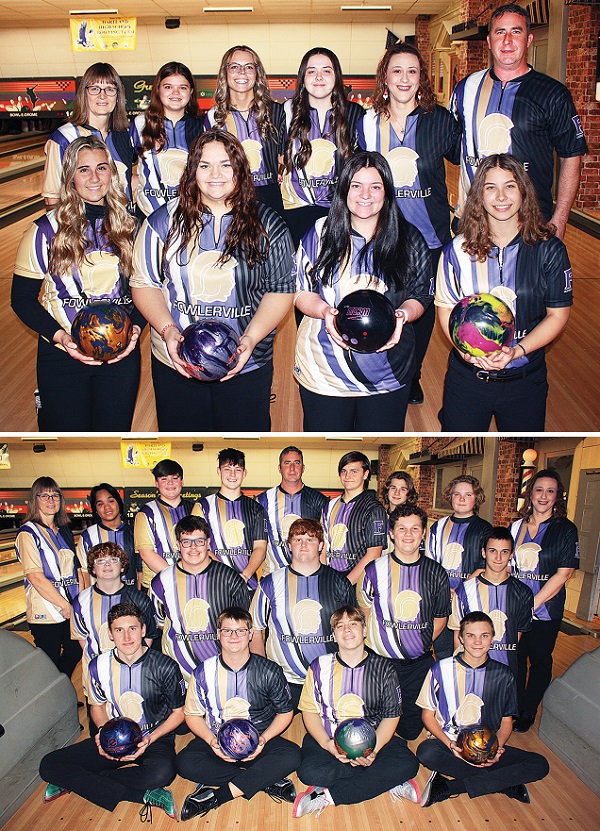
Never before a coach, nor a bowler outside of family fun, she agreed to start a Gladiators high school bowling program – one that four years later has two varsities and a JV team and had to make cuts this winter for the first time.
Building any program from ground level is full of challenges. Throw in a pandemic, and it gets tougher for sure. But knocking down obstacles has been like knocking down pins – it’s a bit of a theme for the quickly-growing program, its coach and the now-senior who got things rolling.
Bowling began for Brent
Brent Wood had played baseball and flag football and wrestled growing up. He tried everything his mom would let him, and that’s impressive enough – he doesn’t have a complete right hip, just bone on bone where the femur and pelvis meet.
 Considering that challenge, opportunities in those other sports faded as he grew older. And he wasn’t a big fan of school either. But Denise Wood knew a bowling team would motivate Brent to stay active and do well academically.
Does it hurt where that hip padding should be? Brent said no – it just feels like what he knows to be normal. But Mom said she can tell when it does, and he’s had 13 surgeries over the years. Brent still managed to play those sports and learn how to ride a bike with just his left leg – “and I still manage to bowl somewhat decent some days,” he said.
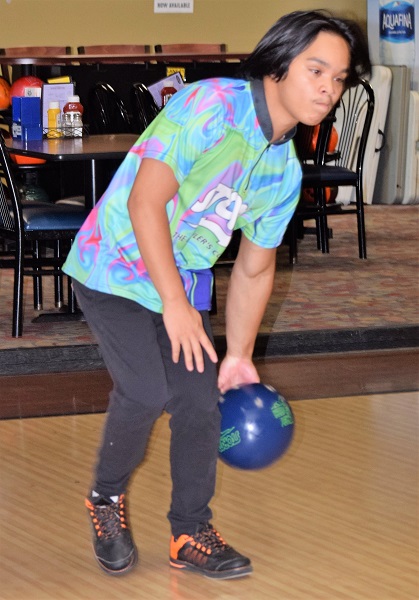
He’s actually become an all-league bowler – most recently finishing ninth at the White Lake Lakeland Invitational last weekend – while employing an uncommon style.
Generally, a left-handed bowler will land on the right foot when releasing the ball. Wood instead lands on his left, or opposite foot, to stay off the right one.
Denise Wood describes it as being a “very non-traditional single-handed lefty who has figured out how to make it work.” Brent said when he first started this bowling style, it was a little complicated – but last summer he took lessons and upped his knowledge by competing in a number of tournaments and against a variety of oil patterns. Additionally, “Over the summer I’ve seen one or two people land on the wrong foot like I do,” Wood said, “so I know I’m not the only one who does it.”
He'll be the second Fowlerville bowler to continue at the college level. He’ll join friend Trevor Cockerill, who graduated last year, at nearby Cleary University where he’ll compete for coach Hayley Dann – who impressed the family by telling them that instead of trying to change Brent’s style, she’ll “work with him with what he’s got,” Denise Wood recalled.
“That’s the coach I need, because that’s what Brent does – he works with what he’s got,” Denise said. “Brent is naturally athletically talented, and when it comes to stuff that’s athletic he’s quite the problem solver. He figures out how to do things.”
Starting from scratch
Mom figured things out, too.
Denise Wood calls herself a “google coach” – as in, she googles to learn drills and pick up tips on how to better guide the Gladiators. But considering the system she and her assistants have built over a short time, she’s not giving herself enough credit.
When Wood first asked Osborn why there wasn’t a program, she followed up by asking if a potential coach needed to be a good bowler. Osborn said not necessarily – if she was willing to learn the bowling side, he would help with how school-based sports work and take care of as much paperwork as possible.
 Challenge accepted.
First, the team needed somewhere to bowl. Fowlerville has made its home at Howell’s Bowl-E-Drome, about a 20-minute drive for practices twice a week.
The bowlers arrived. Fowlerville’s first season in 2019-20 saw 10 boys and two girls come out, making up a co-ed varsity and boys junior varsity team.
Next came “learning the bowling side” – and definitely, the internet helped. Mining various bowling websites and coaching resources, she’s put together a series of drills – all of her bowlers have copies of each in a folder they keep on hand – and with assistants Kelli Wilbur and Kevin Mahon designed practices to begin at the start of the season with skills assessments and then be organized by ability level to provide for more focused attention and instruction. The bowlers also make use of the school’s weight room one day a way – adjusting all of this around schedules for students who also dance, play in the band and train for other sports.
Wilbur and Mahon are experienced bowlers, and their additions have allowed Wood the last few years to focus more on team-building activities and administrative responsibilities like signing up for tournaments and data collection. For competitions, the three coaches take turns coaching each team so that all three become familiar with all of the Gladiators’ styles.
The majority of the bowlers are newcomers to the sport. Junior Emma Wilbur – Kelli’s daughter and the top roller on the girls team – counted herself and two more teammates who had grown up bowling.
“A lot of kids that come in, come in with no bowling experience whatsoever. They just heard it was fun, they wanted to be part of a team,” Wood said. “So this year we actually did an interview for the kids – they had to fill out a personal interview for why they came out for bowling. A lot of it was to have fun, become part of a team, and some kids said to become a better bowler.”
Turning to Paige
After a promising start, the program simply had to survive its second year.
With COVID-19 making everything more complicated, Fowlerville found itself with only five bowlers for the 2020-21 season – and couldn’t even bowl as a team at its Regional with Emma Wilbur in quarantine. Families weren’t allowed to watch competitions, and just getting the word out was a challenge.
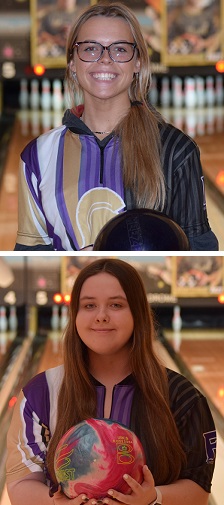 But Paige Frazier saved the day, figuratively speaking – and more realistically, potentially the program.
She solved some of the information block by starting Facebook and Instagram feeds for the bowling program that included video streams of competitions and updated information on cancelations and quarantines. “It definitely brought in a lot of attention,” Frazier remembered.
“If we hadn’t had Paige our COVID year, we wouldn’t have had a season at all,” Wood said. “Paige, I call her my female rock, because she kept the team alive.”
The work done during the COVID season paid off as the team got back in gear for last winter. The bowlers added to their social media marketing by hanging up fliers and getting word out on the program in the school’s morning announcements, and for 2021-22 enough bowlers came out to have separate girls and boys varsities for the first time.
“I had a lot of people ask me about it. A lot of people didn’t even know about it for a good two years,” Emma Wilbur said. “I had a couple friends who said they would try it out.”
Off and rolling again
The interview results from tryouts this season check out. While the team is serious about competing and succeeding, having fun and being part of a team are top priorities for most. The car rides to practices and bus rides to competitions are the best parts.
There’s still some convincing to do among classmates who might not consider bowling a sport. “They laugh about it until they find out we have a 1:30 dismissal for all the meets,” Wilbur said. But she and Frazier both play other sports too – Wilbur soccer and Frazier tennis – and realize the value in what they’ve helped create.
“I think being able to do something that you love to do, with all of your friends, a sport that you can go and do on the weekends and go and do after school … anytime that you want to you can go and do that,” Wilbur noted.
“Bowling's a really social sport,” Frazier added, “so you just learn to get along really well with your teammates, and just kinda relax and enjoy it.”
The Gladiators bowl in league matches once a week and have tournaments most January and February weekends through the regular season. Osborn said he’s excited to see so much interest at each grade level and is hopeful the program will continue to grow.
Brent Wood asked a winning question. The answer has been even better.
“It’s nice to see that we got everyone together that loves to do what we love to do,” Brent Wood said.
“Just seeing everyone enjoy the moment.”
 Geoff Kimmerly joined the MHSAA in Sept. 2011 after 12 years as Prep Sports Editor of the Lansing State Journal. He is a senior editor of MHSAA.com's editorial content and has served as MHSAA Communications Director since January 2021. Contact him at [email protected] with story ideas for the Barry, Eaton, Ingham, Livingston, Ionia, Clinton, Shiawassee, Gratiot, Isabella, Clare and Montcalm counties.
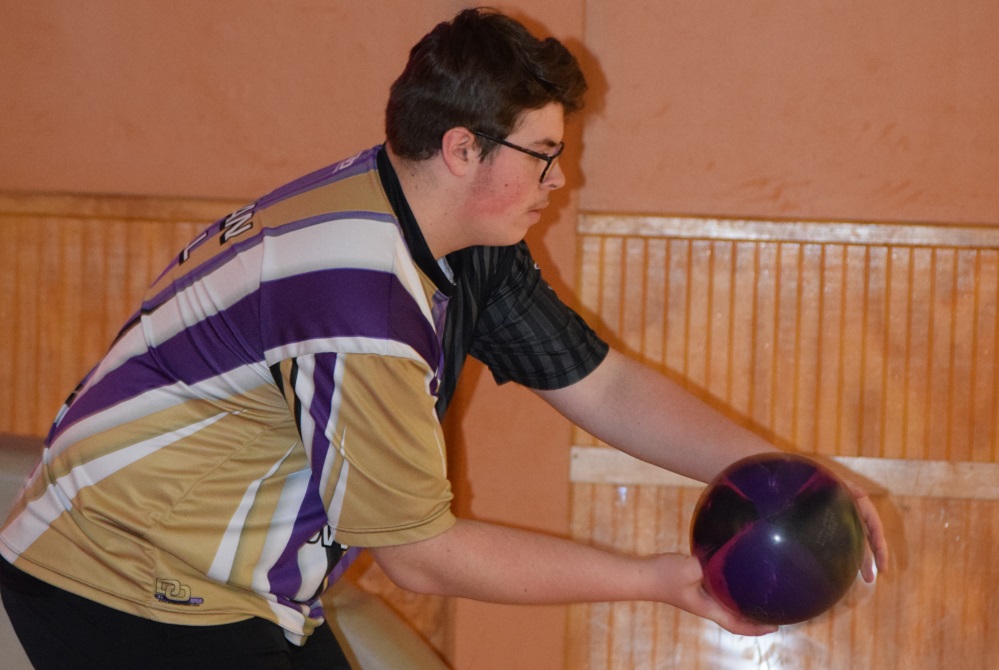
PHOTOS (Top) Fowlerville bowler Ethan Hall begins his approach. (2) Brent Wood shows his left-handed, left-footed bowling style. (3) Fowlerville’s Paige Frazier, top, and Emma Wilbur. (4) Fowlerville’s girls and boys teams this season, including head coach Denise Wood, top row far left, and assistants Kevin Mahon and Kelli Wilbur. (Photos courtesy of the Fowlerville bowling program.)