

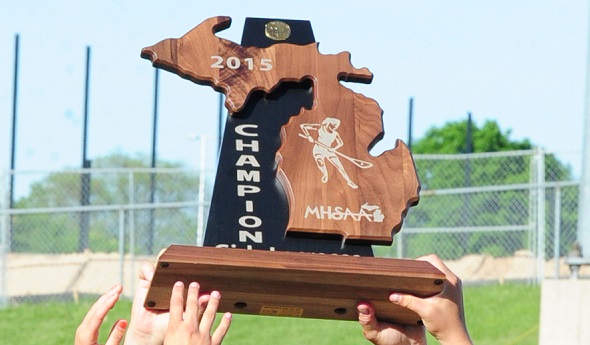
Casting Lines for Future Tournaments
August 12, 2016
By Jack Roberts
MHSAA Executive Director
The MHSAA is best known to the public for the tournaments it conducts to conclude the fall, winter and spring seasons each school year.
These tournaments, the first and largest program of the MHSAA, have survived the Vietnam War, the Korean conflict and two World Wars. They have survived the technology bubble, the housing collapse, the energy crisis and the Great Depression.
MHSAA tournaments existed at the dawn of aviation and at the time of our nation’s lunar landing. Popes, presidents and governors have changed and changed again and again, and MHSAA tournaments roll on year after year.
But the sense of tradition and permanence and inevitability of MHSAA tournaments doesn’t dissuade us from asking questions about our tournaments, even some of the most basic questions. Here are two.
Question #1
I have long been and will always be an advocate for a Ryder Cup format for the MHSAA Golf Finals, and a team tennis approach to the MHSAA Tennis Finals; but 90 years of tradition is hard to overcome. Might this be a more exciting format? Could it be co-ed? Could it reverse the decline in boys tennis participation, and increase girls golf participation? Wouldn’t it be fun to try?
Periodically, the International Olympic Committee requires each of the designated Olympic sports to defend its status, to state its case why the sport should remain a part of the Olympic program. Then, after a series or votes that retain one sport at a time, the IOC drops the sport that makes the weakest case. It does so to make room for one of the previously unlisted sports that makes the best case for inclusion.
This would appear to keep the existing Olympic sports on their toes, and to keep the Olympic movement fresh and reflective of modern trends in sports.
While I would not enjoy the controversy, I can see the potential for some positive results if the MHSAA were to invoke the same policy for determining the 14 tournaments it will provide for girls and the 14 for boys.
This might cause us to consider more deeply what a high school sport should look like, or at least what an MHSAA tournament sport should stand for.
On the one hand, we might be inclined to drop tournaments for those sports that involve mostly non-faculty coaches and non-school venues, or require cooperative programs to generate enough participants to support a team, or resort almost entirely to non-school funding, or cater to individuals more than teams.
Or perhaps this process would cause policymakers to forget traditional thinking and ask: “In this day and age, should we shake off traditional notions of sport and consider more where modern kids are coming from?” That might mean fewer team sports and more individual sports, more “extreme” sports like snowboarding and skateboarding, and more lifetime sports, meaning not just golf and tennis and running sports, but also fishing and even shooting sports.
Currently, MHSAA policy states that the MHSAA will consider sponsorship of a tournament series for any sport which 64 member schools conduct on an interscholastic basis as a result of action by the governing boards of those schools.
Should the only question be how many schools sponsor a sport, or must an activity also have certain qualities and/or avoid certain “defects?” What should an MHSAA tournament sport look like and stand for?
Question #2
Bristling from criticism that his association is a money-grabbing exploiter of children, my counterpart in another state said, “If we were running our programs just to make money, we would do very many things very differently.” I knew exactly what he meant.
Because we care about the health and welfare of students, because we mean what we say that the athletic program needs to maximize the ways it enhances the school experience while minimizing academic conflicts, and because we try to model our claim that no sport is a minor sport when it comes to its potential to teach young people life lessons, we operate our programs in ways that make promoters, marketers and business entrepreneurs laugh, cry or cringe.
If money were the only object, we would seed and select sites to assure the teams that attracted the most spectators had the best chance to advance in our tournaments, regardless of the travel for any team or its fan base. If money were the only object, we would never schedule two tournaments to overlap and compete for public attention, much less tolerate three or four overlapping events. If money were the only object, we would allow signage like NASCAR events and promotions like minor league baseball games.
Those approaches to event sponsorship may not be all wrong; they’re just not all right for us. And we will live with the consequences of our belief system.
During a typical school year, more than 20 percent of the MHSAA’s 2,097 District, Regional and Final tournaments lose money. Not a single site in golf, skiing or tennis makes a single penny. In no sport did every District, Regional and Final site have revenue in excess of direct expenses.
In fact, in only three sports – boys and girls basketball and football – is revenue so much greater than direct expenses overall that it helps to pay for all the other tournaments in which the MHSAA invests.
That’s right: invests. When we present our budget to our board, we talk about the MHSAA’s investment in providing tournament opportunities in all those sports and all those places that cannot sustain the cost of those events on their own. How much is this investment worth to students, schools and society?
These two are core questions that require our focus far in advance of talk about scheduling, site selection, seeding and the myriad matters that too often hijack our time and attention.
Bloomingdale Trainer Performing Invaluable Role in Keeping Athletes Playing
By
Pam Shebest
Special for MHSAA.com
November 22, 2022
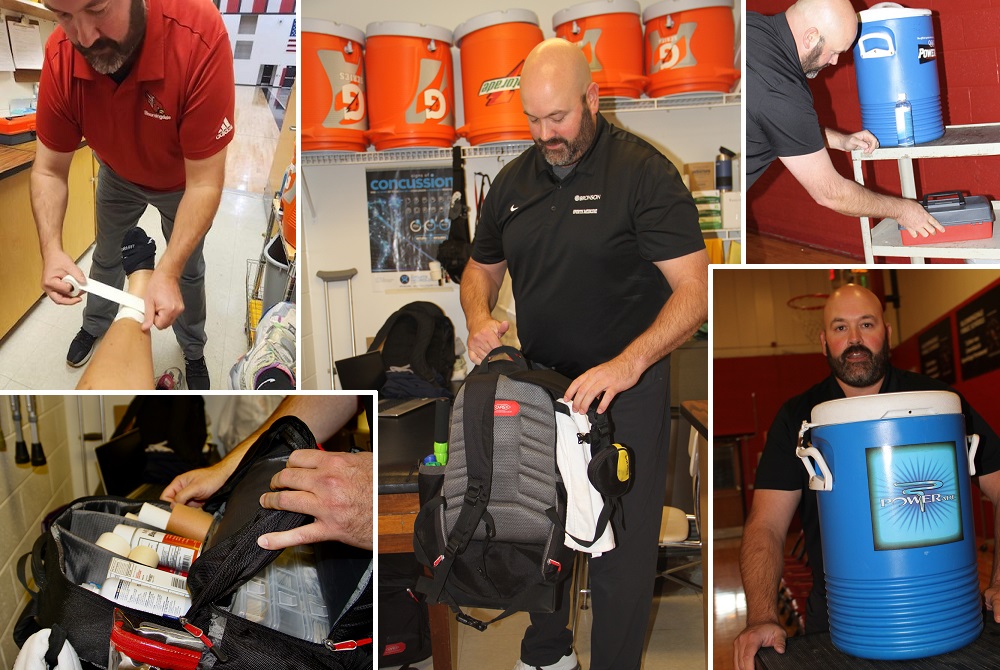
BLOOMINGDALE — If Scott Allison looks bored during one of Bloomingdale’s sporting events, that is a good thing.
 “Trainers like to be behind the scenes and in the shadows,” the certified athletic trainer said. “We’re only needed in emergencies.
“It’s one of those jobs that if we’re sitting around looking bored, then things are going well.”
But if an athlete goes down with an injury, Allison is quick to run onto the court or field.
In his first year at Bloomingdale, he has found that working with middle and high school students is a lot different than his previous work with the minor-league hockey Kalamazoo Wings.
Treating the hockey team, with whom he spent much of his 22 years, “There was a lot of traumatic stuff like lacerations or deep contusions, overuse injuries like hip flexors or core injuries or broken bones.
“Everything’s acute and fast. It’s a different animal. In hockey, they’re all pro athletes so they know their bodies really well.”
However, high school and middle school athletes are still in a growing phase.
“These kids don’t really know what’s going on a lot of times, so it’s a lot more education on what’s happening,” Allison said.
“Is it an injury, or is it just soreness? You get a lot of kids that don’t understand the difference between aches and pains or an injury. We see a lot of ankle sprains or shin splints because they’re just developing. They’re in that awkward range where their bodies try to grow too fast.”
 Allison is the Cardinals’ first certified athletic trainer, a new position for which athletic director Jason Hayes campaigned.
“What we notice is that if a kid’s injured, they’re out a lot less if you have a trainer because it speeds up recovery time,” said Hayes, who also coaches varsity football and is an assistant wrestling coach. “It’s like having a built-in physical therapist on your staff, too.”
Studies support Hayes’ statements.
According to information from The Sports Institute at University of Washington, “‘The athletic trainers know the athletes,” says Stan Herring, M.D., cofounder of The Sports Institute at (University of Washington) Medicine and a team physician for the Seattle Seahawks and Seattle Mariners. “They see the athletes frequently, if not every day. They know when something is wrong. They are medical professionals who evaluate, treat and rehabilitate athletes.’”
The article continued: “Three recent studies suggest that athletic trainers are linked to significant improvements in the diagnosis of concussion in young athletes and significant reductions in ‘time-loss’ injuries that require athletes to take time away from sports.”
Allison sees himself as a teacher as well as a trainer.
“We see a lot more strains or growth issues,” he said. “A lot of it is maintenance and teaching kids what’s going on with their bodies or what they need to do to change things.”
He also meets with parents and coaches to talk about the best way to prevent injuries.
Allison’s day begins about 1:30 or 2 p.m., giving athletes a chance to talk with him before practices or games.
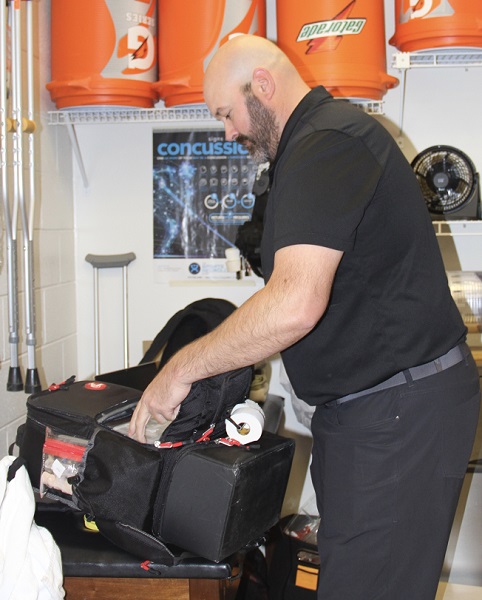
During the action, he always has his first aid backpack filled with the basics: air splints for fractures or dislocations, AED, EpiPens, and bench kits (with taping and bandaging supplies, splints, gauze, ACE wraps, ice bags, latex gloves and other basic first aid supplies.)
He travels with the teams when they are involved in high-impact sports, such as football, and many times he is also called to treat an opposing player if that team has no trainer.
 Allison is a perfect fit with Bloomingdale, Hayes said.
His wife, Kirsten, coached the Cardinals girls basketball team for seven years. His daughter Emma, now at Glen Oaks Community College, graduated from there, and his daughter Bailey is an eighth grader.
“We are a very lucky town,” Hayes said. “We had Doc (Robert) Stevens, who had been volunteering as our athletic trainer for 15 years. He’s just aging out.
“About a year ago, he came to me and said that it was his last year. Scott has 22 years experience, and he has relationships here. To me, it was a no-brainer.”
Assistant varsity football coach Lance Flynn, who also coaches the middle school football team, saw Allison in action during competition in the fall.
“First quarter in a middle school football game, a kid broke his arm,” Flynn said. “My own son, Ryder, was on the varsity team and he sprained his AC socket and Scott took care of him.
“If something happens during a game, they can go see him and I don’t have to worry much because I know they’re in good hands.”
Allison’s affiliation with Bronson Sports Medicine is also a plus, the trainer said.
“With Bronson, we can offer a lot more and expedite getting in to see doctors or specialists if we need to,” he said. “We’re on the same system as the doctors, so we can diagnose and send notes to the doctors and they can send notes back to us.
“If there’s anybody we need to keep track of with the doctors, I can talk with the doctors and figure out how that’s going. If anybody needs to see me, they know I’m here early if they just want to come down to talk.”
Bronson also provides certified athletic trainers at 21 other southwest Michigan high schools: Brooke Vandepolder (Battle Creek Central), Lindsay Aarseth-Lindhorst (Climax-Scotts), Amanda Monsivaes (Comstock), Makenzie Hodgson (Delton Kellogg), Salvador Robles-Soriano (Gobles), Holly Ives (Richland Gull Lake), Katelyn Baker-Contreras (Kalamazoo Hackett Catholic Prep), Lizzy Smith (Kalamazoo Central), Emma Beener (Kalamazoo Christian), Holly Sisson (Kalamazoo Loy Norrix), Nico Talentino (Mattawan), Aaron Eickhoff (Otsego), Quincey Powell (Parchment), Malorie Most (Paw Paw), Jessica Bakhuyzen (Plainwell), Lance LeTourneau (Portage Central), Janelle Currie (Portage Northern), Carrie Calhoun (Schoolcraft), Chelsea Harrison (South Haven), Alexis Walters (Three Rivers) and Natalie McClish (Vicksburg).
 Pam Shebest served as a sportswriter at the Kalamazoo Gazette from 1985-2009 after 11 years part-time with the Gazette while teaching French and English at White Pigeon High School. She can be reached at [email protected] with story ideas for Calhoun, Kalamazoo and Van Buren counties.
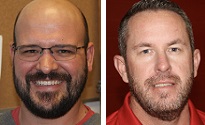
PHOTOS (Top) Bloomingdale trainer Scott Allison has several tasks as he works to keep the school’s student-athletes healthy and pain-free. (Middle) Bloomingdale athletic director Jason Hayes, left, and assistant varsity football coach Lance Flynn. (Below) Allison packs his bag for another full afternoon. (Ankle-taping photo by Andreya Robinson; all other photos by Pam Shebest.)