

Casting Lines for Future Tournaments
August 12, 2016
By Jack Roberts
MHSAA Executive Director
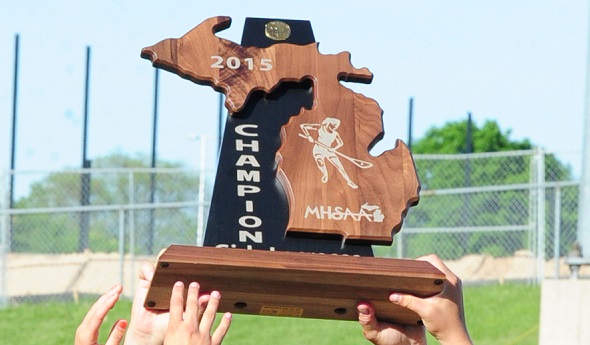
The MHSAA is best known to the public for the tournaments it conducts to conclude the fall, winter and spring seasons each school year.
These tournaments, the first and largest program of the MHSAA, have survived the Vietnam War, the Korean conflict and two World Wars. They have survived the technology bubble, the housing collapse, the energy crisis and the Great Depression.
MHSAA tournaments existed at the dawn of aviation and at the time of our nation’s lunar landing. Popes, presidents and governors have changed and changed again and again, and MHSAA tournaments roll on year after year.
But the sense of tradition and permanence and inevitability of MHSAA tournaments doesn’t dissuade us from asking questions about our tournaments, even some of the most basic questions. Here are two.
Question #1
I have long been and will always be an advocate for a Ryder Cup format for the MHSAA Golf Finals, and a team tennis approach to the MHSAA Tennis Finals; but 90 years of tradition is hard to overcome. Might this be a more exciting format? Could it be co-ed? Could it reverse the decline in boys tennis participation, and increase girls golf participation? Wouldn’t it be fun to try?
Periodically, the International Olympic Committee requires each of the designated Olympic sports to defend its status, to state its case why the sport should remain a part of the Olympic program. Then, after a series or votes that retain one sport at a time, the IOC drops the sport that makes the weakest case. It does so to make room for one of the previously unlisted sports that makes the best case for inclusion.
This would appear to keep the existing Olympic sports on their toes, and to keep the Olympic movement fresh and reflective of modern trends in sports.
While I would not enjoy the controversy, I can see the potential for some positive results if the MHSAA were to invoke the same policy for determining the 14 tournaments it will provide for girls and the 14 for boys.
This might cause us to consider more deeply what a high school sport should look like, or at least what an MHSAA tournament sport should stand for.
On the one hand, we might be inclined to drop tournaments for those sports that involve mostly non-faculty coaches and non-school venues, or require cooperative programs to generate enough participants to support a team, or resort almost entirely to non-school funding, or cater to individuals more than teams.
Or perhaps this process would cause policymakers to forget traditional thinking and ask: “In this day and age, should we shake off traditional notions of sport and consider more where modern kids are coming from?” That might mean fewer team sports and more individual sports, more “extreme” sports like snowboarding and skateboarding, and more lifetime sports, meaning not just golf and tennis and running sports, but also fishing and even shooting sports.
Currently, MHSAA policy states that the MHSAA will consider sponsorship of a tournament series for any sport which 64 member schools conduct on an interscholastic basis as a result of action by the governing boards of those schools.
Should the only question be how many schools sponsor a sport, or must an activity also have certain qualities and/or avoid certain “defects?” What should an MHSAA tournament sport look like and stand for?
Question #2
Bristling from criticism that his association is a money-grabbing exploiter of children, my counterpart in another state said, “If we were running our programs just to make money, we would do very many things very differently.” I knew exactly what he meant.
Because we care about the health and welfare of students, because we mean what we say that the athletic program needs to maximize the ways it enhances the school experience while minimizing academic conflicts, and because we try to model our claim that no sport is a minor sport when it comes to its potential to teach young people life lessons, we operate our programs in ways that make promoters, marketers and business entrepreneurs laugh, cry or cringe.
If money were the only object, we would seed and select sites to assure the teams that attracted the most spectators had the best chance to advance in our tournaments, regardless of the travel for any team or its fan base. If money were the only object, we would never schedule two tournaments to overlap and compete for public attention, much less tolerate three or four overlapping events. If money were the only object, we would allow signage like NASCAR events and promotions like minor league baseball games.
Those approaches to event sponsorship may not be all wrong; they’re just not all right for us. And we will live with the consequences of our belief system.
During a typical school year, more than 20 percent of the MHSAA’s 2,097 District, Regional and Final tournaments lose money. Not a single site in golf, skiing or tennis makes a single penny. In no sport did every District, Regional and Final site have revenue in excess of direct expenses.
In fact, in only three sports – boys and girls basketball and football – is revenue so much greater than direct expenses overall that it helps to pay for all the other tournaments in which the MHSAA invests.
That’s right: invests. When we present our budget to our board, we talk about the MHSAA’s investment in providing tournament opportunities in all those sports and all those places that cannot sustain the cost of those events on their own. How much is this investment worth to students, schools and society?
These two are core questions that require our focus far in advance of talk about scheduling, site selection, seeding and the myriad matters that too often hijack our time and attention.
'Go-To Guy' Kanitz Sets Selfless Example in Helping Make St. Francis Sports Go
By
Tom Spencer
Special for MHSAA.com
August 26, 2022
Traverse City has had a few head football coaches named Kanitz.
 But Mike Kanitz has no interest in becoming a head football coach. In fact, no interest in being a head coach of any sport.
So far he’s worked for nine head coaches. He’s seen what it takes to be a head varsity coach and he’ll stay where he is, which is pretty much anywhere there is a high school sporting event.
Kanitz spends his days and nights dedicated to the Traverse City St. Francis student-athletes, staff, administration and Gladiators community. He is the junior varsity girls basketball coach, volleyball game manager, volleyball announcer and volleyball scorekeeper, football press box manager, and the Glads’ soccer game manager. Additionally, as director of basketball operations at St. Francis, he finds himself at the scorer’s table for boys basketball games.
The volleyball, soccer and football duties are performed at every home game. He doesn’t take a paycheck for any of it. If the school does pay for his services, he promptly donates the funds to the source.
The soft-spoken and renowned St. Francis supporter is not the slightest bit interested in getting any recognition for his efforts.
Tonight he’ll run the Thirlby Field press box as the Gladiators host Ogemaw Heights. And, he’s ready for the Glads’ first home volleyball match Sept. 8.
“He is one of those unique people that shies away from the spotlight — he is a pure servant, said Aaron Biggar, St. Francis’ athletic director. “He doesn’t want any accolades or anything like that.”
Kanitz’ father, Hugo Kanitz – who also went by Mike all his life – was the head football coach of Traverse City St. Francis during the 1960s. Another Kanitz, Dutch — not related to the father-son combo —was at the helm of the Traverse City Central High School football program.
 Mike Kanitz finds himself regularly receiving phone calls and letters from former players intended for the Kanitz coaches. He has to explain he’s not the deceased Central coach, nor his father. And he’s glad he gets to pass on positive feedback to his father, also a former athletic director for St. Francis.
“My grandmother said, ‘Never call him Hugo – his name is Mike,’” Kanitz said. “Don’t ask me where it came from, but he was Mike his whole life.
“I am junior in most people’s minds,” Kanitz went on. “Traverse City was a small town back then; to have two Coach Kanitz was confusing.”
His father now lives in Traverse City after retiring as a teacher and professor. The son enjoys picking his brain.
“I am blessed to still be able to run stuff by him (because) that’s really where I got my coaching start,” he said. “I used to get calls after coming back to Traverse City and the callers would say, ‘Is this Coach Kanitz?’ and I started to catch on that these were his former students.
“I don’t think my dad ever knew the impact he was having on kids,” Kanitz continued. “I don’t think coaches really know what an impact they have on kids.”
Hearing from his father’s former players helped shape his coaching.
“It made me realize as a coach you have the ability every time you open your mouth to either hurt a kid or help a kid,” he said. “So helping a kid is my desire.”
Officials, media and visiting coaches for many sports have noted Kanitz’ demeanor and contributions. They also know he’ll do anything to make sure they have a good experience at St. Francis.
Among other things, Mike reportedly once became a makeshift tailor when a basketball official showed up without his referee pants. Mostly using safety pins, a borrowed pair of pants went from 2XL to large in time for tip-off.
“Mike Kanitz should have a name tag that says, ‘Nicest Man on the Planet,’” said former St. Francis AD Tom Hardy. “Mike is the perfect representative that you can have for any event at school.
 “He greets every team, official, and spectator with such grace and compassion, which leads to a very positive experience for all involved,” Hardy continued. “Mike has volunteered too many hours to count at basketball and soccer games as a game manager and coach.”
Hardy believes all sports fans need to follow Kanitz’ lead.
“Mike Kanitz is the example of how people should treat each other at any athletic event,” he said. “You truly would have to look long and hard to find a more compassionate and caring individual, and I would challenge anyone to find a person that has a negative thing to say about him.”
Barb Becket, a longtime MHSAA official and assignor, has similar views of Kanitz. She’s worked with him while he’s served as a coach, game manager and during community activities through her role with the Grand Traverse YMCA.
“Mike is the go-to guy,” she said. “He is a servant in the true sense of the word.
“Besides being the go-to guy for coaches, admin, and players, Mike also acts as the liaison between the sports officials and the sports participants,” she continued. “Mike handles his responsibilities with grace, humility, common sense, and accountability.”
Kanitz’ favorite sport to play is baseball, but his favorite sport to coach is basketball. After graduating from Alma College where he competed in track & field, he was thrilled to move back to Traverse City to start a family with his wife Marcy, a Traverse City obstetrician.
The couple’s three children graduated from St. Francis, and Kanitz first focused on elementary baseball. He was able to step away from his pharmaceutical career to step in and fill pretty much any need the St. Francis community had.
Kanitz points to his wife’s passion for caring for women as a motivator for him to get more girls involved in sports and receiving the benefits they provide.
“Marcy spent her whole life taking care of women,” he said. “So she sees the side effects of women not being given opportunities.
“So we’ve got to correct that stuff.”
Kanitz’s first job was as a water boy, along with his siblings born to Hugo and Margo Kanitz. If he ever can’t coach or serve in other capacities for the Gladiators, he hopes to return to the very first job he had as a preschooler.
“I am sincere when I say I started as a water boy, and I am going to finish as a water boy,” Kanitz said. “I am very blessed and I am thankful for the life I’ve had here in Traverse City.
“I am thankful for the school allowing me to be a part of it.”
 Tom Spencer is a longtime MHSAA-registered basketball and soccer official, and former softball and baseball official, and he also has coached in the northern Lower Peninsula area. He previously has written for the Saginaw News, Bay County Sports Page and Midland Daily News. He can be reached at [email protected] with story ideas for Manistee, Wexford, Missaukee, Roscommon, Ogemaw, Iosco, Alcona, Oscoda, Crawford, Kalkaska, Grand Traverse, Benzie, Leelanau, Antrim, Otsego, Montmorency, Alpena, Presque Isle, Cheboygan, Charlevoix and Emmet counties.
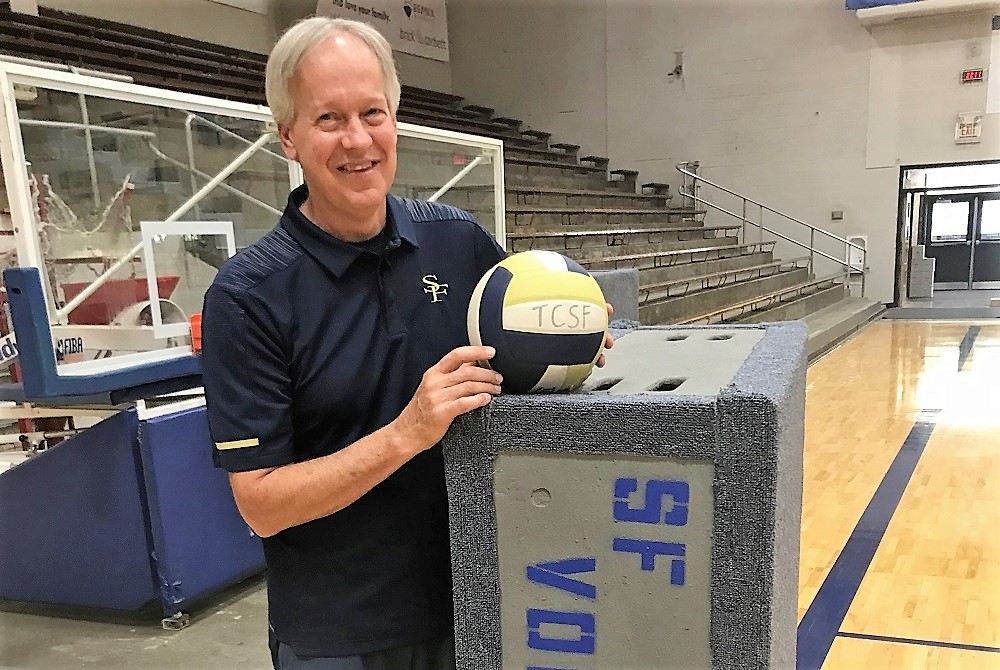
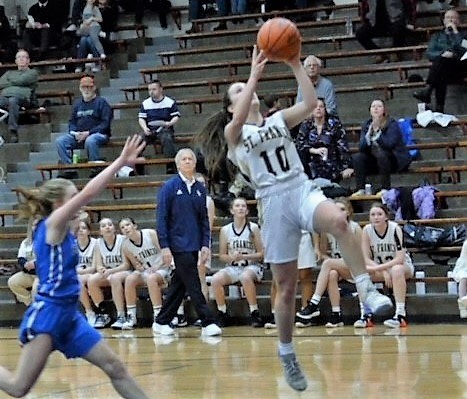
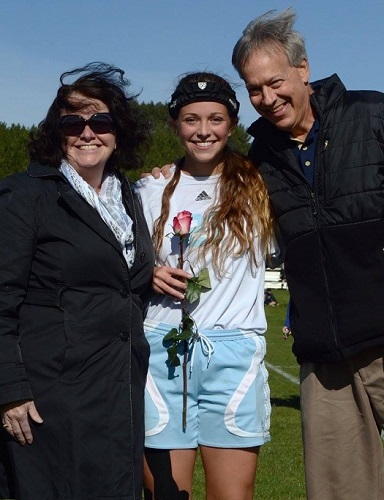
PHOTOS (Top) Mike Kanitz fills many roles for Traverse City St. Francis including girls junior varsity basketball coach and game manager for a variety of sports including volleyball. (Middle) Kanitz walks the sideline during one of his games leading the JV Gladiators. (Below) Mike Kanitz enjoys his daughter Delin’s Senior Night game with wife Marcy Verplank-Kanitz. (Top photo by Mike Spencer; middle and below photos by Julie English.)