

Casting Lines for Future Tournaments
August 12, 2016
By Jack Roberts
MHSAA Executive Director
The MHSAA is best known to the public for the tournaments it conducts to conclude the fall, winter and spring seasons each school year.
These tournaments, the first and largest program of the MHSAA, have survived the Vietnam War, the Korean conflict and two World Wars. They have survived the technology bubble, the housing collapse, the energy crisis and the Great Depression.
MHSAA tournaments existed at the dawn of aviation and at the time of our nation’s lunar landing. Popes, presidents and governors have changed and changed again and again, and MHSAA tournaments roll on year after year.
But the sense of tradition and permanence and inevitability of MHSAA tournaments doesn’t dissuade us from asking questions about our tournaments, even some of the most basic questions. Here are two.
Question #1
I have long been and will always be an advocate for a Ryder Cup format for the MHSAA Golf Finals, and a team tennis approach to the MHSAA Tennis Finals; but 90 years of tradition is hard to overcome. Might this be a more exciting format? Could it be co-ed? Could it reverse the decline in boys tennis participation, and increase girls golf participation? Wouldn’t it be fun to try?
Periodically, the International Olympic Committee requires each of the designated Olympic sports to defend its status, to state its case why the sport should remain a part of the Olympic program. Then, after a series or votes that retain one sport at a time, the IOC drops the sport that makes the weakest case. It does so to make room for one of the previously unlisted sports that makes the best case for inclusion.
This would appear to keep the existing Olympic sports on their toes, and to keep the Olympic movement fresh and reflective of modern trends in sports.
While I would not enjoy the controversy, I can see the potential for some positive results if the MHSAA were to invoke the same policy for determining the 14 tournaments it will provide for girls and the 14 for boys.
This might cause us to consider more deeply what a high school sport should look like, or at least what an MHSAA tournament sport should stand for.
On the one hand, we might be inclined to drop tournaments for those sports that involve mostly non-faculty coaches and non-school venues, or require cooperative programs to generate enough participants to support a team, or resort almost entirely to non-school funding, or cater to individuals more than teams.
Or perhaps this process would cause policymakers to forget traditional thinking and ask: “In this day and age, should we shake off traditional notions of sport and consider more where modern kids are coming from?” That might mean fewer team sports and more individual sports, more “extreme” sports like snowboarding and skateboarding, and more lifetime sports, meaning not just golf and tennis and running sports, but also fishing and even shooting sports.
Currently, MHSAA policy states that the MHSAA will consider sponsorship of a tournament series for any sport which 64 member schools conduct on an interscholastic basis as a result of action by the governing boards of those schools.
Should the only question be how many schools sponsor a sport, or must an activity also have certain qualities and/or avoid certain “defects?” What should an MHSAA tournament sport look like and stand for?
Question #2
Bristling from criticism that his association is a money-grabbing exploiter of children, my counterpart in another state said, “If we were running our programs just to make money, we would do very many things very differently.” I knew exactly what he meant.
Because we care about the health and welfare of students, because we mean what we say that the athletic program needs to maximize the ways it enhances the school experience while minimizing academic conflicts, and because we try to model our claim that no sport is a minor sport when it comes to its potential to teach young people life lessons, we operate our programs in ways that make promoters, marketers and business entrepreneurs laugh, cry or cringe.
If money were the only object, we would seed and select sites to assure the teams that attracted the most spectators had the best chance to advance in our tournaments, regardless of the travel for any team or its fan base. If money were the only object, we would never schedule two tournaments to overlap and compete for public attention, much less tolerate three or four overlapping events. If money were the only object, we would allow signage like NASCAR events and promotions like minor league baseball games.
Those approaches to event sponsorship may not be all wrong; they’re just not all right for us. And we will live with the consequences of our belief system.
During a typical school year, more than 20 percent of the MHSAA’s 2,097 District, Regional and Final tournaments lose money. Not a single site in golf, skiing or tennis makes a single penny. In no sport did every District, Regional and Final site have revenue in excess of direct expenses.
In fact, in only three sports – boys and girls basketball and football – is revenue so much greater than direct expenses overall that it helps to pay for all the other tournaments in which the MHSAA invests.
That’s right: invests. When we present our budget to our board, we talk about the MHSAA’s investment in providing tournament opportunities in all those sports and all those places that cannot sustain the cost of those events on their own. How much is this investment worth to students, schools and society?
These two are core questions that require our focus far in advance of talk about scheduling, site selection, seeding and the myriad matters that too often hijack our time and attention.
Hrynewich's Star Continuing to Rise with Olympic, Pro Sports Arrivals
By
Tom Kendra
Special for MHSAA.com
June 30, 2022
Hailey Hrynewich is only 27, and she’s already worked as an on-camera reporter for NBC at the recent Winter Olympics and for The Golf Channel at last month’s Canadian Open.
Hrynewich, who goes by the name Hailey Hunter in her broadcasting career, gives much of the credit for her early success to her parents, her twin brother Reed, her teachers and her coaches.
But she learned even more from a game.
“I have learned so many life lessons from golf,” explained Hailey, who was an all-state golfer at Muskegon Mona Shores and led the Sailors to Lower Peninsula Division 2 championships all four years of high school, from 2009 to 2012.
“I learned how to prepare, to work hard, and I learned discipline. But I think the biggest thing golf taught me is how to be coachable and take criticism. I can honestly say that I love criticism. I need it to get better.”
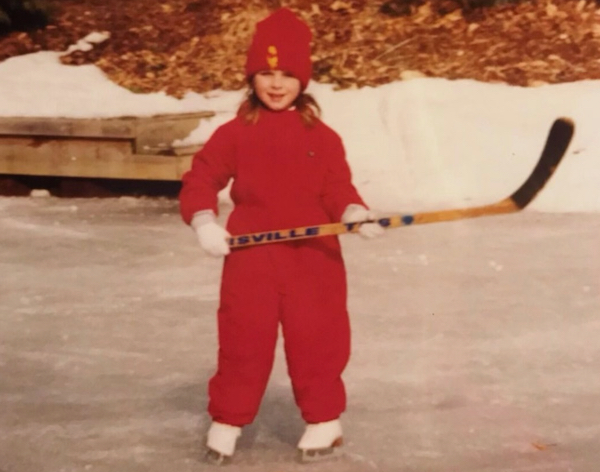
Hrynewich, who also played soccer and ran track for one year at Mona Shores, grew up playing hockey on a homemade rink in her backyard and was a competitive figure skater. But it was golf that captured her heart.
Even though she is right-handed, she “wanted to play golf like my dad and brother,” who are both left-handed. So she started mimicking their swings, and not only got good at it, she became one of the top female left-handed golfers in the state.
In addition to the four team state titles, Hrynewich earned Division 2 all-state honors all four years and was a Super Team selection as a senior, given to the top eight golfers in the state, regardless of division.
But with her combination of smarts, a heavy dose of sports in her DNA and charismatic personality, Hrynewich was ready for her next challenge.
“I had a great high school experience,” said Hrynewich, who did journalism work and was a regular on Mona Shores morning announcements during the school days. “I learned so much and had so much fun. It made me want to learn more and go places.”
Golf & broadcasting
Hrynewich was one of those rare high school seniors who knew exactly what she wanted to do in college:
Play golf and study sports broadcasting.
With that in mind, she sat down during her senior year at Mona Shores with her father, Tim, who played nine years of professional hockey including two with the Pittsburgh Penguins, and did research to identify the top 10 sports broadcasting schools in the country.
 That search led Hailey to Ohio University in Athens, Ohio, where she was a four-year standout for the Division I Bobcats and a two-time academic all-Mid-American Conference selection.
Reed, who was an all-state golfer and hockey player at Mona Shores, chose to stay in-state and play golf at University of Michigan. His success on and off the course mirrored his sister – and they remain each other’s biggest fans.
“So many people in that industry get in because of their family or who they know, but that wasn’t the case with Hailey,” said Reed, who is four minutes younger than his twin sister. “When she gets a freelance gig, she will study non-stop for days and days to be 100-percent prepared. She has gotten where she is through hard work.”
Hailey said she gets her analytical side from her dad. When she was 12, she memorized the statistics of the top 50 golfers and hockey players.
“I thought that was fun,” Hrynewich explained.
Her outgoing personality and courage in new situations come from her mother Susan – and those traits come in handy as she juggles freelance broadcasting opportunities from all over the world, including getting set in front of the camera earlier this month at the RBC Canadian Open with stars such as Rory McIlroy, Justin Thomas and Scottie Scheffler.
“I watch her clips and I see her talking to these famous people, and she’s so comfortable,” said Tim Hrynewich, who now works in real estate in Muskegon. “That’s the most impressive part of it to me. Her confidence. I could never do that.”
Proving herself
After graduating from Ohio University in 2017, Hailey still had the same two passions as when she graduated from Mona Shores four years earlier – golf and sports broadcasting.
The only difference is that she was now at the point where she had to choose between the two.
Hailey, who played in the prestigious U.S. Women’s Amateur in 2015, moved to Florida after graduation and turned pro for a short period – even shooting a career-best 66 in her first professional tournament.
 Ultimately, she decided that the time requirement and uncertainty of professional golf was too much, and she focused on broadcasting.
Her initial job was working for what is now Amalie Arena in Tampa, covering the Tampa Bay Lightning of the NHL and the Tampa Bay Storm of the Arena Football League.
That gave way to an internship with the LPGA Tour, which turned into a full-time job as a content producer and host, which she did for almost three years.
She estimates that during her time at the LPGA, her work was “30 percent on camera and 70 percent off camera.” Wanting more on-camera experience, she took a job as a sports reporter and weekend sports anchor at WJTV-12 in Jackson, Miss., where she learned a variety of skills necessary to put together a broadcast and covered SEC football and basketball.
Three weeks after she moved to Mississippi, the COVID-19 pandemic hit and she was quarantined in a city where she knew nobody.
Hrynewich describes her time as a small-town, Southern TV reporter as a “humbling grind” of shooting her own footage and even doing a live report from outside of the Alabama at Ole Miss football game during a tropical storm.
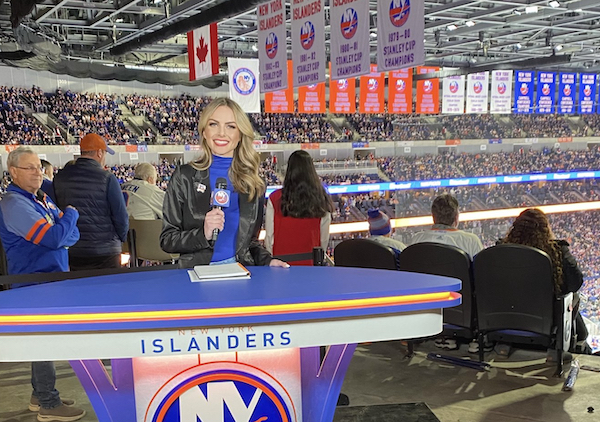
During this time, she made it a goal to work for an NHL team. After several near-misses, she landed a job with the New York Islanders as a team reporter and studio host, and in November of last year, she was off to Long Island.
“I went from one of the least-populated states in the country to one of the most populated – from Southern to big city,” Hrynewich said with a laugh. “But it was fun, and it was time.”
Just a couple of months into her gig with the Islanders, Hailey received a dream-come-true opportunity and set the stage for a crazy 2022 (which is only at the halfway point).
Olympics, PGA and beyond
The call came from Molly Solomon, who Hrynewich got to know when she was working for the LPGA Tour, and was now NBC’s Executive Producer for the Winter Olympic Games in Beijing, China, which started Feb. 4.
Basically, one week before the Games, one of the reporters dropped out, so Solomon asked Hrynewich if she would step in.
 “Of course, I said yes,” said Hrynewich, who was granted a leave of absence by the Islanders to go to Beijing. “Then I stressed myself out getting over there and studying everything I possibly could about sports I knew nothing about.”
She was assigned as NBC’s on-site reporter for four sports – moguls, aerials, ski cross and snowboard cross – and, as fate would have it, she covered one of the most compelling stories of the entire Games. Hrynewich drew praise for her handling of an emotional interview with Nick Baumgartner of Iron River, who failed to make the finals in snowboard cross in his fifth Olympic Games. Then she was there two days later when he redeemed himself with a gold medal in the team competition.
“It was raw emotion,” Hrynewich recalled. “He went from low to high, but I had to stay in the middle. I will never forget that interview.”
Both of those clips, along with many other highlights of her young career, are featured on her web site – haileyhunter.com.
Since the Olympics, Hrynewich has been pin-balling all over North America. She covered track & field for NBC Sports, then did the ACC Track & Field Championships for the ACC Network, the U.S. Women’s Open for the USGA and the Canadian Open for The Golf Channel.
She is momentarily catching her breath at home in Jackson, Miss., and is looking forward to coming back to Muskegon to see family and friends for the Fourth of July.
But she doesn’t expect to be sitting still for too long, with several more exciting projects in the hopper.
“I can’t believe everything I’ve done already this year,” Hailey said. “I’m really thankful and blessed and can’t wait to see what’s around the corner. Golf has opened up so many doors for me.”
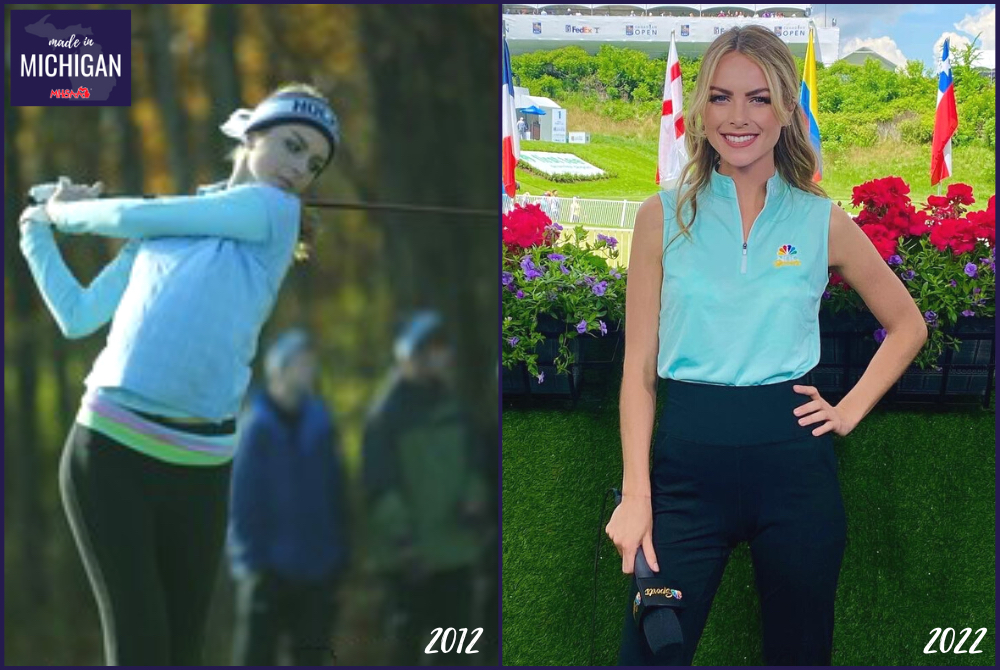
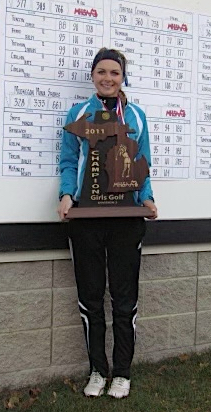
PHOTOS (Top) From left, Mona Shores' Hailey Hrynewich watches a drive during the 2012 MHSAA Lower Peninsula Division 2 Final, and at right Hrynewich hosts during a PGA event. (2) Hrynewich skates as a child. (3) Hrynewich poses with the leaderboard after her team collects the 2021 championship trophy. (4) On set with the Islanders, Hrynewich provides her knowledge as a team reporter and studio host. (Photos provided by Hailey Hrynewich.)