

Casting Lines for Future Tournaments
August 12, 2016
By Jack Roberts
MHSAA Executive Director
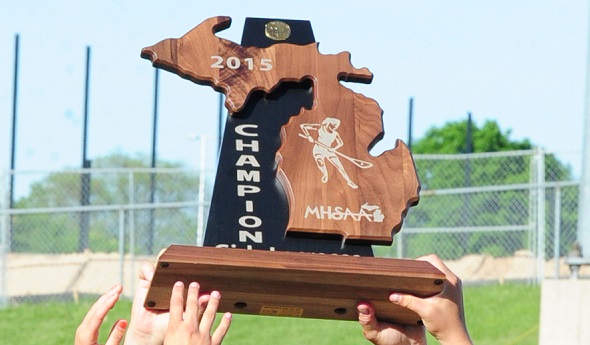
The MHSAA is best known to the public for the tournaments it conducts to conclude the fall, winter and spring seasons each school year.
These tournaments, the first and largest program of the MHSAA, have survived the Vietnam War, the Korean conflict and two World Wars. They have survived the technology bubble, the housing collapse, the energy crisis and the Great Depression.
MHSAA tournaments existed at the dawn of aviation and at the time of our nation’s lunar landing. Popes, presidents and governors have changed and changed again and again, and MHSAA tournaments roll on year after year.
But the sense of tradition and permanence and inevitability of MHSAA tournaments doesn’t dissuade us from asking questions about our tournaments, even some of the most basic questions. Here are two.
Question #1
I have long been and will always be an advocate for a Ryder Cup format for the MHSAA Golf Finals, and a team tennis approach to the MHSAA Tennis Finals; but 90 years of tradition is hard to overcome. Might this be a more exciting format? Could it be co-ed? Could it reverse the decline in boys tennis participation, and increase girls golf participation? Wouldn’t it be fun to try?
Periodically, the International Olympic Committee requires each of the designated Olympic sports to defend its status, to state its case why the sport should remain a part of the Olympic program. Then, after a series or votes that retain one sport at a time, the IOC drops the sport that makes the weakest case. It does so to make room for one of the previously unlisted sports that makes the best case for inclusion.
This would appear to keep the existing Olympic sports on their toes, and to keep the Olympic movement fresh and reflective of modern trends in sports.
While I would not enjoy the controversy, I can see the potential for some positive results if the MHSAA were to invoke the same policy for determining the 14 tournaments it will provide for girls and the 14 for boys.
This might cause us to consider more deeply what a high school sport should look like, or at least what an MHSAA tournament sport should stand for.
On the one hand, we might be inclined to drop tournaments for those sports that involve mostly non-faculty coaches and non-school venues, or require cooperative programs to generate enough participants to support a team, or resort almost entirely to non-school funding, or cater to individuals more than teams.
Or perhaps this process would cause policymakers to forget traditional thinking and ask: “In this day and age, should we shake off traditional notions of sport and consider more where modern kids are coming from?” That might mean fewer team sports and more individual sports, more “extreme” sports like snowboarding and skateboarding, and more lifetime sports, meaning not just golf and tennis and running sports, but also fishing and even shooting sports.
Currently, MHSAA policy states that the MHSAA will consider sponsorship of a tournament series for any sport which 64 member schools conduct on an interscholastic basis as a result of action by the governing boards of those schools.
Should the only question be how many schools sponsor a sport, or must an activity also have certain qualities and/or avoid certain “defects?” What should an MHSAA tournament sport look like and stand for?
Question #2
Bristling from criticism that his association is a money-grabbing exploiter of children, my counterpart in another state said, “If we were running our programs just to make money, we would do very many things very differently.” I knew exactly what he meant.
Because we care about the health and welfare of students, because we mean what we say that the athletic program needs to maximize the ways it enhances the school experience while minimizing academic conflicts, and because we try to model our claim that no sport is a minor sport when it comes to its potential to teach young people life lessons, we operate our programs in ways that make promoters, marketers and business entrepreneurs laugh, cry or cringe.
If money were the only object, we would seed and select sites to assure the teams that attracted the most spectators had the best chance to advance in our tournaments, regardless of the travel for any team or its fan base. If money were the only object, we would never schedule two tournaments to overlap and compete for public attention, much less tolerate three or four overlapping events. If money were the only object, we would allow signage like NASCAR events and promotions like minor league baseball games.
Those approaches to event sponsorship may not be all wrong; they’re just not all right for us. And we will live with the consequences of our belief system.
During a typical school year, more than 20 percent of the MHSAA’s 2,097 District, Regional and Final tournaments lose money. Not a single site in golf, skiing or tennis makes a single penny. In no sport did every District, Regional and Final site have revenue in excess of direct expenses.
In fact, in only three sports – boys and girls basketball and football – is revenue so much greater than direct expenses overall that it helps to pay for all the other tournaments in which the MHSAA invests.
That’s right: invests. When we present our budget to our board, we talk about the MHSAA’s investment in providing tournament opportunities in all those sports and all those places that cannot sustain the cost of those events on their own. How much is this investment worth to students, schools and society?
These two are core questions that require our focus far in advance of talk about scheduling, site selection, seeding and the myriad matters that too often hijack our time and attention.
After 2021 Semifinal Trip, Huron Building Toward Another Big Finish
By
Doug Donnelly
Special for MHSAA.com
May 10, 2022
NEW BOSTON – Phil Yancey learned an important lesson while coaching baseball to teenagers in the Dominican Republic – a lesson that he uses today with his players at New Boston Huron.
 “The kids there play hard, from the warm-ups right through the last play of a game,” he said. “They give 100 percent. For many of them, it’s there only way out of poverty. Baseball is their ticket off the island.”
Yancey stresses to his players now to play hard every single minute they are on the field.
“Field that ground ball like it’s your last ground ball,” he tells them. “Go up to the plate like it’s your last at-bat.”
Yancey coached five seasons in the Dominican before becoming the varsity baseball coach at Huron High School in southern Wayne County seven years ago. He’s developed a rock-solid program at Huron, one that is currently ranked among top teams in the state and looks to be built for a deep tournament run.
Huron went 26-8 in 2021, reaching the state rankings for the first time in school history. The Chiefs won Division 2 District and Regional titles and made the Semifinals before bowing out to eventual champion Orchard Lake St. Mary’s. That club had 10 seniors, but Yancey saw potential for big things this season.
“It was nice coming into the season with guys to build around, but we found some really talented players this year too,” he said. “We are playing pretty well right now.”
The Chiefs are off to a 17-2 start. The losses came to Grosse Ile in an early-season game and to Livonia Stevenson in an 8-7 slugfest. The Chiefs have a key matchup with Riverview this week, and a win would go a long way toward the team repeating as Huron League champion.
The team is built with a solid core of seniors including shortstop-pitcher Cole Grunwald and centerfielder Matt Williams, plus juniors like Rory Callahan, Michigan State University commit-Gavin Moczydlowski and sophomore Micah Smith – who is quickly gaining the interest of multiple colleges.
Moczydlowski is the ace of the pitching staff and one of the top hitters on the team. He committed to MSU in the fall after a great season last year.
“He throws 90-92,” Yancey said. “He’s a really good pitcher, doesn’t walk many, and hitters have a tough time with him.”
 Moczydlowski would have been on the varsity as a freshman, but the season was canceled because of COVID-19. As a sophomore he broke a bone in his elbow during basketball season, and no one knew it until after he pitched – and won – the baseball season opener. He ended up playing first base all season due to the arm injury. This year he’s in the rotation, and Yancey considers him the ace.
“It like an addition to the team because he didn’t pitch last year,” Yancey said. “We like the combination of him starting and Micah Smith closing.”
Smith has been a pleasant surprise. He’s another hard-throwing righthander. Yancey wasn’t even counting on him when the season started, but he’s throwing in the 90s and has more than proven himself. Oakland University and the University of Pittsburgh have been in regular contact with Yancey about the sophomore, who has a 1.80 ERA with 34 strikeouts among the 84 batters he’s faced.
“He’s a diamond in the rough,” Yancey said.
Grunwald is 4-0 with an ERA under 1.00. Grunwald pitched a perfect game in the Regional Final last season and hit for the cycle in the Quarterfinal. He’s hitting almost .400 this season.
Junior Lucas Coll is another solid piece of the rotation.
“We definitely have a better, deeper pitching staff than last year,” Yancey said. “It’s hard to win deep in the tournament with one guy or two. We have five. We are setting up nicely. It’s like we added a whole new pitching staff to our team since last year.
“It’s a good problem to have.”
Catcher Connor Grant is hitting .468 with three doubles in his first season behind the plate. Ashton Warren is hitting over .500 in limited action, and Callahan has raised his average more than 100 points over last year and is batting .377.
Yancey says Williams might be the fastest guy in centerfield in the state.
“When other teams look back at why we beat them, inevitably the answer is Matt Williams,” Yancey said. “He can dominate games.”
Yancey has coached on and off for about 20 years, including time as an assistant softball coach at Huron when his daughter was an all-state player. His time in the Dominican Republic was an eye-opener.
“The kids play hard, but they play loose,” he said. “They know they are out there to have fun. That’s one thing I tell my kids at Huron – play to have fun – but never take a play off. We’ve had very good results that way.”
New Boston Huron will start the MHSAA Tournament run with Carleton Airport. After that, Yancey has the path to Michigan State and the Finals well-mapped out. Now, the Chiefs must go out and perform.
“We’ve built a program,” he said. “It’s not a varsity team, junior varsity team and freshman team. It’s a program. We all wear the same uniforms. Every guy, from the nine guys on the field to the guys on the bench or guys on the JV team … they are all competing for spots. Everyone knows their number could be called at any time.”
 Doug Donnelly has served as a sports and news reporter and city editor over 25 years, writing for the Daily Chief-Union in Upper Sandusky, Ohio from 1992-1995, the Monroe Evening News from 1995-2012 and the Adrian Daily Telegram since 2013. He's also written a book on high school basketball in Monroe County and compiles record books for various schools in southeast Michigan. E-mail him at [email protected] with story ideas for Jackson, Washtenaw, Hillsdale, Lenawee and Monroe counties.
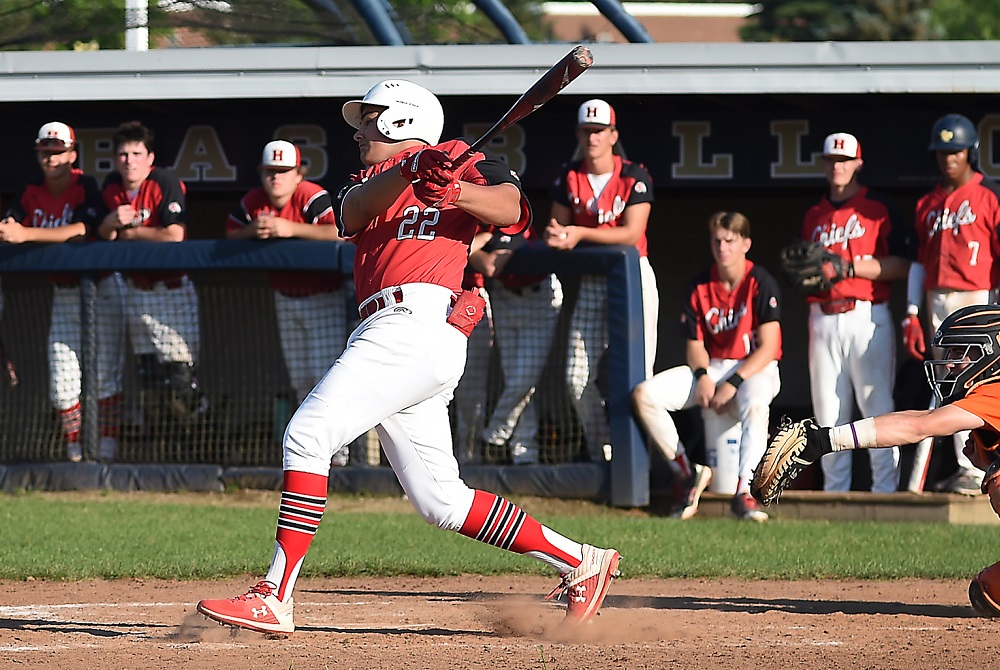
PHOTOS (Top) Huron’s Gavin Moczydlowski drives a pitch while his teammates look on during a game at Chelsea. (Middle) The Chiefs’ Cole Grunwald pulls into third base during a game against Trenton. (Photos by Tom Hawley/Monroe News.)