

Casting Lines for Future Tournaments
August 12, 2016
By Jack Roberts
MHSAA Executive Director
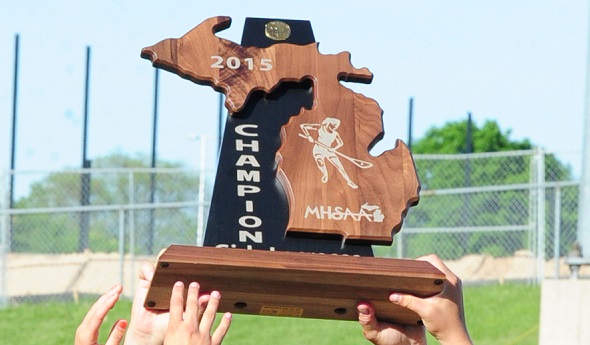
The MHSAA is best known to the public for the tournaments it conducts to conclude the fall, winter and spring seasons each school year.
These tournaments, the first and largest program of the MHSAA, have survived the Vietnam War, the Korean conflict and two World Wars. They have survived the technology bubble, the housing collapse, the energy crisis and the Great Depression.
MHSAA tournaments existed at the dawn of aviation and at the time of our nation’s lunar landing. Popes, presidents and governors have changed and changed again and again, and MHSAA tournaments roll on year after year.
But the sense of tradition and permanence and inevitability of MHSAA tournaments doesn’t dissuade us from asking questions about our tournaments, even some of the most basic questions. Here are two.
Question #1
I have long been and will always be an advocate for a Ryder Cup format for the MHSAA Golf Finals, and a team tennis approach to the MHSAA Tennis Finals; but 90 years of tradition is hard to overcome. Might this be a more exciting format? Could it be co-ed? Could it reverse the decline in boys tennis participation, and increase girls golf participation? Wouldn’t it be fun to try?
Periodically, the International Olympic Committee requires each of the designated Olympic sports to defend its status, to state its case why the sport should remain a part of the Olympic program. Then, after a series or votes that retain one sport at a time, the IOC drops the sport that makes the weakest case. It does so to make room for one of the previously unlisted sports that makes the best case for inclusion.
This would appear to keep the existing Olympic sports on their toes, and to keep the Olympic movement fresh and reflective of modern trends in sports.
While I would not enjoy the controversy, I can see the potential for some positive results if the MHSAA were to invoke the same policy for determining the 14 tournaments it will provide for girls and the 14 for boys.
This might cause us to consider more deeply what a high school sport should look like, or at least what an MHSAA tournament sport should stand for.
On the one hand, we might be inclined to drop tournaments for those sports that involve mostly non-faculty coaches and non-school venues, or require cooperative programs to generate enough participants to support a team, or resort almost entirely to non-school funding, or cater to individuals more than teams.
Or perhaps this process would cause policymakers to forget traditional thinking and ask: “In this day and age, should we shake off traditional notions of sport and consider more where modern kids are coming from?” That might mean fewer team sports and more individual sports, more “extreme” sports like snowboarding and skateboarding, and more lifetime sports, meaning not just golf and tennis and running sports, but also fishing and even shooting sports.
Currently, MHSAA policy states that the MHSAA will consider sponsorship of a tournament series for any sport which 64 member schools conduct on an interscholastic basis as a result of action by the governing boards of those schools.
Should the only question be how many schools sponsor a sport, or must an activity also have certain qualities and/or avoid certain “defects?” What should an MHSAA tournament sport look like and stand for?
Question #2
Bristling from criticism that his association is a money-grabbing exploiter of children, my counterpart in another state said, “If we were running our programs just to make money, we would do very many things very differently.” I knew exactly what he meant.
Because we care about the health and welfare of students, because we mean what we say that the athletic program needs to maximize the ways it enhances the school experience while minimizing academic conflicts, and because we try to model our claim that no sport is a minor sport when it comes to its potential to teach young people life lessons, we operate our programs in ways that make promoters, marketers and business entrepreneurs laugh, cry or cringe.
If money were the only object, we would seed and select sites to assure the teams that attracted the most spectators had the best chance to advance in our tournaments, regardless of the travel for any team or its fan base. If money were the only object, we would never schedule two tournaments to overlap and compete for public attention, much less tolerate three or four overlapping events. If money were the only object, we would allow signage like NASCAR events and promotions like minor league baseball games.
Those approaches to event sponsorship may not be all wrong; they’re just not all right for us. And we will live with the consequences of our belief system.
During a typical school year, more than 20 percent of the MHSAA’s 2,097 District, Regional and Final tournaments lose money. Not a single site in golf, skiing or tennis makes a single penny. In no sport did every District, Regional and Final site have revenue in excess of direct expenses.
In fact, in only three sports – boys and girls basketball and football – is revenue so much greater than direct expenses overall that it helps to pay for all the other tournaments in which the MHSAA invests.
That’s right: invests. When we present our budget to our board, we talk about the MHSAA’s investment in providing tournament opportunities in all those sports and all those places that cannot sustain the cost of those events on their own. How much is this investment worth to students, schools and society?
These two are core questions that require our focus far in advance of talk about scheduling, site selection, seeding and the myriad matters that too often hijack our time and attention.

Retired MHSAA Executive Director Roberts Selected for NFHS Hall of Fame
By
Geoff Kimmerly
MHSAA.com senior editor
March 8, 2022
During an award introduction two years ago, MHSAA associate director Tom Rashid described his longtime close friend Jack Roberts as the leader who “took our darkest hours and problems and turned them into positives.”
The MHSAA has faced its share of challenging times, and those may have been among Roberts’ finest hours over 32 years as MHSAA executive director – and admittedly the times when his adrenaline flowed most. But there were many more good times and memorable advances for Michigan school sports under his leadership, and he will be recognized again this summer both for those and a lifetime of service to school sports in this state and across the nation.
John E. “Jack” Roberts was one of 12 honorees announced Tuesday as this year’s inductees into the National High School Sports Hall of Fame by the National Federation of State High School Associations (NFHS). He will be inducted as one of three former state association administrators selected for the 39th Hall of Fame class at a ceremony during the NFHS summer meeting July 1 in San Antonio, Texas.
He began his tenure as MHSAA executive director in 1986, and at the time of his retirement he was the nation’s longest-serving executive director of a state high school athletic association. He was the fourth person to serve the MHSAA in that leadership role full time, following Charles E. Forsythe (1931-42, 1945-68), Allen W. Bush (1968-78) and Vern L. Norris (1978-86).
Roberts will become the Hall of Fame’s ninth inductee from Michigan, joining Forsythe (inducted 1983), River Rouge boys basketball coach Lofton Greene (1986), Warren Regina athletic director, softball and basketball coach Diane Laffey (2000), Fennville basketball and baseball standout Richie Jordan (2001), Grosse Pointe Woods University Liggett boys and girls tennis coach Bob Wood (2005), Bloomfield Hills Cranbrook hockey standout Jim Johnson (2007), Owosso football, basketball and baseball all-stater Brad Van Pelt (2011); and Vermontville Maple Valley baseball national record holder Ken Beardslee (2016).
Roberts also follows in the footsteps of his late father, John Roberts, who served as executive director of the Wisconsin Interscholastic Athletic Association from 1957-85 and was inducted into the National High School Hall of Fame in 2000. They will be the first father-son team in the Hall of Fame.
Jack Roberts began his career serving as an assistant director for the National Federation from 1973-80. He was involved with the implementation of Title IX at the local and state levels and made immense contributions as the NFHS representative to the landmark Amateur Sports Act of 1978, and also played a significant role in the NFHS rules-writing process as the organization started writing and publishing rules for a number of new sports during the 1970s.
The MHSAA enjoyed continued growth under Roberts’ guidance, particularly in the number of Michigan students participating in athletics and in the number of MHSAA-sponsored tournament sports available to them. Several key rules changes came under Roberts’ watch and direction, and he made the MHSAA a national leader in health and safety efforts particularly in the areas of head injury care, heart safety initiatives and heat management strategies.
“I had a head start in this work. Growing up in the home of the executive director of the Wisconsin Interscholastic Athletic Association and then spending most of my 20s working for the National Federation office, and much of it with (longtime NFHS executive director) Cliff Fagan, was a jumpstart on this career,” Roberts said. “But I’m also satisfied at this point that, to paraphrase Hamilton in the musical ‘Hamilton,’ I didn’t give up on my shot. I was given a shot, I took it and I didn’t waste the chance.
“The job fit me, and I think I maxed the opportunity I had to serve educational athletics in this job, and that’s satisfying to think about at this time.”
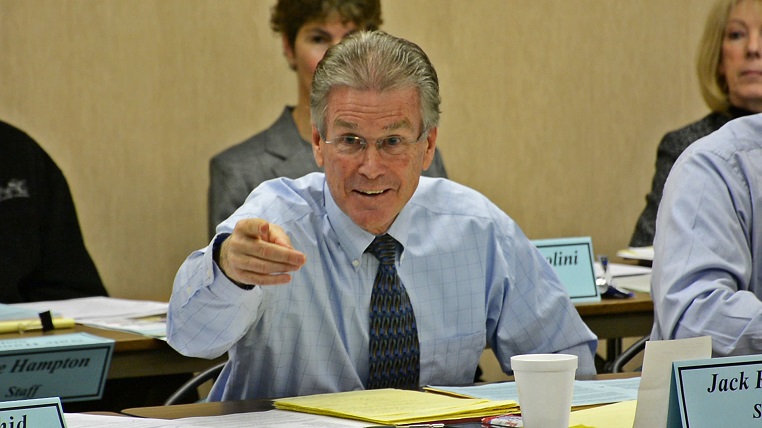 Under Roberts’ leadership, overall participation in high school athletics in Michigan increased 10 percent, and the MHSAA added more than 200 schools in increasing its membership by more than 15 percent at the high school and junior high/middle school levels combined. His tenure saw the addition of girls competitive cheer (1994), girls & boys bowling (2004) and girls & boys lacrosse (2005) to the MHSAA Tournament sport lineup, the creation of a separate wrestling tournament to determine champions by team format (1988), and 8-player football (2010, first playoffs 2011) as many small schools across the state began having trouble fielding 11-player teams because of enrollment and population decreases. Meanwhile, also under his leadership, the 11-player Football Playoffs expanded, doubling to 256 teams in 1999.
Among rules changes put in place during Roberts’ tenure was the addition of opportunities for multiple schools to create cooperative teams in sports where participation is lagging. He also helped Michigan become a national leader in improving sportsmanship; a comprehensive package enacted in 1996 set a statewide tone for appropriate behavior and perspective that continues to make an impact today.
Perhaps the most significant influences by Roberts came on the topics of health and safety. The MHSAA has led nationally in concussion care with its first programming in 2000 and return-to-play protocols enacted in 2010, and with mandated concussion reporting and insurance for those who suffer head injuries rolled out in 2015. A heat management policy and CPR requirements for coaches were introduced in 2013.
Also under this leadership, the first program for coaches education was launched in 1987 and evolved into the Coaches Advancement Program, with nearly 34,000 courses administered as part of CAP since 2004-05. The Women in Sports Leadership Conference was created in 1989 and remains the first, largest and longest-running program of its type in the country, regularly drawing upwards of 500 participants. The first of now-annual statewide Athletic Director In-Service Programs was conducted in 1992, and Michigan also remains a national leader in student services thanks to a variety of programs that were introduced under Roberts’ leadership.
Internally, he put the MHSAA on the leading edge nationally when it came to use the technology, especially in the realm of communications, where he put special emphasis on telling the story of school sports. “I think I was considered a conservative as to rules for eligibility and competition, and a progressive in how we delivered services to schools and school sports,” Roberts said.
In addition to his work specifically in Michigan, Roberts carried significant influence at the national level. He served as part of the NFHS Board of Directors and led the creation of the NFHS Network for video productions in 2012, serving as that board’s chairperson. He also has served on the board of directors of the National Association of Sports Officials (NASO).
“For 32 years, Jack Roberts was the epitome of what leadership looks like. He was the strongest advocate for high school sports that anyone could ever hope for,” said MHSAA Executive Director Mark Uyl, who succeeded Roberts in 2018. “He is without question one of the preeminent pioneers and difference-makers in the world of high school sports over the past 100 years.
“And other than my father, there has not been a man who has had a bigger impact and positive influence on my life personally than Jack Roberts.”
The National High School Hall of Fame was started in 1982 by the NFHS, and the rest of this year’s class is made up of athletes, coaches, administrators and an official. The 12 individuals were chosen after a two-level selection process involving a screening committee composed of active high school state association administrators, coaches and officials, and a final selection committee composed of coaches, former athletes, state association officials, media representatives and educational leaders. Nominations were made through NFHS member associations. Also chosen for this class were athletes Notah Begay (New Mexico), Walter Payton (Mississippi), Sanya Richards-Ross (Florida) and Thurman Thomas (Texas); sport coaches Ray Crowe (Indiana), Ron Kordes (Kentucky) and Lamar Rogers (Tennessee); administrators E. Wayne Cooley (Iowa) and Becky Oakes (Missouri), official Jeff Risk (North Dakota) and speech/debate coach Susan McLain (Oregon). (Click for more.)
Roberts came to the MHSAA in 1986 from the Fellowship of Christian Athletes, which he served as executive vice president. He is a 1970 graduate of Dartmouth College and taught English and coached football at high schools in Milwaukee and Denver before joining the NFHS staff.
He and his wife Peggy reside in East Lansing, and in retirement they together have increased their contributions to environmental matters and international refugee issues while both serving in leadership roles. Jack Roberts has served as board president for the Refugee Development Center in Lansing for 13 years, and Peggy Roberts served six years as chairperson of the board for Lansing’s Fenner Nature Center. As part of their environmental work, the Roberts are working within a small group of organizations to help them acquire and preserve land.