

Casting Lines for Future Tournaments
August 12, 2016
By Jack Roberts
MHSAA Executive Director
The MHSAA is best known to the public for the tournaments it conducts to conclude the fall, winter and spring seasons each school year.
These tournaments, the first and largest program of the MHSAA, have survived the Vietnam War, the Korean conflict and two World Wars. They have survived the technology bubble, the housing collapse, the energy crisis and the Great Depression.
MHSAA tournaments existed at the dawn of aviation and at the time of our nation’s lunar landing. Popes, presidents and governors have changed and changed again and again, and MHSAA tournaments roll on year after year.
But the sense of tradition and permanence and inevitability of MHSAA tournaments doesn’t dissuade us from asking questions about our tournaments, even some of the most basic questions. Here are two.
Question #1
I have long been and will always be an advocate for a Ryder Cup format for the MHSAA Golf Finals, and a team tennis approach to the MHSAA Tennis Finals; but 90 years of tradition is hard to overcome. Might this be a more exciting format? Could it be co-ed? Could it reverse the decline in boys tennis participation, and increase girls golf participation? Wouldn’t it be fun to try?
Periodically, the International Olympic Committee requires each of the designated Olympic sports to defend its status, to state its case why the sport should remain a part of the Olympic program. Then, after a series or votes that retain one sport at a time, the IOC drops the sport that makes the weakest case. It does so to make room for one of the previously unlisted sports that makes the best case for inclusion.
This would appear to keep the existing Olympic sports on their toes, and to keep the Olympic movement fresh and reflective of modern trends in sports.
While I would not enjoy the controversy, I can see the potential for some positive results if the MHSAA were to invoke the same policy for determining the 14 tournaments it will provide for girls and the 14 for boys.
This might cause us to consider more deeply what a high school sport should look like, or at least what an MHSAA tournament sport should stand for.
On the one hand, we might be inclined to drop tournaments for those sports that involve mostly non-faculty coaches and non-school venues, or require cooperative programs to generate enough participants to support a team, or resort almost entirely to non-school funding, or cater to individuals more than teams.
Or perhaps this process would cause policymakers to forget traditional thinking and ask: “In this day and age, should we shake off traditional notions of sport and consider more where modern kids are coming from?” That might mean fewer team sports and more individual sports, more “extreme” sports like snowboarding and skateboarding, and more lifetime sports, meaning not just golf and tennis and running sports, but also fishing and even shooting sports.
Currently, MHSAA policy states that the MHSAA will consider sponsorship of a tournament series for any sport which 64 member schools conduct on an interscholastic basis as a result of action by the governing boards of those schools.
Should the only question be how many schools sponsor a sport, or must an activity also have certain qualities and/or avoid certain “defects?” What should an MHSAA tournament sport look like and stand for?
Question #2
Bristling from criticism that his association is a money-grabbing exploiter of children, my counterpart in another state said, “If we were running our programs just to make money, we would do very many things very differently.” I knew exactly what he meant.
Because we care about the health and welfare of students, because we mean what we say that the athletic program needs to maximize the ways it enhances the school experience while minimizing academic conflicts, and because we try to model our claim that no sport is a minor sport when it comes to its potential to teach young people life lessons, we operate our programs in ways that make promoters, marketers and business entrepreneurs laugh, cry or cringe.
If money were the only object, we would seed and select sites to assure the teams that attracted the most spectators had the best chance to advance in our tournaments, regardless of the travel for any team or its fan base. If money were the only object, we would never schedule two tournaments to overlap and compete for public attention, much less tolerate three or four overlapping events. If money were the only object, we would allow signage like NASCAR events and promotions like minor league baseball games.
Those approaches to event sponsorship may not be all wrong; they’re just not all right for us. And we will live with the consequences of our belief system.
During a typical school year, more than 20 percent of the MHSAA’s 2,097 District, Regional and Final tournaments lose money. Not a single site in golf, skiing or tennis makes a single penny. In no sport did every District, Regional and Final site have revenue in excess of direct expenses.
In fact, in only three sports – boys and girls basketball and football – is revenue so much greater than direct expenses overall that it helps to pay for all the other tournaments in which the MHSAA invests.
That’s right: invests. When we present our budget to our board, we talk about the MHSAA’s investment in providing tournament opportunities in all those sports and all those places that cannot sustain the cost of those events on their own. How much is this investment worth to students, schools and society?
These two are core questions that require our focus far in advance of talk about scheduling, site selection, seeding and the myriad matters that too often hijack our time and attention.
Mumford's Smith Caps Career as Detroit PSL's 1st Finals Champ
By
Paul Costanzo
Special for MHSAA.com
March 5, 2022
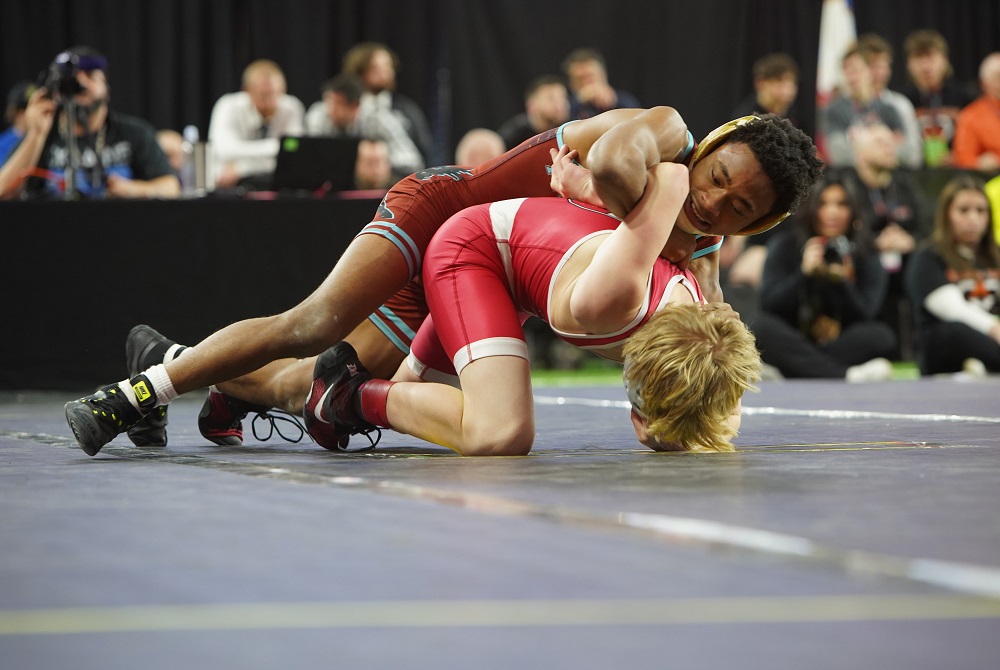
DETROIT – Ja'Marcus Smith felt an immense sense of pride Saturday after becoming the first wrestler from a Detroit Public School to win an Individual Wrestling Finals title.
But he doesn’t plan to be the last to do it.
“It means so much to me,” the Detroit Mumford senior said. “Everything I worked for my freshman year, my 10th-grade year, my 11th-grade year, it’s finally paying off. There’s going to be more than me. There’s going to be a whole ’nother generation.”
Smith defeated Lowell freshman Carter Cichocki (32-5) by pinfall in the 103-pound Division 2 final at Ford Field. Smith was leading 10-1 before getting the pin with two seconds remaining in the third period.
As the referee's hand slapped the mat, the crowd roared. Suddenly, a collection of wrestling fans from all parts of the state joined together in cheering the achievement.
Smith placed fifth at 112 pounds a year ago, and admitted that he felt some pressure to accomplish the feat for his school and city.
“Everybody was on my back about it,” Smith said with a laugh.
112
Champion: Jackson Blum, Lowell, Fr. (37-3)
Fall, 3:02 over Connor Greer, Bay City John Glenn, Fr. (40-1)
Blum was dominant before finishing off his freshman year with a pinfall victory.
“I don’t think I surprised myself,” Blum said. “Obviously, he’s a really good wrestler, undefeated this year and only a freshman. But, just the way that we’ve trained all year and our schedule, I’ve been the most prepared I’ve ever been for this match.”
Blum attacked early and often in the match, and had amassed enough points for the technical fall prior to getting the pin.
119
Champion: Nolan Wertanen, St. Joseph, Sr. (53-0)
Decision, 7-3, over Tee Ward, Fremont, Soph. (49-3)
It took a couple shots to the nose, and a wrap that covered most of his face to get it done, but Wertanen left Ford Field as a three-time champion.
“Going into this match, I knew I was going to have a tough match, as always. It’s the state finals,” Wertanen said. “I wanted to make a point that I’m dominant. Unfortunately, I’ve never wrestled not being able to breathe entirely, so that was tough. But I got the job done.”
Wertanen won at 112 pounds in 2021 and 103 in 2020.
“If you would have told me a long time ago when I would get in every MYWA tournament, when I would get pinned and I was hiding under the bleachers, that I would be a three-time state champion, I would have been stoked,” he said.
125
Champion: Owen Segorski, Lowell, Fr. (28-11)
Decision, 6-1, over Bryce Shingleton, Linden, Jr. (45-3)
Despite wrestling in his first Individual Finals and falling behind, Segorski was unfazed.
“I felt good the whole time,” Segorski said. “I was never scared. I knew he was going to back up and keep diving in, so I just wanted to keep going forward and stay in my stance.”
He trailed 1-0 heading into the third period, but an escape, takedown and nearfall secured the victory and an individual title to go along with Lowell’s team championship won last weekend.
130
Champion: Louden Stradling, Gaylord, Jr. (24-1)
Decision, 3-2 (2OT), over Ramsy Mutschler, Lowell, Sr. (31-6)
Stradling avenged a loss from the week before, and needed to hold on into the final seconds of the second ultimate tiebreaker period.
“Last week I wrestled Ramsy, and it was a really close one,” Stradling said. “I couldn’t open up on him because his defense is amazing. This week, I took it slow, I focused on how to get out on bottom from him, and me getting out on bottom changed the match.”
Mutschler scored an escape early in the first ultimate tiebreaker period, and entered the second with a 2-1 lead. Stradling scored a reversal midway through the second, and held on for his first title.
“It’s an amazing feeling,” Stradling said. “I plan on doing it again, but this year meant a lot to me.”
135
Champion: Aaron Lucio, Stevensville Lakeshore, Jr. (54-0)
Decision, 7-4, over James Link, Lowell, Sr. (38-6)
A year after finishing second in the Finals, Lucio broke through, finishing off an unbeaten season with his first title.
“It means a lot,” Lucio said. “I knew I put the work in. I knew I could get it done. I knew that my coaches told me to stay tough in close matches, and if that would happen, I would win.”
Lucio scored an early takedown in the match, and never trailed, but he used a three-point third period to give himself some space before Link scored an escape in the final minute.
“More points were on the board than I thought,” Lucio said. “But as I opened up and I got to feel him and he could feel me, I knew I could get to his legs a lot easier.”

140
Champion: Jacob Brya, St. Johns, Sr. (42-0)
Decision, 1-0, over Carsen Richards, Goodrich, Sr. (45-3)
After a positive COVID-19 test ended his junior season and a potential run at four individual titles, Brya came into his senior season with something to prove – after a nudge from his dad.
“I was sitting around for a while, then my dad started yelling at me,” Brya said. “Ever since then I’ve been doing two-a-days and lifting all the time. I just feel like I have more motivation than I’ve ever had.”
Brya won at 112 pounds in 2020 and 103 in 2019. He held a slim 1-0 advantage in Saturday’s final, but rode Richards out to get the victory.
It was the third time the two had wrestled this season, and while each match was close, Brya was able to win the battle while on top, giving him the confidence to do it again.
145
Champion: Zamuel Thompson, Stevensville Lakeshore, Sr. (51-3)
Decision, 8-6, over Timmy Simons, Gibraltar Carlson, Jr. (37-4)
Thompson joined his sister, Sydney, of Eaton Rapids in winning a Finals title (110 pounds), becoming the first brother-sister combination to win MHSAA wrestling titles in the same season.
“It’s amazing,” Zamuel Thompson said. “I didn’t even know she was going to do it until three or four weeks ago. That made my day.”
In his own match, Thompson needed a third-period takedown to hold off Simons.
“I knew I shouldn’t have let him take me down in the first place,” Thompson said. “I was wrestling sloppy. Just conditioning we’re doing, I knew that in the end I would get him, there was no doubt in my mind. It was just a matter of when.”
152
Champion: Micah Hanau, Stevensville Lakeshore, Sr. (52-2)
Decision, 3-2, over Julius Polk, Pontiac, Sr. (36-2)
Hanau felt he was too reckless his junior season, which didn’t allow him to repeat as an individual champion.
But he was well under control Saturday as he was able to wrap up a second title.
“I feel great,” Hanau said. “I wrestled the match I wanted to. Last year, I didn’t do how I wanted because of how (out-of-control) my wrestling style was. I took time to control that, and I feel like I won the match I planned on winning.”
Hanau was the champion at 130 pounds in 2020.
160
Champion: Jacob Gonzales, Holly, Sr. (49-0)
Decision, 7-3, over William Bradley, Paw Paw, Sr. (51-2)
Gonzales became a three-time individual champion with his victory. The Holly senior won at 152 pounds in 2021 and 2020.
“It’s everything I wanted,” Gonzales said. “I wanted four, I had to settle for three, but history isn’t easy.”
Gonzales was in control for most of the match, but Bradley was able to put a little scare into the Holly fans near the end. Gonzales was less scared.
“I knew he was a funky wrestler,” Gonzales said. “I knew I was going to have to be flexible and ready for everything he threw at me, and I was.”
171
Champion: Brayden Gatreau, Gaylord, Jr. (42-1)
Major decision, 10-2, over Derek Badgley, Mason, Soph. (49-3)
Gatreau turned up the heat in the third period, making what was a tight match a major decision.
“I felt great,” he said. “I worked towards my cardio all season. I knew that, no matter what, I’m working harder than anybody else. At the end of the day, it comes down to who wants it more, and I want it more than anyone else in this state. No matter what time, I’m going to close out the match and I’m going to win it.”
Gatreau scored six points in the third period, including a takedown and nearfall during the final 20 seconds.
189
Champion: Adam Haselius, Jackson Northwest, Jr. (45-1)
Decision, 7-2, over Kael Wisler, New Boston Huron, Sr. (54-2)
Haselius won the match on his feet, getting three takedowns to Wisler’s zero. And as the match was ending, he was still pushing for a pin, despite having it wrapped up.
“Can’t let up, that’s letting the other guy into the match,” Haselius said. “I have to keep grinding no matter what the score is. It’s the feeling of accomplishment.
“This right here is what you work for. It feels so good to finally complete that goal. To finally reach that high point. I just wrestled my match; it’s a great feeling.”
215
Champion: Carter Blough, Lowell, Sr. (37-2)
Decision, 4-0, over James Campbell, Mattawan, Sr. (36-1)
As Blough walked off the mat following his first individual title, he was mobbed by his family.
“That’s crazy,” he said. “I’ve been waiting for this since I was like 6. It couldn’t be any better. This is what I’ve been wanting since I started wrestling. This is the best moment of my life right here.”
Blough got an early takedown in the first period, and while there wasn’t much scoring afterward, he appeared to be in control throughout.
“I just had to be careful, cautious,” Blough said. “I was just being stingy on top. Just keeping my hips up so he couldn’t hit any big moves, and I knew the match was mine.”
285
Champion: Ira Jenkins, Whitehall, Sr. (51-0)
Fall 0:38, over Joshua Cook, Ferndale, Sr. (52-1)
Jenkins had a dominant run through the tournament, pinning each of his opponents, including the final three in the opening minute.
“I just knew I had to go out there and do what I do,” Jenkins said. “I was just taking it one thing at a time, and I guess that’s what it ended up being.”
It was the second-straight individual title for Jenkins, who pinned through the 285-pound bracket in Division 3 a year ago.
“Being able to pin through the state tournament two years in a row, that’s pretty cool, I think,” Jenkins said.
PHOTOS (Top) Detroit Mumford’s Jamarcus Smith works toward a pin in his 103-pound championship match Saturday at Ford Field. (Middle) St. Johns’ Jacob Brya maintains a hold on his way to winning at 140. (Click for more from HighSchoolSportsScene.com.)