

Casting Lines for Future Tournaments
August 12, 2016
By Jack Roberts
MHSAA Executive Director
The MHSAA is best known to the public for the tournaments it conducts to conclude the fall, winter and spring seasons each school year.
These tournaments, the first and largest program of the MHSAA, have survived the Vietnam War, the Korean conflict and two World Wars. They have survived the technology bubble, the housing collapse, the energy crisis and the Great Depression.
MHSAA tournaments existed at the dawn of aviation and at the time of our nation’s lunar landing. Popes, presidents and governors have changed and changed again and again, and MHSAA tournaments roll on year after year.
But the sense of tradition and permanence and inevitability of MHSAA tournaments doesn’t dissuade us from asking questions about our tournaments, even some of the most basic questions. Here are two.
Question #1
I have long been and will always be an advocate for a Ryder Cup format for the MHSAA Golf Finals, and a team tennis approach to the MHSAA Tennis Finals; but 90 years of tradition is hard to overcome. Might this be a more exciting format? Could it be co-ed? Could it reverse the decline in boys tennis participation, and increase girls golf participation? Wouldn’t it be fun to try?
Periodically, the International Olympic Committee requires each of the designated Olympic sports to defend its status, to state its case why the sport should remain a part of the Olympic program. Then, after a series or votes that retain one sport at a time, the IOC drops the sport that makes the weakest case. It does so to make room for one of the previously unlisted sports that makes the best case for inclusion.
This would appear to keep the existing Olympic sports on their toes, and to keep the Olympic movement fresh and reflective of modern trends in sports.
While I would not enjoy the controversy, I can see the potential for some positive results if the MHSAA were to invoke the same policy for determining the 14 tournaments it will provide for girls and the 14 for boys.
This might cause us to consider more deeply what a high school sport should look like, or at least what an MHSAA tournament sport should stand for.
On the one hand, we might be inclined to drop tournaments for those sports that involve mostly non-faculty coaches and non-school venues, or require cooperative programs to generate enough participants to support a team, or resort almost entirely to non-school funding, or cater to individuals more than teams.
Or perhaps this process would cause policymakers to forget traditional thinking and ask: “In this day and age, should we shake off traditional notions of sport and consider more where modern kids are coming from?” That might mean fewer team sports and more individual sports, more “extreme” sports like snowboarding and skateboarding, and more lifetime sports, meaning not just golf and tennis and running sports, but also fishing and even shooting sports.
Currently, MHSAA policy states that the MHSAA will consider sponsorship of a tournament series for any sport which 64 member schools conduct on an interscholastic basis as a result of action by the governing boards of those schools.
Should the only question be how many schools sponsor a sport, or must an activity also have certain qualities and/or avoid certain “defects?” What should an MHSAA tournament sport look like and stand for?
Question #2
Bristling from criticism that his association is a money-grabbing exploiter of children, my counterpart in another state said, “If we were running our programs just to make money, we would do very many things very differently.” I knew exactly what he meant.
Because we care about the health and welfare of students, because we mean what we say that the athletic program needs to maximize the ways it enhances the school experience while minimizing academic conflicts, and because we try to model our claim that no sport is a minor sport when it comes to its potential to teach young people life lessons, we operate our programs in ways that make promoters, marketers and business entrepreneurs laugh, cry or cringe.
If money were the only object, we would seed and select sites to assure the teams that attracted the most spectators had the best chance to advance in our tournaments, regardless of the travel for any team or its fan base. If money were the only object, we would never schedule two tournaments to overlap and compete for public attention, much less tolerate three or four overlapping events. If money were the only object, we would allow signage like NASCAR events and promotions like minor league baseball games.
Those approaches to event sponsorship may not be all wrong; they’re just not all right for us. And we will live with the consequences of our belief system.
During a typical school year, more than 20 percent of the MHSAA’s 2,097 District, Regional and Final tournaments lose money. Not a single site in golf, skiing or tennis makes a single penny. In no sport did every District, Regional and Final site have revenue in excess of direct expenses.
In fact, in only three sports – boys and girls basketball and football – is revenue so much greater than direct expenses overall that it helps to pay for all the other tournaments in which the MHSAA invests.
That’s right: invests. When we present our budget to our board, we talk about the MHSAA’s investment in providing tournament opportunities in all those sports and all those places that cannot sustain the cost of those events on their own. How much is this investment worth to students, schools and society?
These two are core questions that require our focus far in advance of talk about scheduling, site selection, seeding and the myriad matters that too often hijack our time and attention.
D1 Preview: Adams' Title Streak Up Against Field of Past Champions
By
Geoff Kimmerly
MHSAA.com senior editor
March 3, 2022
Rochester Adams has risen above the rest of Division 1 to win the last two Finals championships, and few would argue with the Highlanders as at least one of the favorites heading into Friday’s season-ending competition.
But the Grand Rapids Delta Plex also will welcome back the two most successful championship winners in Division 1/Class A history, plus four more teams that have finished first or second at this event over the last decade and an eighth team that came in third only two seasons ago.
Division 1 competition begins at 6 p.m. Friday. Tickets cost $10 and may be bought at the Delta Plex, and all four Finals will be broadcast live on MHSAA.tv and viewable with a subscription. More information, including the spectator seating chart, is posted at MHSAA.com.
Below is a look at all eight finalists:
GRAND BLANC
League finish: First in Saginaw Valley League.
Coach: Christina Swansey, 11th season
Championship history: Seeking first top-two Finals finish.
Top score: 790.92.
Team composition: 24 total (six seniors, eight juniors, six sophomores, four freshmen).
Outlook: The Bobcats finished fourth last season, their fourth straight finish among the top five in Division 1, and they could make another run this weekend at a first top-two finish after coming in third in 2020. They won their District and Regional the last two weeks going over 786 points at both. Seniors Adrianna Fuller and Isabella Haber are returning all-state first teamers, senior Jackie Kloph made the second team last season and junior Nevaeh Keller earned honorable mention.
GRANDVILLE
League finish: Third in Ottawa-Kent Conference Red
Coach: Julie Smith-Boyd, 41st season
Championship history: Six MHSAA titles (most recent 2015), 10 runner-up finishes.
Top score: 785.6.
Team composition: 25 total (eight seniors, two juniors, 14 sophomores, one freshman).
Outlook: Grandville returned to the Finals after a season away in 2021 and claimed its 16th top-two finish, placing second – its highest since 2016. This season’s team has posted its top two scores over its last two competitions, winning its District and finishing third at its Regional. Senior Elyse Friberg made the all-state first team last season, seniors Cece Duffy, Santana Duffy and Ashley Lam made the second, and senior Alexis Parker and sophomore Lexsee Pawloski earned honorable mentions.
HARTLAND
League finish: First in Kensington Lakes Activities Association Gold
Coach: Candace Fahr, fifth season
Championship history: Division 1 runner-up 2013.
Top score: 787.16 at Regional
Team composition: 26 total (one senior, nine juniors, 12 sophomores, four freshmen).
Outlook: Hartland missed the Finals last season but is back for the third time in four years – contending this time but also likely building for the next few with large junior and sophomore classes anchoring the roster. The Eagles have scored 782 or higher four of their last five competitions. Junior Lily Pies earned an all-District honorable mention in 2021.
HUDSONVILLE
League finish: Second in O-K Red
Coach: Andrea Crowley, fifth season
Championship history: Division 1 runner-up 2012.
Top score: N/A but did score 783.94 at Regional
Team composition: 29 total (12 seniors, 13 sophomores, four freshmen).
Outlook: Hudsonville is back at the Finals for the first time since 2017, following a sizable senior class after just missing with a fifth-place Regional finish last season. The Eagles finished only 38 hundredths of a point off the lead at their District two weeks ago, also scoring better than 780 points at that meet. Seniors Jadyn Jarosch, Ava Ham and Amanda White all earned all-Regional recognition in 2021.
PLYMOUTH
League finish: Third in KLAA Gold.
Coach: Samantha Koehler, seventh season
Championship history: Division 1 runner-up 2020.
Top score: 787.98 at District.
Team composition: 31 total (11 seniors, eight juniors, eight sophomores, four freshmen)
Outlook: Plymouth has been in the championship mix the last two seasons finishing third last year and second in 2020. The Wildcats won their District two weeks ago by nearly eight points, and their 787.16 at the Regional was their second-highest score this winter. Senior Allison Cassar is a returning two-time all-state first teamer, while Avery Maruszewski and Natalia Muzquiz Inda made the second team in 2021 and senior Hailey Tocco and junior Lexi Macyda earned honorable mentions.
ROCHESTER
League finish: Third in Oakland Activities Association Red
Coach: Susan Wood, 41st season
Championship history: 14 MHSAA titles (most recent 2017), four runner-up finishes.
Top score: 789.9 at District
Team composition: 25 total (nine seniors, nine juniors, four sophomores, three freshmen)
Outlook: The MHSAA record holder for most Finals championships in this sport is back after a 2021 season derailed by COVID-19, and with plenty of power having nearly reached 790 points at both the District and Regional. The Falcons are made up mostly of upperclassmen and do have Finals experience on which to draw, with senior Holly McDonald an all-state second teamer and senior Isabella Olivares earning honorable mention when the team finished fifth in 2020.
ROCHESTER ADAMS
League finish: First in OAA Red.
Coach: Brooke Miller, eighth season
Championship history: Division 1 champion 2021 and 2020, three runner-up finishes.
Top score: 792.16 at District.
Team composition: 25 total (nine seniors, 10 juniors, six sophomores).
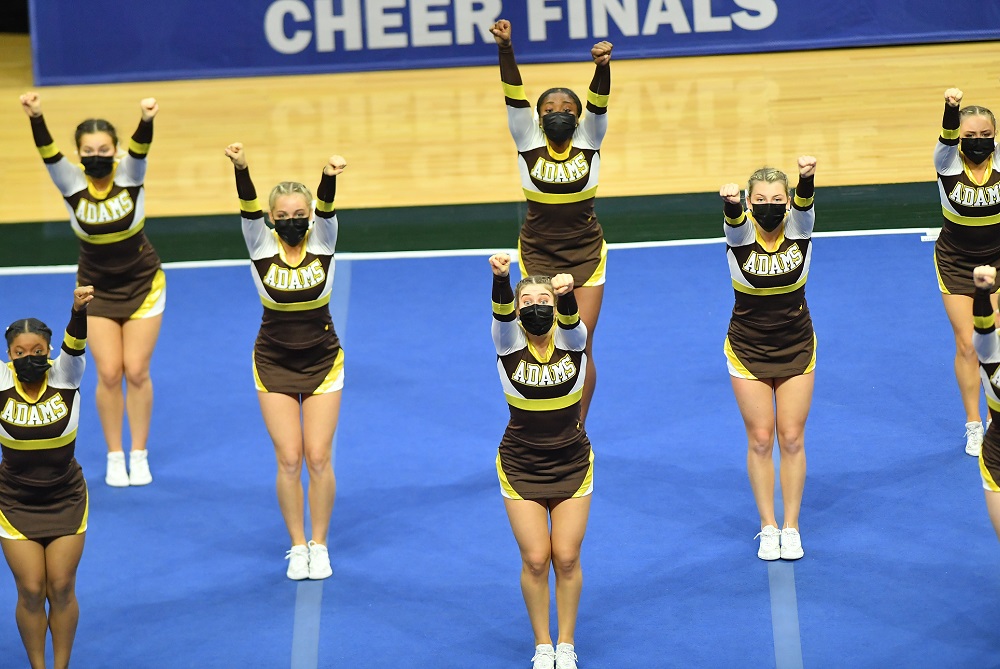
Outlook: Adams has moved from a back-to-back runner-up in 2018 and 2019 to a back-to-back champion the last two seasons, clearing the field last winter by nearly eight points. And that said, they have two scores this season higher than their highest heading into Finals weekend a year ago, posting them to win District and Regional titles. Senior Gigi Schultz made the all-state first team last season, while seniors Christina Truszkowski, Sabrina Lee and Destini Dorkins made the second team and junior Emma Maynard earned an honorable mention.
ROCHESTER HILLS STONEY CREEK
League finish: Second in OAA Red.
Coach: Tricia Williams, 19th season
Championship history: Division 1 champion 2019 and 2010.
Top score: 790.30 at District.
Team composition: 21 total (nine seniors, three juniors, eight sophomores, one freshman).
Outlook: Stoney Creek returned to the Finals last season and finished eighth, and its best score this season is nearly two points better than this time a year ago. The Cougars have scored 781 or better at eight competitions and 787 or higher three of their last four. Seniors Ella DeGraw, Rachael Kim and Jenna Lanfear earned all-Regional recognition last season.
PHOTO Rochester Adams competes during Round 2 of last season’s Division 1 Finals at Breslin Center. (Click for more from Hockey Weekly Action Photos.)