

Casting Lines for Future Tournaments
August 12, 2016
By Jack Roberts
MHSAA Executive Director
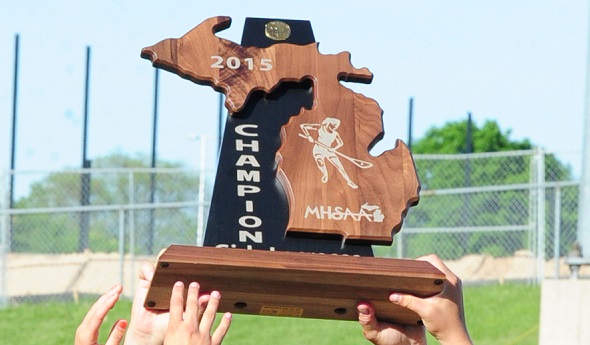
The MHSAA is best known to the public for the tournaments it conducts to conclude the fall, winter and spring seasons each school year.
These tournaments, the first and largest program of the MHSAA, have survived the Vietnam War, the Korean conflict and two World Wars. They have survived the technology bubble, the housing collapse, the energy crisis and the Great Depression.
MHSAA tournaments existed at the dawn of aviation and at the time of our nation’s lunar landing. Popes, presidents and governors have changed and changed again and again, and MHSAA tournaments roll on year after year.
But the sense of tradition and permanence and inevitability of MHSAA tournaments doesn’t dissuade us from asking questions about our tournaments, even some of the most basic questions. Here are two.
Question #1
I have long been and will always be an advocate for a Ryder Cup format for the MHSAA Golf Finals, and a team tennis approach to the MHSAA Tennis Finals; but 90 years of tradition is hard to overcome. Might this be a more exciting format? Could it be co-ed? Could it reverse the decline in boys tennis participation, and increase girls golf participation? Wouldn’t it be fun to try?
Periodically, the International Olympic Committee requires each of the designated Olympic sports to defend its status, to state its case why the sport should remain a part of the Olympic program. Then, after a series or votes that retain one sport at a time, the IOC drops the sport that makes the weakest case. It does so to make room for one of the previously unlisted sports that makes the best case for inclusion.
This would appear to keep the existing Olympic sports on their toes, and to keep the Olympic movement fresh and reflective of modern trends in sports.
While I would not enjoy the controversy, I can see the potential for some positive results if the MHSAA were to invoke the same policy for determining the 14 tournaments it will provide for girls and the 14 for boys.
This might cause us to consider more deeply what a high school sport should look like, or at least what an MHSAA tournament sport should stand for.
On the one hand, we might be inclined to drop tournaments for those sports that involve mostly non-faculty coaches and non-school venues, or require cooperative programs to generate enough participants to support a team, or resort almost entirely to non-school funding, or cater to individuals more than teams.
Or perhaps this process would cause policymakers to forget traditional thinking and ask: “In this day and age, should we shake off traditional notions of sport and consider more where modern kids are coming from?” That might mean fewer team sports and more individual sports, more “extreme” sports like snowboarding and skateboarding, and more lifetime sports, meaning not just golf and tennis and running sports, but also fishing and even shooting sports.
Currently, MHSAA policy states that the MHSAA will consider sponsorship of a tournament series for any sport which 64 member schools conduct on an interscholastic basis as a result of action by the governing boards of those schools.
Should the only question be how many schools sponsor a sport, or must an activity also have certain qualities and/or avoid certain “defects?” What should an MHSAA tournament sport look like and stand for?
Question #2
Bristling from criticism that his association is a money-grabbing exploiter of children, my counterpart in another state said, “If we were running our programs just to make money, we would do very many things very differently.” I knew exactly what he meant.
Because we care about the health and welfare of students, because we mean what we say that the athletic program needs to maximize the ways it enhances the school experience while minimizing academic conflicts, and because we try to model our claim that no sport is a minor sport when it comes to its potential to teach young people life lessons, we operate our programs in ways that make promoters, marketers and business entrepreneurs laugh, cry or cringe.
If money were the only object, we would seed and select sites to assure the teams that attracted the most spectators had the best chance to advance in our tournaments, regardless of the travel for any team or its fan base. If money were the only object, we would never schedule two tournaments to overlap and compete for public attention, much less tolerate three or four overlapping events. If money were the only object, we would allow signage like NASCAR events and promotions like minor league baseball games.
Those approaches to event sponsorship may not be all wrong; they’re just not all right for us. And we will live with the consequences of our belief system.
During a typical school year, more than 20 percent of the MHSAA’s 2,097 District, Regional and Final tournaments lose money. Not a single site in golf, skiing or tennis makes a single penny. In no sport did every District, Regional and Final site have revenue in excess of direct expenses.
In fact, in only three sports – boys and girls basketball and football – is revenue so much greater than direct expenses overall that it helps to pay for all the other tournaments in which the MHSAA invests.
That’s right: invests. When we present our budget to our board, we talk about the MHSAA’s investment in providing tournament opportunities in all those sports and all those places that cannot sustain the cost of those events on their own. How much is this investment worth to students, schools and society?
These two are core questions that require our focus far in advance of talk about scheduling, site selection, seeding and the myriad matters that too often hijack our time and attention.
2022 WISL Honoree Hyman Lauded for Lifetime of Leadership
By
Geoff Kimmerly
MHSAA.com senior editor
February 25, 2022
Lori Hyman was a sports standout in high school, then at Michigan State University. She then coached college basketball for 17 years, starting when she was only 23 years old, and surely could’ve continued down that path.
While always a leader, she decided to change gears in 1995 and provide guidance another way – coaching up coaches as a high school athletic director. Over the next 27 years, she became one of the most respected ADs in Michigan – and contributed in that role at her alma mater Livonia Stevenson over the last 22.
To celebrate her many contributions to school sports, at home but also statewide, Hyman has been named the 35th recipient of the MHSAA Women In Sports Leadership Award. She will receive the award during the Division 1 Girls Basketball Final on March 19 at Michigan State’s Breslin Center.
Hyman served her first five years as an athletic director at Dexter, making the move there after four college basketball coaching stops. After a memorable hoops career at MSU, she served as a women’s basketball graduate assistant at Ferris State University and then head coach at Northwood Institute (now University) from 1981-82 – when she was only 23 years old – through 1985-86.
She then served as an assistant at University of Illinois before returning as head coach at Ferris State from 1989-90 through 1994-95. In Fall 1995, she began at Dexter.
“Every part of my career I’ve been happy with, and honored, and just thoroughly enjoyed it,” Hyman said. “It’s been a passion of mine, every aspect.
“(Playing at Michigan State) was one of the best times, if not the best time, of my life as a youngster. And then being an athletic director has probably been the most rewarding as an adult. And being at Stevenson, coming back home, has been quite an honor and just a very rich experience for me.”
Each year, the Representative Council considers the achievements of women coaches, officials and athletic administrators affiliated with the MHSAA who show exemplary leadership capabilities and positive contributions to athletics.
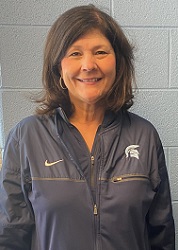 Hyman is a 1975 graduate of Stevenson, where she also played softball and competed in track & field. She was named MSU’s Outstanding Athlete of the Year for women’s basketball in 1979, after serving as co-captain of the team that season but missing the majority of it with an injury.
As an athlete at MSU, she joined her teammates in filing a 1978 discrimination complaint that requested the women’s basketball team receive travel allowances equal to those received by the Spartans men’s team. “It is very meaningful that Michigan State is where they are now, not just in women’s basketball but the women’s sport program,” Hyman said. “I feel like we were part of that growing and moving forward in a positive way, and I thank Michigan State for recognizing that and moving it forward.”
She graduated with a bachelor’s degree in physical education and health in 1980 and has a master’s in athletic administration from Wayne State University. She received her certified master athletic administrator designation from the National Interscholastic Athletic Administrators Association (NIAAA) in 2006.
Back at Stevenson, Hyman has directed the athletic program for a high school with nearly 1,700 students, which by enrollment ranks 50th out of 750 MHSAA member schools.
She has hosted a multitude of MHSAA Tournament events while at both Dexter and Stevenson and has served on the MHSAA’s girls tennis, girls basketball and boys basketball committees. She also has served as the girls and boys tennis commissioner of the Kensington Lakes Activities Association, of which Stevenson is a member.
“Lori has been a leader and pioneer in the world of athletics, and in particular as an advocate for females and girls sports,” MHSAA Executive Director Mark Uyl said. “When she left coaching basketball to work as an AD, it was an incredible victory for kids in our state. She’s been dependable, loyal and just a model of consistency in running a first-class program.”
Hyman was named her region’s Athletic Director of the Year by the Michigan Interscholastic Athletic Administrators Association (MIAAA) in 2014 and received its Jack Johnson Distinguished Service Award in 2015.
As an instructor for the MIAAA, Hyman has provided training particularly to beginning athletic directors. She has served as a Leadership Training Institute instructor as well for the MIAAA and as a presider and speaker at the MIAAA’s annual conference. She also has spoken at the MHSAA’s Women In Sports Leadership Conference.
“I’ve always been an advocate for women in sports and equal opportunity,” Hyman added. “I treat all of the sports here equally, male and female. But if I feel that there needs to be a little bit more advocacy for women in sports, whether it’s coaching and getting more girls involved, or officiating, administration, any kind of leadership, I’m really big on that.”
“I’m a big advocate for women in athletics, but (also) just athletics in general.”
In addition to her vast school sports responsibilities and contributions, Hyman has volunteered with Special Olympics, Livonia’s Newburg United Methodist Church and Rotary Club.
The first Women In Sports Leadership Award was presented in 1990.
Past recipients
1990 – Carol Seavoy, L’Anse
1991 – Diane Laffey, Harper Woods
1992 – Patricia Ashby, Scotts
1993 – Jo Lake, Grosse Pointe
1994 – Brenda Gatlin, Detroit
1995 – Jane Bennett, Ann Arbor
1996 – Cheryl Amos-Helmicki, Huntington Woods
1997 – Delores L. Elswick, Detroit
1998 – Karen S. Leinaar, Delton
1999 – Kathy McGee, Flint
2000 – Pat Richardson, Grass Lake
2001 – Suzanne Martin, East Lansing
2002 – Susan Barthold, Kentwood
2003 – Nancy Clark, Flint
2004 – Kathy Vruggink Westdorp, Grand Rapids
2005 – Barbara Redding, Capac
2006 – Melanie Miller, Lansing
2007 – Jan Sander, Warren Woods
2008 – Jane Bos, Grand Rapids
2009 – Gail Ganakas, Flint; Deb VanKuiken, Holly
2010 – Gina Mazzolini, Lansing
2011 – Ellen Pugh, West Branch; Patti Tibaldi, Traverse City
2012 – Janet Gillette, Comstock Park
2013 – Barbara Beckett, Traverse City
2014 – Teri Reyburn, DeWitt
2015 – Jean LaClair, Bronson
2016 – Betty Wroubel, Pontiac
2017 – Dottie Davis, Ann Arbor
2018 – Meg Seng, Ann Arbor
2019 – Kris Isom, Adrian
2020 – Nikki Norris, East Lansing
2021 – Dorene Ingalls, St. Ignace
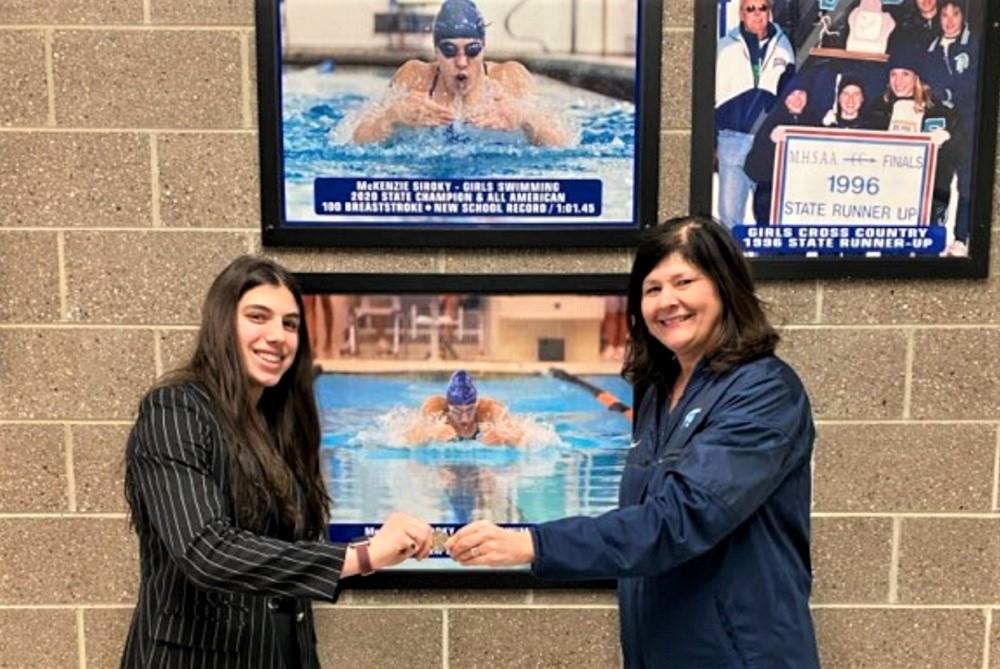
PHOTO Livonia Stevenson athletic director Lori Hyman (right) and Finals swimming champion McKenzie Siroky hold up a championship medal alongside photos honoring Siroky's achievements. (Photo courtesy of the Stevenson athletic department.)