

Casting Lines for Future Tournaments
August 12, 2016
By Jack Roberts
MHSAA Executive Director
The MHSAA is best known to the public for the tournaments it conducts to conclude the fall, winter and spring seasons each school year.
These tournaments, the first and largest program of the MHSAA, have survived the Vietnam War, the Korean conflict and two World Wars. They have survived the technology bubble, the housing collapse, the energy crisis and the Great Depression.
MHSAA tournaments existed at the dawn of aviation and at the time of our nation’s lunar landing. Popes, presidents and governors have changed and changed again and again, and MHSAA tournaments roll on year after year.
But the sense of tradition and permanence and inevitability of MHSAA tournaments doesn’t dissuade us from asking questions about our tournaments, even some of the most basic questions. Here are two.
Question #1
I have long been and will always be an advocate for a Ryder Cup format for the MHSAA Golf Finals, and a team tennis approach to the MHSAA Tennis Finals; but 90 years of tradition is hard to overcome. Might this be a more exciting format? Could it be co-ed? Could it reverse the decline in boys tennis participation, and increase girls golf participation? Wouldn’t it be fun to try?
Periodically, the International Olympic Committee requires each of the designated Olympic sports to defend its status, to state its case why the sport should remain a part of the Olympic program. Then, after a series or votes that retain one sport at a time, the IOC drops the sport that makes the weakest case. It does so to make room for one of the previously unlisted sports that makes the best case for inclusion.
This would appear to keep the existing Olympic sports on their toes, and to keep the Olympic movement fresh and reflective of modern trends in sports.
While I would not enjoy the controversy, I can see the potential for some positive results if the MHSAA were to invoke the same policy for determining the 14 tournaments it will provide for girls and the 14 for boys.
This might cause us to consider more deeply what a high school sport should look like, or at least what an MHSAA tournament sport should stand for.
On the one hand, we might be inclined to drop tournaments for those sports that involve mostly non-faculty coaches and non-school venues, or require cooperative programs to generate enough participants to support a team, or resort almost entirely to non-school funding, or cater to individuals more than teams.
Or perhaps this process would cause policymakers to forget traditional thinking and ask: “In this day and age, should we shake off traditional notions of sport and consider more where modern kids are coming from?” That might mean fewer team sports and more individual sports, more “extreme” sports like snowboarding and skateboarding, and more lifetime sports, meaning not just golf and tennis and running sports, but also fishing and even shooting sports.
Currently, MHSAA policy states that the MHSAA will consider sponsorship of a tournament series for any sport which 64 member schools conduct on an interscholastic basis as a result of action by the governing boards of those schools.
Should the only question be how many schools sponsor a sport, or must an activity also have certain qualities and/or avoid certain “defects?” What should an MHSAA tournament sport look like and stand for?
Question #2
Bristling from criticism that his association is a money-grabbing exploiter of children, my counterpart in another state said, “If we were running our programs just to make money, we would do very many things very differently.” I knew exactly what he meant.
Because we care about the health and welfare of students, because we mean what we say that the athletic program needs to maximize the ways it enhances the school experience while minimizing academic conflicts, and because we try to model our claim that no sport is a minor sport when it comes to its potential to teach young people life lessons, we operate our programs in ways that make promoters, marketers and business entrepreneurs laugh, cry or cringe.
If money were the only object, we would seed and select sites to assure the teams that attracted the most spectators had the best chance to advance in our tournaments, regardless of the travel for any team or its fan base. If money were the only object, we would never schedule two tournaments to overlap and compete for public attention, much less tolerate three or four overlapping events. If money were the only object, we would allow signage like NASCAR events and promotions like minor league baseball games.
Those approaches to event sponsorship may not be all wrong; they’re just not all right for us. And we will live with the consequences of our belief system.
During a typical school year, more than 20 percent of the MHSAA’s 2,097 District, Regional and Final tournaments lose money. Not a single site in golf, skiing or tennis makes a single penny. In no sport did every District, Regional and Final site have revenue in excess of direct expenses.
In fact, in only three sports – boys and girls basketball and football – is revenue so much greater than direct expenses overall that it helps to pay for all the other tournaments in which the MHSAA invests.
That’s right: invests. When we present our budget to our board, we talk about the MHSAA’s investment in providing tournament opportunities in all those sports and all those places that cannot sustain the cost of those events on their own. How much is this investment worth to students, schools and society?
These two are core questions that require our focus far in advance of talk about scheduling, site selection, seeding and the myriad matters that too often hijack our time and attention.
D2 Preview: Contenders Line Up as Lowell Hopes to Run Streak to 9
By
Geoff Kimmerly
MHSAA.com senior editor
February 24, 2022
Two other contenders are undefeated this season. Two more are past MHSAA Finals champions.
But until defeated, Lowell will be the team leading the Division 2 title chase – in this weekend’s case, with the hope of adding to its record eight-season Finals championship streak.
That quest begins with Friday’s 6:45 p.m. Quarterfinals at Kalamazoo’s Wings Event Center – see matchups below. Semifinals will start at noon Saturday, with the championship match later that day at 3:45 p.m.
#1 Lowell (20-3) vs. #8 Birmingham Brother Rice (19-5)
#4 Gaylord (27-0) vs. #5 Monroe Jefferson (18-3)
#3 Goodrich (29-2) vs. #6 Mason (32-3)
#2 Whitehall (26-0) vs. #7 St. Joseph (23-8)
Tickets for Quarterfinals, Semifinals and Finals will be sold by the Wings Event Center box office. All matches for all three rounds also will be viewable on MHSAA.tv with subscription.
Below is a look at all eight teams competing in Division 2, listed by seed. (Girls Finals qualifiers are noted with “G” with weight class, as those classes differ from the other Individual Finals brackets.)
#1 LOWELL
Record/rank: 20-3, No. 1
League finish: First in Ottawa-Kent Conference White
Coach: R.J. Boudro, eighth season (159-24)
Championship history: Eleven MHSAA championships (most recent 2021), six runner-up finishes.
Individual Finals qualifiers: 103 Carter Cichocki (28-3) fr., 103 Landon Musgrave (20-5) fr., 112 Jackson Blum (31-3) fr., 119 Easton Lyons (18-15) jr., 125 Owen Segorski (22-11) fr., 130 Ramsy Mutschler (26-5) sr., 135 James Link (32-5) sr., 140 Landon Miller (24-7) jr., 140 Jared Boone (25-9) soph., 145 Nate Cleaver (28-11) sr., 152 Tacho Gonzales (18-13) soph., Carson Crace (21-9) jr., 215 Carter Blough (31-2) sr., 285 Bryson Vandermeulen (23-13) sr.
Outlook: The Lowell championship machine keeps churning even after graduating four individual champs from last year’s team title winner. Crace is the reigning runner-up at 160 (after losing to graduated teammate Doak Dean in his 2021 title match), with Blough, Mutschler, Miller, Gonzales and Link also returning Individual Finals placers. The Red Arrows own wins over the other three 2021 team champions – Davison, Dundee and Clinton – plus victories over Grandville and Rockford, among others, and with their losses only to Detroit Catholic Central and two out-of-state powers.
#2 WHITEHALL
Record/rank: 26-0, No. 2
League finish: First in West Michigan Conference
Co-coaches: Justin Zeerip and Collin Zeerip, fourth seasons (100-7)
Championship history: Division 3 runner-up 2021, Class C runner-up 1984.
Individual Finals qualifiers: 130 Riley Buys (34-10) sr., 145 Max Brown (37-5) sr., 152 Alec Pruett (36-10) sr., 160 Wyatt Jenkins (37-8) fr., 171 Nicholas Blanchard (43-2) sr., 215 Shane Cook (43-2) jr., 285 Ira Jenkins (45-0) sr.
Outlook: For the second season in a row, Whitehall is entering Finals weekend as a second seed, and last year’s run to the Division 3 Final was its fourth making at least the Semifinals over the last six seasons. Jenkins hasn’t lost a match since his sophomore season and won the Division 3 title at 215 last winter, and Brown was last season’s D3 title winner at 140. Blanchard and Pruett also are returning individual placers; those four are among eight seniors in the starting lineup.
#3 GOODRICH
Record/rank: 29-2, No. 3
League finish: First in Flint Metro League
Coach: Kenneth Sirignano, 12th season (record N/A)
Championship history: Two MHSAA championships (most recent 2009), four runner-up finishes.
Individual Finals qualifiers: 103 Jaden Davis (27-2) fr., 119 Brody Orcutt (33-9) soph., 125 Ryan Angelo (35-6) sr., 125 Heremias Cheff (17-6) jr., 140 Carsen Richards (39-2) sr., 152 Max Macklem (27-9) fr., 160 Easton Phipps (25-6) soph., 171 Cameron Macklem (39-3) sr., 215 James Mahon (33-10) fr.; 115-G Kendra Vickory (7-6) soph., 125-G Ryen Allen (3-0) soph.
Outlook: Goodrich is another regular at Finals weekend, making the trip for the fifth time in seven seasons, and the Martians have finished Division 2 runners-up two of the last three years. This team has only three senior starters and nine underclassmen in the lineup, but the group is plenty accomplished already. Nine starters are back from last season’s championship match, with six repeat Individual Finals qualifiers.
#4 GAYLORD
Record/rank: 27-0, No. 4
League finish: First in Big North Conference
Coach: Jerry LaJoie, 28th season (775-136-2)
Championship history: Division 2 runner-up 2020 and 2018.
Individual Finals qualifiers: 130 Louden Stradling (19-0) jr., 135 Gabe Thompson (31-2) sr., 140 Gus James (36-8) jr., 160 Ty Bensinger (38-3) soph., 171 Brayden Gautreau (37-1) jr., 189 Riley Hush (32-5) soph.; 105-G Sunni LaFond (29-8) fr., 120-G Hanna Blyveis (14-1) fr.
Outlook: Few programs can match Gaylord’s record over the last many seasons – the Blue Devils are 106-3 over the last four and a combined 282-10 over the last nine. They also are seeking to make the Semifinals for the sixth time over the last eight seasons. Gaylord edged No. 10 Bay City John Glenn 34-29 in the Regional Final to secure this trip.
#5 MONROE JEFFERSON
Record/rank: 18-3, No. 6
League finish: First in Huron League
Coach: Mike Humphrey, 19th season (368-158)
Championship history: Has never appeared in an MHSAA Final.
Individual Finals qualifiers: 103 Issac Masserant (25-6) soph., 130 Dylan Garcia (32-6) sr., 135 Caleb Smiley (26-10) sr., 140 Noah White (29-11) sr., 145 Carter Simota (18-10) soph., 189 Anthony Cousino (20-17) soph., 215 Nathan Masserant (36-5) jr.
Outlook: After returning to the Quarterfinals last season for the first time since 1995, Jefferson is making a repeat trip and has been considered among the top 10 teams in Division 2 all season. Senior Cody Richards (28-6 at 103) was last season’s runner-up at that weight, and Garcia and junior Seth Minney (31-7 at 160) were both individual placers as well.
#6 MASON
Record/rank: 32-3, No. 7
League finish: First in Capital Area Activities Conference Red
Coach: Brian Martel, 19th season (544-113)
Championship history: Three MHSAA titles (most recent 2006), one runner-up finish.
Individual Finals qualifiers: 103 Matt Ausel (43-2) fr., 125 Tayden Miller (32-0) jr., 171 Derek Badgley (45-2) soph., 189 Landon Peiffer (29-6) sr., 285 David Fancher (40-8) sr.
Outlook: Mason is headed back to Finals weekend for the second time in three seasons and with its most team wins since 2013-14. The Bulldogs also have been considered among the division’s top 10 all season, with Badgley, Miller and sophomore AJ Martel (27-1 at 160) all returning Finals placers.
#7 ST. JOSEPH
Record/rank: 23-8, No. 9
League finish: First in Southwestern Michigan Athletic Conference
Coach: Taylor Misel, seventh season (83-97)
Championship history: Has never appeared in an MHSAA Final.
Individual Finals qualifiers: 103 Marcus Lowry (30-17) fr., 112 Noah Dahlke (33-14) fr., 119 Nolan Wertanen (46-0) sr.; 125 Landon Thomas (48-6) fr., 130 Jack Sherman (43-10) sr., 171 Jacob Halsey (46-1) sr., 189 Matthew Morris (36-12) sr., 130-G Maya Milletics (10-7) fr.
Outlook: The Bears are making their first trip to Finals weekend, with the key victory 35-34 over No. 5 Stevensville Lakeshore in the District Final. Eight senior starters are leading the charge, with Wertanen the reigning champion at 112 and Halsey last season’s runner-up at 152.
#8 BLOOMFIELD HILLS BROTHER RICE
Record/rank: 19-5, unranked
League finish: Seventh in Detroit Catholic League
Coach: Scott Kolesky, third season (41-25)
Championship history: Has never appeared in an MHSAA Final.
Individual Finals qualifiers: 112 Jace Morgan (46-6) fr., 119 Ricardo Saenz (46-0) fr., 125 Luke Nelson (36-13) jr., 152 Brennan Parent (37-11) jr.
Outlook: Brother Rice has earned its second trip to Finals weekend and first since 1988, winning all four of its postseason matches so far by at least 45 points. Kolesky formerly was the head coach at Clinton Township Chippewa Valley and Troy Athens and has a 293-210 record over 17 seasons total. This team has taken major strides after going 6-11 a year ago, and nearly half the roster is freshmen – with five of the team’s eight starting.
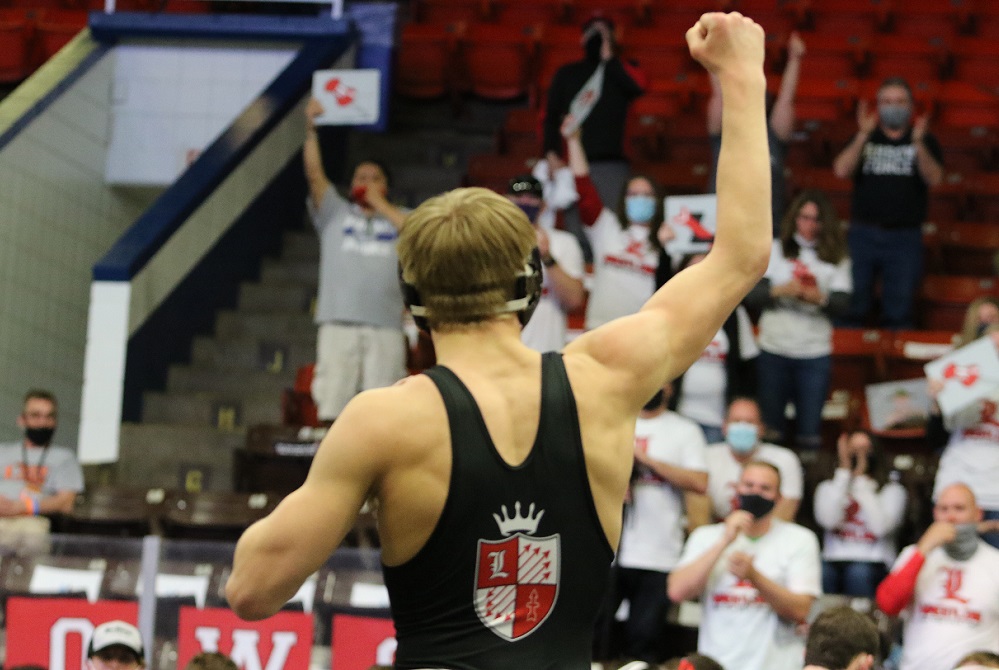
PHOTO Lowell celebrates a match win during last season’s Division 2 Final. (Click for more from HighSchoolSportsScene.com.)