

Casting Lines for Future Tournaments
August 12, 2016
By Jack Roberts
MHSAA Executive Director
The MHSAA is best known to the public for the tournaments it conducts to conclude the fall, winter and spring seasons each school year.
These tournaments, the first and largest program of the MHSAA, have survived the Vietnam War, the Korean conflict and two World Wars. They have survived the technology bubble, the housing collapse, the energy crisis and the Great Depression.
MHSAA tournaments existed at the dawn of aviation and at the time of our nation’s lunar landing. Popes, presidents and governors have changed and changed again and again, and MHSAA tournaments roll on year after year.
But the sense of tradition and permanence and inevitability of MHSAA tournaments doesn’t dissuade us from asking questions about our tournaments, even some of the most basic questions. Here are two.
Question #1
I have long been and will always be an advocate for a Ryder Cup format for the MHSAA Golf Finals, and a team tennis approach to the MHSAA Tennis Finals; but 90 years of tradition is hard to overcome. Might this be a more exciting format? Could it be co-ed? Could it reverse the decline in boys tennis participation, and increase girls golf participation? Wouldn’t it be fun to try?
Periodically, the International Olympic Committee requires each of the designated Olympic sports to defend its status, to state its case why the sport should remain a part of the Olympic program. Then, after a series or votes that retain one sport at a time, the IOC drops the sport that makes the weakest case. It does so to make room for one of the previously unlisted sports that makes the best case for inclusion.
This would appear to keep the existing Olympic sports on their toes, and to keep the Olympic movement fresh and reflective of modern trends in sports.
While I would not enjoy the controversy, I can see the potential for some positive results if the MHSAA were to invoke the same policy for determining the 14 tournaments it will provide for girls and the 14 for boys.
This might cause us to consider more deeply what a high school sport should look like, or at least what an MHSAA tournament sport should stand for.
On the one hand, we might be inclined to drop tournaments for those sports that involve mostly non-faculty coaches and non-school venues, or require cooperative programs to generate enough participants to support a team, or resort almost entirely to non-school funding, or cater to individuals more than teams.
Or perhaps this process would cause policymakers to forget traditional thinking and ask: “In this day and age, should we shake off traditional notions of sport and consider more where modern kids are coming from?” That might mean fewer team sports and more individual sports, more “extreme” sports like snowboarding and skateboarding, and more lifetime sports, meaning not just golf and tennis and running sports, but also fishing and even shooting sports.
Currently, MHSAA policy states that the MHSAA will consider sponsorship of a tournament series for any sport which 64 member schools conduct on an interscholastic basis as a result of action by the governing boards of those schools.
Should the only question be how many schools sponsor a sport, or must an activity also have certain qualities and/or avoid certain “defects?” What should an MHSAA tournament sport look like and stand for?
Question #2
Bristling from criticism that his association is a money-grabbing exploiter of children, my counterpart in another state said, “If we were running our programs just to make money, we would do very many things very differently.” I knew exactly what he meant.
Because we care about the health and welfare of students, because we mean what we say that the athletic program needs to maximize the ways it enhances the school experience while minimizing academic conflicts, and because we try to model our claim that no sport is a minor sport when it comes to its potential to teach young people life lessons, we operate our programs in ways that make promoters, marketers and business entrepreneurs laugh, cry or cringe.
If money were the only object, we would seed and select sites to assure the teams that attracted the most spectators had the best chance to advance in our tournaments, regardless of the travel for any team or its fan base. If money were the only object, we would never schedule two tournaments to overlap and compete for public attention, much less tolerate three or four overlapping events. If money were the only object, we would allow signage like NASCAR events and promotions like minor league baseball games.
Those approaches to event sponsorship may not be all wrong; they’re just not all right for us. And we will live with the consequences of our belief system.
During a typical school year, more than 20 percent of the MHSAA’s 2,097 District, Regional and Final tournaments lose money. Not a single site in golf, skiing or tennis makes a single penny. In no sport did every District, Regional and Final site have revenue in excess of direct expenses.
In fact, in only three sports – boys and girls basketball and football – is revenue so much greater than direct expenses overall that it helps to pay for all the other tournaments in which the MHSAA invests.
That’s right: invests. When we present our budget to our board, we talk about the MHSAA’s investment in providing tournament opportunities in all those sports and all those places that cannot sustain the cost of those events on their own. How much is this investment worth to students, schools and society?
These two are core questions that require our focus far in advance of talk about scheduling, site selection, seeding and the myriad matters that too often hijack our time and attention.

Longtime Coach's Legendary Expertise Keeps Manistee Surging
By
Tom Spencer
Special for MHSAA.com
November 19, 2021
Name any high school or community pool in Michigan, and odds are Corey Van Fleet has been there.
 Perhaps it is true of any pool in the United States.
He might have even helped build it.
And, a little more odds. If the pool hosted an MHSAA Finals meet, one of Van Fleet’s teams likely participated. Although he won’t have any qualifiers making the trip to the Division 3 girls meet Friday, he’s been to championship weekend lots of times with Birmingham Seaholm and Manistee. His 1962-65 Seaholm boys teams won four straight Class A Finals, and his Manistee boys team is coming off a Finals trip last winter and its best season ever.
Van Fleet, now 85 years young, is in his 68th of coaching swimmers. He’s spent the last 13 with the boys and girls teams of Manistee High School. He started the program after helping build the pool.
The school utilizes the Paine Aquatics Center named after Bill Paine, who presented a proposal to the City of Manistee, the Manistee Area Public Schools and Van Fleet. Paine’s proposal called for the pool, which opened in July 2009, to be attached to the high school facilities.
“So I’m sitting in my office one day and this tall, lanky guy (Paine) walks in and closes the door and says my wife and I want to donate an aquatics complex in Manistee, and Sandy Saylor says you know something about swimming,” Van Fleet recalls. “‘Will you help me build it?’
“We talked about it for a while and I said yeah, I’d help him,” Van Fleet continued. “So we ended up with a nice eight-lane swimming pool in Manistee.”
Van Fleet, who also had coached at Florida State, coached and served as athletic director at Oakland University and then served as AD at Long Beach State (Calif.) during an illustrious career at the college level, took the next step naturally.
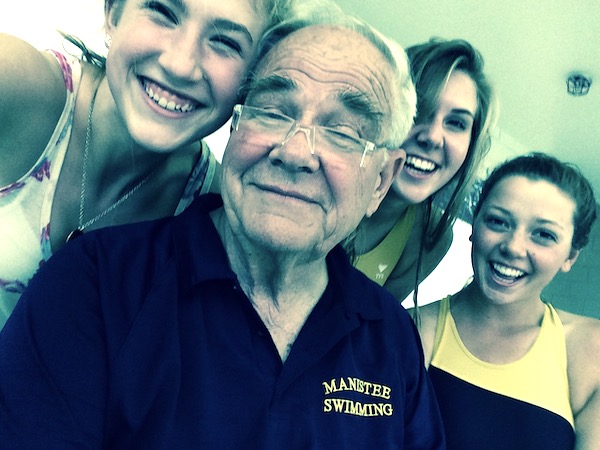 “The superintendent of schools at the time (Robert Olsen) said you build the darn thing, you might as well get some programs started,” Van Fleet recalled. “That was 13 years ago, and I’m still at it.”
At it, Van Fleet continues. He plans to stay with it until he just can’t do it anymore.
“I am still fairly healthy,” he said. “If I can find six people that can carry me out of church, I can think about quitting.”
During his tenure at Manistee, Van Fleet’s teams have dominated the Coastal Conference and produced multiple academic all-state swimmers. The boys team captured the 2020 academic all-state title with a 3.82 team grade point average.
“I am most proud, I think, about our academic progress,” Van Fleet said. “We take great pride in passing some classes.”
Van Fleet is also filled with pride when he reflects on all the swimmers he’s seen go on to become lawyers, doctors, teachers, engineers and coaches.
“I am pleased with the number of kids who have gone on to do some pretty big things in the world off our swimming programs,” he said. “I’d like to think they might have learned lessons about goal planning and sticking to it and hard work and all that stuff.
“That’s what lights me up.”
Van Fleet’s initial high school coaching job was at Madison Heights in 1959. He’s coached at camps all over Michigan, including his first at Burt Lake in 1954. Today he owns and operates a summer swimming camp in Irons, 30 miles southeast of Manistee. He also built it.
Jeff Brunner, a veteran MHSAA official in multiple sports including swimming, and father of former members of the Traverse City high school swimming co-op, is among many singing praises of Van Fleet’s impact on the sport.
“Corey has a wealth of information that he has accumulated in his coaching career,” Brunner said. “If I was a high school swimmer, I’d want to learn all I could from him – swimming for him would be such a unique opportunity.”
Andrew Huber, principal of Manistee’s middle and high schools, agrees with Brunner.
“We're humbled to have had Corey as part of our school and community,” he said. “His wealth of experience, knowledge, and relationship building has helped create a foundation of well-being for students and adults alike.
“His enthusiasm for swimming is infectious, and his energy is amazing for anyone regardless of age,” he continued. “It's been truly impressive to observe him connect and inspire students for the many years he's been in Manistee, and realize his impact is generational.”
The Manistee boys swim team starts practice next week. The Chippewas, along with their girls squad, have battled through COVID. The pandemic is one of many changes through which Van Fleet has guided his athletes.
“We’ve seen changes in training methods,” he said. “We’ve seen changes in diet.
“We’ve seen changes in philosophies in terms of what’s important and what’s not important,” he went on. “Kids have changed, and parents have changed.”
Training methods have been modified the most, along with new multi-lane pools popping up in Michigan, Van Fleet noted.
“Swimming is more technical now,” he said. “The science of swimming has become paramount.
“It is not just going in and kick a few legs and swim a few hundreds and go home — we’ve gone the gamut,” he continued. “It is very specific now every time you want a kid to do something, and now our swimming pools are showplaces – they are magnificent.”
 Tom Spencer is a longtime MHSAA-registered basketball and soccer official, and former softball and baseball official, and he also has coached in the northern Lower Peninsula area. He previously has written for the Saginaw News, Bay County Sports Page and Midland Daily News. He can be reached at [email protected] with story ideas for Manistee, Wexford, Missaukee, Roscommon, Ogemaw, Iosco, Alcona, Oscoda, Crawford, Kalkaska, Grand Traverse, Benzie, Leelanau, Antrim, Otsego, Montmorency, Alpena, Presque Isle, Cheboygan, Charlevoix and Emmet counties.
PHOTOS (Top) Corey Van Fleet (far right) visits with his Manistee girls team the wall honoring him at Oakland University. (Middle) Van Fleet is in his 68th year coaching swimming. (Photos courtesy of the Manistee girls swimming & diving program.)