

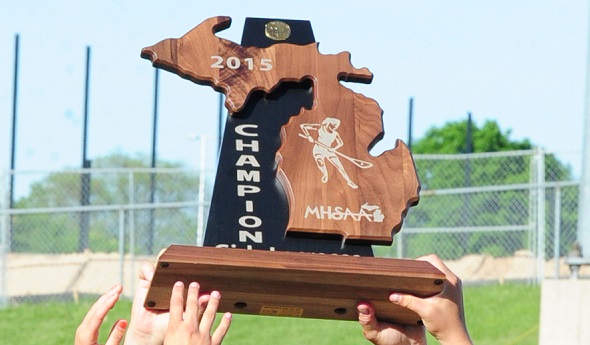
Casting Lines for Future Tournaments
August 12, 2016
By Jack Roberts
MHSAA Executive Director
The MHSAA is best known to the public for the tournaments it conducts to conclude the fall, winter and spring seasons each school year.
These tournaments, the first and largest program of the MHSAA, have survived the Vietnam War, the Korean conflict and two World Wars. They have survived the technology bubble, the housing collapse, the energy crisis and the Great Depression.
MHSAA tournaments existed at the dawn of aviation and at the time of our nation’s lunar landing. Popes, presidents and governors have changed and changed again and again, and MHSAA tournaments roll on year after year.
But the sense of tradition and permanence and inevitability of MHSAA tournaments doesn’t dissuade us from asking questions about our tournaments, even some of the most basic questions. Here are two.
Question #1
I have long been and will always be an advocate for a Ryder Cup format for the MHSAA Golf Finals, and a team tennis approach to the MHSAA Tennis Finals; but 90 years of tradition is hard to overcome. Might this be a more exciting format? Could it be co-ed? Could it reverse the decline in boys tennis participation, and increase girls golf participation? Wouldn’t it be fun to try?
Periodically, the International Olympic Committee requires each of the designated Olympic sports to defend its status, to state its case why the sport should remain a part of the Olympic program. Then, after a series or votes that retain one sport at a time, the IOC drops the sport that makes the weakest case. It does so to make room for one of the previously unlisted sports that makes the best case for inclusion.
This would appear to keep the existing Olympic sports on their toes, and to keep the Olympic movement fresh and reflective of modern trends in sports.
While I would not enjoy the controversy, I can see the potential for some positive results if the MHSAA were to invoke the same policy for determining the 14 tournaments it will provide for girls and the 14 for boys.
This might cause us to consider more deeply what a high school sport should look like, or at least what an MHSAA tournament sport should stand for.
On the one hand, we might be inclined to drop tournaments for those sports that involve mostly non-faculty coaches and non-school venues, or require cooperative programs to generate enough participants to support a team, or resort almost entirely to non-school funding, or cater to individuals more than teams.
Or perhaps this process would cause policymakers to forget traditional thinking and ask: “In this day and age, should we shake off traditional notions of sport and consider more where modern kids are coming from?” That might mean fewer team sports and more individual sports, more “extreme” sports like snowboarding and skateboarding, and more lifetime sports, meaning not just golf and tennis and running sports, but also fishing and even shooting sports.
Currently, MHSAA policy states that the MHSAA will consider sponsorship of a tournament series for any sport which 64 member schools conduct on an interscholastic basis as a result of action by the governing boards of those schools.
Should the only question be how many schools sponsor a sport, or must an activity also have certain qualities and/or avoid certain “defects?” What should an MHSAA tournament sport look like and stand for?
Question #2
Bristling from criticism that his association is a money-grabbing exploiter of children, my counterpart in another state said, “If we were running our programs just to make money, we would do very many things very differently.” I knew exactly what he meant.
Because we care about the health and welfare of students, because we mean what we say that the athletic program needs to maximize the ways it enhances the school experience while minimizing academic conflicts, and because we try to model our claim that no sport is a minor sport when it comes to its potential to teach young people life lessons, we operate our programs in ways that make promoters, marketers and business entrepreneurs laugh, cry or cringe.
If money were the only object, we would seed and select sites to assure the teams that attracted the most spectators had the best chance to advance in our tournaments, regardless of the travel for any team or its fan base. If money were the only object, we would never schedule two tournaments to overlap and compete for public attention, much less tolerate three or four overlapping events. If money were the only object, we would allow signage like NASCAR events and promotions like minor league baseball games.
Those approaches to event sponsorship may not be all wrong; they’re just not all right for us. And we will live with the consequences of our belief system.
During a typical school year, more than 20 percent of the MHSAA’s 2,097 District, Regional and Final tournaments lose money. Not a single site in golf, skiing or tennis makes a single penny. In no sport did every District, Regional and Final site have revenue in excess of direct expenses.
In fact, in only three sports – boys and girls basketball and football – is revenue so much greater than direct expenses overall that it helps to pay for all the other tournaments in which the MHSAA invests.
That’s right: invests. When we present our budget to our board, we talk about the MHSAA’s investment in providing tournament opportunities in all those sports and all those places that cannot sustain the cost of those events on their own. How much is this investment worth to students, schools and society?
These two are core questions that require our focus far in advance of talk about scheduling, site selection, seeding and the myriad matters that too often hijack our time and attention.
Preview: Return of Traditional Finals Format Joined by Return of Annual Contenders
By
Geoff Kimmerly
MHSAA.com senior editor
October 14, 2021
What’s old is new again at the Lower Peninsula Boys Tennis Finals, but with plenty of what we’re used to expected this weekend as well.
After a format switch to a head-to-head team championship tournament last year due to COVID-19 precautions, the traditional format has returned with team and individual qualifiers at four sites – Division 1 playing on Thursday and Friday and the other three divisions Friday and Saturday.
Many of the usual favorites are expected to push for championships again. Okemos is the top-ranked team in Division 2 after winning Division 1 a year ago, while Bloomfield Hills Cranbrook Kingswood is top-ranked and the reigning champion in Division 3. A number of other recent champs should be in the mixes again as well.
See below for a look at many of those contenders, and check out the MHSAA Website for brackets and more (Final rounds will be played at sites listed first below):
LP Division 1 at Kalamazoo College & Western Michigan University
Top-ranked: T-1. Bloomfield Hills, T-1. Troy, 3. Novi.
Bloomfield Hills and Troy have been tied for the top spot since the second set of rankings were posted in mid-September, and there are good stories accompanying both being in contention. Bloomfield Hills won outright or tied for the championship three of four seasons from 2015-18, while Troy’s only top-two finish came to the Black Hawks in 2017. Bloomfield Hills, Troy and Novi all won their Regionals, Novi against the toughest field finishing a point ahead of No. 8 Northville and eight points better than No. 9 Detroit Catholic Central. Bloomfield Hills and Troy did face off Sept. 9, with Troy winning 5-4 playing a fifth doubles flight, and Bloomfield Hills was first and Troy second at a quad Oct. 2.
Bloomfield Hills: The Black Hawks are seeded at seven flights with the top seeds at all four singles – Noah Roslin at No. 1, Daniel Stojanov at No. 2, Pierce Shaya at No. 3 and Aaron Rose at No. 4. Roslin advanced to the No. 1 semifinals last season and is the lone senior in the starting lineup – he has wins over the second and third seeds at his flight this season. Stojanov is one of only three juniors in the starting lineup, so Bloomfield HIlls could make a run at team championships over at least the next two seasons.
Troy: The Colts have found the same success as the Black Hawks but thanks to different strengths, with seven seniors and a junior anchoring the lineup and the top seeds at all four doubles flights – Andrew Wang and Nikhil Tatineni at No. 1, Srihari Ananthalwan and Aryan Gupta at No. 2, Pranav Bellad and Zach Saad at No. 3 and Dhruv Gupta and Rushil Kagithala at No. 4. Three singles flights also are seeded, including Haresh Anand second at No. 4 singles.
Novi: The Wildcats also have seven seeded flights, led by second seeds Cole Anderson at No. 2 singles and Rohit Saripelle and Nikhil Daniel at No. 4 doubles. Novi had four flight champions at its strong Regional and will be making a run at its first team Finals title since sharing with Bloomfield Hills in 2015.
Dimitri Moriarty, Bloomfield Hills Brother Rice: After a solid season at No. 2 singles last fall, Moriarty moved up to No. 1 and is 16-4 and seeded second as a junior.
Anthony Van Oyen, Ann Arbor Skyline: Van Oyen, also a junior, made the No. 1 singles bracket in 2020 as the eighth seed and returns to the Finals this weekend third at No. 1 singles.
LP Division 2 at Hope College and Holland Christian
Top-ranked: 1. Okemos, 2. Mattawan, 3. Detroit U-D Jesuit.
Okemos is back in Division 2 after winning last season’s Division 1 team championship, which combined with Division 2 titles in 2017 and 2018 was the program’s third in four years. Mattawan is seeking its first Finals championship in this sport and was the Division 2 team runner-up a year ago, while Jesuit twice has been runner-up – most recently in 2019 – and also is seeking its first Finals championship. These three in order have been ranked the top three since the Sept. 20 poll.
Okemos: Despite almost an entirely new lineup from last year’s team championship run, Okemos has five flights seeded and all four singles seeded first or second. Ethan Portnoy is seeded second at No. 1 singles after playing No. 2 doubles last season as a freshman, and junior George Fan is the top seed at No. 2 singles and played No. 4 a year ago. Hannah Letzer is the second seed at No. 3, and Suchir Nagisetty is the top seed at No. 4.
Mattawan: The Wildcats are chasing a historic finish with a strong singles lineup featuring three of the team’s four seeded flights. Luke Hodgman at No. 2 and Andrew Williams at No. 4 singles are both third seeded, as is the No. 2 doubles pair of Garrett Cheng and Brady Sullivan.
Detroit U-D Jesuit: Doubles drove the team’s runner-up finish in 2019, and that could be the scenario again this weekend. Five seeded flights total are expected to lead the Cubs into contention, with Sam Owens and Stephen Cibulas the top-seeded pair at No. 4 doubles and Alex Kuplicki and Luke Padilla the second seed at No. 2.
Sammy Yin, Grand Rapids Forest Hills Central: The junior singles standout is seeded first at No. 1 after reaching the semifinals last season, and he has wins over the next two seeded players at his flight.
Connor Stafford, Grosse Pointe South: Stafford, also a junior, carries the third seed at No. 1 into this weekend and has played the top flight all three seasons.
LP Division 3 at Midland Tennis Center and Midland High School
Top-ranked: 1. Bloomfield Hills Cranbrook Kingswood, 2. Detroit Country Day, 3. Ann Arbor Greenhills.
These three programs have taken turns winning the Division 3 title going back to 2008, with Greenhills entering the mix in 2019 after dominating Division 4 previously. Cranbrook Kingswood won last season’s Division 3 team title, with Greenhills the runner-up, and Greenhills was the 2019 champion with Cranbrook and Country Day tying for second place.
Bloomfield Hills Cranbrook Kingswood: The Cranes moved into the top spot in the rankings this week after winning a Regional that included No. 6 St. Clair. All eight flights are seeded, including one top seed and five second seeds. No. 3 doubles pair Ryan Michaels and Andrew Fink earned that top spot, while Owen DeMuth at No. 1 singles, Patrick Tiwari at No. 3 and Caden Che at No. 4 are all second-seeded as are No. 2 doubles Jacob Coburn and Sebs Taubman and No. 4 Aryan Tiwari and Praneel Pillarisetty. DeMuth was the No. 1 singles runner-up last season.
Detroit Country Day: The Yellowjackets have finished Finals runners-up five of the last six seasons since concluding a four-year championship run in 2014, and they were Regional runners-up to Greenhills by two points last week. All eight flights are seeded as well, with doubles particularly powerful. No. 2 pair Aiden Khaghany and Clay Hartje and No. 4 Ramzi Nassif and Aayush Dagar are top seeds, and No. 1 Alex Pollak and Petros Kalabat and No. 3 Nick Kalkanis and Charlie Holman are second seeds. Hartje and Khaghany won No. 3 doubles in 2019.
Ann Arbor Greenhills: The Gryphons went from No. 1 to No. 3 in the team rankings despite the Regional win mentioned above, but they’ll no doubt remain in this weekend’s mix with seven seeded flights – including the top seeds at all four singles. Senior Mert Oral is the two-time reigning champion at No. 1 singles, with Rishi Verma slotted No. 2, Chakor Rajendra at No. 3 and Kabir Rajendra at No. 4. Verma won at No. 3 and Chakhor Rajendra at No. 4 in 2019.
Simon Volkema, Grand Rapids Christian: The Eagles senior is the third seed at No. 1 singles after making the semifinals at the top flight last season.
Derek Distelrath, St. Clair: Also a senior, Distelrath is the fourth seed at No. 1 after also making the semifinals in 2020. He was the No. 1 singles runner-up in 2019.
Tanner Warners & Dream Kwon, Grand Rapids Christian: The Eagles have three doubles pairs made up of seniors, and Warners and Kwon are the top seed at No. 1. Warners was part of the No. 1 runner-up with a different partner in 2019.
LP Division 4 at University of Michigan & Ann Arbor Pioneer
Top-ranked: 1. Traverse City St. Francis, 2. Grosse Pointe Woods University Liggett, 3. Hudsonville Unity Christian.
These three have been the top three in the rankings all season, and in this order since the second poll was posted. University Liggett is the reigning team champion and has claimed three of the last five Division 4 titles with victories as well in 2016 and 2017. St. Francis is a frequent contender and seeking its first championship, having come in runner-up for the first time in 2018. Unity Christian was the team runner-up a year ago, also its highest Finals finish.
Traverse City St. Francis: A singles lineup full of underclassmen and a doubles lineup packed with seven seniors or juniors will attempt to take the Gladiators the final step for the first time. All eight flights are seeded and six are top seeds: Tristan Bonanni at No. 2 singles, Owen Jackson at No. 3 and Chris Bobrowski at No. 4; and Cody Richards and Ben Schmude at No. 1 doubles, Charlie King and Derek Berta at No. 3 and Tommy Puetz and Eli Schmude at No. 4. Richards was the No. 3 singles champion in 2019, and Schmude was part of the champion No. 1 doubles that fall with a different partner.
Grosse Pointe Woods University Liggett: The Knights graduated a four-time No. 1 singles champion, but still have plenty of contenders among eight seeded flights. Sebastian Courtright at No. 2 singles and Gerry Sherer at No. 4 carry second seeds into the weekend; Sherer was the No. 4 runner-up in 2019.
Hudsonville Unity Christian: Five of the team’s six seeded flights are fourth-seeded or higher. Ben Timmermans at No. 4 singles leads the way with a second seed, and Ryan Broek is the fourth seed at No. 1 singles after entering as the fifth seed a year ago.
Andrew Solarewicz, Grand Rapids West Catholic: A senior and individual qualifier, Solarewicz is the top-flight favorite carrying the top seed after finishing runner-up at No. 1 a year ago.
Alberto Gonzalez-Perez, Grand Rapids South Christian: Gonzalez-Perez, a junior, is the top player for No. 7 South Christian and earned the fourth seed at No. 1 singles after claiming a Regional title without losing a set.
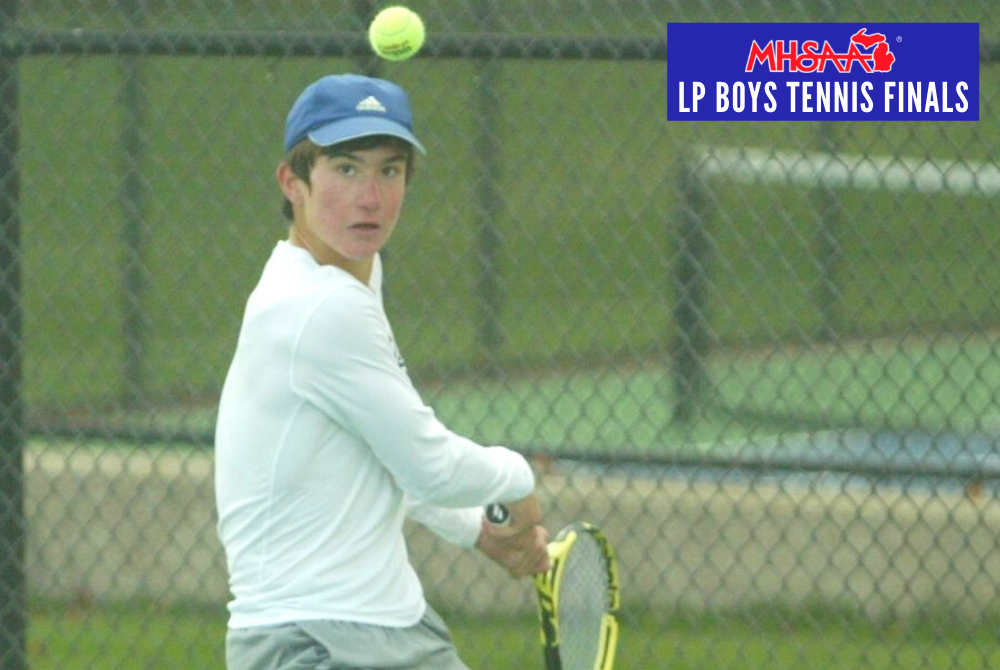
PHOTO Ann Arbor Greenhills’ Mert Oral steps into a backhand during last season’s Lower Peninsula Division 3 Team Final. Click for more from High School Sports Scene.