

Casting Lines for Future Tournaments
August 12, 2016
By Jack Roberts
MHSAA Executive Director
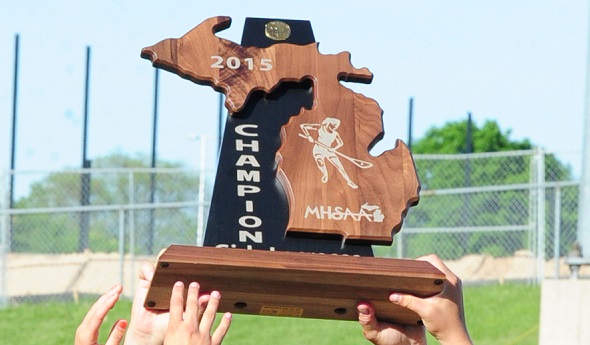
The MHSAA is best known to the public for the tournaments it conducts to conclude the fall, winter and spring seasons each school year.
These tournaments, the first and largest program of the MHSAA, have survived the Vietnam War, the Korean conflict and two World Wars. They have survived the technology bubble, the housing collapse, the energy crisis and the Great Depression.
MHSAA tournaments existed at the dawn of aviation and at the time of our nation’s lunar landing. Popes, presidents and governors have changed and changed again and again, and MHSAA tournaments roll on year after year.
But the sense of tradition and permanence and inevitability of MHSAA tournaments doesn’t dissuade us from asking questions about our tournaments, even some of the most basic questions. Here are two.
Question #1
I have long been and will always be an advocate for a Ryder Cup format for the MHSAA Golf Finals, and a team tennis approach to the MHSAA Tennis Finals; but 90 years of tradition is hard to overcome. Might this be a more exciting format? Could it be co-ed? Could it reverse the decline in boys tennis participation, and increase girls golf participation? Wouldn’t it be fun to try?
Periodically, the International Olympic Committee requires each of the designated Olympic sports to defend its status, to state its case why the sport should remain a part of the Olympic program. Then, after a series or votes that retain one sport at a time, the IOC drops the sport that makes the weakest case. It does so to make room for one of the previously unlisted sports that makes the best case for inclusion.
This would appear to keep the existing Olympic sports on their toes, and to keep the Olympic movement fresh and reflective of modern trends in sports.
While I would not enjoy the controversy, I can see the potential for some positive results if the MHSAA were to invoke the same policy for determining the 14 tournaments it will provide for girls and the 14 for boys.
This might cause us to consider more deeply what a high school sport should look like, or at least what an MHSAA tournament sport should stand for.
On the one hand, we might be inclined to drop tournaments for those sports that involve mostly non-faculty coaches and non-school venues, or require cooperative programs to generate enough participants to support a team, or resort almost entirely to non-school funding, or cater to individuals more than teams.
Or perhaps this process would cause policymakers to forget traditional thinking and ask: “In this day and age, should we shake off traditional notions of sport and consider more where modern kids are coming from?” That might mean fewer team sports and more individual sports, more “extreme” sports like snowboarding and skateboarding, and more lifetime sports, meaning not just golf and tennis and running sports, but also fishing and even shooting sports.
Currently, MHSAA policy states that the MHSAA will consider sponsorship of a tournament series for any sport which 64 member schools conduct on an interscholastic basis as a result of action by the governing boards of those schools.
Should the only question be how many schools sponsor a sport, or must an activity also have certain qualities and/or avoid certain “defects?” What should an MHSAA tournament sport look like and stand for?
Question #2
Bristling from criticism that his association is a money-grabbing exploiter of children, my counterpart in another state said, “If we were running our programs just to make money, we would do very many things very differently.” I knew exactly what he meant.
Because we care about the health and welfare of students, because we mean what we say that the athletic program needs to maximize the ways it enhances the school experience while minimizing academic conflicts, and because we try to model our claim that no sport is a minor sport when it comes to its potential to teach young people life lessons, we operate our programs in ways that make promoters, marketers and business entrepreneurs laugh, cry or cringe.
If money were the only object, we would seed and select sites to assure the teams that attracted the most spectators had the best chance to advance in our tournaments, regardless of the travel for any team or its fan base. If money were the only object, we would never schedule two tournaments to overlap and compete for public attention, much less tolerate three or four overlapping events. If money were the only object, we would allow signage like NASCAR events and promotions like minor league baseball games.
Those approaches to event sponsorship may not be all wrong; they’re just not all right for us. And we will live with the consequences of our belief system.
During a typical school year, more than 20 percent of the MHSAA’s 2,097 District, Regional and Final tournaments lose money. Not a single site in golf, skiing or tennis makes a single penny. In no sport did every District, Regional and Final site have revenue in excess of direct expenses.
In fact, in only three sports – boys and girls basketball and football – is revenue so much greater than direct expenses overall that it helps to pay for all the other tournaments in which the MHSAA invests.
That’s right: invests. When we present our budget to our board, we talk about the MHSAA’s investment in providing tournament opportunities in all those sports and all those places that cannot sustain the cost of those events on their own. How much is this investment worth to students, schools and society?
These two are core questions that require our focus far in advance of talk about scheduling, site selection, seeding and the myriad matters that too often hijack our time and attention.
Talented QB, Veteran Lineup Elevating Churchill Into League, D2 Challenger
By
Tom Markowski
Special for Second Half
September 22, 2021
The first item on the docket when one assesses the first half of the season for the Livonia Churchill football team is its 28-21 victory over Belleville on Sept. 10.
 But turn back the pages and you'll find the success coach Bill DeFillippo and his Chargers are experiencing began during the pre-pandemic season of 2019.
Churchill (4-0) is expected to be tested again Friday when it travels to Dearborn High (3-1) in a Kensington Lakes Activities Association East game. Dearborn's loss was to Belleville (49-0). Churchill is tied with Dearborn Fordson (4-0) for first place at 3-0 in the East. Belleville (3-1) and Dearborn are a game back.
Two years ago DeFillippo started eight sophomores on a team that lost to Belleville 35-14 and finished 7-5 after a 1-4 start. Churchill was 6-3 during last year's COVID-shortened season, and expectations were high heading into this fall – especially with the return of quarterback Taj Williams.
Considered one of the top offensive-minded coaches in the Detroit area, DeFillippo is in his ninth season as Churchill's head coach. The previous five seasons he was the program's offensive coordinator under coach John Filiatraut. DeFillippo cut his teeth as the offensive coordinator at Ann Arbor Huron (1990-99) under coach Paul Verska. The 1997 Huron team reached the MHSAA Class AA Final before losing to Detroit Catholic Central, 23-7.
DeFillippo continues to run the offense, and his specialty is working with quarterbacks. With Williams, he has another in a long line of talented ones.
Beginning with Seth Suda in 2011, DeFillippo coached five quarterbacks who went on to play in college (one, Drew Alsobrooks, is on the Central Michigan baseball roster). Williams is quite possibly headed toward becoming his sixth.
Williams started a few games as a sophomore at Churchill. Before his junior season, his family followed a job move to Stockbridge, Ga., (Stockbridge High School), where Williams started three games before suffering a broken collarbone.
He's recovered well from that injury and has shown improvement in his return to Churchill, particularly in the passing game. Simply, Williams makes the offense go.
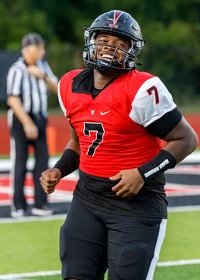 At 5-foot-11 and 205 pounds, Williams has always been a strong runner. This season he's become a true dual threat throwing for 10 touchdowns and just one interception. He's also rushed for three touchdowns, and his completion success is a tad under 70 percent.
In addition to his growth physically, Williams is playing with a chip on his shoulder. As a freshman he attended Belleville, where he was a starter on the junior varsity before transferring to Churchill. There were those who muttered that Williams feared the competition he faced at Belleville, and thus the transfer. The truth is, his family simply moved to Livonia.
“I have a lot to prove to a lot of people,” Williams said. “People doubted me. (People) said I left Belleville because I wouldn't play there.”
Williams owes his development to a handful of coaches, DeFillippo obviously included. Williams also credits his Stockbridge coach for assisting in his improvement as a pocket passer. Then there's Terrance Williams, Taj's uncle, who's the running backs coach at Churchill and has served as another mentor.
On a day-to-day basis, at practice or at home, Williams confides in DeFillippo. Take a Saturday afternoon for example. Both will be at their homes watching a college game, and they'll compare notes as to what type of offense a particular team is running. One will see a play work, and that'll start a conversation on what they can do to expand Churchill’s offense.
“(DeFillippo) has been very helpful,” Williams said. “He teaches me about the game. He breaks it down – how to learn my progressions.”
DeFillippo's shotgun spread scheme features Williams and his versatility, but there's much more to this offense that's averaging 42 points per game. Running back Boston Clegg is one of eight three-year starters, and his power running style allows Williams room to maneuver on the perimeter. Clegg started at linebacker his sophomore and junior seasons, but DeFillippo has limited his play on defense this season to keep him fresh on offense.
Josh Brown and Bailey Brooks have big-play potential at the receiver spot. The left side of the offensive line is anchored by tackle Matt Landis (6-4, 240) and guard Lawrence Nash-Martin (6-3, 285).
The defense allowed 54 points over the first two games, but has played well since. The line is loaded with experience as Demarius Gibson-Wells (DT), Kameron Balhorn (DE) and VJ Ragland (DE) are all three-year starters. Brown starts at cornerback and also returns kicks.
There are no big-time college recruits in the mix, but many of the seniors are being recruited by Division II and FCS schools.
“We have a lot of very good high school players,” said DeFillippo, a teacher in the Livonia school system since 1994. “We're a blue-collar community. We have a lot of kids who need football and love the sport.”
Churchill is ranked No. 2 in Division 2 according to the latest Associated Press poll, and DeFillippo is quick to point out that two KLAA East teams – Belleville and Fordson – are ranked in the top 10 in Division 1.
Belleville (3-1) remains the measuring stick for teams in the KLAA. The Tigers reached the MHSAA Division 1 Semifinals both of the past two seasons, losing to eventual champ West Bloomfield 35-34 in double overtime to cap last year’s extended run.
“It's (was) our fourth time playing them since they entered the KLAA four years ago,” DeFillippo said of this season’s Belleville win. “The first time we led at halftime, then lost. They jumped us in 2019 when we had all those sophomores and it was 21-14 in the fourth quarter last season.
“We have played them as well as anyone in our league. We gained a lot of confidence with that win. We executed, and our players played out of their minds.
“We know we have the target on our backs after that.”
After this week, Churchill has Livonia Franklin, Fordson and Livonia Stevenson left to play in the division before ending the regular season with a KLAA crossover. As the smallest school by enrollment in the KLAA and one of two teams (Franklin is the other) that does not compete in Division 1, Churchill is sure to benefit from the tough schedule as it prepares for the postseason.
 Tom Markowski primarily covered high school sports for the The Detroit News from 1984-2014, focusing on the Detroit area and contributing to statewide coverage of football and basketball. He also is a former correspondent and web content director for State Champs! Sports Network. Contact him at [email protected] with story ideas for Oakland, Macomb and Wayne counties.
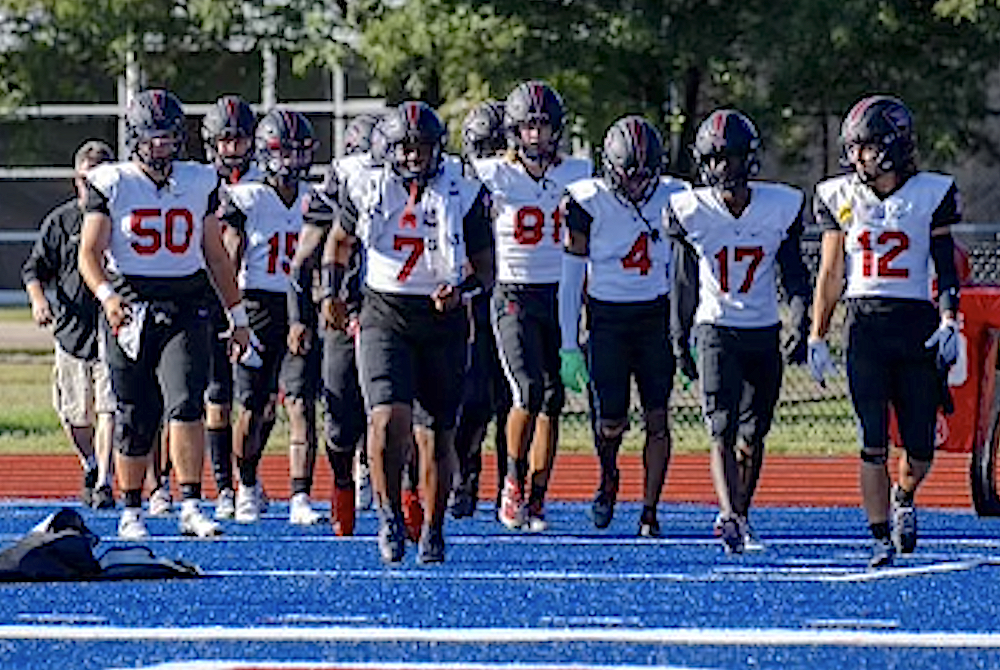
PHOTOS: (Top) Taj Williams (7) and his Churchill teammates take the field this season. (Middle) Williams’ return to the field this fall has been a big part of his team’s 4-0 start. (Photos courtesy of the Livonia Churchill football program.)