

Casting Lines for Future Tournaments
August 12, 2016
By Jack Roberts
MHSAA Executive Director
The MHSAA is best known to the public for the tournaments it conducts to conclude the fall, winter and spring seasons each school year.
These tournaments, the first and largest program of the MHSAA, have survived the Vietnam War, the Korean conflict and two World Wars. They have survived the technology bubble, the housing collapse, the energy crisis and the Great Depression.
MHSAA tournaments existed at the dawn of aviation and at the time of our nation’s lunar landing. Popes, presidents and governors have changed and changed again and again, and MHSAA tournaments roll on year after year.
But the sense of tradition and permanence and inevitability of MHSAA tournaments doesn’t dissuade us from asking questions about our tournaments, even some of the most basic questions. Here are two.
Question #1
I have long been and will always be an advocate for a Ryder Cup format for the MHSAA Golf Finals, and a team tennis approach to the MHSAA Tennis Finals; but 90 years of tradition is hard to overcome. Might this be a more exciting format? Could it be co-ed? Could it reverse the decline in boys tennis participation, and increase girls golf participation? Wouldn’t it be fun to try?
Periodically, the International Olympic Committee requires each of the designated Olympic sports to defend its status, to state its case why the sport should remain a part of the Olympic program. Then, after a series or votes that retain one sport at a time, the IOC drops the sport that makes the weakest case. It does so to make room for one of the previously unlisted sports that makes the best case for inclusion.
This would appear to keep the existing Olympic sports on their toes, and to keep the Olympic movement fresh and reflective of modern trends in sports.
While I would not enjoy the controversy, I can see the potential for some positive results if the MHSAA were to invoke the same policy for determining the 14 tournaments it will provide for girls and the 14 for boys.
This might cause us to consider more deeply what a high school sport should look like, or at least what an MHSAA tournament sport should stand for.
On the one hand, we might be inclined to drop tournaments for those sports that involve mostly non-faculty coaches and non-school venues, or require cooperative programs to generate enough participants to support a team, or resort almost entirely to non-school funding, or cater to individuals more than teams.
Or perhaps this process would cause policymakers to forget traditional thinking and ask: “In this day and age, should we shake off traditional notions of sport and consider more where modern kids are coming from?” That might mean fewer team sports and more individual sports, more “extreme” sports like snowboarding and skateboarding, and more lifetime sports, meaning not just golf and tennis and running sports, but also fishing and even shooting sports.
Currently, MHSAA policy states that the MHSAA will consider sponsorship of a tournament series for any sport which 64 member schools conduct on an interscholastic basis as a result of action by the governing boards of those schools.
Should the only question be how many schools sponsor a sport, or must an activity also have certain qualities and/or avoid certain “defects?” What should an MHSAA tournament sport look like and stand for?
Question #2
Bristling from criticism that his association is a money-grabbing exploiter of children, my counterpart in another state said, “If we were running our programs just to make money, we would do very many things very differently.” I knew exactly what he meant.
Because we care about the health and welfare of students, because we mean what we say that the athletic program needs to maximize the ways it enhances the school experience while minimizing academic conflicts, and because we try to model our claim that no sport is a minor sport when it comes to its potential to teach young people life lessons, we operate our programs in ways that make promoters, marketers and business entrepreneurs laugh, cry or cringe.
If money were the only object, we would seed and select sites to assure the teams that attracted the most spectators had the best chance to advance in our tournaments, regardless of the travel for any team or its fan base. If money were the only object, we would never schedule two tournaments to overlap and compete for public attention, much less tolerate three or four overlapping events. If money were the only object, we would allow signage like NASCAR events and promotions like minor league baseball games.
Those approaches to event sponsorship may not be all wrong; they’re just not all right for us. And we will live with the consequences of our belief system.
During a typical school year, more than 20 percent of the MHSAA’s 2,097 District, Regional and Final tournaments lose money. Not a single site in golf, skiing or tennis makes a single penny. In no sport did every District, Regional and Final site have revenue in excess of direct expenses.
In fact, in only three sports – boys and girls basketball and football – is revenue so much greater than direct expenses overall that it helps to pay for all the other tournaments in which the MHSAA invests.
That’s right: invests. When we present our budget to our board, we talk about the MHSAA’s investment in providing tournament opportunities in all those sports and all those places that cannot sustain the cost of those events on their own. How much is this investment worth to students, schools and society?
These two are core questions that require our focus far in advance of talk about scheduling, site selection, seeding and the myriad matters that too often hijack our time and attention.
St. Mary's Standout McLaurin Becomes Chinese Football Pioneer
By
Tom Markowski
Special for Second Half
August 19, 2021
The eight years Chris McLaurin spent in China not only changed his life, but they changed the perception of American football in China and elsewhere – and just may have opened the door to a whole new market.
 We're talking “American football,” not soccer. Most of us are familiar with NFL Europe, but NFL China? Not so much. When McLaurin went to China in 2011, the thought of teaching the locals American football never occurred to him. He went there to work for a private company, and circumstances just seemed to fall in place.
Some might say McLaurin was in the right place at the right time, but it can also be said he was the right person at the right time to lead this undertaking. McLaurin had the background, both athletically and organizationally, to take on such an endeavor.
“I met a lot of people who were interested in football,” McLaurin said. “I thought, football? I had a limited understanding of what they knew. I was very surprised they would reach out to me. I quickly found out they were hungry to learn.”
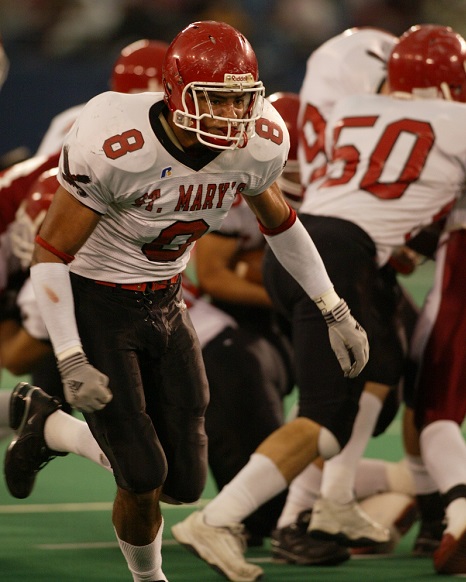
A 2005 graduate of Orchard Lake St. Mary's, McLaurin started at tight end and linebacker, and helped the Eaglets reach the MHSAA Division 2 Final in 2004 (where they lost to Muskegon). McLaurin went on to play four seasons at Michigan and graduated in 2009 with a degree in history and minor in urban and community studies. He had thoughts of entering law school when other opportunities interceded.
During his time in Ann Arbor, McLaurin worked with an organization that focused on disadvantaged youth in the area and helped open doors for them. They were allowed to attend lectures at the university as well as sporting events.
Upon graduation, the seeds that would blossom in Asia began being sown in other parts of the world.
McLaurin received a Fulbright Scholarship and went to Johannesburg, South Africa, to work with underprivileged youth as part of a program called Tomorrow Trust. During this time he worked with the United Nations Development Programme and Harvard Law School in their pursuit of promoting economic rights for the poor.
Following his work in South Africa, McLaurin began his post-graduate work at the London School of Economics. He earned his degree after working in the House of Commons and as a research assistant for the Runnymede Trust. Then came a six-month internship within the Obama Administration as part of the White House Domestic Policy Council.
And after that, he was off to Chongqing in western China to work for a private equity company as a project manager. Two years later, he started his own company in addition to a non-profit organization. Much of his work centered on the automobile industry and global technology.
During this time he learned to speak Mandarin and, in doing so, was introduced to more of the local customs – including American football.
 What McLaurin found was a rudimental brand of football, what we would term a recreational type of competition. McLaurin began his involvement gradually, on weekends.
“After that first year (2012), I took it up a notch,” McLaurin said. “We started recruiting players and bought new equipment. They watched football on TV, but it's not an easy game to understand. You have to play football to learn it. You don't get that from watching TV.”
A year of training, recruiting and, yes, some frustration, led McLaurin to start a league, the American Football League of China (now known as the China National Football League). The rules are similar to those at the U.S. college level. There are 11 players a side, and when a ball carrier's knee touches the ground the play is over.
In the beginning “it was successful,” he said. “There were no leagues when I got there. There was no one to organize it. We went from (fewer than) 10 teams to, 3-to-4 years later, there are 80-90.”
McLaurin quickly learned he needed help if this adventure was to succeed. USA Football had a footprint in Shanghai, and McLaurin reached out to the organization. McLaurin contacted a handful of former teammates including Prescott Burgess and Morgan Trent for advice. Former NFL player Bruce Plummer and NFL coach and scout Jerry Hardaway worked some of the camps and clinics with McLaurin and added much-needed experience and expertise.
After playing at Southern Illinois, Hardaway’s first coaching position was at Memphis State as an assistant, and then he went to Grambling State to coach under the legendary Eddie Robison for six seasons. He also coached at the University of California under Joe Kapp prior to working in the NFL and then heading to China.
“I was told, through another guy, that (McLaurin) needed some help,” Hardaway said. “It was all about getting back to basics. That's what made it fun. They had no clue when you'd say to them, control the ground at impact when you're making a block. They had no idea of the terms that you'd use. To see the young kids, to see on their faces, they were absorbing everything.
 “Yes, yes, yes, it was worthwhile. First of all, people had no clue about what it takes to do something like this. They were learning. Some of the parents thought it was a violent sport. That's what they heard. Then they switched. They saw me, us, teach the basics and they saw what we were doing. For me, it gave me a sense, like hey, you have to teach and you have to enjoy it.”
Soon after that first season, the NFL got involved as did the National Committee on United States - China Relations. McLaurin credits the NFL for advising him on the business end of starting a new league and structuring. After 18 months, McLaurin got out of coaching and became the commissioner.
“(The NFL) wanted to expand,” he said. “They saw how their brand was quite low (in China). China is a natural.”
Progress was slow, but it was still progress. The 2015 championship game was played in Shanghai, and McLaurin estimates it drew 3,500 spectators.
He continued to work with the AFLC through 2019 but then decided to make a career move. He returned to the U.S. and, this fall, is pursuing a dream he's held since leaving U-M. At age 34, McLaurin entered Harvard Law School.
“When I started, the last thing we wanted was a U.S. version of football,” he said. “We wanted it to be Chinese football. There were limitations on how many foreigners would compete. At first it was five (per team), then three. We wanted it to be a Chinese experience."
2020-21 Made in Michigan
August 5: Herremans' Focus on 'Dadding,' Giving Kids Similar Small-Town Childhood - Read
July 29: Loy Norrix Career Prepped Crocker for U-M Success, Law Degree Pursuit - Read
July 19: Top PGA Pro Finish Latest Greatest Highlight as Cook Continues Climb - Read
July 16: TC West Standout Renews Ties to Titans, Cheers Past Teammates' Gold Pursuit - Read
July 8: Caro Champs Find Common Ground Again as Mental Health Providers - Read
June 28: Michigan's Minor Leaguers Making Up for Lost Season - Read
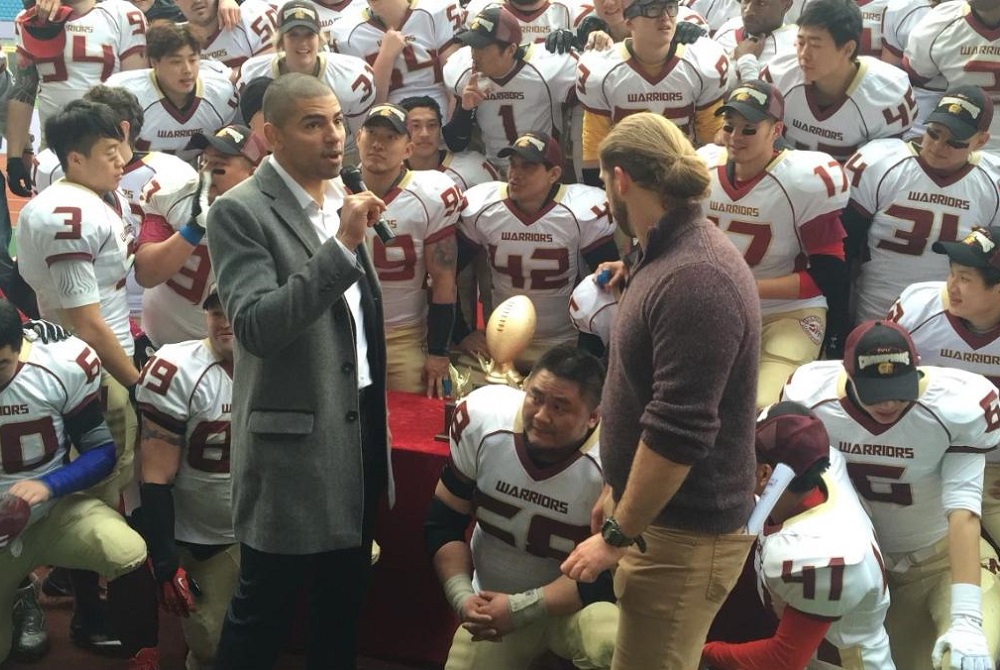
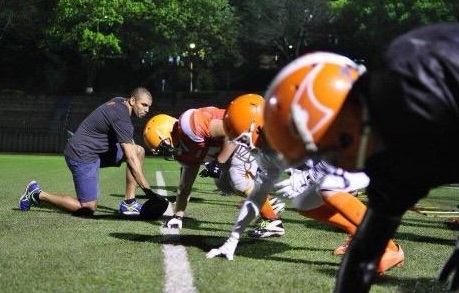
PHOTOS: (Top) Former Orchard Lake St. Mary's standout Chris McLaurin started an American football league in China and remained part of its leadership through 2019. (Middle) McLaurin was a two-way starter for St. Mary's 2004 Division 2 runner-up team. (Below) McLaurin runs drills for one of the Chinese teams. (Top and below photos courtesy of Chris McLaurin; middle photo from MHSAA archives.)