

Casting Lines for Future Tournaments
August 12, 2016
By Jack Roberts
MHSAA Executive Director
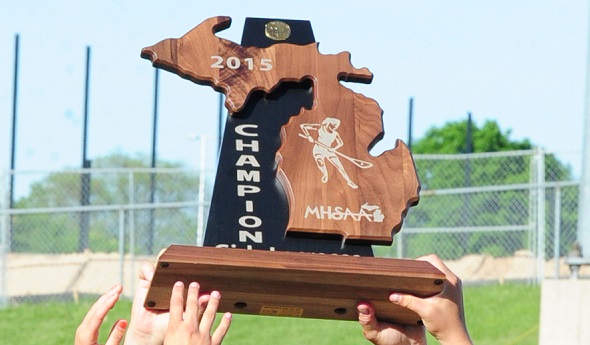
The MHSAA is best known to the public for the tournaments it conducts to conclude the fall, winter and spring seasons each school year.
These tournaments, the first and largest program of the MHSAA, have survived the Vietnam War, the Korean conflict and two World Wars. They have survived the technology bubble, the housing collapse, the energy crisis and the Great Depression.
MHSAA tournaments existed at the dawn of aviation and at the time of our nation’s lunar landing. Popes, presidents and governors have changed and changed again and again, and MHSAA tournaments roll on year after year.
But the sense of tradition and permanence and inevitability of MHSAA tournaments doesn’t dissuade us from asking questions about our tournaments, even some of the most basic questions. Here are two.
Question #1
I have long been and will always be an advocate for a Ryder Cup format for the MHSAA Golf Finals, and a team tennis approach to the MHSAA Tennis Finals; but 90 years of tradition is hard to overcome. Might this be a more exciting format? Could it be co-ed? Could it reverse the decline in boys tennis participation, and increase girls golf participation? Wouldn’t it be fun to try?
Periodically, the International Olympic Committee requires each of the designated Olympic sports to defend its status, to state its case why the sport should remain a part of the Olympic program. Then, after a series or votes that retain one sport at a time, the IOC drops the sport that makes the weakest case. It does so to make room for one of the previously unlisted sports that makes the best case for inclusion.
This would appear to keep the existing Olympic sports on their toes, and to keep the Olympic movement fresh and reflective of modern trends in sports.
While I would not enjoy the controversy, I can see the potential for some positive results if the MHSAA were to invoke the same policy for determining the 14 tournaments it will provide for girls and the 14 for boys.
This might cause us to consider more deeply what a high school sport should look like, or at least what an MHSAA tournament sport should stand for.
On the one hand, we might be inclined to drop tournaments for those sports that involve mostly non-faculty coaches and non-school venues, or require cooperative programs to generate enough participants to support a team, or resort almost entirely to non-school funding, or cater to individuals more than teams.
Or perhaps this process would cause policymakers to forget traditional thinking and ask: “In this day and age, should we shake off traditional notions of sport and consider more where modern kids are coming from?” That might mean fewer team sports and more individual sports, more “extreme” sports like snowboarding and skateboarding, and more lifetime sports, meaning not just golf and tennis and running sports, but also fishing and even shooting sports.
Currently, MHSAA policy states that the MHSAA will consider sponsorship of a tournament series for any sport which 64 member schools conduct on an interscholastic basis as a result of action by the governing boards of those schools.
Should the only question be how many schools sponsor a sport, or must an activity also have certain qualities and/or avoid certain “defects?” What should an MHSAA tournament sport look like and stand for?
Question #2
Bristling from criticism that his association is a money-grabbing exploiter of children, my counterpart in another state said, “If we were running our programs just to make money, we would do very many things very differently.” I knew exactly what he meant.
Because we care about the health and welfare of students, because we mean what we say that the athletic program needs to maximize the ways it enhances the school experience while minimizing academic conflicts, and because we try to model our claim that no sport is a minor sport when it comes to its potential to teach young people life lessons, we operate our programs in ways that make promoters, marketers and business entrepreneurs laugh, cry or cringe.
If money were the only object, we would seed and select sites to assure the teams that attracted the most spectators had the best chance to advance in our tournaments, regardless of the travel for any team or its fan base. If money were the only object, we would never schedule two tournaments to overlap and compete for public attention, much less tolerate three or four overlapping events. If money were the only object, we would allow signage like NASCAR events and promotions like minor league baseball games.
Those approaches to event sponsorship may not be all wrong; they’re just not all right for us. And we will live with the consequences of our belief system.
During a typical school year, more than 20 percent of the MHSAA’s 2,097 District, Regional and Final tournaments lose money. Not a single site in golf, skiing or tennis makes a single penny. In no sport did every District, Regional and Final site have revenue in excess of direct expenses.
In fact, in only three sports – boys and girls basketball and football – is revenue so much greater than direct expenses overall that it helps to pay for all the other tournaments in which the MHSAA invests.
That’s right: invests. When we present our budget to our board, we talk about the MHSAA’s investment in providing tournament opportunities in all those sports and all those places that cannot sustain the cost of those events on their own. How much is this investment worth to students, schools and society?
These two are core questions that require our focus far in advance of talk about scheduling, site selection, seeding and the myriad matters that too often hijack our time and attention.
As Football Launches Again, Reeths-Puffer Fueled for Fresh Start
By
Geoff Kimmerly
MHSAA.com senior editor
August 9, 2021
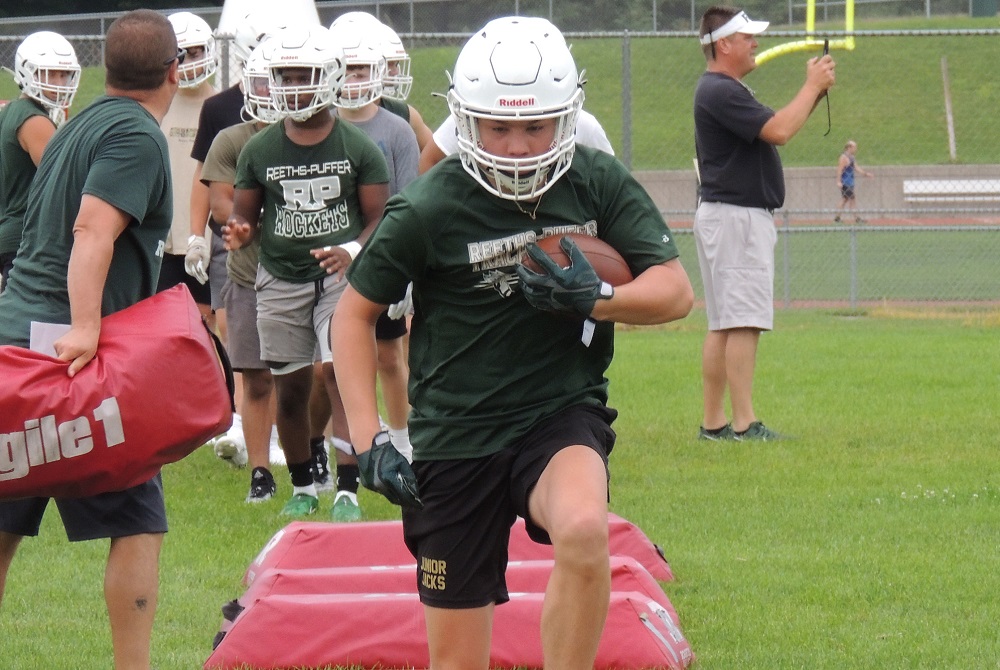
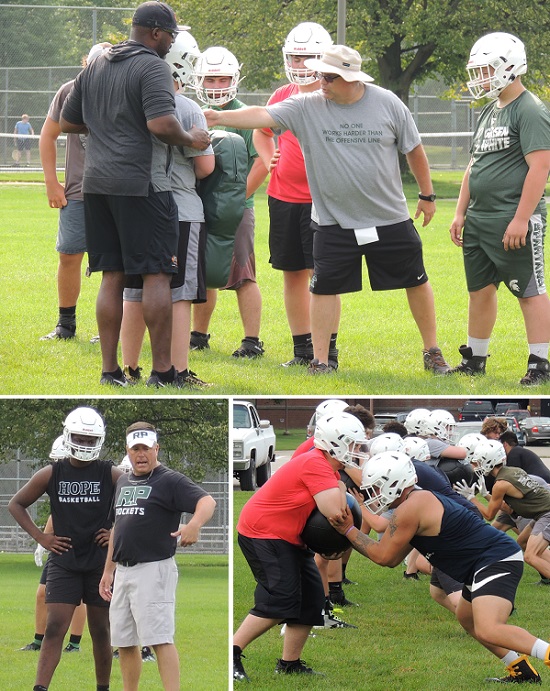
MUSKEGON – A Reeths-Puffer running back tripped and plowed into the Kit Kat-shaped bags he was supposed to be hurdling Monday, and his teammates laughed. The offensive line coach wore a shirt, like line coaches always do, that read “No One Works Harder Than The Offensive Line.” The sun came out about halfway through, but the breeze kept the weather just right, and after a hands-in, all-together “R-P!” someone shouted, “I’ve missed that!”
The setting was as typical as could be for the first day of football practice at any high school across Michigan over the last many years … except for 2020.
Remember a year ago? When COVID-19 precautions meant little to no contact for the most contact-filled sport? When locker rooms were closed and footballs were wiped down after every snap? And the possibility of the season ending at any moment hung in the air?
“I was telling the team (last year) we could play our first game and the rest of the season could get canceled, so you don’t know,” Rockets senior lineman Marco Fields recalled. “The seniors only got to play half their season, and some got hurt.
“Now that we know we have a full senior season ahead of us, for us seniors, all we can do now is stay focused.”
 Indeed, although there’s little debate that COVID-19 is still lingering, just about everything Monday at Reeths-Puffer felt differently from the first day of football practice a year ago. And although varsity head coach Matt Bird thought he might have an answer to what remained the same from 2020 … he really didn’t.
“The same is … (searching for his thought)
“… that you are … (pause)
“Kids … (trailed off)
“Actually, I don’t feel that anything is the same,” he admitted. “Other than we have a football, and we have some things involved from that standpoint.”
Monday marked a fresh start for high school football across Michigan, after last season included multiple COVID-related delays before finishing up in late January – which followed also an abbreviated regular season during which the conversation was forced at times into much more serious topics than the highlights on the field.
But every first day of practice means starting anew. And when it comes to fresh starts, Reeths-Puffer is a great place to begin Fall 2021.
Start with Bird, something of a master when it comes to building from a clean slate.
Way back in 2000, he was an offensive assistant when Grand Ledge won the Division 1 championship, the only Division 1 title that’s been won by a Lansing-area team. Six years later, he took over the Comets program and debuted with back-to-back 3-6 seasons (which predictably didn’t go over too well) before rattling off 10 winning seasons over the next 12 including a Semifinals trip in 2015. That eventually led to a rarely-seen career move after the 2018 season – leaving an established power for a new challenge, as Bird took the Reeths-Puffer job and took on a program that was coming off a second-straight 5-4 finish but accomplished with just under 30 players on the roster.
Bird led his first Rockets team to another 5-4 finish in 2019 … and then 2020 hit. Reeths-Puffer finished 2-5, but all things considered there were plenty of positives to take away.
When practice started, Bird was just finishing up recovery from COVID-19. And despite the unpredictability the season promised, the varsity still managed to grow to 53 players.
“As a coach you have to acknowledge it,” Bird said Monday, recalling 2020. “But the thing that is frustrating to me is you want to acknowledge it, but when you look at it everything was done so differently; it didn’t even feel like a season. At times you’d get started, then kicked back, then started and kicked back. We couldn’t do team dinners, we couldn’t do a lot of the bonding things we do as a group, and that hurt us.”
Monday was the beginning of another fresh start for the Rockets. Set aside that the great majority of COVID restrictions are off – the program is still emphasizing a number of hygiene and health-related concepts to help players avoid illness – and the football-related details provide plenty of excitement.
 On one hand, Reeths-Puffer still plays in the Ottawa-Kent Conference Green – which includes the winningest program in MHSAA history in Muskegon High, back-to-back Division 2 champion Mona Shores and powerful neighbors Zeeland West and East. Grand Rapids Union, Holland and Wyoming all provide some intriguing possibilities as well heading into the new season.
But Bird’s varsity roster looks to push past 50 again, with 20 seniors including four returning senior starters on both sides of the ball. Fields is a Division I-caliber college line prospect, and the sophomore class is shaping up to be special with 6-foot-7 Travis Ambrose of particular note.
“I know every coach says their sport is the best team sport, but there’s something about football where you’ve got 11 guys out there and everybody can contribute,” Bird said. “The 6-5 kid to the 5-7 kid, and you can find a way to make that come together. I’ve always been a big fan, where it’s ‘Tell me that we can’t do something, and let me prove that (we can).’ … We compete using our strengths rather than focusing on some of the things that we don’t have.”
And there are lessons learned last season which, despite its wildness, should pay off. For example, last year teams were forced to focus more on technique with contact cut down substantially, and then rely on technology to cut down on face-to-face conversation. On Monday, Bird was recording his quarterbacks’ footwork with a tablet so he could share the video later over Google Meet, the new norm in communication but something Bird considers a valuable teaching tool brought on by the last 18 months.
The players, for their part, could allow themselves to feel a little lighter than a year ago. Fields and his teammates got to have more fun this time. And they were able talk about the expectations and aspirations that always make the first day a special one.
“I’ve heard people are expecting a normal Reeths-Puffer, and some say ‘Rocket failure again,’ which is just us going 2-5 or whatever they’re trying to say,” Fields said. “But I think we’re going to take this thing all the way.”
“This is normalcy, to an extent,” was Bird’s take on the day. “And it’s just really nice.”
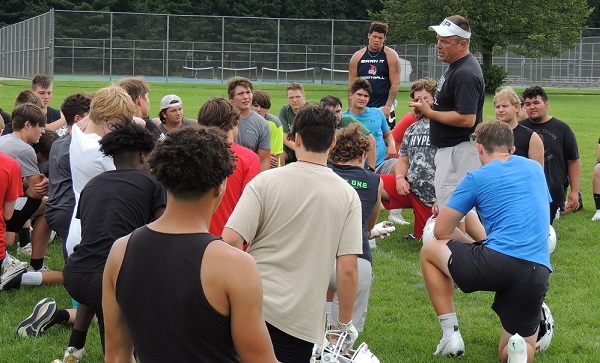
PHOTOS: (Top) Reeths-Puffer running backs hurdle a series of bags during a busy first practice Monday. (Middle) Clockwise from top: Assistant coaches Jari Brown (left) and Jeff Uganski work with the linemen; senior Marco Fields (front, blue sleeveless shirt) is among those working on his form; varsity coach Matt Bird works with one of his quarterbacks and their receivers. (Below) Bird gathers with his team at the end of their first practice of the season. (Photos by Geoff Kimmerly.)