

Casting Lines for Future Tournaments
August 12, 2016
By Jack Roberts
MHSAA Executive Director
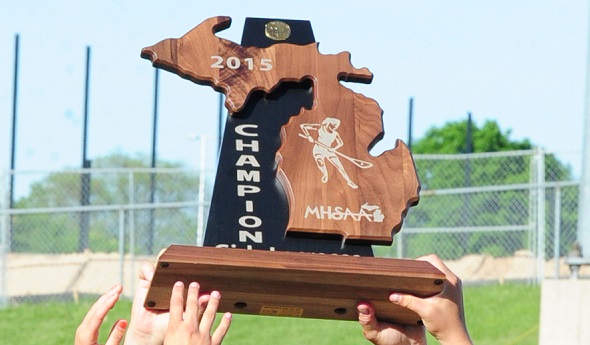
The MHSAA is best known to the public for the tournaments it conducts to conclude the fall, winter and spring seasons each school year.
These tournaments, the first and largest program of the MHSAA, have survived the Vietnam War, the Korean conflict and two World Wars. They have survived the technology bubble, the housing collapse, the energy crisis and the Great Depression.
MHSAA tournaments existed at the dawn of aviation and at the time of our nation’s lunar landing. Popes, presidents and governors have changed and changed again and again, and MHSAA tournaments roll on year after year.
But the sense of tradition and permanence and inevitability of MHSAA tournaments doesn’t dissuade us from asking questions about our tournaments, even some of the most basic questions. Here are two.
Question #1
I have long been and will always be an advocate for a Ryder Cup format for the MHSAA Golf Finals, and a team tennis approach to the MHSAA Tennis Finals; but 90 years of tradition is hard to overcome. Might this be a more exciting format? Could it be co-ed? Could it reverse the decline in boys tennis participation, and increase girls golf participation? Wouldn’t it be fun to try?
Periodically, the International Olympic Committee requires each of the designated Olympic sports to defend its status, to state its case why the sport should remain a part of the Olympic program. Then, after a series or votes that retain one sport at a time, the IOC drops the sport that makes the weakest case. It does so to make room for one of the previously unlisted sports that makes the best case for inclusion.
This would appear to keep the existing Olympic sports on their toes, and to keep the Olympic movement fresh and reflective of modern trends in sports.
While I would not enjoy the controversy, I can see the potential for some positive results if the MHSAA were to invoke the same policy for determining the 14 tournaments it will provide for girls and the 14 for boys.
This might cause us to consider more deeply what a high school sport should look like, or at least what an MHSAA tournament sport should stand for.
On the one hand, we might be inclined to drop tournaments for those sports that involve mostly non-faculty coaches and non-school venues, or require cooperative programs to generate enough participants to support a team, or resort almost entirely to non-school funding, or cater to individuals more than teams.
Or perhaps this process would cause policymakers to forget traditional thinking and ask: “In this day and age, should we shake off traditional notions of sport and consider more where modern kids are coming from?” That might mean fewer team sports and more individual sports, more “extreme” sports like snowboarding and skateboarding, and more lifetime sports, meaning not just golf and tennis and running sports, but also fishing and even shooting sports.
Currently, MHSAA policy states that the MHSAA will consider sponsorship of a tournament series for any sport which 64 member schools conduct on an interscholastic basis as a result of action by the governing boards of those schools.
Should the only question be how many schools sponsor a sport, or must an activity also have certain qualities and/or avoid certain “defects?” What should an MHSAA tournament sport look like and stand for?
Question #2
Bristling from criticism that his association is a money-grabbing exploiter of children, my counterpart in another state said, “If we were running our programs just to make money, we would do very many things very differently.” I knew exactly what he meant.
Because we care about the health and welfare of students, because we mean what we say that the athletic program needs to maximize the ways it enhances the school experience while minimizing academic conflicts, and because we try to model our claim that no sport is a minor sport when it comes to its potential to teach young people life lessons, we operate our programs in ways that make promoters, marketers and business entrepreneurs laugh, cry or cringe.
If money were the only object, we would seed and select sites to assure the teams that attracted the most spectators had the best chance to advance in our tournaments, regardless of the travel for any team or its fan base. If money were the only object, we would never schedule two tournaments to overlap and compete for public attention, much less tolerate three or four overlapping events. If money were the only object, we would allow signage like NASCAR events and promotions like minor league baseball games.
Those approaches to event sponsorship may not be all wrong; they’re just not all right for us. And we will live with the consequences of our belief system.
During a typical school year, more than 20 percent of the MHSAA’s 2,097 District, Regional and Final tournaments lose money. Not a single site in golf, skiing or tennis makes a single penny. In no sport did every District, Regional and Final site have revenue in excess of direct expenses.
In fact, in only three sports – boys and girls basketball and football – is revenue so much greater than direct expenses overall that it helps to pay for all the other tournaments in which the MHSAA invests.
That’s right: invests. When we present our budget to our board, we talk about the MHSAA’s investment in providing tournament opportunities in all those sports and all those places that cannot sustain the cost of those events on their own. How much is this investment worth to students, schools and society?
These two are core questions that require our focus far in advance of talk about scheduling, site selection, seeding and the myriad matters that too often hijack our time and attention.
Unexpected Becomes Elite As Hartland Makes History
By
Tom Kendra
Special for MHSAA.com
June 19, 2021
EAST LANSING – Hartland wasn’t supposed to be in the Division 1 championship game.
And Julia Pietila wasn’t supposed to play.
So, naturally, it was Pietila – hobbling on a severely sprained left ankle which almost kept her out of the game altogether – who scored two goals as Hartland blanked Troy Athens, 4-0, in Saturday’s MHSAA Division 1 Girls Soccer Final.
“It was hurting, but it’s the state championship game,” explained Pietila, who scored the Eagles’ first and last goals in the weekend’s final game in calm, dry conditions at Michigan State University’s DeMartin Soccer Complex.
“It was now or never, so I just went with it. Once I got into the swing of things, I forgot about it.”
Hartland (20-4-1) had entered the postseason off a third-place league finish and ranked 23rd in Division 1 based on the Michigan Power Rating used to seed the top two teams at the District level.
But the Eagles seemingly forgot about all of that and the fact that it had never played in a girls soccer Finals game before, shutting out six of its seven postseason opponents.
The Eagles capped it Saturday by making Athens – No. 2 in final regular-season MPR – pay for its aggressiveness with an impressive counterattack, then cashing in on their opportunities.
It was an emotional win for veteran Hartland coach Andrew Kartsounes – who has been teaching at Hartland for 30 years and coaching soccer for 27, including the past 16 as the girls head coach – in his first appearance in a championship game.
“I was wondering if I was ever going to get here, and then to play the kind of game we did today was just amazing,” said Kartsounes, who is assisted by Wade Foster and Eric Anderson. “We just kept plugging away and created chances and, today, we finished a lot of our chances.”
Hartland grabbed a 1-0 halftime lead after junior Hannah Kastamo broke through the Athens defense and put a shot on goal, which Pietila booted in off the rebound at the 16:56 mark.
The key portion of the game was the first 10 minutes of the second half. During that period, the Red Hawks controlled play and had two excellent scoring chances – a header off a free kick that missed wide right and a nifty boot by junior Abby Mayne which just missed wide left.
 But just as Athens was feeling good about things and the crowd of red was coming alive in the stands, Hartland responded with its aforementioned counterattack.
Senior Maria Storm was able to break away and send a perfectly angled kick into the top-right corner of the net with 31:32 remaining to make it 2-0 – a goal which seemed to demoralize Athens. Just two minutes later, Hartland made it 3-0 on another goal by Kastamo.
“We haven’t seen that kind of counterattack in a while,” said 10th-year Athens coach Todd Heugh. “We generated corner kicks, and they generated goals. Soccer is a game of chances. They made good on theirs, and we did not on ours.”
Athens (17-2-4) has won four girls soccer championships, but its last title came 21 years ago in 2000. The Red Hawks, who had posted eight consecutive shutouts coming into Saturday’s Final, now have three runner-up finishes.
Kartsounes agreed the key to the victory was weathering the storm early in the second half.
“They started the second half and were really taking it to us,” said Kartsounes, who received tremendous on-field leadership from captains Kamryn Gereck, Justina L’Esperance and Storm. “I told my assistants that we can’t survive like this for 40 minutes, then we finally started possessing the ball.”
Pietila completed the scoring with her second goal of the day at the 18:21 mark. Alyse Daavettila and L’Esperance added assists for the Eagles.
Athens actually held the edge in total shots (16-14) and corner kicks (6-3), but Hartland held a 9-7 advantage in shots on goal. Athens senior keeper Nitya Balusu made five saves.
Hartland junior keeper Morgan Seog was outstanding in goal, finishing with six saves. The Eagles produced shutouts in the first five playoff games and final game.
The only postseason game in which Hartland allowed a goal was Wednesday’s Semifinal, a narrow 3-2 win over Grand Rapids Forest Hills Central. It was also seven minutes into that game when Pietila sprained her ankle on a sprinkler.
“On Wednesday night, there was no way she was going to play, Thursday was a little better and it wasn’t until after warmups today that we knew she was going to play for sure,” said Kartsounes. “Then she goes out there and scores the game-winning goal of the state finals on one leg.”
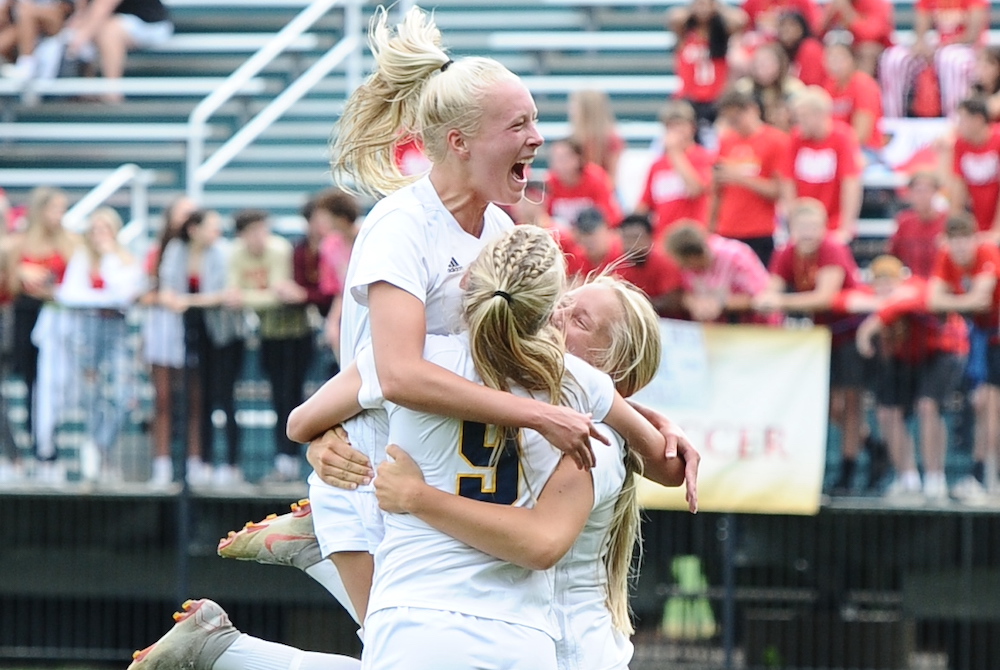
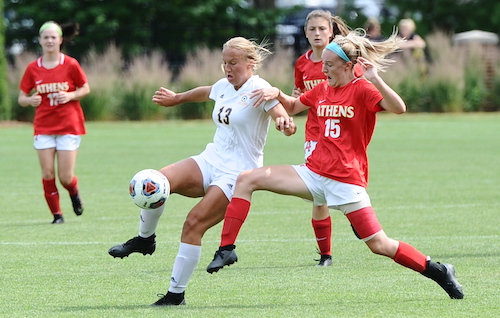
PHOTOS: (Top) Hartland players celebrate during their Division 1 Final win Saturday. (Middle) The Eagles’ Maria Storm (13) and Athens’ Meagan Lindgren (15) battle for possession.