

Casting Lines for Future Tournaments
August 12, 2016
By Jack Roberts
MHSAA Executive Director
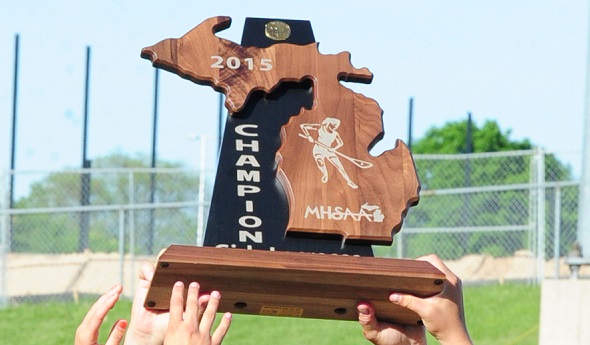
The MHSAA is best known to the public for the tournaments it conducts to conclude the fall, winter and spring seasons each school year.
These tournaments, the first and largest program of the MHSAA, have survived the Vietnam War, the Korean conflict and two World Wars. They have survived the technology bubble, the housing collapse, the energy crisis and the Great Depression.
MHSAA tournaments existed at the dawn of aviation and at the time of our nation’s lunar landing. Popes, presidents and governors have changed and changed again and again, and MHSAA tournaments roll on year after year.
But the sense of tradition and permanence and inevitability of MHSAA tournaments doesn’t dissuade us from asking questions about our tournaments, even some of the most basic questions. Here are two.
Question #1
I have long been and will always be an advocate for a Ryder Cup format for the MHSAA Golf Finals, and a team tennis approach to the MHSAA Tennis Finals; but 90 years of tradition is hard to overcome. Might this be a more exciting format? Could it be co-ed? Could it reverse the decline in boys tennis participation, and increase girls golf participation? Wouldn’t it be fun to try?
Periodically, the International Olympic Committee requires each of the designated Olympic sports to defend its status, to state its case why the sport should remain a part of the Olympic program. Then, after a series or votes that retain one sport at a time, the IOC drops the sport that makes the weakest case. It does so to make room for one of the previously unlisted sports that makes the best case for inclusion.
This would appear to keep the existing Olympic sports on their toes, and to keep the Olympic movement fresh and reflective of modern trends in sports.
While I would not enjoy the controversy, I can see the potential for some positive results if the MHSAA were to invoke the same policy for determining the 14 tournaments it will provide for girls and the 14 for boys.
This might cause us to consider more deeply what a high school sport should look like, or at least what an MHSAA tournament sport should stand for.
On the one hand, we might be inclined to drop tournaments for those sports that involve mostly non-faculty coaches and non-school venues, or require cooperative programs to generate enough participants to support a team, or resort almost entirely to non-school funding, or cater to individuals more than teams.
Or perhaps this process would cause policymakers to forget traditional thinking and ask: “In this day and age, should we shake off traditional notions of sport and consider more where modern kids are coming from?” That might mean fewer team sports and more individual sports, more “extreme” sports like snowboarding and skateboarding, and more lifetime sports, meaning not just golf and tennis and running sports, but also fishing and even shooting sports.
Currently, MHSAA policy states that the MHSAA will consider sponsorship of a tournament series for any sport which 64 member schools conduct on an interscholastic basis as a result of action by the governing boards of those schools.
Should the only question be how many schools sponsor a sport, or must an activity also have certain qualities and/or avoid certain “defects?” What should an MHSAA tournament sport look like and stand for?
Question #2
Bristling from criticism that his association is a money-grabbing exploiter of children, my counterpart in another state said, “If we were running our programs just to make money, we would do very many things very differently.” I knew exactly what he meant.
Because we care about the health and welfare of students, because we mean what we say that the athletic program needs to maximize the ways it enhances the school experience while minimizing academic conflicts, and because we try to model our claim that no sport is a minor sport when it comes to its potential to teach young people life lessons, we operate our programs in ways that make promoters, marketers and business entrepreneurs laugh, cry or cringe.
If money were the only object, we would seed and select sites to assure the teams that attracted the most spectators had the best chance to advance in our tournaments, regardless of the travel for any team or its fan base. If money were the only object, we would never schedule two tournaments to overlap and compete for public attention, much less tolerate three or four overlapping events. If money were the only object, we would allow signage like NASCAR events and promotions like minor league baseball games.
Those approaches to event sponsorship may not be all wrong; they’re just not all right for us. And we will live with the consequences of our belief system.
During a typical school year, more than 20 percent of the MHSAA’s 2,097 District, Regional and Final tournaments lose money. Not a single site in golf, skiing or tennis makes a single penny. In no sport did every District, Regional and Final site have revenue in excess of direct expenses.
In fact, in only three sports – boys and girls basketball and football – is revenue so much greater than direct expenses overall that it helps to pay for all the other tournaments in which the MHSAA invests.
That’s right: invests. When we present our budget to our board, we talk about the MHSAA’s investment in providing tournament opportunities in all those sports and all those places that cannot sustain the cost of those events on their own. How much is this investment worth to students, schools and society?
These two are core questions that require our focus far in advance of talk about scheduling, site selection, seeding and the myriad matters that too often hijack our time and attention.
'Retired' Periard Still Finding Ways to Serve Suttons Bay
By
Tom Spencer
Special for MHSAA.com
May 28, 2021
When Doug Periard retired in August, some thought he had done it all as a teacher, coach, mentor and athletic director for Suttons Bay Schools.
 Retirement has proven many wrong.
He did intend to stay on as the baseball coach at least thru the 2022 season. He also thought he’d help out some with the bus driver shortage using the CDL (Commercial Drivers License) he’d recently obtained. Substitute teaching sounded good to him too.
So he came back in October. He immediately took on an emergency assignment, coaching the school’s 8-player football team to a win over Manistee Catholic Central. He also drove the bus to the game.
“Doug is that kind of guy ... when there is a need to filled, Doug will fill it for you,” said Andy Melius, principal at Suttons Bay. “The community means a lot to him, and the school means a lot to him. He bleeds red and white.”
Also since returning, he’s served as a K-1 gym teacher, filled in at the school’s front desk and headed up the district’s COVID-19 testing as the Quarantine Officer.
On Tuesday, Periard will coach baseball after driving the bus transporting the Norsemen to Buckley to begin postseason play. It’s no different than what he’s been doing all spring.
However, some questioned if Periard could handle bus driving and coaching on the same day.
 “It’s been interesting,” Periard said with a little laugh. “I was a champion at taking a nap (on the bus as coach).
“I would be asleep before we got to the split in the road and wake up when we got there,” he continued. “So, there was some real skeptics out there wondering if I’d be able to both drive and coach when I got there.”
Periard has hopes of hitting the 400-win mark before giving up baseball. He’s compiled a 379-280-18 record since taking over the Norseman baseball program on a “temporary” basis in 1998. It was supposed to be only until another coach was found. He had coached the JV squad the year prior.
And, there’s something else about Periard very few people know. Someone who does is Christine Mikesell, Suttons Bay’s assistant athletic director. Mikesell’s five boys at one time or another played sports coached by Periard.
“Every kid is important to Doug,” noted Mikesell, who is stepping down in June. “He really has a big heart for those that are struggling, and he makes a pathway for a kid to achieve if they take it.
“He is one of those kind of guys you want on your side because he is a team player ... a real team player when it comes to the school and athletics and coaching.”
Mikesell has seen him help lots of high schoolers who end up graduating perhaps without knowing how much help Periard provided. He often made sure kids had a white dress shirt so no one was left out on the school’s game day dress-up tradition. He’s also paid for lunches and arranged transportation for students coming from hard-life circumstances.
“I have seen him go well out of his way,” said Mikesell. “I know a lot of it is his own pocket.
“He has eyes, and he watches,” she continued. “He finds the one that is struggling, and he goes and brings them as part of the team.”
Periard became AD in 2008, a year he will never forget. It was marked by the stock market crash and he, along with his wife Anne, was dealing with his daughter Grace’s new diabetes diagnosis. The economic circumstances also threatened his continued employment as a teacher.
The job loss did not materialize. Grace is now in college. And, she was the 2020 recipient of the Suttons Bay High School Berserker Award presented to Norse athletes who have competed in three sports every year of high school.
The award was created several years back by Periard. Now he hopes his son Hugh, a junior pitcher and three-sport athlete, will follow his sister’s footsteps and be similarly recognized next spring.
“I stole the (Berserker) idea from my little brother who was the AD at Birch Run,” he admitted. “I am proud to have gotten the thing rolling.
“I think playing three sports is vital to a small school and development of young people.”
Periard’s legacy also will include strong co-op developments, including the establishment of NorthBay, and keeping a great football tradition alive while the school struggled with declining enrollment. The co-ops are established for all sports with Northport and include Leelanau St. Mary’s in boys and girls track & field and soccer.
 Periard guided the Norsemen’s move to 8-player football in 2017. The previous season, Suttons Bay had to forfeit the majority of its games because it did not have enough players to compete in 11-player.
Mikesell’s son Baylor was one of seniors who missed out as part of that 2016 team. Another son, Lucas, was a star player in the school’s run to back-to-back 8-player Division 2 runner-up finishes the last two seasons.
“My son lost his senior year because we were still 11-man, and we couldn’t field a team,” she said. “Doug is a problem solver and comes up with solutions outside the box.
“He did tons of research on it to get us in a place (where) we could participate in football because he saw that the risk of losing football here at the school, what a damaging thing it would be.”
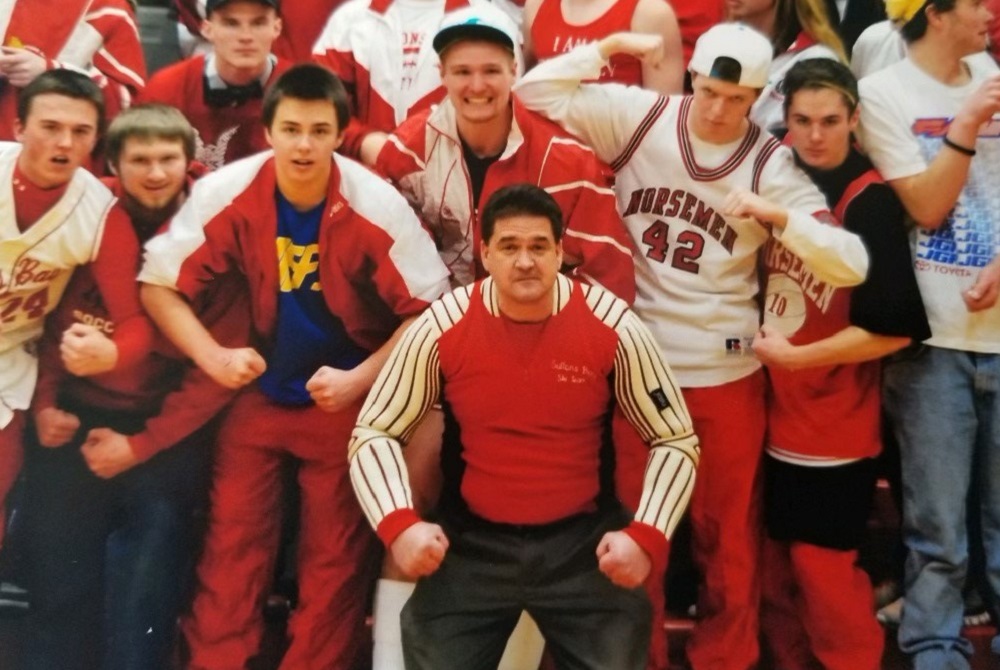
Periard is most proud, however, of the behavior of the student body during athletic contests. His game management included a “bristle” – a knowing look – passed on from his grandfather to his mother and ultimately to he and his brothers.
With his simple bristle he was able to instantly, and non-verbally, communicate to the students they’d better stop what they’re doing.
“They bought into my stern look when they were in any way at all not cheering for their team,” he said. “They knew they should be cheering for their teams and not being disparaging against their opponent, and only treating opponents with class.”
 Tom Spencer is a longtime MHSAA-registered basketball and soccer official, and former softball and baseball official, and he also has coached in the northern Lower Peninsula area. He previously has written for the Saginaw News, Bay County Sports Page and Midland Daily News. He can be reached at [email protected] with story ideas for Manistee, Wexford, Missaukee, Roscommon, Ogemaw, Iosco, Alcona, Oscoda, Crawford, Kalkaska, Grand Traverse, Benzie, Leelanau, Antrim, Otsego, Montmorency, Alpena, Presque Isle, Cheboygan, Charlevoix and Emmet counties.
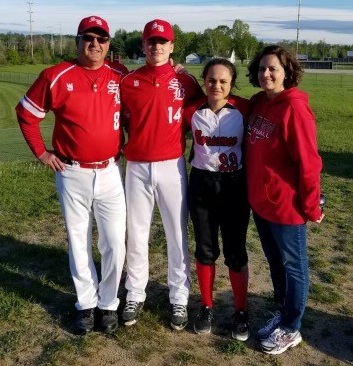
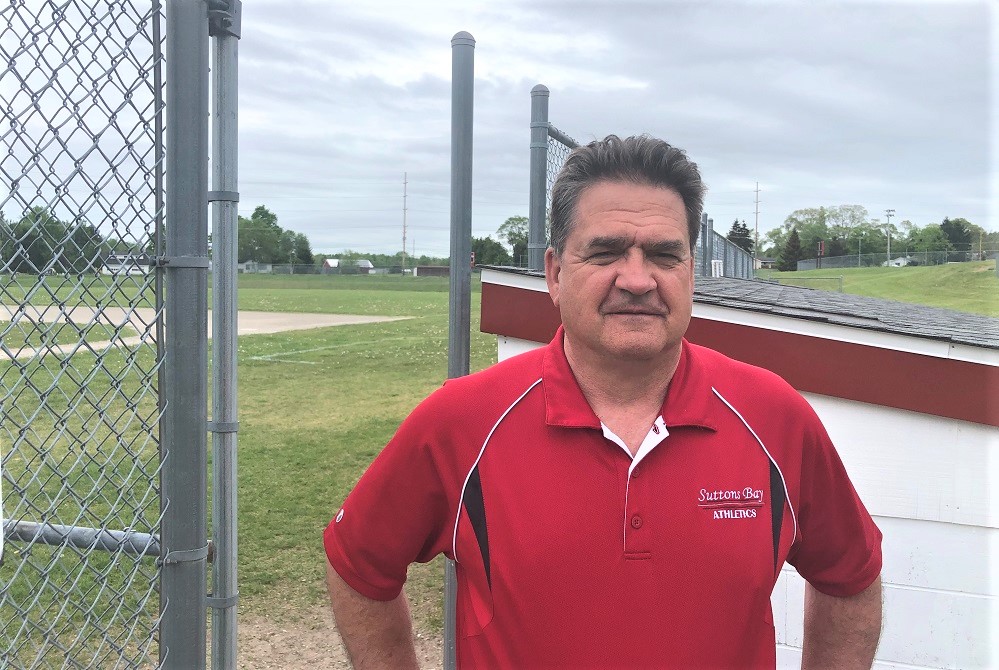
PHOTOS: (Top) Doug Periard enjoys a moment surrounded by enthusiastic Suttons Bay student fans during his tenure. (Middle) Periard, also the baseball coach, with son Hugh, daughter Grace and wife Anne a few years ago. (Below) Even in retirement, Periard remains a mainstay in Suttons Bay. (Top and middle photos courtesy of Doug Periard; bottom photo by Tom Spencer.)