

Casting Lines for Future Tournaments
August 12, 2016
By Jack Roberts
MHSAA Executive Director
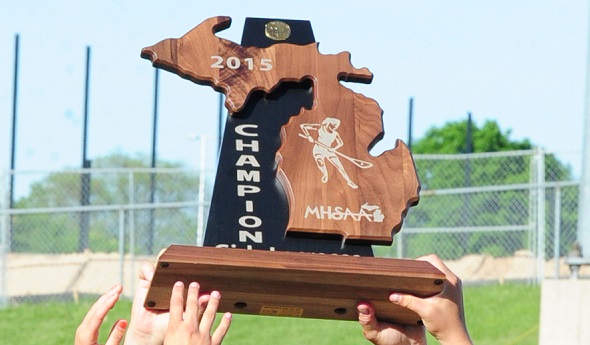
The MHSAA is best known to the public for the tournaments it conducts to conclude the fall, winter and spring seasons each school year.
These tournaments, the first and largest program of the MHSAA, have survived the Vietnam War, the Korean conflict and two World Wars. They have survived the technology bubble, the housing collapse, the energy crisis and the Great Depression.
MHSAA tournaments existed at the dawn of aviation and at the time of our nation’s lunar landing. Popes, presidents and governors have changed and changed again and again, and MHSAA tournaments roll on year after year.
But the sense of tradition and permanence and inevitability of MHSAA tournaments doesn’t dissuade us from asking questions about our tournaments, even some of the most basic questions. Here are two.
Question #1
I have long been and will always be an advocate for a Ryder Cup format for the MHSAA Golf Finals, and a team tennis approach to the MHSAA Tennis Finals; but 90 years of tradition is hard to overcome. Might this be a more exciting format? Could it be co-ed? Could it reverse the decline in boys tennis participation, and increase girls golf participation? Wouldn’t it be fun to try?
Periodically, the International Olympic Committee requires each of the designated Olympic sports to defend its status, to state its case why the sport should remain a part of the Olympic program. Then, after a series or votes that retain one sport at a time, the IOC drops the sport that makes the weakest case. It does so to make room for one of the previously unlisted sports that makes the best case for inclusion.
This would appear to keep the existing Olympic sports on their toes, and to keep the Olympic movement fresh and reflective of modern trends in sports.
While I would not enjoy the controversy, I can see the potential for some positive results if the MHSAA were to invoke the same policy for determining the 14 tournaments it will provide for girls and the 14 for boys.
This might cause us to consider more deeply what a high school sport should look like, or at least what an MHSAA tournament sport should stand for.
On the one hand, we might be inclined to drop tournaments for those sports that involve mostly non-faculty coaches and non-school venues, or require cooperative programs to generate enough participants to support a team, or resort almost entirely to non-school funding, or cater to individuals more than teams.
Or perhaps this process would cause policymakers to forget traditional thinking and ask: “In this day and age, should we shake off traditional notions of sport and consider more where modern kids are coming from?” That might mean fewer team sports and more individual sports, more “extreme” sports like snowboarding and skateboarding, and more lifetime sports, meaning not just golf and tennis and running sports, but also fishing and even shooting sports.
Currently, MHSAA policy states that the MHSAA will consider sponsorship of a tournament series for any sport which 64 member schools conduct on an interscholastic basis as a result of action by the governing boards of those schools.
Should the only question be how many schools sponsor a sport, or must an activity also have certain qualities and/or avoid certain “defects?” What should an MHSAA tournament sport look like and stand for?
Question #2
Bristling from criticism that his association is a money-grabbing exploiter of children, my counterpart in another state said, “If we were running our programs just to make money, we would do very many things very differently.” I knew exactly what he meant.
Because we care about the health and welfare of students, because we mean what we say that the athletic program needs to maximize the ways it enhances the school experience while minimizing academic conflicts, and because we try to model our claim that no sport is a minor sport when it comes to its potential to teach young people life lessons, we operate our programs in ways that make promoters, marketers and business entrepreneurs laugh, cry or cringe.
If money were the only object, we would seed and select sites to assure the teams that attracted the most spectators had the best chance to advance in our tournaments, regardless of the travel for any team or its fan base. If money were the only object, we would never schedule two tournaments to overlap and compete for public attention, much less tolerate three or four overlapping events. If money were the only object, we would allow signage like NASCAR events and promotions like minor league baseball games.
Those approaches to event sponsorship may not be all wrong; they’re just not all right for us. And we will live with the consequences of our belief system.
During a typical school year, more than 20 percent of the MHSAA’s 2,097 District, Regional and Final tournaments lose money. Not a single site in golf, skiing or tennis makes a single penny. In no sport did every District, Regional and Final site have revenue in excess of direct expenses.
In fact, in only three sports – boys and girls basketball and football – is revenue so much greater than direct expenses overall that it helps to pay for all the other tournaments in which the MHSAA invests.
That’s right: invests. When we present our budget to our board, we talk about the MHSAA’s investment in providing tournament opportunities in all those sports and all those places that cannot sustain the cost of those events on their own. How much is this investment worth to students, schools and society?
These two are core questions that require our focus far in advance of talk about scheduling, site selection, seeding and the myriad matters that too often hijack our time and attention.
Balanced, Gritty Lamphere Back Among Baseball's Best
By
Tom Markowski
Special for Second Half
May 27, 2021
Two walk-off home runs defined the success of the Madison Heights Lamphere baseball team’s regular-season championship run this spring.
 The next two games will determine the success of the Rams’ postseason.
Lamphere – 22-3 and ranked No. 7 in Division 2 this week – is in the midst of one of the program’s best seasons, as the Rams captured the Macomb Area Conference Gold title outright posting a 13-2 mark. On May 19, Lamphere faced St. Clair Shores Lakeview in the last division game of the season. If Lakeview had won, it would have created a shared title with Lamphere (the teams also shared in 2019). But with one out in the bottom of the seventh inning, Nick Krstich, a junior catcher-third baseman, hit the first pitch he saw for a home run to give Lamphere a 4-3 victory and the outright championship.
“It was probably the greatest moment in my baseball life, and I’ve been playing since I was 8 (years old),” Krstich said. “It took me a few steps to realize it was out. All game they were starting me off with a curveball. They brought in a new guy. He threw a fastball, and it was in my happy zone. As I came around third, all the guys were waiting for me and they all jumped on me as I crossed the plate.”
Rewind another month to April 23, shortly before the start of the league season, when Lamphere played traditional power Detroit Country Day. In a wild affair, junior Aiden McGinnis, a spot starting pitcher who works mainly in relief, came to bat in the bottom of the seventh inning with the score tied at 13-13. McGinnis sent an 0-1 pitch over the left field fence for a 14-13 victory.
“That got us going in the right direction,” Lamphere coach Adam Wooley said. “That was cool. It showed we could play with anybody.”
Wooley is in his 20th season as the program’s head varsity coach and his teams, for the most part, have been competitive. His best were headed by players like Greg Fettes, Ryan Horvath and others a decade ago. In 2010, Lamphere reached the MHSAA Division 2 Regional Finals before losing to eventual champion Dearborn Divine Child. The next season expectations were greater with the return of Fettes and Horvath, but Lamphere lost to Country Day in District play.
Full, clear video of @NickKrstich walk off HR to clinch outright MAC Gold title on Thursday for @LHShardball @statechampsmich please feel free to repost. pic.twitter.com/sQEQWQsbqs
— Lamphere Baseball (@LHShardball) May 22, 2021
“We had seven players who went on to play in college from those teams,” Wooley said. “We have five on this team. We won Districts in 2012 and 2014, and again in 2019. It probably sounds worn out, but I thought we’d be good this year. We had eight starters back (from two years ago) and they had had success. They were anticipating getting back together.
“I’m a lot different coach than I was 10 years ago. I was like a Kirk Gibson then, intense. Now I’m more like a Miguel Cabrera, more laid back.”
Wooley has 16 on his varsity roster, including nine seniors. There are no superstars – just a bunch of good players who pull for each other and have played a lot of baseball together over the years.
Wooley said he and his program hit a downturn for a few years following the 2014 season. Coaching had become a drudgery, not something Wooley looked forward to after teaching class (at Lamphere). Simply put, he got stale.
“I questioned myself,” he said. “It was getting to the point where I was getting frustrated. Then in 2017, I went to an aspiring principal program, as part of my wanting to become an administrator. I had a chance to look at myself. It made me look at my core values. Core values? What are they? I needed to change.”
Wooley redefined his role as a coach. He built his new approach on what he calls the three pillars of his program – trust, commitment and grit.
“The mantra is family,” he said. “We give up so much to be a part of this. You have to understand that we are working toward the same goal. That grit piece? I’m from Madison Heights. No one has succeeded in this town without hard work.”
After last season was cancelled due to COVID-19, Wooley knew there would be a transition period so he intentionally started the season late (April 9) to give his players time to get back to basics. And he’s convinced that extra time spent practicing paid off.
Lamphere’s strengths are hitting, one through nine in the order, and pitching. The players are patient at the plate, and they’re not afraid to fail.
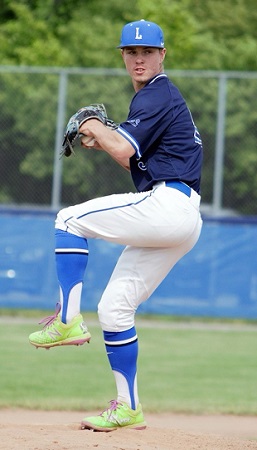 One of Lamphere’s top players is Jake Malak, a pitcher-catcher-outfielder, who will play at St. Clair Community College next season. Malak is batting over .400 and is 4-0 as the team’s No. 2 starter.
The third starter is Dylan Chargo, who’s 3-0 with an ERA below 2.50. He’s batting .350 with 10 extra-base hits.
Defensively, Lamphere makes the routine plays. K.J. Whitman covers a lot of ground in center field, and shortstop Noah Hurst earned the nickname “dirtball” because he’s always diving for ground balls and dirtying his uniform.
And Wooley has the luxury of rotating three catchers on a weekly basis – Chargo, Malak and Krstich.
Malak is one of the leaders and, like Krstich, was a starter on the football team. Malak comes from a family of catchers. His father, Ricky Malak, was a catcher at Madison High. His grandfather, Ronald Malak, also caught and his cousin Billy Malak was a catcher-third baseman on the Madison Heights Bishop Foley teams that claimed a Finals three-peat with Division 3 titles in 2011, 2012 and 2013.
“I love catching,” Jake Malak said. “I like being the leader on the field. I honestly love everything about it. You’re always doing something.”
To stay on top of his game during the cancelled 2020 season, Malak continued to do “something.” He worked with his father one-on-one on catching drills and hitting. Malak also joined a health club nearby to maintain his conditioning.
On Tuesday, Lamphere will play Bloomfield Hills Cranbrook Kingswood in a Division 2 District opener at Orchard Lake St. Mary’s. Cranbrook handed Lamphere its only nonconference loss, 9-4. The winner will play Country Day on June 5 in a District Semifinal. Should Lamphere win, the Rams will likely play the host team, top-ranked St. Mary’s, for the championship that same afternoon.
It’s a daunting task but one the Rams have been preparing for since the start of the season. And should they reach the District Final and play St. Mary’s which, by virtue of its title in 2019, is the reigning Division 2 champion, Lamphere would be a decided underdog.
So be it.
“Hey, it’s baseball,” Krstich said. “Anything can happen.”
 Tom Markowski is a correspondent for the State Champs! Sports Network and previously directed its web coverage. He also covered primarily high school sports for the The Detroit News from 1984-2014, focusing on the Detroit area and contributing to statewide coverage of football and basketball. Contact him at [email protected] with story ideas for Oakland, Macomb and Wayne counties.
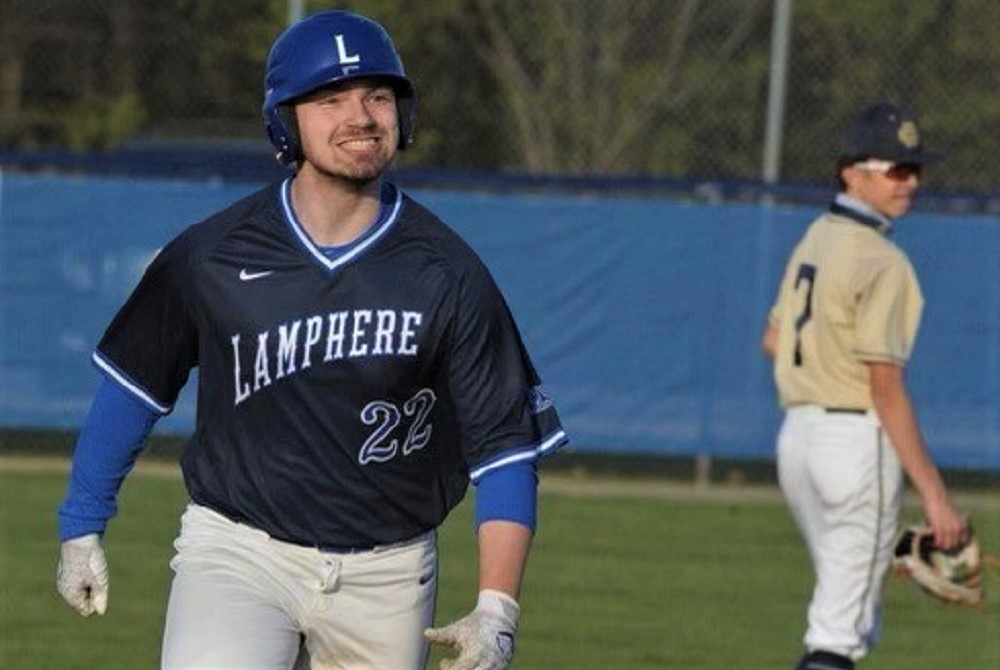
PHOTOS: (Top) Aiden McGinnis (22) and his Lamphere teammates have had plenty to smile about this spring. (Middle) KJ Whitman makes his move toward the plate Friday against Madison Heights Bishop Foley. (Photos courtesy of Allison Minowa and the Lamphere baseball program.)