

Casting Lines for Future Tournaments
August 12, 2016
By Jack Roberts
MHSAA Executive Director
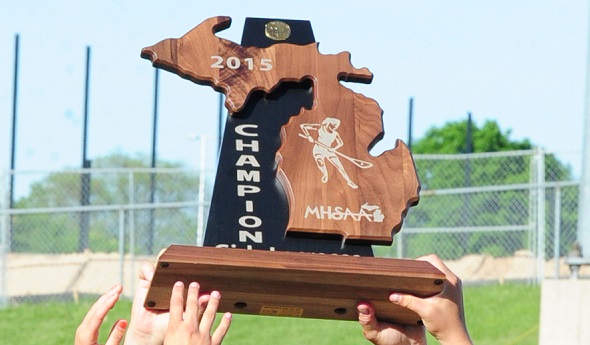
The MHSAA is best known to the public for the tournaments it conducts to conclude the fall, winter and spring seasons each school year.
These tournaments, the first and largest program of the MHSAA, have survived the Vietnam War, the Korean conflict and two World Wars. They have survived the technology bubble, the housing collapse, the energy crisis and the Great Depression.
MHSAA tournaments existed at the dawn of aviation and at the time of our nation’s lunar landing. Popes, presidents and governors have changed and changed again and again, and MHSAA tournaments roll on year after year.
But the sense of tradition and permanence and inevitability of MHSAA tournaments doesn’t dissuade us from asking questions about our tournaments, even some of the most basic questions. Here are two.
Question #1
I have long been and will always be an advocate for a Ryder Cup format for the MHSAA Golf Finals, and a team tennis approach to the MHSAA Tennis Finals; but 90 years of tradition is hard to overcome. Might this be a more exciting format? Could it be co-ed? Could it reverse the decline in boys tennis participation, and increase girls golf participation? Wouldn’t it be fun to try?
Periodically, the International Olympic Committee requires each of the designated Olympic sports to defend its status, to state its case why the sport should remain a part of the Olympic program. Then, after a series or votes that retain one sport at a time, the IOC drops the sport that makes the weakest case. It does so to make room for one of the previously unlisted sports that makes the best case for inclusion.
This would appear to keep the existing Olympic sports on their toes, and to keep the Olympic movement fresh and reflective of modern trends in sports.
While I would not enjoy the controversy, I can see the potential for some positive results if the MHSAA were to invoke the same policy for determining the 14 tournaments it will provide for girls and the 14 for boys.
This might cause us to consider more deeply what a high school sport should look like, or at least what an MHSAA tournament sport should stand for.
On the one hand, we might be inclined to drop tournaments for those sports that involve mostly non-faculty coaches and non-school venues, or require cooperative programs to generate enough participants to support a team, or resort almost entirely to non-school funding, or cater to individuals more than teams.
Or perhaps this process would cause policymakers to forget traditional thinking and ask: “In this day and age, should we shake off traditional notions of sport and consider more where modern kids are coming from?” That might mean fewer team sports and more individual sports, more “extreme” sports like snowboarding and skateboarding, and more lifetime sports, meaning not just golf and tennis and running sports, but also fishing and even shooting sports.
Currently, MHSAA policy states that the MHSAA will consider sponsorship of a tournament series for any sport which 64 member schools conduct on an interscholastic basis as a result of action by the governing boards of those schools.
Should the only question be how many schools sponsor a sport, or must an activity also have certain qualities and/or avoid certain “defects?” What should an MHSAA tournament sport look like and stand for?
Question #2
Bristling from criticism that his association is a money-grabbing exploiter of children, my counterpart in another state said, “If we were running our programs just to make money, we would do very many things very differently.” I knew exactly what he meant.
Because we care about the health and welfare of students, because we mean what we say that the athletic program needs to maximize the ways it enhances the school experience while minimizing academic conflicts, and because we try to model our claim that no sport is a minor sport when it comes to its potential to teach young people life lessons, we operate our programs in ways that make promoters, marketers and business entrepreneurs laugh, cry or cringe.
If money were the only object, we would seed and select sites to assure the teams that attracted the most spectators had the best chance to advance in our tournaments, regardless of the travel for any team or its fan base. If money were the only object, we would never schedule two tournaments to overlap and compete for public attention, much less tolerate three or four overlapping events. If money were the only object, we would allow signage like NASCAR events and promotions like minor league baseball games.
Those approaches to event sponsorship may not be all wrong; they’re just not all right for us. And we will live with the consequences of our belief system.
During a typical school year, more than 20 percent of the MHSAA’s 2,097 District, Regional and Final tournaments lose money. Not a single site in golf, skiing or tennis makes a single penny. In no sport did every District, Regional and Final site have revenue in excess of direct expenses.
In fact, in only three sports – boys and girls basketball and football – is revenue so much greater than direct expenses overall that it helps to pay for all the other tournaments in which the MHSAA invests.
That’s right: invests. When we present our budget to our board, we talk about the MHSAA’s investment in providing tournament opportunities in all those sports and all those places that cannot sustain the cost of those events on their own. How much is this investment worth to students, schools and society?
These two are core questions that require our focus far in advance of talk about scheduling, site selection, seeding and the myriad matters that too often hijack our time and attention.

Reeths-Puffer ‘Ironman’ Slows Down to Help Team Surge
By
Tom Kendra
Special for MHSAA.com
May 6, 2021
Klay Grant’s strategy going into last week’s Greater Muskegon Athletic Association city track meet seemed, at first, counterintuitive.
 “My plan was to try and run each event as slow as possible,” said Grant, a junior at Muskegon Reeths-Puffer, before adding:
“And still win.”
His plan to conserve energy – essentially sacrificing fast times for himself to try and gather as many points as possible for his team – worked to perfection as Grant became the first athlete in the 65-year history of the GMAA meet to take first place in the four longest events.
Grant’s “Ironman” performance and four first-place finishes accounted for 40 of his team’s 132 points, helping the Rockets edge six-time reigning champion Fruitport and win the meet for the first time since 2006.
Grant started his record-breaking night by running the anchor leg on R-P’s winning 3,200-meter relay team (8:40.84), then followed with wins in the open 1,600 (4:42.94), 800 (2:07.25) and 3,200 (10:29.69).
“Klay is all about the team,” explained Reeths-Puffer boys track coach Don Ketner, who is in his 15th year. “He’s the kind of kid that would give the shirt off of his back for you, and that’s basically what we asked him to do on Friday night.”
The GMAA Meet, known locally simply as the “City Meet,” dates back to the 1950s, and during its long history many male and female athletes have won four events. However, that feat normally happens with sprinters in short events and relays or with an athlete who picks up a win or two in the field events before the running finals begin.
Grant was the first to capture all four of the longest running events, but he said that individual feat was secondary. He said the best part was helping to deliver a memorable night for Reeths-Puffer, as his family is heavily invested in the Muskegon County school district and its track & field and cross country programs.
Both of his parents, Darren and Angie Grant, are Reeths-Puffer graduates and runners who went on to run in college at Indiana Wesleyan and now teach and coach in the R-P district. Darren Grant, who teaches fifth grade, is the Rockets’ head cross country coach and assistant boys track coach. Angie Grant teaches special education at the middle school and is the head girls track coach.
 “It was fun to be a part of such a great night,” said Grant, 17, who plans to go into the ministry and pursue Biblical studies in college. “Faith encompasses everything that I do, so it felt great to use my gifts to help out my teammates and coaches.”
Grant, who is also laser-focused in the classroom with a gaudy 4.333 GPA, is the third of four children. His older siblings are Cole and Kenna, and younger brother Kye is a talented runner on the Reeths-Puffer middle school team.
While running has always been a part of his life because of his parents, his primary sport growing up was soccer. In fact, it wasn’t until last year that he focused exclusively on track and cross country, which is why he believes he can greatly improve his times.
Perhaps the key race of the entire GMAA meet last week was the opening 3,200-meter relay, which Fruitport was favored to win. Ketner gambled that by putting Grant on the anchor leg, he might be able to catch up and pass Fruitport.
As it turned out, strong performances on the first three legs by freshmen Jackson Allen and Tate Bradley and senior Caden Tufts had the Rockets in the lead when Grant got the baton – allowing him to cruise to the tape and make a major statement in the process.
Grant then had a nice stretch of time to rest before his next race, the 1,600, but that was the first of three long races over a short period of time.
After pulling away from Jackson Helmer of Mona Shores in the 1,600, Grant had just three events of rest before getting back on the track for the 800 – the event he will likely focus on for the upcoming Ottawa-Kent Conference Green meet May 13 and the Division 2 Regional on May 20.
Then came the shortest turnaround of the night, with just the quick 200-meter run coming between the 800 and the 3,200.
Grant knew he could empty the tank in the 3,200, and it didn’t take long for Grant and his senior teammate and training partner Brett Schlaff to separate themselves from the rest of the field. With those two running 1-2 ahead of the pack, it was clear that the Rockets would pick up 18 points in that event and clinch the meet title.
The only drama remaining was whether Grant would make history or if the fresher Schlaff would prevail.
“With about 300 meters to go they were still close and I said out loud: ‘Klay is so nice, he’s going to let Brett win,’” said Ketner.
Grant ended up pulling away over the final 200 meters to win the race and make history. Schlaff took a strong second, and the Rockets were on top of the Muskegon city track world for the first time in 15 years.
“My times were nothing special that night, that’s for sure,” said Grant. “But this meet wasn’t about me. This meet was all about the team.”
 Tom Kendra worked 23 years at The Muskegon Chronicle, including five as assistant sports editor and the final six as sports editor through 2011. E-mail him at [email protected] with story ideas for Muskegon, Oceana, Mason, Lake, Oceola, Mecosta and Newaygo counties.
PHOTOS: (Top) Klay Grant (1) competes in the 800-meter run at the Rocket Invitational on April 16 at Reeths-Puffer. Grant won the race. (Middle) Grant cruises to victory in the 1,600-meter run at the GMAA city meet. (Photos by Payden Challinor.)