

Casting Lines for Future Tournaments
August 12, 2016
By Jack Roberts
MHSAA Executive Director
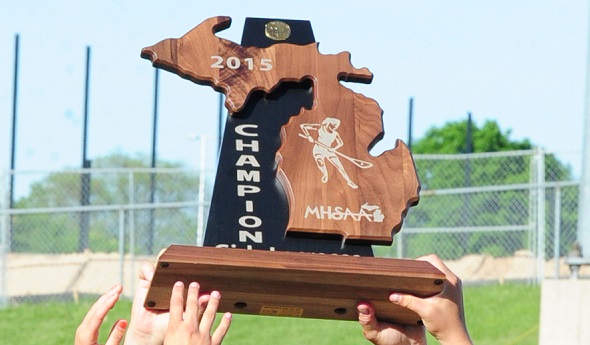
The MHSAA is best known to the public for the tournaments it conducts to conclude the fall, winter and spring seasons each school year.
These tournaments, the first and largest program of the MHSAA, have survived the Vietnam War, the Korean conflict and two World Wars. They have survived the technology bubble, the housing collapse, the energy crisis and the Great Depression.
MHSAA tournaments existed at the dawn of aviation and at the time of our nation’s lunar landing. Popes, presidents and governors have changed and changed again and again, and MHSAA tournaments roll on year after year.
But the sense of tradition and permanence and inevitability of MHSAA tournaments doesn’t dissuade us from asking questions about our tournaments, even some of the most basic questions. Here are two.
Question #1
I have long been and will always be an advocate for a Ryder Cup format for the MHSAA Golf Finals, and a team tennis approach to the MHSAA Tennis Finals; but 90 years of tradition is hard to overcome. Might this be a more exciting format? Could it be co-ed? Could it reverse the decline in boys tennis participation, and increase girls golf participation? Wouldn’t it be fun to try?
Periodically, the International Olympic Committee requires each of the designated Olympic sports to defend its status, to state its case why the sport should remain a part of the Olympic program. Then, after a series or votes that retain one sport at a time, the IOC drops the sport that makes the weakest case. It does so to make room for one of the previously unlisted sports that makes the best case for inclusion.
This would appear to keep the existing Olympic sports on their toes, and to keep the Olympic movement fresh and reflective of modern trends in sports.
While I would not enjoy the controversy, I can see the potential for some positive results if the MHSAA were to invoke the same policy for determining the 14 tournaments it will provide for girls and the 14 for boys.
This might cause us to consider more deeply what a high school sport should look like, or at least what an MHSAA tournament sport should stand for.
On the one hand, we might be inclined to drop tournaments for those sports that involve mostly non-faculty coaches and non-school venues, or require cooperative programs to generate enough participants to support a team, or resort almost entirely to non-school funding, or cater to individuals more than teams.
Or perhaps this process would cause policymakers to forget traditional thinking and ask: “In this day and age, should we shake off traditional notions of sport and consider more where modern kids are coming from?” That might mean fewer team sports and more individual sports, more “extreme” sports like snowboarding and skateboarding, and more lifetime sports, meaning not just golf and tennis and running sports, but also fishing and even shooting sports.
Currently, MHSAA policy states that the MHSAA will consider sponsorship of a tournament series for any sport which 64 member schools conduct on an interscholastic basis as a result of action by the governing boards of those schools.
Should the only question be how many schools sponsor a sport, or must an activity also have certain qualities and/or avoid certain “defects?” What should an MHSAA tournament sport look like and stand for?
Question #2
Bristling from criticism that his association is a money-grabbing exploiter of children, my counterpart in another state said, “If we were running our programs just to make money, we would do very many things very differently.” I knew exactly what he meant.
Because we care about the health and welfare of students, because we mean what we say that the athletic program needs to maximize the ways it enhances the school experience while minimizing academic conflicts, and because we try to model our claim that no sport is a minor sport when it comes to its potential to teach young people life lessons, we operate our programs in ways that make promoters, marketers and business entrepreneurs laugh, cry or cringe.
If money were the only object, we would seed and select sites to assure the teams that attracted the most spectators had the best chance to advance in our tournaments, regardless of the travel for any team or its fan base. If money were the only object, we would never schedule two tournaments to overlap and compete for public attention, much less tolerate three or four overlapping events. If money were the only object, we would allow signage like NASCAR events and promotions like minor league baseball games.
Those approaches to event sponsorship may not be all wrong; they’re just not all right for us. And we will live with the consequences of our belief system.
During a typical school year, more than 20 percent of the MHSAA’s 2,097 District, Regional and Final tournaments lose money. Not a single site in golf, skiing or tennis makes a single penny. In no sport did every District, Regional and Final site have revenue in excess of direct expenses.
In fact, in only three sports – boys and girls basketball and football – is revenue so much greater than direct expenses overall that it helps to pay for all the other tournaments in which the MHSAA invests.
That’s right: invests. When we present our budget to our board, we talk about the MHSAA’s investment in providing tournament opportunities in all those sports and all those places that cannot sustain the cost of those events on their own. How much is this investment worth to students, schools and society?
These two are core questions that require our focus far in advance of talk about scheduling, site selection, seeding and the myriad matters that too often hijack our time and attention.

Buell Becomes 29th 4-Time Champ as Dundee Sets Finals Record
By
Geoff Kimmerly
MHSAA.com senior editor
April 3, 2021
KALALAMZOO – Stoney Buell wasn’t exactly a secret as a freshman, already considered one of the state’s best as a top-seeded contender at his first Individual Wrestling Finals in 2018. He would go on to win his first championship on the same night as teammate Brandon Whitman would become the first in Dundee history to claim a fourth Finals title.
Three years later, Buell will be leaving high school wrestling with an even bigger stack of accomplishments, having more than justified those predictions of greatness.
Buell became the 29th wrestler in MHSAA history to claim a fourth Individual Finals championship Friday, earning the Division 3 title at 189 pounds at Wings Event Center. With Dundee’s fourth-straight team championship Tuesday, Buell also is now one of just three in state history to be part of four team and four individual Finals wins – joining 2020 Lowell grad Austin Boone and Davison legend Brent Metcalf, who accomplished the feat from 2002-05.
“I think it just kinda added a little bit to prove people wrong as a freshman – because people talk and it always adds a little bit of fuel,” Buell said. “Just to finally accomplish that goal that I’ve had for so long is unreal.”
Buell, who will continue at Purdue, capped his Dundee career with a 6-1 decision against Constantine senior Isaac Hall (33-2) after pins of 27 seconds, 37 seconds and 30 seconds to reach the finale.
He had won at 135 pounds as a freshman, 152 as a sophomore and 160 as a junior. He ended this shortened season 27-0 and with a career record of 160-15.
Buell also was joined by seven teammates winning titles Friday as Dundee set a Finals record with eight champions.
“I’m just beyond grateful that we got to be here right now,” Buell said. “A huge shout out to Wings Event Center, and just the sport of wrestling for allowing me to be able to wrestle right now, and be able to do it with a team that makes you better every day. I wouldn’t want to do it with anybody else.”
103
Champion: Kade Kluce, Dundee, Fr. (18-2)
Decision, 7-3, over Talan Parsons, Ovid-Elsie, Fr. (24-1)
With three champions graduating, Kluce is part of the next generation of Dundee contenders – and he’s off to the best-possible start.
Kluce handed Parsons his only defeat of the season in a matchup of standout freshmen.
“It was really important for me, my team, my family. I worked a long time for this,” Kluce said. “And it’s paid off.
“I definitely want to do it three more times.”
112
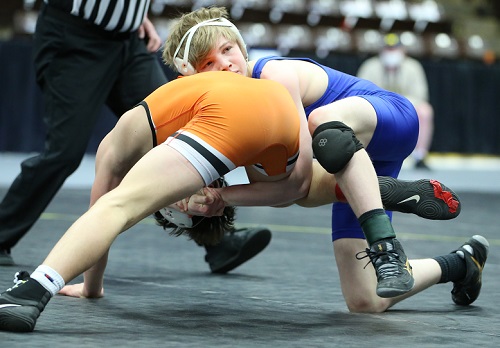
Champion: Braeden Davis, Dundee, Soph. (27-0)
Fall, 1:26, over Gavyn Merchant, Kingsley, Fr. (28-1)
Davis is halfway to matching Buell. And he’s blazing a similarly dominant trail.
Davis never wrestled past the second period this season, winning all of his matches by pin or tech fall including this finale to hand Merchant his only loss.
The championship followed Davis’ title at 103 a year ago.
“This year I felt more prepared and used to it,” he said. “Less nerves, and I’m used to going to big-level tournaments, so I guess it helped.
“I’m going to take a week off and I’m going right into freestyle training and getting ready for Fargo (Nationals).”
119
Champion: Kaden Chinavare, Dundee, Soph. (24-0)
Major Decision, 16-5, over Dominic Anguiano, Alma, Sr. (29-4)
Chinavare had placed third at 112 as a freshman and was ready to take his turn among the many Dundee champions over the last two seasons.
He entered as the top seed at this weight and opened with a technical fall and pin on the way to claiming that first title.
“All these guys, they train with me every day. We scrap in the wrestling room 24/7, and it feels great to finally win the first title,” he said. “It’s kinda what we work for in the room all season.”
125
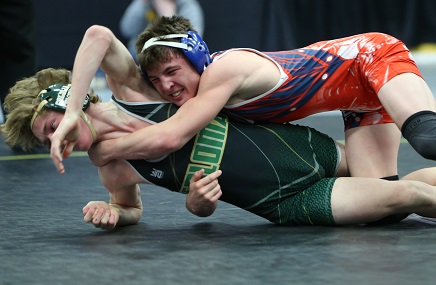
Champion: Zachary Gibson, Lake Odessa Lakewood, Jr. (33-1)
Decision, 2-1, over Caeleb Ishmael, Coloma, Jr. (30-5)
Gibson jumped from finishing fifth at 103 as a freshman and fifth again at 112 last season to claim his first title. He scored a reversal in the third period and held on.
“After I got the two, I figured, I couldn’t turn the kid the first two periods … so just stay smart. State champ match, you’ve gotta stay smart,” Gibson said.
He gave Lakewood a champion at the Finals for the second straight season, after entering as the second seed at this weight and getting pins in his first two matches of the day.
“It’s really awesome, really sets an example for the rest of the guys,” Cooper said. “My team, they see me as an upperclassmen. They want to fight to get up there with me, and it’s awesome. I work with all the guys, all the underclassmen.”
130
Champion: Ryker Johnecheck, Williamston, Jr. (27-0)
Decision, 6-2, over Brock Holek, Durand, Sr. (25-4)
Both were making repeat appearances in a championship match, Johnecheck after winning 125 last year and Holek after coming in second at 130.
Holek defeated Johnecheck’s brother Camden 5-3 in a semifinal, setting up this clash.
“I’ve wrestled him at Districts and Regionals, and I know what he likes to do,” Ryker Johnecheck said. “I was just waiting for the opportunity, and I got the takedowns when I needed to, and it turned out with me on top.”
Williamston has produced its share of champions in the past, including a pair of the best-known in MHSAA history. Johnecheck became the Hornets’ first repeat champion since Andy Simmons won his fourth title in 2002.
“We’ve had a lot of guys coming up around my age,” Johnecheck said. “We brought five guys to states today; we’ve got five placers. It’s all a team. We push each other at practice, and it shows.”
135
Champion: Aiden Davis, Dundee, Soph. (27-1)
Decision, 5-1, over Jack Sherman, Millington, Sr. (28-1)
Davis had come up just short as a freshman, losing the championship match at 125 to Johnecheck on a last-second ultimate tiebreaker takedown last winter.
After this win he talked about always getting better, by baby steps or leaps and bounds. And he finished the season by making that next move and handing Sherman his only defeat.
“This was one was pretty sweet, because last year I lost in literally the last second,” Davis said. “So I felt like this one meant something to really get it.
“I knew I deserved it last year. This year I just had to prove that.”
140
Champion: Max Brown, Whitehall, Jr. (35-1)
Decision, 7-1, over Austin Fietz, Dundee, Sr. (23-4)
Brown made some noise when he started Tuesday’s Team Final against Dundee with a win over the top-seeded Fietz, a 2020 champion.
Then it was back to preparing for a possible rematch, as Brown was the second seed in this bracket. He lined up a pair of pins Friday to earn the opportunity.
“After our match Tuesday at team states, we went back to the practice room, we worked hard, we got a strategy and went out and executed the strategy,” Brown said. “I knew what to block for, what to look for, how to keep working the whole time.”
Brown had finished third at 130 as a sophomore and fourth at 125 as a freshman.
145
Champion: Casey Swiderski, Dundee, Jr. (28-0)
Major Decision, 20-7, over Dametrius Castillo, Alma, Sr. (29-5)
It seemed appropriate that Swiderski earned not only Dundee’s last championship of the day, but also the last win of the Division 3 meet – because after this weekend, the spotlight is sure to turn his way even more.
Swiderski will have the opportunity next year to join the prestigious group of four-time champs, with Friday’s Finals win at 145 adding to his past titles at 135 as a sophomore and 103 as a freshman.
He won his first three matches this time by pin before the major decision against Castillo, who was a champion as a freshman and runner-up as a junior.
“State titles are state titles. If my goal is this high, this is just a stepping stone to my goals – Division I college, NCAAs, all that,” Swiderski said.
“Getting that fourth (would be) awesome for the history. And being one of those guys, not many people get to do that. Not many people alone get (one) state title.”
152
Champion: Nick Dodman, Sanford Meridian, Sr. (31-5)
Decision, 9-2, over Nicholas Blanchard, Whitehall, Jr. (30-7)
Dodman became his school’s third Individual Finals champion, and first since 2014 – and also Meridian’s first non-heavyweight title winner.
He made good on his top seed Friday after previous Finals finishes of sixth at 140 and eighth at 135 as a junior and sophomore, respectively.
“I knew I could beat anyone in this bracket, and that mindset helped me do it,” Dodman said. “I’d wrestled a lot of them before, and I know nobody here has put in as many hours as me. I knew they didn’t stand a chance.”
160
Champion: Tyler Swiderski, Dundee, Sr. (27-1)
Decision, 7-2, over Connor Owens, Flint Powers Catholic, Soph. (24-1)
Friday’s win over the previously-undefeated Owens came at the opening weight for this year’s Finals and kicked off the Vikings’ record run of champions while also giving Swiderski his second-straight title to go with last year’s at 145.
Swiderski had opened his high school career with Individual Finals runner-up finishes at 112 as a freshman and 135 as a sophomore. And then the key to taking the next step clicked.
“Just to wrestle my matches like I do in practice and not overthink the whole tournament,” he said.
“I think (this year) was a lot better, just because I think I was a lot more free this year,” Swiderski added, comparing his first and second championships. “And it was my last season, so I thought it was very important.”
171
Champion: Dominick Lomazzo, Dundee, Sr. (23-3)
Decision, 7-4, over Randy Pyrzewski, Gladwin, Jr. (28-2)
Lomazzo capped his career with a second-straight championship, adding to the title he won at 152 a year ago.
This run certainly was different though, even if the end result was the same. Lomazzo, who earned a pin and then a major decision to start off Friday, did it all with an ankle injury he suffered during last week’s Regional Final.
But he fought through it to finish a career that included multiple team championships as well and a third place in Division 1 at 125 as a freshman wrestling for Detroit Catholic Central.
“I’m just really happy to be part of this team. These are all my best friends,” Lomazzo said. “It just feels great to finish it out on a bang and know that I did everything I could to finish it, and I got it done.”
215
Champion: Ira Jenkins, Whitehall, Jr. (38-0)
Fall, 0:44, over Ryan Osterland, Algonac, Sr. (31-2)
Jenkins arguably had the most dominating day of any Division 3 competitor Friday, with pins in 1:28, 1:46, 19 seconds and then 44 seconds in the finale to lock down a perfect season and his first championship.
He’d previously finished third at 152 in Division 3 as a freshman and fifth at 171 in Division 2 as a sophomore.
“I wanted to come into this tournament and dominate as best I could,” Jenkins said. “I wanted to get four pins all the way through – that was just my goal, I guess. I know there’s some things I could’ve done better, but I got it done.
“Coming off last year, a fifth-place finish wasn’t where I wanted to end up. So I went back to working and learned from that, and just kept improving. All the offseason work is paying off.”
285
Champion: Dan McKiernan, Richmond, Sr. (16-0)
Decision, 3-1, over Levi Harber, Montrose, Jr. (18-3)
The McKiernans can wrestle. There’s no doubt about that.
Dan finished his high school career Friday by becoming the fourth McKiernan brother to compete in an MHSAA individual championship match – and the second from his family to win one.
McKiernan earned a last-second takedown for the go-ahead points.
“We were both tired, got barely anything left by the end,” Dan McKiernan said. “I knew it’s not worth resting toward the end of the period, so I just thought I had to get and go.”
Jake McKiernan had won the Division 3 title at 189 pounds in 2014, while Jordan McKiernan was runner-up at 152 for Richmond in 2006 and Colton McKiernan was runner-up at 189 in 2017 and 215 pounds in 2018.
“I’m so proud of it. I love my family,” said Dan, who had taken fifth at 285 as a junior. “I’m hoping they’re happy.”
PHOTOS: (Top) Dundee’s Stoney Buell raises four fingers on each hand to the crowd signifying his fourth championship won Friday at the Division 3 Individual Wrestling Finals. (Middle) The Vikings’ Braeden Davis, right, works toward a win at 112. (Below) Lakewood’s Zachary Gibson, right, maintains control during his title match win at 125. (Click for more from HighSchoolSportsScene.com.)