

Casting Lines for Future Tournaments
August 12, 2016
By Jack Roberts
MHSAA Executive Director
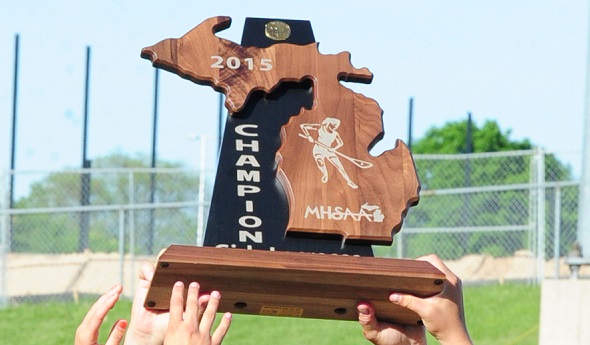
The MHSAA is best known to the public for the tournaments it conducts to conclude the fall, winter and spring seasons each school year.
These tournaments, the first and largest program of the MHSAA, have survived the Vietnam War, the Korean conflict and two World Wars. They have survived the technology bubble, the housing collapse, the energy crisis and the Great Depression.
MHSAA tournaments existed at the dawn of aviation and at the time of our nation’s lunar landing. Popes, presidents and governors have changed and changed again and again, and MHSAA tournaments roll on year after year.
But the sense of tradition and permanence and inevitability of MHSAA tournaments doesn’t dissuade us from asking questions about our tournaments, even some of the most basic questions. Here are two.
Question #1
I have long been and will always be an advocate for a Ryder Cup format for the MHSAA Golf Finals, and a team tennis approach to the MHSAA Tennis Finals; but 90 years of tradition is hard to overcome. Might this be a more exciting format? Could it be co-ed? Could it reverse the decline in boys tennis participation, and increase girls golf participation? Wouldn’t it be fun to try?
Periodically, the International Olympic Committee requires each of the designated Olympic sports to defend its status, to state its case why the sport should remain a part of the Olympic program. Then, after a series or votes that retain one sport at a time, the IOC drops the sport that makes the weakest case. It does so to make room for one of the previously unlisted sports that makes the best case for inclusion.
This would appear to keep the existing Olympic sports on their toes, and to keep the Olympic movement fresh and reflective of modern trends in sports.
While I would not enjoy the controversy, I can see the potential for some positive results if the MHSAA were to invoke the same policy for determining the 14 tournaments it will provide for girls and the 14 for boys.
This might cause us to consider more deeply what a high school sport should look like, or at least what an MHSAA tournament sport should stand for.
On the one hand, we might be inclined to drop tournaments for those sports that involve mostly non-faculty coaches and non-school venues, or require cooperative programs to generate enough participants to support a team, or resort almost entirely to non-school funding, or cater to individuals more than teams.
Or perhaps this process would cause policymakers to forget traditional thinking and ask: “In this day and age, should we shake off traditional notions of sport and consider more where modern kids are coming from?” That might mean fewer team sports and more individual sports, more “extreme” sports like snowboarding and skateboarding, and more lifetime sports, meaning not just golf and tennis and running sports, but also fishing and even shooting sports.
Currently, MHSAA policy states that the MHSAA will consider sponsorship of a tournament series for any sport which 64 member schools conduct on an interscholastic basis as a result of action by the governing boards of those schools.
Should the only question be how many schools sponsor a sport, or must an activity also have certain qualities and/or avoid certain “defects?” What should an MHSAA tournament sport look like and stand for?
Question #2
Bristling from criticism that his association is a money-grabbing exploiter of children, my counterpart in another state said, “If we were running our programs just to make money, we would do very many things very differently.” I knew exactly what he meant.
Because we care about the health and welfare of students, because we mean what we say that the athletic program needs to maximize the ways it enhances the school experience while minimizing academic conflicts, and because we try to model our claim that no sport is a minor sport when it comes to its potential to teach young people life lessons, we operate our programs in ways that make promoters, marketers and business entrepreneurs laugh, cry or cringe.
If money were the only object, we would seed and select sites to assure the teams that attracted the most spectators had the best chance to advance in our tournaments, regardless of the travel for any team or its fan base. If money were the only object, we would never schedule two tournaments to overlap and compete for public attention, much less tolerate three or four overlapping events. If money were the only object, we would allow signage like NASCAR events and promotions like minor league baseball games.
Those approaches to event sponsorship may not be all wrong; they’re just not all right for us. And we will live with the consequences of our belief system.
During a typical school year, more than 20 percent of the MHSAA’s 2,097 District, Regional and Final tournaments lose money. Not a single site in golf, skiing or tennis makes a single penny. In no sport did every District, Regional and Final site have revenue in excess of direct expenses.
In fact, in only three sports – boys and girls basketball and football – is revenue so much greater than direct expenses overall that it helps to pay for all the other tournaments in which the MHSAA invests.
That’s right: invests. When we present our budget to our board, we talk about the MHSAA’s investment in providing tournament opportunities in all those sports and all those places that cannot sustain the cost of those events on their own. How much is this investment worth to students, schools and society?
These two are core questions that require our focus far in advance of talk about scheduling, site selection, seeding and the myriad matters that too often hijack our time and attention.
Preview: Dundee Again Paces Powerful D3 Contenders
By
Geoff Kimmerly
MHSAA.com senior editor
March 29, 2021
Forget for a minute that Dundee on Tuesday will attempt to win a fourth-straight MHSAA Finals championship for the second time in the program’s illustrious history.
Consider first the relative strength of the Division 3 field as this season comes to a close.
Four of seven competing teams are undefeated or have lost only once during this abbreviated season. Combined those seven have 67 qualifiers for the Individual Finals – or nearly 10 per team.
Back to Dundee. The Vikings will travel to Kalamazoo looking to match the 1995-98 teams’ string of four Finals titles, the first of that of that run coming in Class C-D followed by three in Division 4.
Division 3 Quarterfinals – matchups below – begin at 12:30 p.m. at Wings Event Center’s Valley, with Semifinals at 3 p.m. and the championship match at 6.
Division 3 - 12:30 pm - The Valley
#1 Dundee - BYE - Mat 3
#4 Richmond vs. #5 Montrose - Mat 4
#3 Alma vs. #6 Freeland - Mat 1
#2 Whitehall vs. #7 Hart - Mat 2
(Constantine opted out.)
Spectator limits remain in effect, but all matches will be broadcast live and viewable with subscription on MHSAA.tv. Below is a look at all eight teams competing in Division 3, listed by seed.
#1 DUNDEE
Record/rank: 17-1, No. 1
League finish: First in Lenawee County Athletic Association
Coach: Tim Roberts, 22nd season (555-76-1)
Championship history: Twelve MHSAA championships (most recent 2020), seven runner-up finishes.
Individual Finals qualifiers: 103 Kade Kluce (12-2) fr., 112 Braeden Davis (21-0) soph., 119 Kaden Chinavare (18-0) soph., 119 Kyle Smith (12-2) jr., 125 Logan Sander (13-1) jr., 130 Trey Parker (14-3) fr., 135 Aiden Davis (21-1) soph., 140 Austin Fietz (20-2) sr., 145 Casey Swiderski (22-0) jr., 160 Tyler Swiderski (21-1) sr., 171 Nic Bellaire (7-4) sr., 171 Dominick Lomazzo (17-3) sr., 189 Stoney Buell (21-0) sr.
Outlook: Dundee is favored to extend its Division 3 championship streak to four, and returns with nine starters from last season’s lineup leading the way. Buell this weekend will attempt to become the 29th four-time Individual Finals champion in MHSAA history after winning at 160 a year ago. He’s one of six returning individual champions, along with Braeden Davis (103), Fietz (130), Casey Swiderski (135), Tyler Swiderski (145) and Lomazzo (152), while Chinavare (112) earned a third place and Aiden Davis (125) was a runner-up. Among Dundee’s dual wins this season were bouts over Division 4 top seed Clinton and Division 2 top seed Lowell.
#2 WHITEHALL
Record/rank: 25-1, No. 3
League finish: First in West Michigan Conference
Co-coaches: Justin Zeerip, third season; Collin Zeerip, third season (72-6)
Championship history: Class C runner-up 1984.
Individual Finals qualifiers: 112 Ty Whalen (20-3) sr., 119 Matthew Goodrich (23-6) sr., 140 Max Brown (29-1) jr., 145 Marco Moore (28-3) sr., 152 Nicholas Blanchard (25-5) jr., 152 Alec Pruett (11-4) jr., 160 Jacob Haynes (25-4) sr., 171 Connor Young (25-5) sr., 189 Kris Dowdell (190-8) sr., 215 Ira Jenkins (31-0) jr., 285 Shane Cook (27-2) soph.
Outlook: After missing the Quarterfinals last season in Division 2, Whitehall is back in Division 3 and headed to the Quarterfinals for the fifth time in six years and seeking at least a fourth Semifinal berth during this run. The Vikings will bring an experienced lineup, with 12 of 14 expected starters upperclassmen. Brown finished third in Division 2 at 130 last season, and Jenkins was fifth at 171.
#3 ALMA
Record/rank: 21-3, No. 2
League finish: First in Tri-Valley Conference
Coach: Randy Miniard, 10th season (233-98)
Championship history: Has never appeared in an MHSAA Final
Individual Finals qualifiers: 119 Dominic Anguiano (24-3) sr., 125 Gianni Tripp (24-6) soph., 140 Solomon Rosales (23-5) sr., Dametrius Castillo (24-4) sr., 160 Jacob Munger (22-4) jr., 171 Cole O’Boyle (22-4) fr.
Outlook: The Panthers earned the third seed of the second-straight season, and eliminated No. 7 Portland in the Regional Final to advance. Alma is graduating only three after this season and could another valuable building block with a nice run Tuesday. Castillo, the Division 3 champion at 119 as a freshman, also was runner-up last season at 135, while Rosales was fourth at 130 in 2020.
#4 RICHMOND
Record/rank: 9-0, No. 4
League finish: First in Blue Water Area Conference
Co-coaches: Brandon Day, 17th season (487-99), Preston Treend, fifth season (105-15)
Championship history: Eight MHSAA championships (most recent 2017), eight runner-up finishes
Individual Finals qualifiers: 103 Emmet Kettel (10-1) sr., 112 Noah Harris (11-1) soph., 119 Hunter Keller (10-1) sr., 140 Austin Bergeon (7-3) jr., 160 Gavin Resk (5-1) sr., 171 Kevin McKiernan (8-1) jr., 189 Regan Rewalt (5-2) sr., 189 Wesley Peters (11-1) jr., 215 Eddie Olson (22-2) soph., 285 Dan McKiernan (10-0) sr.
Outlook: Richmond has wrestled in 10 of the last 11 Division 3 Finals and finished runner-up the last three seasons. The Blue Devils have more freshman (five) than seniors (four) in Tuesday’s expected starting lineup, but have continued to roll including downing No. 8 Algonac during this postseason run. Keller is a two-time individual runner-up, including at 112 last season. Also placing last season were Harris (eighth at 103), Peters (third at 171) and McKiernan (fifth at 285).
#5 MONTROSE
Record/rank: 12-1, No. 5
League finish: No league title awarded this season.
Coach: Jason Perrin, fourth season (62-35)
Championship history: Nine MHSAA championships (most recent 2005), five runner-up finishes.
Individual Finals qualifiers: 103 Thor Robbins (11-3) jr., 112 Hunter Coxon (14-4) soph., 119 Seth Coffin (13-3) jr., 125 Aidan Bernard (14-1) jr., 130 Jake Elasivich (15-1) sr., 145 Blake Greenman (14-4) jr., 152 Ty Emmendorfer (15-4) jr., 189 Cody Smith (14-3) jr., 285 Levi Harber (15-1) jr., 285 Aden Viar (7-2) jr.
Outlook: After what had been more than a decade away from the Quarterfinals, Montrose these days is making a third-straight trip and reached the Semifinals a year ago. A young lineup last season now boasts 11 upperclassmen among the expected 14 starters. Harber was third at 215 last season, while Bernard was third at 125 and senior Bobby Skinner (135, 14-2) was seventh at 152.
#6 FREELAND
Record/rank: 19-3, unranked
League finish: Second in Tri-Valley Conference
Coach: Ryan Fournier, first season (19-3)
Championship history: Has never appeared in an MHSAA Final.
Individual Finals qualifiers: 103 Noah Graham (19-2) fr., 112 Gibby Shepard (16-6) fr., 130 Tyler Tomasek (21-4) sr., 135 Wilson Longnecker (15-5) jr., 135 Cayden Remainder (15-6) soph., 140 Cole Fourier (21-3) jr., 160 Nolan VanLoo (22-4) sr.
Outlook: Freeland is making its second appearance at the Quarterfinals – the first was in 2004 – and possibly setting itself up for a quicker return next time with seven freshmen and only two seniors among Tuesday’s projected starters. Another noticeable stride for the program will be noticed more this weekend; VanLoo was Freeland’s only Individual Finals qualifier in 2020 but will be joined by six teammates this time. The Falcons downed No. 10 Remus Chippewa Hills in the Regional Final.
#7 HART
Record/rank: 26-4, No. 6
League finish: Second in West Michigan Conference
Coach: Brad Altland, ninth season (247-90)
Championship history: Has never appeared in an MHSAA Final.
Individual Finals qualifiers: 103 Bryce Jorissen (22-12) soph., 112 Trenton Swihart (29-7) soph., 119 Trayce Tate (23-4) soph., 125 Austin Martinez (18-11) fr., 130 Spencer Vanderzwaaag (29-3) sr., 135 Chance Alvesteffer (30-4) jr., 145 Mason Cantu (30-2) jr., 160 Thomas Tanner (29-5) sr., 189 Leo Guadarrama (32-2) jr., 285 Braeden Carskadon (26-10) sr.
Outlook: After making the Quarterfinals last season for just the second time, in Division 4, Hart has equaled the feat despite facing larger opponents in Division 3. The Pirates defeated No. 9 Kingsley in the Regional Semifinal to highlight this trip. Cantu finished individual runner-up at 135 in Division 4 last season, while Tate was fourth at 112, Alvesteffer was fifth at 130 and Tanner was eighth at 152.
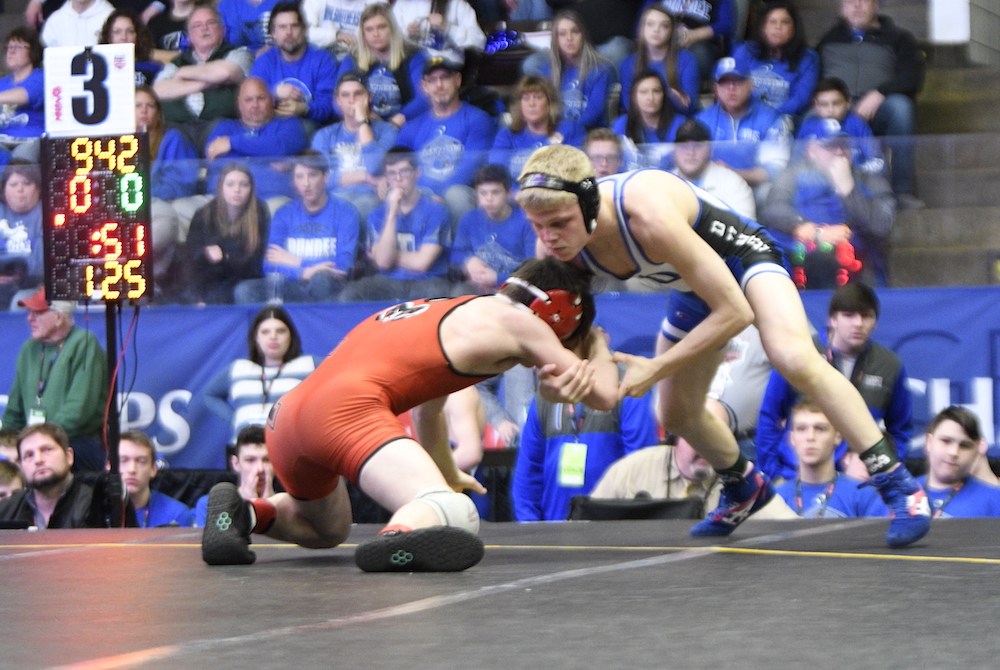
PHOTO: Dundee’s Aiden Davis (right) and Montrose’s Aidan Bernard face off during last season’s Division 3 Semifinals. (Click for more from HighSchoolSportsScene.com.)