

Casting Lines for Future Tournaments
August 12, 2016
By Jack Roberts
MHSAA Executive Director
The MHSAA is best known to the public for the tournaments it conducts to conclude the fall, winter and spring seasons each school year.
These tournaments, the first and largest program of the MHSAA, have survived the Vietnam War, the Korean conflict and two World Wars. They have survived the technology bubble, the housing collapse, the energy crisis and the Great Depression.
MHSAA tournaments existed at the dawn of aviation and at the time of our nation’s lunar landing. Popes, presidents and governors have changed and changed again and again, and MHSAA tournaments roll on year after year.
But the sense of tradition and permanence and inevitability of MHSAA tournaments doesn’t dissuade us from asking questions about our tournaments, even some of the most basic questions. Here are two.
Question #1
I have long been and will always be an advocate for a Ryder Cup format for the MHSAA Golf Finals, and a team tennis approach to the MHSAA Tennis Finals; but 90 years of tradition is hard to overcome. Might this be a more exciting format? Could it be co-ed? Could it reverse the decline in boys tennis participation, and increase girls golf participation? Wouldn’t it be fun to try?
Periodically, the International Olympic Committee requires each of the designated Olympic sports to defend its status, to state its case why the sport should remain a part of the Olympic program. Then, after a series or votes that retain one sport at a time, the IOC drops the sport that makes the weakest case. It does so to make room for one of the previously unlisted sports that makes the best case for inclusion.
This would appear to keep the existing Olympic sports on their toes, and to keep the Olympic movement fresh and reflective of modern trends in sports.
While I would not enjoy the controversy, I can see the potential for some positive results if the MHSAA were to invoke the same policy for determining the 14 tournaments it will provide for girls and the 14 for boys.
This might cause us to consider more deeply what a high school sport should look like, or at least what an MHSAA tournament sport should stand for.
On the one hand, we might be inclined to drop tournaments for those sports that involve mostly non-faculty coaches and non-school venues, or require cooperative programs to generate enough participants to support a team, or resort almost entirely to non-school funding, or cater to individuals more than teams.
Or perhaps this process would cause policymakers to forget traditional thinking and ask: “In this day and age, should we shake off traditional notions of sport and consider more where modern kids are coming from?” That might mean fewer team sports and more individual sports, more “extreme” sports like snowboarding and skateboarding, and more lifetime sports, meaning not just golf and tennis and running sports, but also fishing and even shooting sports.
Currently, MHSAA policy states that the MHSAA will consider sponsorship of a tournament series for any sport which 64 member schools conduct on an interscholastic basis as a result of action by the governing boards of those schools.
Should the only question be how many schools sponsor a sport, or must an activity also have certain qualities and/or avoid certain “defects?” What should an MHSAA tournament sport look like and stand for?
Question #2
Bristling from criticism that his association is a money-grabbing exploiter of children, my counterpart in another state said, “If we were running our programs just to make money, we would do very many things very differently.” I knew exactly what he meant.
Because we care about the health and welfare of students, because we mean what we say that the athletic program needs to maximize the ways it enhances the school experience while minimizing academic conflicts, and because we try to model our claim that no sport is a minor sport when it comes to its potential to teach young people life lessons, we operate our programs in ways that make promoters, marketers and business entrepreneurs laugh, cry or cringe.
If money were the only object, we would seed and select sites to assure the teams that attracted the most spectators had the best chance to advance in our tournaments, regardless of the travel for any team or its fan base. If money were the only object, we would never schedule two tournaments to overlap and compete for public attention, much less tolerate three or four overlapping events. If money were the only object, we would allow signage like NASCAR events and promotions like minor league baseball games.
Those approaches to event sponsorship may not be all wrong; they’re just not all right for us. And we will live with the consequences of our belief system.
During a typical school year, more than 20 percent of the MHSAA’s 2,097 District, Regional and Final tournaments lose money. Not a single site in golf, skiing or tennis makes a single penny. In no sport did every District, Regional and Final site have revenue in excess of direct expenses.
In fact, in only three sports – boys and girls basketball and football – is revenue so much greater than direct expenses overall that it helps to pay for all the other tournaments in which the MHSAA invests.
That’s right: invests. When we present our budget to our board, we talk about the MHSAA’s investment in providing tournament opportunities in all those sports and all those places that cannot sustain the cost of those events on their own. How much is this investment worth to students, schools and society?
These two are core questions that require our focus far in advance of talk about scheduling, site selection, seeding and the myriad matters that too often hijack our time and attention.
1st-Time Finalists Become 1st-Time Champs in D4
By
Keith Dunlap
Special for MHSAA.com
March 27, 2021
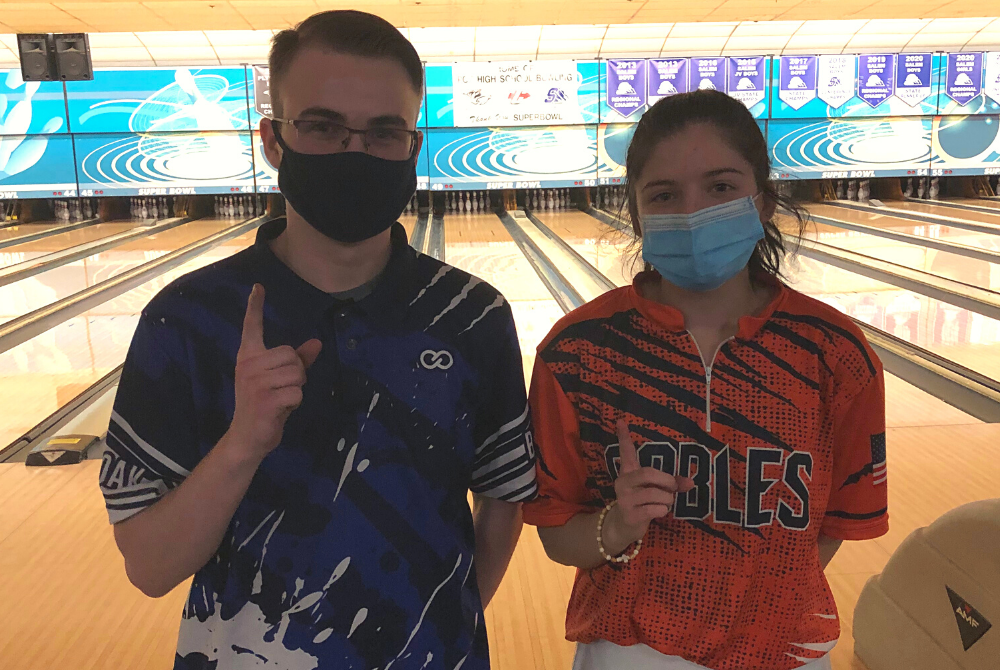
CANTON – Both Burr Oak junior Ethan Lindsay and Gobles sophomore Morgan Brunner obviously hope they qualify for the Division 4 Bowling Finals again during their high school careers.
But if they do, it is certainly going to be hard to top their respective first appearances.
Both not only competed in their first Finals, but they left Super Bowl in Canton with the titles as individual singles champions for 2021.
Lindsay earned his title by beating Stephen Kangas of Ishpeming Westwood in the final, 509-422.
Lindsay all but clinched his championship by bowling a 280 in the first game, a total he wasn’t sure afterwards was a season high or not.
Kangas bowled a 230, but still found himself down 50 pins.
“It was extremely nerve-wracking,” Lindsay said. ‘I would sing songs in my head to distract me from bowling. Anything to take my mind off my opponent and what he was bowling and what I was bowling.”
It was certainly hard for anyone who watched Lindsay’s brilliant day to want to look away from his bowling.
Seeded ninth out of the qualifying block, Lindsay earned a 432-347 win over Aiden Briguglio of Kimball Landmark Academy in the round of 16 before beating Jesse Pancio of Baldwin in a quarterfinal by just two pins, 380-378.
Lindsay then beat Riley Vernon of Ithaca in a semifinal, 355-337, before saving his best pair of games for the final.
At the end, Lindsay was simply thinking about his hometown and the fact he brought a championship back to it.
“It means a lot, especially for my town,” Lindsay said. “We’re a small town in Burr Oak. We’ve got like 300 kids in our school. It’s great to bring back this big trophy to my small town.”
Also bringing back a title to her small town was Brunner, who defeated Ella Wendel of Traverse City Christian in a close championship match.
Brunner prevailed 362-354, knowing she had the title when Wendel wasn’t able to bowl a strike on her first ball of the 10th frame in the second game.
“I was excited,” Brunner said of her mindset coming into her first state tournament. “I’ve been bowling pretty good recently. I just tried to stay positive.”
Brunner was the No. 3 seed out of the qualifying block, and started off by beating Chloe Crick of Maple City Glen Lake in the round of 16, 396-317.
Brunner then beat Arielle Oakley of Vandercook Lake in the quarterfinals, 404-292, and 2020 champ Kassidy Alexander of Hanover-Horton in the semifinals, 376-327, to set up the championship match with Wendel, who was the No. 1 seed out of the qualifying block.
“I was telling myself to stay calm and make good shots,” Brunner said. “It feels good.”
In addition to winning the titles in their first Finals appearances, Lindsay and Brunner did it in what was their only day at Super Bowl of the two-day event.
Their respective teams didn’t qualify for the Friday Team Finals, but it obviously didn’t take Lindsay or Brunner long to get used to the lanes and environment.