

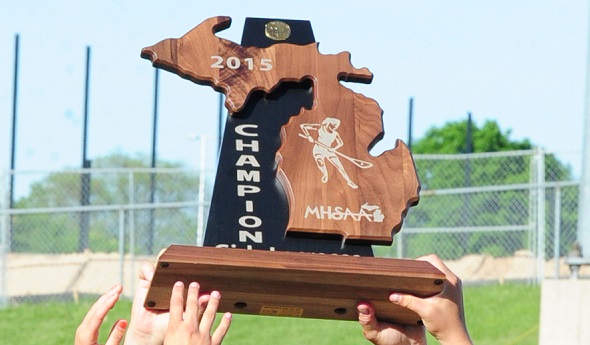
Casting Lines for Future Tournaments
August 12, 2016
By Jack Roberts
MHSAA Executive Director
The MHSAA is best known to the public for the tournaments it conducts to conclude the fall, winter and spring seasons each school year.
These tournaments, the first and largest program of the MHSAA, have survived the Vietnam War, the Korean conflict and two World Wars. They have survived the technology bubble, the housing collapse, the energy crisis and the Great Depression.
MHSAA tournaments existed at the dawn of aviation and at the time of our nation’s lunar landing. Popes, presidents and governors have changed and changed again and again, and MHSAA tournaments roll on year after year.
But the sense of tradition and permanence and inevitability of MHSAA tournaments doesn’t dissuade us from asking questions about our tournaments, even some of the most basic questions. Here are two.
Question #1
I have long been and will always be an advocate for a Ryder Cup format for the MHSAA Golf Finals, and a team tennis approach to the MHSAA Tennis Finals; but 90 years of tradition is hard to overcome. Might this be a more exciting format? Could it be co-ed? Could it reverse the decline in boys tennis participation, and increase girls golf participation? Wouldn’t it be fun to try?
Periodically, the International Olympic Committee requires each of the designated Olympic sports to defend its status, to state its case why the sport should remain a part of the Olympic program. Then, after a series or votes that retain one sport at a time, the IOC drops the sport that makes the weakest case. It does so to make room for one of the previously unlisted sports that makes the best case for inclusion.
This would appear to keep the existing Olympic sports on their toes, and to keep the Olympic movement fresh and reflective of modern trends in sports.
While I would not enjoy the controversy, I can see the potential for some positive results if the MHSAA were to invoke the same policy for determining the 14 tournaments it will provide for girls and the 14 for boys.
This might cause us to consider more deeply what a high school sport should look like, or at least what an MHSAA tournament sport should stand for.
On the one hand, we might be inclined to drop tournaments for those sports that involve mostly non-faculty coaches and non-school venues, or require cooperative programs to generate enough participants to support a team, or resort almost entirely to non-school funding, or cater to individuals more than teams.
Or perhaps this process would cause policymakers to forget traditional thinking and ask: “In this day and age, should we shake off traditional notions of sport and consider more where modern kids are coming from?” That might mean fewer team sports and more individual sports, more “extreme” sports like snowboarding and skateboarding, and more lifetime sports, meaning not just golf and tennis and running sports, but also fishing and even shooting sports.
Currently, MHSAA policy states that the MHSAA will consider sponsorship of a tournament series for any sport which 64 member schools conduct on an interscholastic basis as a result of action by the governing boards of those schools.
Should the only question be how many schools sponsor a sport, or must an activity also have certain qualities and/or avoid certain “defects?” What should an MHSAA tournament sport look like and stand for?
Question #2
Bristling from criticism that his association is a money-grabbing exploiter of children, my counterpart in another state said, “If we were running our programs just to make money, we would do very many things very differently.” I knew exactly what he meant.
Because we care about the health and welfare of students, because we mean what we say that the athletic program needs to maximize the ways it enhances the school experience while minimizing academic conflicts, and because we try to model our claim that no sport is a minor sport when it comes to its potential to teach young people life lessons, we operate our programs in ways that make promoters, marketers and business entrepreneurs laugh, cry or cringe.
If money were the only object, we would seed and select sites to assure the teams that attracted the most spectators had the best chance to advance in our tournaments, regardless of the travel for any team or its fan base. If money were the only object, we would never schedule two tournaments to overlap and compete for public attention, much less tolerate three or four overlapping events. If money were the only object, we would allow signage like NASCAR events and promotions like minor league baseball games.
Those approaches to event sponsorship may not be all wrong; they’re just not all right for us. And we will live with the consequences of our belief system.
During a typical school year, more than 20 percent of the MHSAA’s 2,097 District, Regional and Final tournaments lose money. Not a single site in golf, skiing or tennis makes a single penny. In no sport did every District, Regional and Final site have revenue in excess of direct expenses.
In fact, in only three sports – boys and girls basketball and football – is revenue so much greater than direct expenses overall that it helps to pay for all the other tournaments in which the MHSAA invests.
That’s right: invests. When we present our budget to our board, we talk about the MHSAA’s investment in providing tournament opportunities in all those sports and all those places that cannot sustain the cost of those events on their own. How much is this investment worth to students, schools and society?
These two are core questions that require our focus far in advance of talk about scheduling, site selection, seeding and the myriad matters that too often hijack our time and attention.
Romulus Summit Academy Continuing Impressive Climb
By
Tom Markowski
Special for Second Half
March 17, 2021
As a co-founder of Romulus Summit Academy, Leann Hedke was intent on creating an atmosphere conducive to academic achievement.
 Summit opened its doors in Flat Rock in 1996 for grades K-5, soon expanding to K-12 once the school moved to Romulus the following year. According to Hedke, in the last 10 years 100 percent of those graduating were accepted to a college or university.
Also, according to a 2017 report, Summit had the highest graduation rate among charter schools in Michigan and was ranked in the top 50 by graduation rate during the 2015-2016 school year. Summit, rated No. 17, had a graduation rate of 98.58 percent, nearly 20 percent better than the state average of 79.65.
Mission accomplished.
But something was missing: a competitive athletics program. Often a viable athletic program will enhance academics. A competitive athletic program can generate enthusiasm and give students a reason to be proud of their school, in addition to academics.
Summit Academy North High School didn’t sponsor varsity sports until the early 2000s and, frankly, they weren’t very good, particularly in the sports of boys basketball and football. From 2004-2016 the football team boasted three winning seasons and made the playoffs once (2007). Until the 2019-20 season, the most wins the basketball team totaled was 10.
“Our focus has been on the scholar-athlete,” Hedke said. “We focus on academics. Our GPA (grade-point average) requirements are higher than what the (Michigan High School Athletic Association) requires.”
Hedke said there’s been quite of bit of turnover in the coaching ranks in boys basketball over the years. Part of this is due to the lack of success, as far as wins and losses, but some of this can be attributed to the high standards Hedke and her fellow administrators demand. Swearing is taboo, and a coach is expected to be a stickler for discipline, and must adhere to a strict decorum.
With the backing of Summit athletic director William McKoy, veteran coach Mark White, less than a month before the start of the season, was hired in November of 2018. Summit was 9-12 during White’s first season before showing vast improvement last winter finishing 16-4. Highlighting that season was the school’s first division title (within the Charter School Conference) and a spot in a Division 2 District Final against Flat Rock. Summit has never won a District title so this game loomed as the most important in school history.
Then COVID-19 hit, ending the season.
 Summit returned four starters from that team and is off to a 15-0 start with the MHSAA Tournament less than a week away. Most of its victories have been by double digits including last Saturday’s 71-53 victory over Taylor, a Division 1 school, and Tuesday’s 72-46 victory over Detroit Community in a conference tournament quarterfinal. Summit’s semifinal is scheduled for Thursday.
Two wins stand out in particular, and both came on the road. Summit defeated Harper Woods Chandler Park Academy, 54-51, on March 1 and then upset No. 3-ranked (in Division 2) Detroit Edison, 49-46, on March 8. Edison’s only other loss this season was to Warren De La Salle Collegiate, a Division 1 school, 72-68. Both Chandler Park and Edison are Charter School Conference members and have had strong programs over the years.
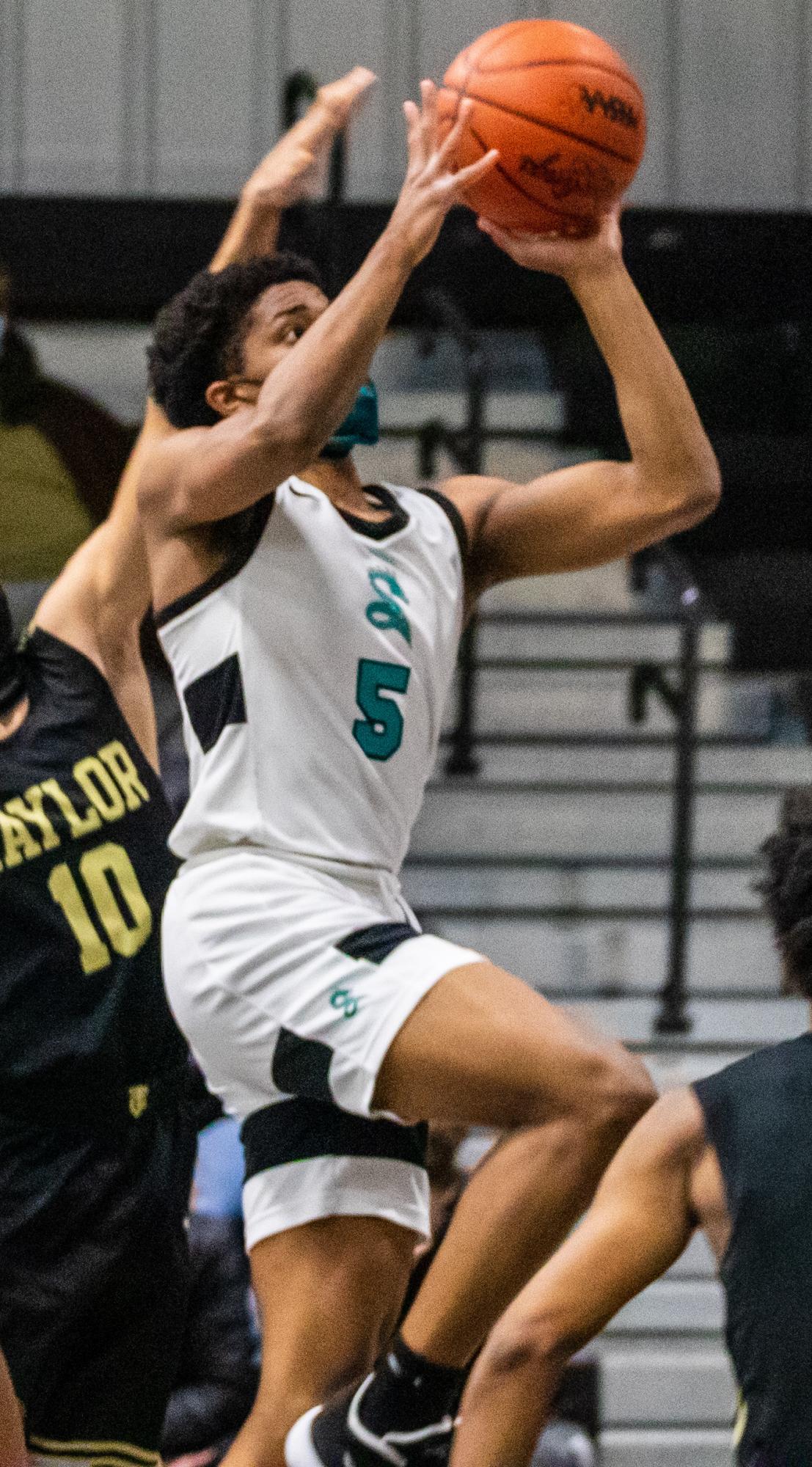
White starts one senior, guard Jamel Johnson, who’s averaging 10 points per game and was selected second-team all-conference. Sophomore James Wright averages 17 points and nine rebounds. White’s top player is junior and three-year starter Orlando Lovejoy, Jr., a 6-2 guard who was selected conference player of the year. His 23 points led Summit in its victory over Community. Lovejoy averages 21 points, 10 rebounds and seven assists per game.
“All of our players got better during the offseason,” Lovejoy said. “(White) is an intense coach. He’s demanding. He’s constantly pushing us. He’s a perfectionist.”
Much of the credit goes to White for the recent success, but one can’t overlook the talented players within the school. Take the recent success of the football program for example. The football team was 0-9 in both 2015 and 2016. The Dragons went 5-4 the next two seasons before finishing 8-3 in 2019, a run which included an 18-12 victory over Redford Union in a Division 4 District opener, the program’s first playoff win. This past regular season was shortened to six games because of the pandemic, and Summit won two playoff games finishing 7-2.
“Summit is an excellent school,” White said. “They’re in line with what I want to be as a coach.
“There are more accolades for a team that hasn’t been that good in the past. (Winning) has never been done before here. I feel the best is yet to come, and not just for the team, but for the school as well. Gaining recognition in basketball helps promote the school. People will find out about how good Summit is as a school.”
Winning is anything but new for White. His first season as a head coach was at his alma mater Detroit Renaissance in 1998. In 2000 Renaissance, which had never played for a Detroit Public School League title, won the PSL defeating Detroit Redford, 41-37, in the championship game. Renaissance won the title again in 2002 and 2003. Renaissance then won two MHSAA Class B titles (2004, 2006) under White.
White left Renaissance after the 2005-06 season to become head coach at Adrian College, another alma mater. He spent seven seasons there before returning to the high school level at River Rouge. White guided River Rouge to the Class B Semifinals in 2017 and 2018.
White said he couldn’t be happier, at this time in his professional life, than he is now at Summit. In addition to his duties as the boys basketball coach, White is also the school’s academic interventionist and assistant athletic director.
 Lovejoy is aware of the success his coach has had at other schools. And even though Summit hasn’t achieved that type of success, he said anything is possible.
“We want to win our conference tournament, a District and Regional title, and the states,” Lovejoy said. “To some that’s farfetched, but it is realistic. We’re with a coach who’s done it before.
“This is special. (Summit) has never won a District, and here we are undefeated. We’re soaking it all in. We want to give the school something to cheer about.”
Lovejoy and his teammates recently gave Hedke a gift from their hearts. It’s a poster, a collage of sorts, with photos of the team in addition to pictures the players painted. This was in response to Hedke being a cancer survivor. She was diagnosed with breast cancer this past November and now is cancer-free.
“Mark is a wonderful coach,” Hedke said. “He focuses on what (the players) do well. He talks about who they are and what they represent. He teaches them to be aware. When I was going through my cancer, he told the players that we’re fighting on the court to win a game. She’s fighting for her life.”
The players have since dedicated their season to Hedke.
 Tom Markowski is a correspondent for the State Champs! Sports Network and previously directed its web coverage. He also covered primarily high school sports for the The Detroit News from 1984-2014, focusing on the Detroit area and contributing to statewide coverage of football and basketball. Contact him at [email protected] with story ideas for Oakland, Macomb and Wayne counties.
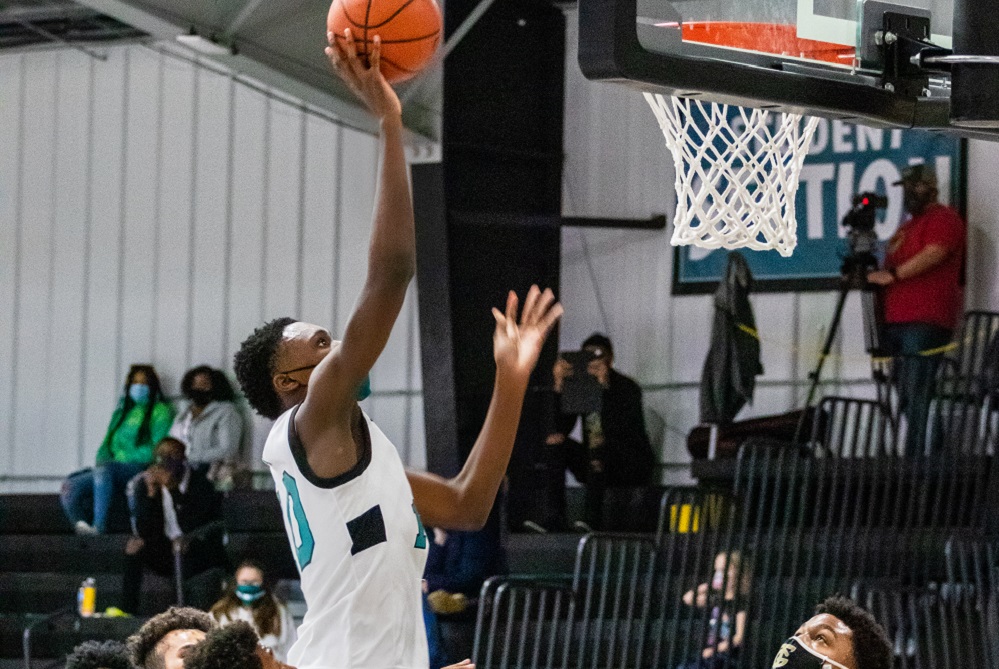
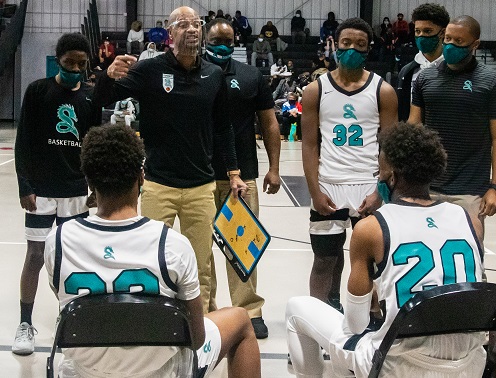
PHOTOS: (Top) Raevon Thomas (10) gets up a shot during Summit Academy’s Senior Night win over Taylor. (Middle) Summit’s Orlando Lovejoy makes a move to the basket Saturday. (Below) Dragons coach Mark White huddles his team. (Photos by Aaron Goodman.)