

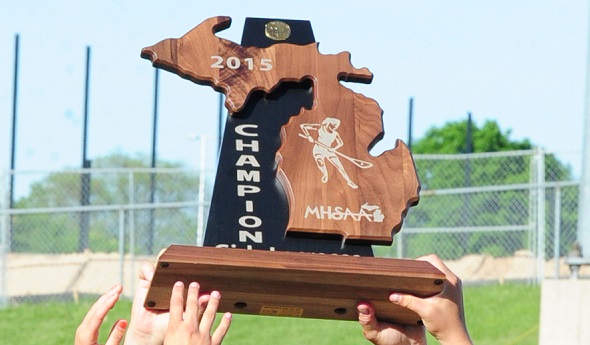
Casting Lines for Future Tournaments
August 12, 2016
By Jack Roberts
MHSAA Executive Director
The MHSAA is best known to the public for the tournaments it conducts to conclude the fall, winter and spring seasons each school year.
These tournaments, the first and largest program of the MHSAA, have survived the Vietnam War, the Korean conflict and two World Wars. They have survived the technology bubble, the housing collapse, the energy crisis and the Great Depression.
MHSAA tournaments existed at the dawn of aviation and at the time of our nation’s lunar landing. Popes, presidents and governors have changed and changed again and again, and MHSAA tournaments roll on year after year.
But the sense of tradition and permanence and inevitability of MHSAA tournaments doesn’t dissuade us from asking questions about our tournaments, even some of the most basic questions. Here are two.
Question #1
I have long been and will always be an advocate for a Ryder Cup format for the MHSAA Golf Finals, and a team tennis approach to the MHSAA Tennis Finals; but 90 years of tradition is hard to overcome. Might this be a more exciting format? Could it be co-ed? Could it reverse the decline in boys tennis participation, and increase girls golf participation? Wouldn’t it be fun to try?
Periodically, the International Olympic Committee requires each of the designated Olympic sports to defend its status, to state its case why the sport should remain a part of the Olympic program. Then, after a series or votes that retain one sport at a time, the IOC drops the sport that makes the weakest case. It does so to make room for one of the previously unlisted sports that makes the best case for inclusion.
This would appear to keep the existing Olympic sports on their toes, and to keep the Olympic movement fresh and reflective of modern trends in sports.
While I would not enjoy the controversy, I can see the potential for some positive results if the MHSAA were to invoke the same policy for determining the 14 tournaments it will provide for girls and the 14 for boys.
This might cause us to consider more deeply what a high school sport should look like, or at least what an MHSAA tournament sport should stand for.
On the one hand, we might be inclined to drop tournaments for those sports that involve mostly non-faculty coaches and non-school venues, or require cooperative programs to generate enough participants to support a team, or resort almost entirely to non-school funding, or cater to individuals more than teams.
Or perhaps this process would cause policymakers to forget traditional thinking and ask: “In this day and age, should we shake off traditional notions of sport and consider more where modern kids are coming from?” That might mean fewer team sports and more individual sports, more “extreme” sports like snowboarding and skateboarding, and more lifetime sports, meaning not just golf and tennis and running sports, but also fishing and even shooting sports.
Currently, MHSAA policy states that the MHSAA will consider sponsorship of a tournament series for any sport which 64 member schools conduct on an interscholastic basis as a result of action by the governing boards of those schools.
Should the only question be how many schools sponsor a sport, or must an activity also have certain qualities and/or avoid certain “defects?” What should an MHSAA tournament sport look like and stand for?
Question #2
Bristling from criticism that his association is a money-grabbing exploiter of children, my counterpart in another state said, “If we were running our programs just to make money, we would do very many things very differently.” I knew exactly what he meant.
Because we care about the health and welfare of students, because we mean what we say that the athletic program needs to maximize the ways it enhances the school experience while minimizing academic conflicts, and because we try to model our claim that no sport is a minor sport when it comes to its potential to teach young people life lessons, we operate our programs in ways that make promoters, marketers and business entrepreneurs laugh, cry or cringe.
If money were the only object, we would seed and select sites to assure the teams that attracted the most spectators had the best chance to advance in our tournaments, regardless of the travel for any team or its fan base. If money were the only object, we would never schedule two tournaments to overlap and compete for public attention, much less tolerate three or four overlapping events. If money were the only object, we would allow signage like NASCAR events and promotions like minor league baseball games.
Those approaches to event sponsorship may not be all wrong; they’re just not all right for us. And we will live with the consequences of our belief system.
During a typical school year, more than 20 percent of the MHSAA’s 2,097 District, Regional and Final tournaments lose money. Not a single site in golf, skiing or tennis makes a single penny. In no sport did every District, Regional and Final site have revenue in excess of direct expenses.
In fact, in only three sports – boys and girls basketball and football – is revenue so much greater than direct expenses overall that it helps to pay for all the other tournaments in which the MHSAA invests.
That’s right: invests. When we present our budget to our board, we talk about the MHSAA’s investment in providing tournament opportunities in all those sports and all those places that cannot sustain the cost of those events on their own. How much is this investment worth to students, schools and society?
These two are core questions that require our focus far in advance of talk about scheduling, site selection, seeding and the myriad matters that too often hijack our time and attention.
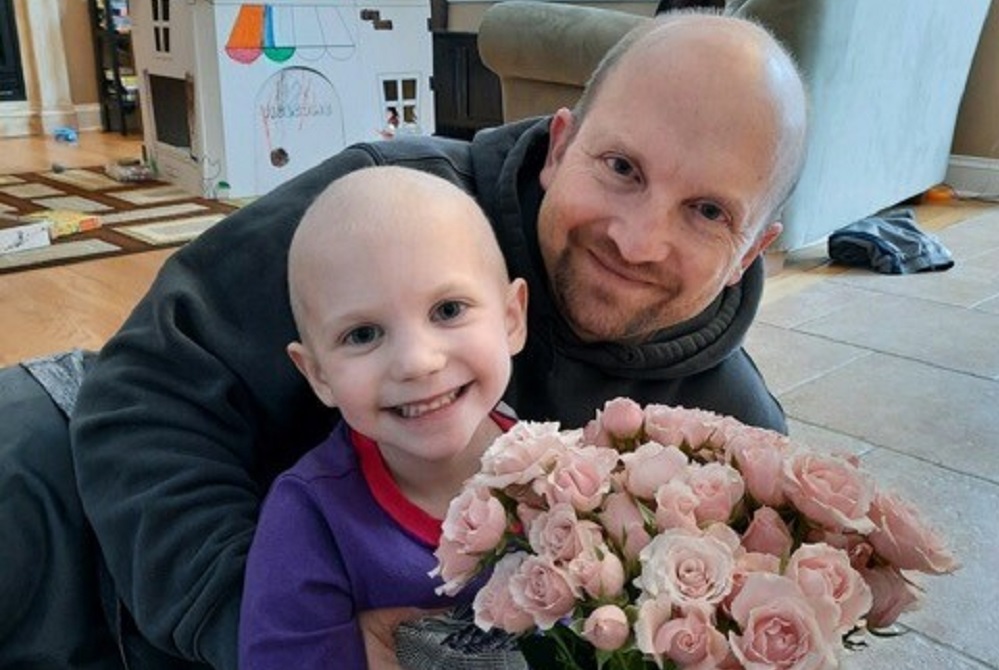
#Charleytough Getting Stronger Amid Outpouring of Support
By
Tim Robinson
Special for MHSAA.com
March 11, 2021
On a recent evening at the home of Corunna boys basketball coach John “Rocky” Buscemi and his wife Chloe, the household is a whirlwind of activity.
 Their daughter Charley, 5, darts in and out of the Buscemis’ home office to ask questions, mimic riding a horse, or whatever else comes to the mind of a little girl full of energy.
The only thing that would tell you that cancer had interrupted their lives for five months in the fall and winter is the hair that just now is starting to grow on Charley’s scalp.
Shock, then Support
Charley Buscemi is named after her grandfather, Charley Silm, who refereed high school basketball for 22 years in and around mid-Michigan when he wasn’t working on the farm. He often took his daughter, Chloe, to games he worked when she was a youngster.
“I remember packing up my little bag with snacks and watch my dad officiate,” Chloe Silm-Buscemi recalled. “Even though I didn’t play basketball, I grew up in the gym, just like Charley did.”
Her daughter has grown up watching her dad coach. She confidently refers to Corunna players as “her boys” and announces that she wants to coach with him some day.
Last summer, Charley was having trouble sleeping, and sleep apnea was diagnosed. Her doctor advised that removing Charley’s tonsils would likely eliminate the apnea.
 The Buscemis agreed, and her tonsils were removed Sept. 25.
“We knew nothing else,” Chloe said, “but apparently the doctor noticed that one of the tonsils looked abnormal, or a little awkward, so he sent it off for testing.”
Chloe said she was told that any complications might require another operation to stop bleeding in the area, but she was stunned when the doctor’s office called back Oct. 1.
“We didn’t know the testing had been done,” Chloe said. “We got a call that said ‘the findings of the pathology are consistent with a diagnosis of lymphoma.’ And we were like, ‘Wait. What?’ It caught us completely off guard. (Charley) was racing in circles around our kitchen island and our dining room table, and I was like, no, you’ve got the wrong kid here. There’s no way this kid has cancer.”
“Initially, it was, this can’t be right,” Rocky said. “I was trying to read between the lines and find some wording that gave some idea that this is what they think. I tried to hang onto the idea that there’s got to be more tests, and those tests will show us that it’s not (cancer).”
The diagnosis was correct. Charley had diffuse large B-cell lymphoma, the most common type of non-Hodgkin lymphoma. It’s a fast-growing cancer that affects B-lymphocytes, a type of blood cell that helps fight infection.
While it is a fast-growing lymphoma, it’s considered potentially curable.
The cancerous cells found in Charley’s tonsil were sent to the Mayo Clinic and the National Institute of Health, and the diagnosis was confirmed.
Charley began chemotherapy at Sparrow Hospital in Lansing and celebrated her fifth birthday there.
Chloe, meanwhile, was also navigating the second trimester of her pregnancy.
“I spent most of my second trimester sleeping on a cot in the hospital while she got chemo treatments,” Chloe said.
“Her first round of chemo was horrible,” Rocky said. “She didn’t react to it well, and we were there 20 of 25 days.”
 But once word got out, people in the Corunna school system, neighbors, fellow coaches and others reached out in the Buscemis’ time of need.
“The schools were so understanding,” Rocky said. “Once we found out, it was, go be with your family. Put in for your (Family and Medical Leave Act). Everyone was supportive from that end.”
The Corunna basketball players drove out to the Buscemi home and raked up its leaves. Some Corunna alumni got together to string up Christmas lights, the Orchard Lake St. Mary’s team sent her a giant stuffed panda, and many more showed support.
“We’re working on thank-yous now,” Chloe said. “My mom says people would know if you posted a thank-you (online), but I want to be able to send something out. Right now there’s something like 250 thank-yous.”
Strength & Sliver Linings
Charley had two rounds of chemotherapy and has been pronounced cancer-free. She has monthly meetings with her oncologist and quarterly CT scans scheduled for the next year.
“They’re watching her heart, because the chemo can affect that, so we meet with the cardiologist,” Chloe says.
“It’s a lot for a little person,” she adds as Charley flits back and forth between parents, announcing at one point she has cleaned her plate at dinner with no small amount of pride. “But for the most part, she’s just like this. She’s pretty happy, pretty easy-going, and takes it in stride. Sometimes I struggle with it more than she does. You feel totally helpless.”
For Rocky, the whole experience is full of silver linings, however hard-won.
“You’re always trying to find the silver linings,’ he said. “We had no idea she had cancer, but the silver lining was once we found out what it was, and it was confined to the tonsil, the blessing was it was almost a miracle we had her tonsils removed almost at the same time it was starting to develop. It wasn’t found anywhere else, so that’s a silver lining.
“Recently she’s been diagnosed as having celiac disease, and we’ve been given the OK to (shift) to a gluten-free diet. If she hadn’t had cancer, we might not have known until she was a teenager and had permanent damage. We’ve been so fortunate and blessed to find things out when we did.”
The Buscemis talk in tones of awe and appreciation for the caring and other gestures that have come their way.
“It’s incredibly humbling,” Rocky said. “It makes you want to do for someone else. I’m much more aware of people in need, and I hope to pay it forward. There are a lot of people you wouldn’t have anticipated reaching out who have reached out.”
The fear and stress of that time, he said, are often near, even with Charley in the clear.
“I wanted to be strong for Chloe and my family and be that rock that could be leaned on,” he said. “But man, oh man, there are still mornings when I drive to school and tear up. It’s nice to have other guys who understand that or have been through it. I’d be the rock here (at home) and then I’d be emotional with my friends in the coaching fraternity.”
Charley and 3-year-old brother Sam were mainstays at practice last year, playing quietly in a corner of the gym while the team practiced. Charley was at most every game, and Rocky always made a point of looking for her and her mother in the stands.
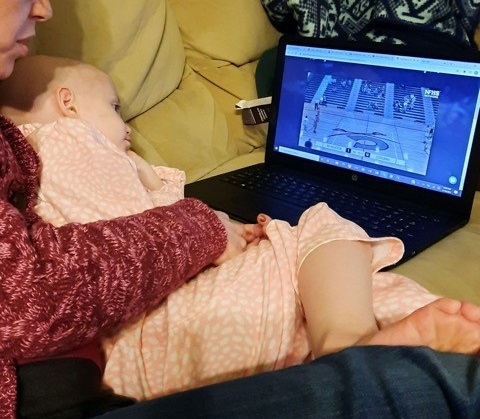
That hasn’t been the case this year, as Charley’s immune system has been weakened by the chemo and has kept her at home this season, watching the Cavaliers play on her mother’s laptop.
There’s been another change, too.
 “I’ve adopted a one-day-at-a-time, appreciate-every-moment approach,” Rocky said. “A year ago in 9-degree weather, I might have been trying to find reasons not to go outside. Now if Charley wants to go sledding, we’re going sledding!”
He laughs as he says that, a man who has a new appreciation of things.
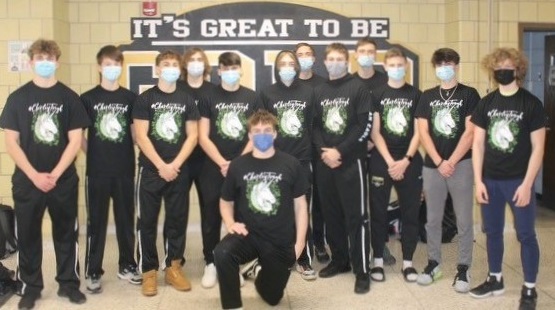
His players have been honoring her, too, wearing black T-shirts at warmups with a large unicorn on the front with the hashtag #Charleytough and the Corunna logo on a basketball.
As for Charley, she will go back to kindergarten next year, but at the moment, she’s anxiously awaiting the birth of her brother or sister March 22.
She already has informed her parents that her new sibling will be a girl, named Maggie, and wants the newborn to sleep in her room.
“She says, ‘Mommy, I’ll feed the baby,’” Chloe said, chuckling. “I told Rocky we don’t have to worry about parenting a third baby. Charley’s got it.”
Besides another new brother or sister, if all goes well, Charley will be back on the sideline with her dad and her basketball team next winter.
Rocky says his family’s experience, among other things, showed him how strong the ties are in the coaching community.
“It was nice to see the game be the bridge that allowed me to reach out and depend on people a little bit,” he said “Without it, you don’t have those relationships. Things like this make you realize how special those things really are. If you don’t experience it, you don’t get to understand people’s true motivations.
“It was humbling,” he added. “It was scary at times, but all in all it was a little bit of everything that helped us to be able to get through this.”
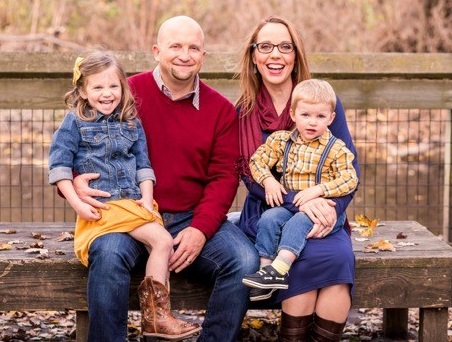
PHOTOS: (Top) Charley Buscemi and her dad Rocky enjoy a fun moment at home. (2) From left: Charley, Rocky, Chloe and Sam Buscemi. (3) Corunna players wear #Charleytough T-shirts as warm-ups for their games. They prominently feature Charley’s favorite animal, a unicorn. (4) Charley’s immune system isn’t robust enough for her to attend games in person, but she never misses a chance to watch “her boys” play on her mom’s laptop. (Photos courtesy of the Buscemi family.)