

Casting Lines for Future Tournaments
August 12, 2016
By Jack Roberts
MHSAA Executive Director
The MHSAA is best known to the public for the tournaments it conducts to conclude the fall, winter and spring seasons each school year.
These tournaments, the first and largest program of the MHSAA, have survived the Vietnam War, the Korean conflict and two World Wars. They have survived the technology bubble, the housing collapse, the energy crisis and the Great Depression.
MHSAA tournaments existed at the dawn of aviation and at the time of our nation’s lunar landing. Popes, presidents and governors have changed and changed again and again, and MHSAA tournaments roll on year after year.
But the sense of tradition and permanence and inevitability of MHSAA tournaments doesn’t dissuade us from asking questions about our tournaments, even some of the most basic questions. Here are two.
Question #1
I have long been and will always be an advocate for a Ryder Cup format for the MHSAA Golf Finals, and a team tennis approach to the MHSAA Tennis Finals; but 90 years of tradition is hard to overcome. Might this be a more exciting format? Could it be co-ed? Could it reverse the decline in boys tennis participation, and increase girls golf participation? Wouldn’t it be fun to try?
Periodically, the International Olympic Committee requires each of the designated Olympic sports to defend its status, to state its case why the sport should remain a part of the Olympic program. Then, after a series or votes that retain one sport at a time, the IOC drops the sport that makes the weakest case. It does so to make room for one of the previously unlisted sports that makes the best case for inclusion.
This would appear to keep the existing Olympic sports on their toes, and to keep the Olympic movement fresh and reflective of modern trends in sports.
While I would not enjoy the controversy, I can see the potential for some positive results if the MHSAA were to invoke the same policy for determining the 14 tournaments it will provide for girls and the 14 for boys.
This might cause us to consider more deeply what a high school sport should look like, or at least what an MHSAA tournament sport should stand for.
On the one hand, we might be inclined to drop tournaments for those sports that involve mostly non-faculty coaches and non-school venues, or require cooperative programs to generate enough participants to support a team, or resort almost entirely to non-school funding, or cater to individuals more than teams.
Or perhaps this process would cause policymakers to forget traditional thinking and ask: “In this day and age, should we shake off traditional notions of sport and consider more where modern kids are coming from?” That might mean fewer team sports and more individual sports, more “extreme” sports like snowboarding and skateboarding, and more lifetime sports, meaning not just golf and tennis and running sports, but also fishing and even shooting sports.
Currently, MHSAA policy states that the MHSAA will consider sponsorship of a tournament series for any sport which 64 member schools conduct on an interscholastic basis as a result of action by the governing boards of those schools.
Should the only question be how many schools sponsor a sport, or must an activity also have certain qualities and/or avoid certain “defects?” What should an MHSAA tournament sport look like and stand for?
Question #2
Bristling from criticism that his association is a money-grabbing exploiter of children, my counterpart in another state said, “If we were running our programs just to make money, we would do very many things very differently.” I knew exactly what he meant.
Because we care about the health and welfare of students, because we mean what we say that the athletic program needs to maximize the ways it enhances the school experience while minimizing academic conflicts, and because we try to model our claim that no sport is a minor sport when it comes to its potential to teach young people life lessons, we operate our programs in ways that make promoters, marketers and business entrepreneurs laugh, cry or cringe.
If money were the only object, we would seed and select sites to assure the teams that attracted the most spectators had the best chance to advance in our tournaments, regardless of the travel for any team or its fan base. If money were the only object, we would never schedule two tournaments to overlap and compete for public attention, much less tolerate three or four overlapping events. If money were the only object, we would allow signage like NASCAR events and promotions like minor league baseball games.
Those approaches to event sponsorship may not be all wrong; they’re just not all right for us. And we will live with the consequences of our belief system.
During a typical school year, more than 20 percent of the MHSAA’s 2,097 District, Regional and Final tournaments lose money. Not a single site in golf, skiing or tennis makes a single penny. In no sport did every District, Regional and Final site have revenue in excess of direct expenses.
In fact, in only three sports – boys and girls basketball and football – is revenue so much greater than direct expenses overall that it helps to pay for all the other tournaments in which the MHSAA invests.
That’s right: invests. When we present our budget to our board, we talk about the MHSAA’s investment in providing tournament opportunities in all those sports and all those places that cannot sustain the cost of those events on their own. How much is this investment worth to students, schools and society?
These two are core questions that require our focus far in advance of talk about scheduling, site selection, seeding and the myriad matters that too often hijack our time and attention.
Inspired by Dad, Southland Sons Give Shores Hoops 2nd-Generation Boost
By
Tom Kendra
Special for MHSAA.com
March 3, 2021
Drew and Jake Southland now have to help their struggling father onto the basketball court at Mona Shores.
 But they know it wasn’t too long ago that Scot Southland was carrying the load for the Sailors’ basketball program.
“People tell me all the time about how good he was,” Drew Southland said of his father, the all-time leading scorer in Mona Shores basketball history with 1,113 career points, who is now battling an even tougher opponent in multiple sclerosis.
“I try to live up to it. He is such an inspiration, with his positive attitude. I try not to complain about anything in my life, that’s for sure.”
Drew, a 6-foot-1 senior, and his team are having a difficult season so far, losing eight in a row before bolting out to a 38-6 halftime lead Tuesday and then cruising to a 64-41 win over visiting Grand Rapids Union. Drew scored a game-high 20 points for the Sailors (2-8).
Jake, a sophomore who is the same height as his brother at 6-1, is the leading scorer and rebounder for the Shores junior varsity, which evened its record at 5-5 on Tuesday, also with a win over GR Union. He scored a season-high 35 points in a loss against Whitehall on Feb. 20.
Win or lose, the Southland boys are always there for their dad, who turned 50 in January. Scot made first-team all-conference in the Ottawa-Kent Conference Red as both a junior and senior, graduating in 1989. He was also a two-time Muskegon Chronicle All-Area selection and averaged better than 20 points per game his senior year.
The first signs of his MS showed up during college, but the symptoms of the progressive nerve disease have become more pronounced in recent years, preventing him from working and even walking on his own. Drew and Jake are always there to help him in and out of his wheelchair and into the family’s van.
“I don’t mind it one bit,” said Jake. “I know he would be taking care of me if it was the other way around. My dad is so good to me and so supportive in everything, so helping him around is really the least I can do.”
Family affair
The Southland family is a fixture at all of Mona Shores’ home games.
Scot is always there at the end of the bleachers on the baseline, with his high school sweetheart and wife, Steffanie, close by his side. Other regulars, when tickets are available with COVID-19 restrictions, are his daughter Mason, his mother Joanne Southland and his mother-in-law Mary Golin.
 Joanne has been going to games at Mona Shores for years as her three boys – Ted, Kip and Scot – worked their way through the system. Kip was a standout basketball player, but his best sport was baseball, as he went on to start at shortstop for Central Michigan University during the mid-1980s and later played in the San Francisco Giants farm system.
Scot started some varsity football games at quarterback, but of the three Southland boys, he was the one who left the biggest mark on the hardcourt.
He was a three-year varsity starter at a time when sophomores rarely started on the varsity, especially at a Class A school. As a junior, he led the Sailors to 13 wins and a rare District championship. As a senior, he became the first Mona Shores basketball player to score 1,000 points – a milestone that the humble, quiet standout wasn’t even cognizant of until after the fact.
“He is out there to set the best example he can,” then-Mona Shores coach John Adams told The Muskegon Chronicle in 1989 about Scot, his senior captain. “He is the All-American, apple pie kid. He’s the perfect role model for the program.”
The strong athletic genes run deep in the family, tracing back to Scot’s maternal grandfather Pete Petroskey, a welterweight boxer who won more than 180 professional fights. Petroskey went on to train some of the best boxers to ever come out of Muskegon, including Kenny Lane and Phil Baldwin, and was inducted into the Muskegon Area Sports Hall of Fame in 2002.
Scot’s athletic achievements continued after high school, as he led the Muskegon Community College basketball team to a runner-up finish at the junior college national tournament in 1990. He later walked on to the University of Arizona football team and made the roster as a backup quarterback.
Scot did some coaching when his kids were younger, but his disease has prevented him from coaching in recent years. He is now the No. 1 fan and encourager for Drew and Jake, as well as Mason, who is having a good year for the Mona Shores eighth-grade girls basketball team.
“The Southland family is very special to Mona Shores basketball,” explained Mona Shores varsity coach Brad Kurth, who missed two games after the death of his mother but returned to guide the Sailors to victory Tuesday night. “Drew and Jake are everything that you can ask for as a coach. They just compete. They go out and give you everything that they have.”
Different perspective
The Mona Shores athletic program has changed drastically since the late 1980s when Scot Southland was leading the Sailors in football and basketball.
Back then, the Sailors struggled to win any games on the football field, but were highly competitive with the likes of Muskegon and Grand Haven in basketball. Now, the Sailors rarely lose a football game and basketball has been looking up at those aforementioned programs over the past 10 years.
 Perhaps no single player has been more affected by the unsettled basketball program as Drew, who has had a different varsity head coach in each of his four years at the high school – as the program has had six head coaches over the past eight years.
“It’s been hard with the different coaches, but I hate making excuses,” said Drew, one of just four seniors on the Shores roster. “We can play much better than we have.”
Through it all, Drew has worked tirelessly to improve his game, waking up early to come in and shoot almost every morning, and still hopes to play college basketball.
Jake, who plays wide receiver and defensive back for the Shores football team and was moved up to the varsity for the team’s recent Division 2 championship run, hopes to be part of a basketball resurgence at Shores over the next two years.
The Sailors have plenty of height and youth on their front line in juniors Donovan Russell (6-8) and Ethan Krueger (6-6) and sophomore Parker Swartz (6-4). With Jake and many other talented players set to move up to the varsity full-time next year, he is hoping to engineer a basketball breakthrough – much like his father did during his junior year of high school.
Jake turned some heads when he got moved up to the varsity for Saturday’s game against Wyoming. In less than two minutes of action, he scored five points and grabbed two rebounds.
“Drew and Jake just love to be out on the basketball court,” said Mona Shores junior varsity coach Tyler VanBergen. “The love that their dad has for the game flows through the whole family.”
Love for the game of basketball, along with humility and a strong work ethic, are not the only gifts Scot has given to his children.
Watching their father handle his illness with grace and a positive attitude – while never wallowing in self-pity or taking his frustrations out on them – has given all three of them a perspective on life which most kids their age simply don’t have.
“I’ve learned from watching him that life isn’t fair,” Jake said. “I mean, I would love to be able to play 1-on-1 against him, but instead we have to do other things. We watch a lot of movies together and talk about them. Doing that with him has really given me a passion for movies, and I’d love to work in film or directing someday.”
 Tom Kendra worked 23 years at The Muskegon Chronicle, including five as assistant sports editor and the final six as sports editor through 2011. E-mail him at [email protected] with story ideas for Muskegon, Oceana, Mason, Lake, Oceola, Mecosta and Newaygo counties.
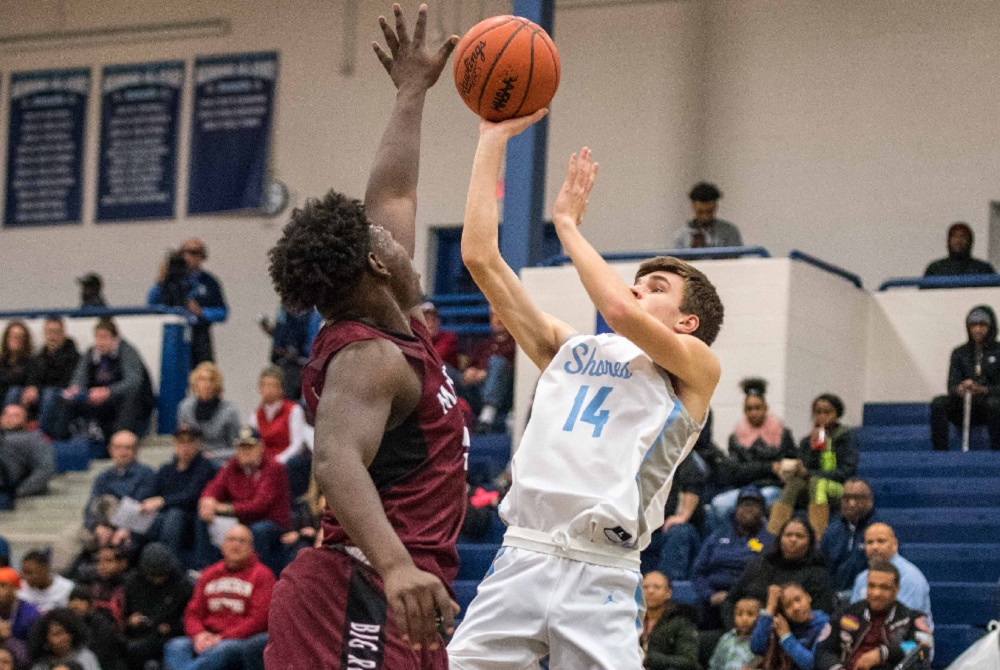
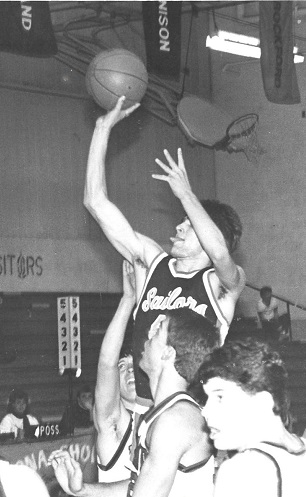
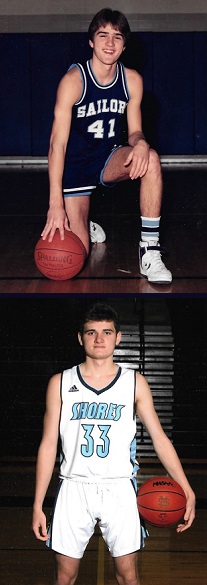
PHOTOS: (Top) Muskegon Mona Shores’ Drew Southland works to get up a shot during a game against Muskegon last season. (Middle) Scot Southland was a standout for Mona Shores before graduating in 1989. (Below) Scot, as a member of the Sailors, and younger son Jake who is playing this season on junior varsity. (Top photo courtesy of Local Sports Journal; additional photos courtesy of Southland family.)