

Casting Lines for Future Tournaments
August 12, 2016
By Jack Roberts
MHSAA Executive Director
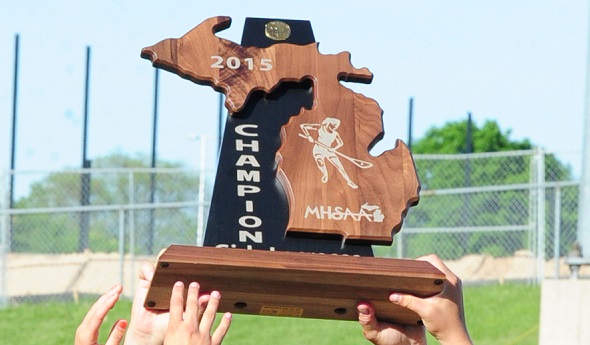
The MHSAA is best known to the public for the tournaments it conducts to conclude the fall, winter and spring seasons each school year.
These tournaments, the first and largest program of the MHSAA, have survived the Vietnam War, the Korean conflict and two World Wars. They have survived the technology bubble, the housing collapse, the energy crisis and the Great Depression.
MHSAA tournaments existed at the dawn of aviation and at the time of our nation’s lunar landing. Popes, presidents and governors have changed and changed again and again, and MHSAA tournaments roll on year after year.
But the sense of tradition and permanence and inevitability of MHSAA tournaments doesn’t dissuade us from asking questions about our tournaments, even some of the most basic questions. Here are two.
Question #1
I have long been and will always be an advocate for a Ryder Cup format for the MHSAA Golf Finals, and a team tennis approach to the MHSAA Tennis Finals; but 90 years of tradition is hard to overcome. Might this be a more exciting format? Could it be co-ed? Could it reverse the decline in boys tennis participation, and increase girls golf participation? Wouldn’t it be fun to try?
Periodically, the International Olympic Committee requires each of the designated Olympic sports to defend its status, to state its case why the sport should remain a part of the Olympic program. Then, after a series or votes that retain one sport at a time, the IOC drops the sport that makes the weakest case. It does so to make room for one of the previously unlisted sports that makes the best case for inclusion.
This would appear to keep the existing Olympic sports on their toes, and to keep the Olympic movement fresh and reflective of modern trends in sports.
While I would not enjoy the controversy, I can see the potential for some positive results if the MHSAA were to invoke the same policy for determining the 14 tournaments it will provide for girls and the 14 for boys.
This might cause us to consider more deeply what a high school sport should look like, or at least what an MHSAA tournament sport should stand for.
On the one hand, we might be inclined to drop tournaments for those sports that involve mostly non-faculty coaches and non-school venues, or require cooperative programs to generate enough participants to support a team, or resort almost entirely to non-school funding, or cater to individuals more than teams.
Or perhaps this process would cause policymakers to forget traditional thinking and ask: “In this day and age, should we shake off traditional notions of sport and consider more where modern kids are coming from?” That might mean fewer team sports and more individual sports, more “extreme” sports like snowboarding and skateboarding, and more lifetime sports, meaning not just golf and tennis and running sports, but also fishing and even shooting sports.
Currently, MHSAA policy states that the MHSAA will consider sponsorship of a tournament series for any sport which 64 member schools conduct on an interscholastic basis as a result of action by the governing boards of those schools.
Should the only question be how many schools sponsor a sport, or must an activity also have certain qualities and/or avoid certain “defects?” What should an MHSAA tournament sport look like and stand for?
Question #2
Bristling from criticism that his association is a money-grabbing exploiter of children, my counterpart in another state said, “If we were running our programs just to make money, we would do very many things very differently.” I knew exactly what he meant.
Because we care about the health and welfare of students, because we mean what we say that the athletic program needs to maximize the ways it enhances the school experience while minimizing academic conflicts, and because we try to model our claim that no sport is a minor sport when it comes to its potential to teach young people life lessons, we operate our programs in ways that make promoters, marketers and business entrepreneurs laugh, cry or cringe.
If money were the only object, we would seed and select sites to assure the teams that attracted the most spectators had the best chance to advance in our tournaments, regardless of the travel for any team or its fan base. If money were the only object, we would never schedule two tournaments to overlap and compete for public attention, much less tolerate three or four overlapping events. If money were the only object, we would allow signage like NASCAR events and promotions like minor league baseball games.
Those approaches to event sponsorship may not be all wrong; they’re just not all right for us. And we will live with the consequences of our belief system.
During a typical school year, more than 20 percent of the MHSAA’s 2,097 District, Regional and Final tournaments lose money. Not a single site in golf, skiing or tennis makes a single penny. In no sport did every District, Regional and Final site have revenue in excess of direct expenses.
In fact, in only three sports – boys and girls basketball and football – is revenue so much greater than direct expenses overall that it helps to pay for all the other tournaments in which the MHSAA invests.
That’s right: invests. When we present our budget to our board, we talk about the MHSAA’s investment in providing tournament opportunities in all those sports and all those places that cannot sustain the cost of those events on their own. How much is this investment worth to students, schools and society?
These two are core questions that require our focus far in advance of talk about scheduling, site selection, seeding and the myriad matters that too often hijack our time and attention.
1st & Goal: 11-Player Semifinals Preview
January 15, 2021
By Geoff Kimmerly
Second Half editor
Five months have passed since the first football practices of this season.
But 24 hours from now, 16 11-player teams will have earned tickets to the destination they’ve been dreaming about since long before those first snaps of the fall.
The last outdoor MHSAA football games of January 2021 will send 15 more teams to Ford Field for the Jan. 22-23 Finals, with Semifinals to be played all over the Lower Peninsula (and one finalist already decided as Centreville will advance after a forfeit).
Spectators remain limited this weekend, but every game will be streamed live by FOX Sports Detroit or MHSAA.com – Click for the list of broadcasts.
Visit the MHSAA Football Playoff Home for Saturday’s entire schedule and scores as they come in, and see below for a glance at the matchups that will determine this season’s championship weekend field.
Division 1
Davison (10-0) at Rockford (8-0)
Reigning Division 1 champion Davison might be missing quarterback Brendan Sullivan, now at Northwestern, but Dion Brown Jr. stepped in mightily last week after leading the team in receiving prior to the move. Carter Cryderman (848 yards/11 TDs) paces a rushing attack averaging 215 yards per game. The Rams have succeeded with a similar style, averaging 222 yards on the ground with lead back Ethan Nash and quarterback Zak Ahern combining for 1,217 yards and 14 touchdowns rushing. Ahern also has 20 touchdowns passes.
West Bloomfield (9-1) at Belleville (10-0)
Two of the most exciting offensive stars in the state will face off among a collection of future college players taking the field in this Semifinal. West Bloomfield running back Donovan Edwards ran for four touchdowns in last week’s return-to-play Regional Final win over Romeo, while Belleville quarterback Christian Dhue-Reid threw three touchdowns passes as the Tigers handed Detroit Cass Tech its lone loss of this season.
Division 2
Traverse City Central (9-1) at Muskegon Mona Shores (10-0)
Shores quarterback Brady Rose started his star run stepping in for an injured all-stater at last year’s Final and leading the Sailors to the Division 2 title. Now he has his team one win from returning to Ford Field having run for 1,057 yards and 17 touchdowns and thrown for 949 yards and 10 scores this season. The Trojans are playing for their first Finals berth since 1988, before the old Traverse City High split into Central and West. Josh Burnham is another standout quarterback, with 903 yards and 18 TDs rushing and 1,215 yards and 16 scores through the air.
Oak Park (5-5) at Warren De La Salle Collegiate (6-4)
Oak Park is one of the best stories so far of this playoffs, as it entered the first all-in postseason in MHSAA football history with a single victory. Running back Davion Primm is another of the top talents in the entire state and the focus of an offense that scored 25 points total over five regular-season games followed by a combined 119 over four playoff wins. The Pilots will attempt to end that dream run, in part with a defense that has given up only 23 points during the postseason. Brady Drogosh (949 yards/9 TDs passing) directs a balanced attack.
Division 3
Muskegon (9-1) vs. DeWitt (10-0) at Lansing Catholic
These two have met in the playoffs two of the last three seasons, and Muskegon won the 2019 Semifinal matchup 28-21. Senior Amari Crowley is the Big Reds’ latest standout quarterback; he’s thrown for 1,008 yards and 12 touchdowns and run for 884 yards and 13 scores. DeWitt also has a playmaking QB, with Tyler Holtz throwing for 2,109 yards and 31 scores – and equally important will be a defense that gives up only 157 total yards per game. The Panthers also must stop running back Jacarri Kitchen, who averages 11.3 yards per carry and has 1,098 total over 10 games.
River Rouge (8-1) at Chelsea (10-0)
Reigning Division 3 champion River Rouge is a win away from what would be a third championship game appearance in six seasons, and with quarterback Mareyohn Hrabowski again one of the toughest to stop in any division. Chelsea is playing in a Semifinal for the third-straight season and also hoping to make the Finals for the third time in six seasons. The Bulldogs also have enjoyed one of the state’s top game changers, receiver Joe Taylor, who has caught 14 touchdowns passes, run for two scores and returned a kickoff for one more.
Division 4
Cadillac (7-2) at Edwardsburg (9-0)
The Eddies are running for their third championship game appearance in four seasons, and as always running for a ton with 3,098 yards in only eight games on the field (the ninth was a forfeit). They’re averaging 55 points per game with their top two rushers, Jackson Hoover and Brett Allen, both averaging at least 14 yards per carry. Cadillac is making its first appearance in the Semifinals and following the same strategy. The Vikings have run for 2,507 yards, with top rusher Aden Gurden gaining 878 on 8.4 per carry.
Detroit Country Day (7-2) vs. Williamston (9-1) at Okemos
Reigning Division 4 runner-up Country Day is playing to reach its third championship game in five seasons. The Yellowjackets were able to get only four games in during the regular season but have played the same number during the playoffs and downed unbeaten North Branch last week. Jacob Yarberry is a playmaker to watch on both sides of the field. The Hornets have been on the verge as well with this their second Semifinal in three seasons. Williamston’s attack is tough on both fronts; quarterback Luke Mahaney guides an offense that has nearly equal yardage and touchdowns rushing and passing.
Division 5
Freeland (9-1) at Grand Rapids Catholic Central (9-0)
The Cougars claimed the Division 4 title last season, their third in four years, and are riding a 21-game winning streak. They returned last week with their highest-scoring performance since 2018, a 58-7 win over Muskegon Oakridge. Freeland’s 14th-straight winning season has landed the Falcons in their first Semifinal since 1998. Four players have scored at least six touchdowns; leading rusher Jacob Kundinger (519 yards) is one of three with a team-best eight touchdowns.
Lansing Catholic (8-2) at Frankenmuth (10-0)
The Eagles are attempting to reach the Finals for the first time, but standing in the way is reigning Division 5 champion Lansing Catholic. Junior Alex Watters stepped in at quarterback last week and finished with 153 yards rushing with a touchdown and 73 yards and a score passing. Frankenmuth will be playing in its third Semifinal in five seasons, this time paced by a running attack averaging 286 yards per game. Cole Lindow is the top ground gainer with 907 yards, plus 12 scores, with quarterback Davin Reif adding more than 800 yards rushing and throwing.
Division 6
Grayling (7-3) at Montague (10-0)
After winning Division 6 in 2018, the Wildcats missed a return trip to the Finals by a one-point Semifinal loss last fall. Quarterback Drew Collins is leading the return attempt, topping the team in rushing with 638 yards (with 16 touchdowns) while passing for 1,640 yards and 20 scores. After two straight 3-6 seasons, Grayling has reached its first Semifinal with a six-game winning streak. David Millikin is averaging 10.1 yards per carry and 151 per game, with 29 rushing touchdowns total.
Constantine (9-1) at Clinton (9-1)
Clinton will be playing in its first Semifinal since 2015 after winning its last two playoff games, over unbeaten opponents, by a combined four points. Constantine has reached nine wins and the Semifinals both for the first time since 2012. The Falcons are averaging an obliterating 524 yards and 7.5 touchdowns on the ground per game.
Division 7
Traverse City St. Francis (8-2) at Cass City (10-0)
Cass City earned home field for its Semifinal with a road win last week over undefeated Ithaca. This will be the second-straight appearance in this round for the Red Hawks, who average 339 rushing yards per game behind backs Alex Perry (897 yards/13 TDs) and Jordan Mester (847/11 TDs). St. Francis also dominates in the ground game, averaging 215 rush yards per game led by Owen Mueller (523 yards/5 TDs) among a large group of contributing backs.
Schoolcraft (9-1) at New Lothrop (9-0)
The Hornets will be playing in their third Semifinal in six seasons and are looking to win their second Division 7 title in three seasons. No opponent has scored more than 16 points against them, which works well with an offense scoring 50 points per game. Quarterback Cam Orr (1,721 yards/24 TDs passing, 569 yards/16 TDs rushing) is among standouts. Schoolcraft turned its third-straight Regional Finals run into its first Semifinal since 2001. Alex Thole has thrown for 2,288 yards and 32 touchdowns. The Eagles downed reigning Division 7 runner-up Jackson Lumen Christi 29-22 last week and handed Division 6 semifinalist Constantine its only loss, in the season opener.
Division 8
Ubly (8-2) at Johannesburg-Lewiston (10-0)
Johannesburg-Lewiston also earned a home Semifinal after a Regional Final road trip, edging Iron Mountain 7-6 last week at the Superior Dome. Sheldon Huff paces another dominating running attack, averaging 9.3 yards per carry for 1,295 total and 16 touchdowns on the ground. This will be the Cardinals’ first Semifinal since 1998, but Ubly’s second straight and third in four seasons. The Bearcats missed Ford Field in 2019 with a one-point loss to Beal City.
NOTE: Centreville (10-0) advanced to the Division 8 Final after Clarkston Everest Collegiate had to withdraw from the playoffs this week.
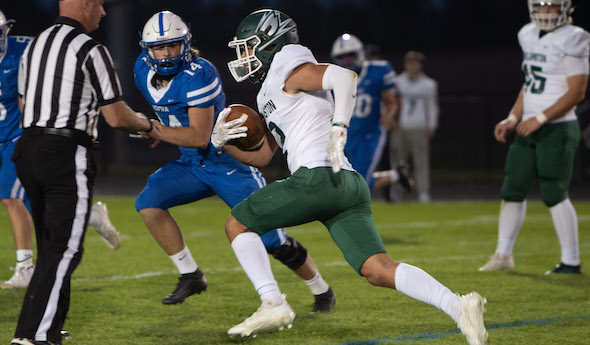
PHOTO: Williamston, here during a 45-7 win over Ionia in Week 7, is back in the Semifinals this weekend for the second time in three seasons. (Click to see more from HighSchoolSportsScene.com.)