

Casting Lines for Future Tournaments
August 12, 2016
By Jack Roberts
MHSAA Executive Director
The MHSAA is best known to the public for the tournaments it conducts to conclude the fall, winter and spring seasons each school year.
These tournaments, the first and largest program of the MHSAA, have survived the Vietnam War, the Korean conflict and two World Wars. They have survived the technology bubble, the housing collapse, the energy crisis and the Great Depression.
MHSAA tournaments existed at the dawn of aviation and at the time of our nation’s lunar landing. Popes, presidents and governors have changed and changed again and again, and MHSAA tournaments roll on year after year.
But the sense of tradition and permanence and inevitability of MHSAA tournaments doesn’t dissuade us from asking questions about our tournaments, even some of the most basic questions. Here are two.
Question #1
I have long been and will always be an advocate for a Ryder Cup format for the MHSAA Golf Finals, and a team tennis approach to the MHSAA Tennis Finals; but 90 years of tradition is hard to overcome. Might this be a more exciting format? Could it be co-ed? Could it reverse the decline in boys tennis participation, and increase girls golf participation? Wouldn’t it be fun to try?
Periodically, the International Olympic Committee requires each of the designated Olympic sports to defend its status, to state its case why the sport should remain a part of the Olympic program. Then, after a series or votes that retain one sport at a time, the IOC drops the sport that makes the weakest case. It does so to make room for one of the previously unlisted sports that makes the best case for inclusion.
This would appear to keep the existing Olympic sports on their toes, and to keep the Olympic movement fresh and reflective of modern trends in sports.
While I would not enjoy the controversy, I can see the potential for some positive results if the MHSAA were to invoke the same policy for determining the 14 tournaments it will provide for girls and the 14 for boys.
This might cause us to consider more deeply what a high school sport should look like, or at least what an MHSAA tournament sport should stand for.
On the one hand, we might be inclined to drop tournaments for those sports that involve mostly non-faculty coaches and non-school venues, or require cooperative programs to generate enough participants to support a team, or resort almost entirely to non-school funding, or cater to individuals more than teams.
Or perhaps this process would cause policymakers to forget traditional thinking and ask: “In this day and age, should we shake off traditional notions of sport and consider more where modern kids are coming from?” That might mean fewer team sports and more individual sports, more “extreme” sports like snowboarding and skateboarding, and more lifetime sports, meaning not just golf and tennis and running sports, but also fishing and even shooting sports.
Currently, MHSAA policy states that the MHSAA will consider sponsorship of a tournament series for any sport which 64 member schools conduct on an interscholastic basis as a result of action by the governing boards of those schools.
Should the only question be how many schools sponsor a sport, or must an activity also have certain qualities and/or avoid certain “defects?” What should an MHSAA tournament sport look like and stand for?
Question #2
Bristling from criticism that his association is a money-grabbing exploiter of children, my counterpart in another state said, “If we were running our programs just to make money, we would do very many things very differently.” I knew exactly what he meant.
Because we care about the health and welfare of students, because we mean what we say that the athletic program needs to maximize the ways it enhances the school experience while minimizing academic conflicts, and because we try to model our claim that no sport is a minor sport when it comes to its potential to teach young people life lessons, we operate our programs in ways that make promoters, marketers and business entrepreneurs laugh, cry or cringe.
If money were the only object, we would seed and select sites to assure the teams that attracted the most spectators had the best chance to advance in our tournaments, regardless of the travel for any team or its fan base. If money were the only object, we would never schedule two tournaments to overlap and compete for public attention, much less tolerate three or four overlapping events. If money were the only object, we would allow signage like NASCAR events and promotions like minor league baseball games.
Those approaches to event sponsorship may not be all wrong; they’re just not all right for us. And we will live with the consequences of our belief system.
During a typical school year, more than 20 percent of the MHSAA’s 2,097 District, Regional and Final tournaments lose money. Not a single site in golf, skiing or tennis makes a single penny. In no sport did every District, Regional and Final site have revenue in excess of direct expenses.
In fact, in only three sports – boys and girls basketball and football – is revenue so much greater than direct expenses overall that it helps to pay for all the other tournaments in which the MHSAA invests.
That’s right: invests. When we present our budget to our board, we talk about the MHSAA’s investment in providing tournament opportunities in all those sports and all those places that cannot sustain the cost of those events on their own. How much is this investment worth to students, schools and society?
These two are core questions that require our focus far in advance of talk about scheduling, site selection, seeding and the myriad matters that too often hijack our time and attention.
Kicker Steps Into Historic Moment
December 8, 2020
By Doug Donnelly
Special for Second Half
CLINTON – After what Jonathan Baughey has gone through, kicking a football through two yellow goal posts doesn’t seem like a very big deal.

But, when it came against an undefeated, state-ranked team on the last play of the Division 6 District championship game, it was just that.
“It was definitely a scary moment,” said Baughey, a junior from Clinton High School in Lenawee County.
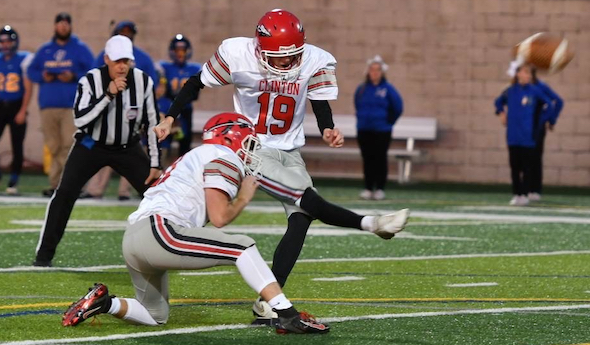
Baughey’s 22-yard field goal as time expired gave Clinton a 16-13 victory over Blissfield and sent his team into a Regional Final against Warren Michigan Collegiate.
It’s been a long road for Baughey, who thought that after a successful kidney transplant in 2015 that his football career was over. At the urging of a family friend and Clinton middle school coach, however, Baughey tried kicking. It was a good choice as he’s now etched his name into Clinton football lore by making probably the biggest field goal in school history.
 “He’s been through so much, and I couldn’t be happier for him,” said Clinton football coach Jeremy Fielder. “We had a lot confidence in him kicking in that situation. There was no hesitation.”
Baughey was born with one kidney functioning at 25 percent and the other at 75.
“From birth he always had kidney issues,” said his mother, Kelly Baughey. “We knew growing up he would need a transplant. They tested his father and I, and we were both matches. His dad (Kevin) decided that he wanted to do it for him. He was his donor.”
Kevin Baughey never hesitated.
“It wasn’t a decision at all,” he said. “I would have given him both if I needed to.”
For years, dealing with the kidney issue was just part of Jonathan’s life. He would tire easier than other kids, but he learned to cope with it.
“I was more of a tired kid,” Baughey said. “When I was younger, it wasn’t about contact, it was about how tired I would get. I couldn’t keep up with a lot of other kids. It was hard.”
He had a kidney removed in December of 2012. After that, he said, “it was a roller coaster.” The transplant didn’t come until June of 2015, soon after he finished the sixth grade.
It took roughly six weeks in the hospital for Baughey to recover from the transplant.
“As soon as I had the transplant, I started feeling better than I had felt,” he said. “I had more energy.”
Baughey played flag football as a kid and had started playing tackle football. But when he neared the time for a transplant, he figured his football days were done. That’s when family friend and Clinton middle school coach Keith Tschirhart suggested he try kicking for the Clinton middle school team.
“I had played soccer and thought it was something I could do, so I tried it,” Baughey said. “I went out with him to the football field to see how I would do. It was pretty rough at the beginning. It took some time.”
He didn’t get much practice that first season.
“We never really kicked extra points,” he said.
Baughey kept working at it though and made it through his eighth-grade season. As a freshman he figured he would continue kicking, most likely for the Clinton JV team. He went to the tryouts.
“I kicked my first football and the coach said I was on the varsity,” he said.
Fielder said Baughey made an immediate impact.
“We didn’t have a kicker,” he said. “We had no one. I even told the coaches, ‘What are we going to do?’ Then, I saw him kick the ball and it was like, ‘He’s our kicker.’”
 It was big adjustment for Baughey. Not only had he once thought he would never play football again – but he found himself suddenly on the varsity as a freshman, not knowing anyone on the team. And, being exclusively a kicker, meant he practiced mainly by himself.
“That was the struggle that I went through,” he said. “I didn’t know anyone. The only kids I knew were the snapper and the holder.”
Clinton grad Erik Bouse stepped in to help Baughey. Bouse had been a standout kicker for Clinton for three seasons before graduating in 2017.
“He was the one who I mainly worked with,” Baughey said. “He helped me a lot. He really started me out not creating bad habits and helped with the mental part of it.”
As a freshman, Baughey made 42 of his 50 extra-point attempts and a 21-yard field goal. As a sophomore he made 48 of 54 with a 19-yard field goal. This season he has made 29 of 37 extra-point attempts. The winning field goal against Blissfield was his only field goal of the season, on two tries.
Baughey is exclusively a kicker because of the potential risk of injury following the transplant. He wears a special pad on his stomach under his uniform because that is where doctors put his new kidney.
His mother said the no-contact rule causes some angst for her.
“He knows there is a chance he could get hit,” she said. “He wears a shield for padding. The transplant team has okayed him to play.”
Baughey practices every day, often by himself. He goes to the game field and starts at the extra point yardage and works his way back, making at least two kicks at each distance before moving on to the next level. He’ll use his cell phone to record himself, then watch the videos to make sure he is kicking correctly and not developing bad habits.
“The biggest part for me is to go out and know that I can do it,” he said. “You have to know you are going to kick it through the uprights, not just think you are going to. I like to pick out a small target, even a leaf or something, and just clear my mind and just kick the ball.”
When Clinton got the ball back with just over three minutes to go in the District Final against Blissfield, Baughey started thinking the game might come down to his foot.
“I went to the net and started kicking,” he said.
Clinton drove the ball inside the Blissfield 10-yard line, but did not reach the end zone. Fielder called a timeout on fourth down with only a few seconds left. Baughey jogged onto the field and lined up when Blissfield called a timeout.
“I remember walking to the sidelines and taking a deep breath,” he said. “People came up and talked to me and told me I could do it”
Baughey blocked everything out.
“I was really mentally focused,” he said. “After I made the kick, I started clapping. I turned around and all my teammates were jumping up and down. I ran to our coaches and everyone started hugging.”
His father, his donor, could not have been happier to see the ball go through the uprights.
“I was beside myself happy,” Kevin Baughey said. “Thinking about all of the time he spent working in the offseason, and then seeing the confidence his coaches showed with making the call to go for the field goal ... I was as proud as I could possibly be.”
 Doug Donnelly has served as a sports and news reporter and city editor over 25 years, writing for the Daily Chief-Union in Upper Sandusky, Ohio from 1992-1995, the Monroe Evening News from 1995-2012 and the Adrian Daily Telegram since 2013. He's also written a book on high school basketball in Monroe County and compiles record books for various schools in southeast Michigan. E-mail him at [email protected] with story ideas for Jackson, Washtenaw, Hillsdale, Lenawee and Monroe counties.
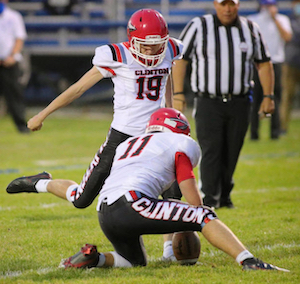
PHOTOS: (Top) Clinton's Jonathan Baughey connects on a kick. (Middle) Baughey, following through on another kick this season, clinched his team's District title with a game-winning field goal. (Photos courtesy of the Clinton football program.)