

Casting Lines for Future Tournaments
August 12, 2016
By Jack Roberts
MHSAA Executive Director
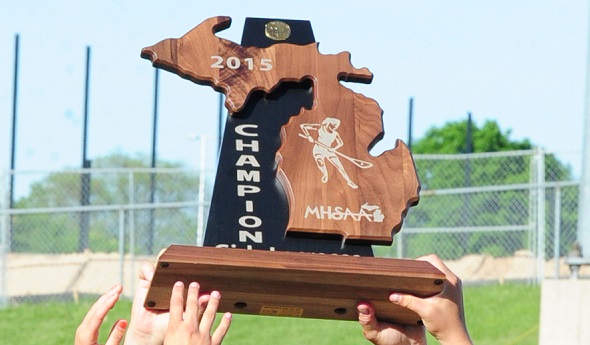
The MHSAA is best known to the public for the tournaments it conducts to conclude the fall, winter and spring seasons each school year.
These tournaments, the first and largest program of the MHSAA, have survived the Vietnam War, the Korean conflict and two World Wars. They have survived the technology bubble, the housing collapse, the energy crisis and the Great Depression.
MHSAA tournaments existed at the dawn of aviation and at the time of our nation’s lunar landing. Popes, presidents and governors have changed and changed again and again, and MHSAA tournaments roll on year after year.
But the sense of tradition and permanence and inevitability of MHSAA tournaments doesn’t dissuade us from asking questions about our tournaments, even some of the most basic questions. Here are two.
Question #1
I have long been and will always be an advocate for a Ryder Cup format for the MHSAA Golf Finals, and a team tennis approach to the MHSAA Tennis Finals; but 90 years of tradition is hard to overcome. Might this be a more exciting format? Could it be co-ed? Could it reverse the decline in boys tennis participation, and increase girls golf participation? Wouldn’t it be fun to try?
Periodically, the International Olympic Committee requires each of the designated Olympic sports to defend its status, to state its case why the sport should remain a part of the Olympic program. Then, after a series or votes that retain one sport at a time, the IOC drops the sport that makes the weakest case. It does so to make room for one of the previously unlisted sports that makes the best case for inclusion.
This would appear to keep the existing Olympic sports on their toes, and to keep the Olympic movement fresh and reflective of modern trends in sports.
While I would not enjoy the controversy, I can see the potential for some positive results if the MHSAA were to invoke the same policy for determining the 14 tournaments it will provide for girls and the 14 for boys.
This might cause us to consider more deeply what a high school sport should look like, or at least what an MHSAA tournament sport should stand for.
On the one hand, we might be inclined to drop tournaments for those sports that involve mostly non-faculty coaches and non-school venues, or require cooperative programs to generate enough participants to support a team, or resort almost entirely to non-school funding, or cater to individuals more than teams.
Or perhaps this process would cause policymakers to forget traditional thinking and ask: “In this day and age, should we shake off traditional notions of sport and consider more where modern kids are coming from?” That might mean fewer team sports and more individual sports, more “extreme” sports like snowboarding and skateboarding, and more lifetime sports, meaning not just golf and tennis and running sports, but also fishing and even shooting sports.
Currently, MHSAA policy states that the MHSAA will consider sponsorship of a tournament series for any sport which 64 member schools conduct on an interscholastic basis as a result of action by the governing boards of those schools.
Should the only question be how many schools sponsor a sport, or must an activity also have certain qualities and/or avoid certain “defects?” What should an MHSAA tournament sport look like and stand for?
Question #2
Bristling from criticism that his association is a money-grabbing exploiter of children, my counterpart in another state said, “If we were running our programs just to make money, we would do very many things very differently.” I knew exactly what he meant.
Because we care about the health and welfare of students, because we mean what we say that the athletic program needs to maximize the ways it enhances the school experience while minimizing academic conflicts, and because we try to model our claim that no sport is a minor sport when it comes to its potential to teach young people life lessons, we operate our programs in ways that make promoters, marketers and business entrepreneurs laugh, cry or cringe.
If money were the only object, we would seed and select sites to assure the teams that attracted the most spectators had the best chance to advance in our tournaments, regardless of the travel for any team or its fan base. If money were the only object, we would never schedule two tournaments to overlap and compete for public attention, much less tolerate three or four overlapping events. If money were the only object, we would allow signage like NASCAR events and promotions like minor league baseball games.
Those approaches to event sponsorship may not be all wrong; they’re just not all right for us. And we will live with the consequences of our belief system.
During a typical school year, more than 20 percent of the MHSAA’s 2,097 District, Regional and Final tournaments lose money. Not a single site in golf, skiing or tennis makes a single penny. In no sport did every District, Regional and Final site have revenue in excess of direct expenses.
In fact, in only three sports – boys and girls basketball and football – is revenue so much greater than direct expenses overall that it helps to pay for all the other tournaments in which the MHSAA invests.
That’s right: invests. When we present our budget to our board, we talk about the MHSAA’s investment in providing tournament opportunities in all those sports and all those places that cannot sustain the cost of those events on their own. How much is this investment worth to students, schools and society?
These two are core questions that require our focus far in advance of talk about scheduling, site selection, seeding and the myriad matters that too often hijack our time and attention.
Rouge Primed for 1st-Time Repeat Attempt
By
Tom Markowski
Special for Second Half
September 17, 2020
Mareyohn Hrabowski has a tough act to follow after a historic season for the River Rouge football program.
 All the same, Hrabowski, now a senior quarterback for coach Corey Parker, is just thankful he and his teammates will get that opportunity.
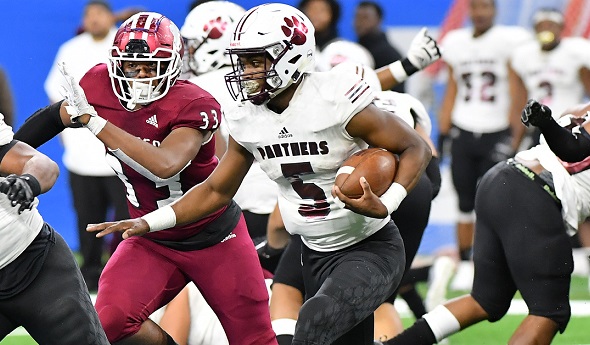
Hrabowski’s three rushing touchdowns led the Panthers to a 30-7 victory over Muskegon in the Division 3 title game last November at Ford Field. The title was the school’s first in football, and the win over the Big Reds to earn it shocked many football enthusiasts throughout the state.
“It was awesome,” Hrabowski said. “To think the year before I was playing (on the junior varsity). To make the move up, the game was faster and the energy we got throughout the season was amazing.
“Before the season we talked about a state championship. When we got to the (MHSAA) playoffs we knew we had to put the foot on the gas.
“This year, expectations are the same. We don’t want to push anything. We don’t want to make this a one-man show. That title made us hungrier.”
River Rouge weathered a rugged schedule in 2019 finishing 13-1, highlighted in part by a 16-3 victory over state power Detroit Catholic Central in Week 8. Of its five playoff wins, only one, a 14-7 victory over Chelsea, came by fewer than 23 points.
With more than half his starters returning, Parker was optimistic heading into this season. Then COVID-19 hit. Normal preparations were all but cancelled, and until schools were given the go-ahead to begin preseason practice midway through the summer it looked like this season would be cancelled or postponed. The ups and downs continued when football shut down after the first week of practice and before teams were to begin training in full pads.
Earlier this month, Governor Gretchen Whitmer relaxed restrictions that in turn opened up the opportunity to play football again, and the MHSAA Representative Council voted to allow programs to resume practice with the start of the season pushed back to Sept. 18. What we’re left with is a shortened season, six regular-season games for most teams, with the playoffs set to begin Oct. 30.
“You’re setting up dates, scrimmages, games, then you’re shut down,” Parker said. “We didn’t know what was happening. Then we had to deal with the parents and fans, and explaining to them what we would do.
“(The virus) is very scary. Some of our players live with their grandparents. Some have younger siblings at home. (If you get infected) you don’t want to bring that home to them. I have (three) young children at home. We had one player who said he was in contact with someone who had tested positive. We couldn’t let him practice with us. He said he might transfer if he couldn’t practice and I said if that’s your best option, go ahead.”
Parker’s practices are highly monitored. He has what he terms a sanitation station for the players where, when they’re finished with a drill, they wash down and are told to keep their distance.
With its classrooms empty, River Rouge has adopted a virtual classroom schedule for all students from 8 a.m. until 1 p.m. As the dean of students and athletic director, Parker’s responsibilities have changed. In addition to the virtual classroom, students have the opportunity to safely meet with teachers, face-to-face, from 2-4 p.m.
“We call it a drop-in center,” Parker said. “It’s like a Q&A. If a student has a question about the work they did (virtually), they can come in and meet with their teacher. We allow two or three students, something like that, in an area at one time.”
 This is Parker’s 12th season as football coach and dean of students. In addition, four years ago he became athletic director. Since his arrival, the football program has taken off and the high school’s enrollment has more than doubled to more than 1,000 students.
In the six football seasons prior to Parker’s first (2009), the Panthers were a combined 13-41 with no playoff appearances. Before Parker arrived, over its football history, Rouge had made the playoffs four times with one playoff win.
River Rouge has made the playoffs the last 10 seasons including runs to Division 5 Regional finals in 2012 and 2014, Division 4 Semifinals in 2016 and 2017, and to a Division 5 runner-up finish at Ford Field in 2015.
Success has equated to an increase in participation. Parker had approximately 20 players in the program the first four seasons. This season he has 130 including a freshman team for the first time (River Rouge will not play a freshman schedule due to the lack of freshman teams in the area).
“When I got here, football was something they did before basketball,” Parker said. “We were successful and in 2012 our goal was to win a playoff game then a District title, and we did that. We beat Almont (44-22). That was a turning point. We kept it simple back then. We ran the ball. We’re still a single wing, but we spread it out now.
“(Defeating Muskegon) was huge. (Muskegon) is the cream of the crop. If you talk about football in Michigan, you have to talk about Muskegon. Winning a title changes everything. Our numbers are up, the most ever, and the fan base is different. We have people in their cars in the parking lot now watching practice. It puts our players under a microscope. They realize they’re representing something bigger than yourself.
“Sure there’s pressure. Pressure either bursts pipes or creates diamonds.”
The strength of this year’s team is experience on the offensive and defensive lines plus the play of Hrabowski. Many of River Rouge’s linemen are college-bound players like Jalen Johnson, Chance Moore and Tyler McMillan on the offensive side; Mark Gilbert, Pius Odjugo and Deavontae Miles on defense. Safety Armorion Smith is a playmaker. He had six sacks in the victory over Detroit Catholic Central.
Offensively the Panthers will pin their hopes on Hrabowski, who at 6-foot-3 and 215 pounds can control a game with his strength and athleticism. Hrabowski answered the bell time and time again during last year’s Final. He rushed for 175 yards on 15 carries and completed half of his 12 pass attempts for 45 yards. River Rouge did not commit a turnover.
“(Hrabowski) does not believe in turning it over,” Parker said. “He’s a bigtime teammate. He’s old school. At lunch, he’s always sitting with his offensive linemen. He’s a great runner and a better passer. When he has the opportunity to run, he makes plays.”
Lurking in the back of everyone’s mind is the virus. Coaches and players know they must be constantly on their guard, adhering to protocol and using caution at all times.
“I’m an only child, so there isn’t that many I come in contact with at home,” Hrabowski said. “I have my childhood friends, but I’ve noticed I’m not around as many people as I used to. I know my limits. Coach does a great job of reminding us of social distancing and wearing masks.”
River Rouge, which plays an independent schedule, opens the season at Ecorse on Friday. East Lansing is scheduled the following week and, later, Detroit Catholic Central and Detroit Renaissance.
As the COVID crisis continues to evolve, players are expected to wear masks, not only on the sidelines but while participating as well. As difficult as this sounds, Parker said his players are ready for the challenges that await.
“(Wearing masks) is going to be uncomfortable,” he said. “But we don’t mind dealing with that discomfort for these seniors to have a chance to perform and earn a scholarship to move out of their parents’ house.”
 Tom Markowski is a correspondent for the State Champs! Sports Network and previously directed its web coverage. He also covered primarily high school sports for the The Detroit News from 1984-2014, focusing on the Detroit area and contributing to statewide coverage of football and basketball. Contact him at [email protected] with story ideas for Oakland, Macomb and Wayne counties.
PHOTOS: (Top) River Rouge quarterback Mareyohn Hrabowski finds a path during last season's Division 3 Final against Muskegon. (Middle) Panthers coach Corey Parker and his players prepare to except their championship trophy at Ford Field.