

Casting Lines for Future Tournaments
August 12, 2016
By Jack Roberts
MHSAA Executive Director
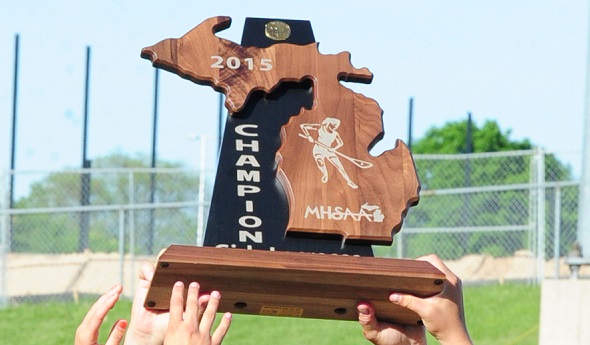
The MHSAA is best known to the public for the tournaments it conducts to conclude the fall, winter and spring seasons each school year.
These tournaments, the first and largest program of the MHSAA, have survived the Vietnam War, the Korean conflict and two World Wars. They have survived the technology bubble, the housing collapse, the energy crisis and the Great Depression.
MHSAA tournaments existed at the dawn of aviation and at the time of our nation’s lunar landing. Popes, presidents and governors have changed and changed again and again, and MHSAA tournaments roll on year after year.
But the sense of tradition and permanence and inevitability of MHSAA tournaments doesn’t dissuade us from asking questions about our tournaments, even some of the most basic questions. Here are two.
Question #1
I have long been and will always be an advocate for a Ryder Cup format for the MHSAA Golf Finals, and a team tennis approach to the MHSAA Tennis Finals; but 90 years of tradition is hard to overcome. Might this be a more exciting format? Could it be co-ed? Could it reverse the decline in boys tennis participation, and increase girls golf participation? Wouldn’t it be fun to try?
Periodically, the International Olympic Committee requires each of the designated Olympic sports to defend its status, to state its case why the sport should remain a part of the Olympic program. Then, after a series or votes that retain one sport at a time, the IOC drops the sport that makes the weakest case. It does so to make room for one of the previously unlisted sports that makes the best case for inclusion.
This would appear to keep the existing Olympic sports on their toes, and to keep the Olympic movement fresh and reflective of modern trends in sports.
While I would not enjoy the controversy, I can see the potential for some positive results if the MHSAA were to invoke the same policy for determining the 14 tournaments it will provide for girls and the 14 for boys.
This might cause us to consider more deeply what a high school sport should look like, or at least what an MHSAA tournament sport should stand for.
On the one hand, we might be inclined to drop tournaments for those sports that involve mostly non-faculty coaches and non-school venues, or require cooperative programs to generate enough participants to support a team, or resort almost entirely to non-school funding, or cater to individuals more than teams.
Or perhaps this process would cause policymakers to forget traditional thinking and ask: “In this day and age, should we shake off traditional notions of sport and consider more where modern kids are coming from?” That might mean fewer team sports and more individual sports, more “extreme” sports like snowboarding and skateboarding, and more lifetime sports, meaning not just golf and tennis and running sports, but also fishing and even shooting sports.
Currently, MHSAA policy states that the MHSAA will consider sponsorship of a tournament series for any sport which 64 member schools conduct on an interscholastic basis as a result of action by the governing boards of those schools.
Should the only question be how many schools sponsor a sport, or must an activity also have certain qualities and/or avoid certain “defects?” What should an MHSAA tournament sport look like and stand for?
Question #2
Bristling from criticism that his association is a money-grabbing exploiter of children, my counterpart in another state said, “If we were running our programs just to make money, we would do very many things very differently.” I knew exactly what he meant.
Because we care about the health and welfare of students, because we mean what we say that the athletic program needs to maximize the ways it enhances the school experience while minimizing academic conflicts, and because we try to model our claim that no sport is a minor sport when it comes to its potential to teach young people life lessons, we operate our programs in ways that make promoters, marketers and business entrepreneurs laugh, cry or cringe.
If money were the only object, we would seed and select sites to assure the teams that attracted the most spectators had the best chance to advance in our tournaments, regardless of the travel for any team or its fan base. If money were the only object, we would never schedule two tournaments to overlap and compete for public attention, much less tolerate three or four overlapping events. If money were the only object, we would allow signage like NASCAR events and promotions like minor league baseball games.
Those approaches to event sponsorship may not be all wrong; they’re just not all right for us. And we will live with the consequences of our belief system.
During a typical school year, more than 20 percent of the MHSAA’s 2,097 District, Regional and Final tournaments lose money. Not a single site in golf, skiing or tennis makes a single penny. In no sport did every District, Regional and Final site have revenue in excess of direct expenses.
In fact, in only three sports – boys and girls basketball and football – is revenue so much greater than direct expenses overall that it helps to pay for all the other tournaments in which the MHSAA invests.
That’s right: invests. When we present our budget to our board, we talk about the MHSAA’s investment in providing tournament opportunities in all those sports and all those places that cannot sustain the cost of those events on their own. How much is this investment worth to students, schools and society?
These two are core questions that require our focus far in advance of talk about scheduling, site selection, seeding and the myriad matters that too often hijack our time and attention.
Neitzel Finds Way Back to High School Hoops
By
Dean Holzwarth
Special for MHSAA.com
July 31, 2020
GRAND RAPIDS – Drew Neitzel is a self-proclaimed basketball junkie.
 So when the opportunity arose to reconnect with the high school basketball scene, the former Mr. Basketball and Michigan State standout didn’t think twice.
Neitzel, 35, has spent the past five years as a high school basketball radio analyst alongside longtime broadcaster Bret Bakita.
“It was a natural fit for me coming back to Grand Rapids, and I’ve known Bret since he was broadcasting my games at Wyoming Park,” Neitzel said. “He was looking for a partner and reached out to me.
“I didn’t have the time or desire to maybe get involved with coaching locally, so the high school broadcasting was the perfect fit to keep me around the game and feed my appetite for the game. Friday night hoops is one of the best atmospheres with the student sections and great crowds, and there’s a great following in West Michigan. It’s great to be a part of that high school action again.”
Bakita has been a staple in the West Michigan sports scene and has been a mentor to Neitzel.
“Bret is a true professional and a great guy to work with and learn from,” Neitzel said. “It’s been a great fit and a great team, and hopefully we have a season this winter.”
Neitzel and Bakita were broadcasting a boys District Semifinal in Holland the night before the Covid-19 pandemic started affecting the landscape of sports.
NCAA conference tournaments were canceled, and soon after March Madness and the remainder of the high school winter and spring seasons as well.
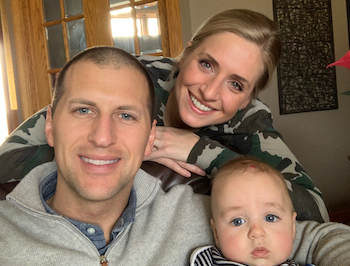
Netizel currently lives in Grand Rapids with wife, Kristi, and their son, Drake, who turns 1 in August.
The recent pandemic has changed the lives of many around the world, but Neitzel has tried to take everything in stride.
“It’s certainly been different, and my wife and I are both working from home, which has been good since we have a 1-year-old,” said Neitzel, who works as a financial advisor in Grand Rapids.
“We try to see the positives with everything going on and the craziness in the world, and working from home allows us to spend extra time with our little guy.
“It presents its own challenges, but overall we’re doing well and we’re trying to be smart and responsible by social distancing and staying outside. Not putting ourselves in harm’s way if we don’t have to.”
The pandemic and enforced precautions has put a damper on summer activities, which included Neitzel’s annual basketball camp.
 The popular Drew Neitzel Basketball Camp has been running for more than a decade, but likely will be halted due to the pandemic.
“This would’ve been our 12th year, and it has been very successful and continued to grow,” Neitzel said. “It’s the one week in the year that I get to get back in the gym with the kids and my dad and 15 of my good buddies who help coach.
“It’s disappointing that we haven’t had the chance to run the camp, and we haven’t officially canceled it, but it looks more like that’s going to be the outcome with everything going on and the gyms not being allowed to open.”
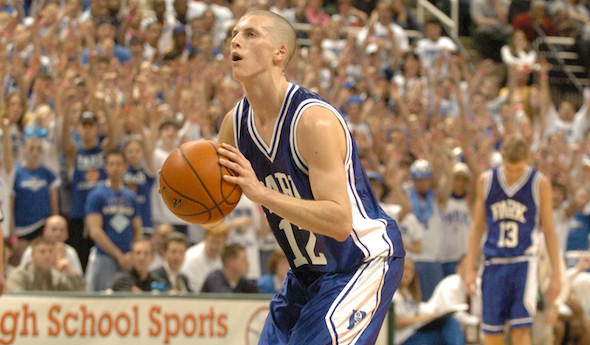
His stellar high school career at Wyoming Park included becoming the school’s all-time leader in points and assists, while winning the Mr. Basketball Award and taking his team to the Class B Semifinals as a senior in 2004. In one of the most memorable games in MHSAA Tournament history – and before a capacity crowd at the Breslin Center – Neitzel scored 36 points but saw his team fall 79-63 to a Detroit Renaissance eventual champion that included major Division I college prospects Malik Hairston, Joseph Crawford and Tajuan Porter.
Quickly, Neitzel made an impact in East Lansing as well. He was a starting point guard for a majority of his time as a Spartan, and helped Michigan State reach the Final Four as a freshman.
“I couldn’t have written a better college career,” Neitzel said. “You wish you would’ve won more games and went to more Final Fours, but when I look back, to step in and start halfway through my freshman year for Coach Izzo and for him to give me the reins with a senior-heavy team was a great experience.
“That 12 months of my life was absolutely crazy. My senior year of high school going to the Breslin Center, winning Mr. Basketball and then earning a starting spot and going to the Final Four was a wild ride. It was an awesome year for me, personally.”
After not being selected in the 2008 NBA Draft, Neitzel played professionally in Germany and France for five years while also being invited to NBA summer leagues and training camps with Minnesota, Portland and Dallas.
His last taste of the NBA came in 2011 during training camp with the Mavericks. He was eventually cut, and finished the season in the G League.
“That was a great experience,” Neitzel said. “They were a first-class organization and Mark Cuban and Rick Carlise were great. It was the year after they beat Miami in the NBA Finals so they were still on cloud nine from the championship.
“The guys in that locker room were Jason Kidd, Jason Terry, Dirk Nowitzki, Vince Carter, Delonte West, Shawn Marion and Lamar Odom. I was a fly on the wall, and to be around those NBA greats and veterans was definitely one of the highlights of my career.”
Made in Michigan 2020
July 28: Nichols Lends Winning Past to West's Present - Read
July 17: Miss Tennis Serving Now as 'Hero Coach' - Read
July 9: Joplin Always Has Known Value of Home - Read
June 24: Fracassa's Remarkable Records Still Rule - Read
June 16: Muskegon Grad Casts "Magic" in HBO Series - Read
 Dean Holzwarth has covered primarily high school sports for Grand Rapids-based WOOD-TV for four years after serving at the Grand Rapids Press and MLive for 16 years along with shorter stints at the Ionia Sentinel and WZZM. Contact him at [email protected] with story ideas for Allegan, Kent and Ottawa counties.
PHOTOS: (Top) Drew Neitzel attempts a free throw before a packed Breslin Center during the 2004 Class B Semifinals. (Middle) Neitzel, with wife Kristi and son Drake. (Top photo by Gary Shook; middle courtesy of Drew Neitzel.)