

Casting Lines for Future Tournaments
August 12, 2016
By Jack Roberts
MHSAA Executive Director
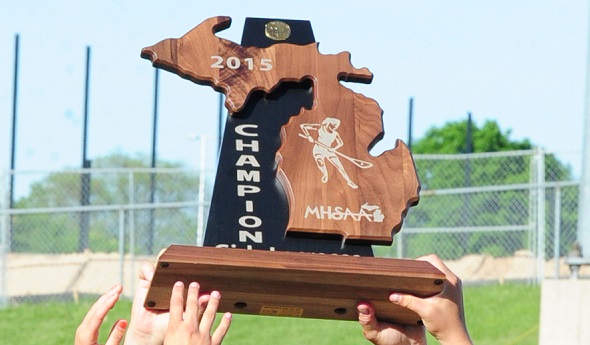
The MHSAA is best known to the public for the tournaments it conducts to conclude the fall, winter and spring seasons each school year.
These tournaments, the first and largest program of the MHSAA, have survived the Vietnam War, the Korean conflict and two World Wars. They have survived the technology bubble, the housing collapse, the energy crisis and the Great Depression.
MHSAA tournaments existed at the dawn of aviation and at the time of our nation’s lunar landing. Popes, presidents and governors have changed and changed again and again, and MHSAA tournaments roll on year after year.
But the sense of tradition and permanence and inevitability of MHSAA tournaments doesn’t dissuade us from asking questions about our tournaments, even some of the most basic questions. Here are two.
Question #1
I have long been and will always be an advocate for a Ryder Cup format for the MHSAA Golf Finals, and a team tennis approach to the MHSAA Tennis Finals; but 90 years of tradition is hard to overcome. Might this be a more exciting format? Could it be co-ed? Could it reverse the decline in boys tennis participation, and increase girls golf participation? Wouldn’t it be fun to try?
Periodically, the International Olympic Committee requires each of the designated Olympic sports to defend its status, to state its case why the sport should remain a part of the Olympic program. Then, after a series or votes that retain one sport at a time, the IOC drops the sport that makes the weakest case. It does so to make room for one of the previously unlisted sports that makes the best case for inclusion.
This would appear to keep the existing Olympic sports on their toes, and to keep the Olympic movement fresh and reflective of modern trends in sports.
While I would not enjoy the controversy, I can see the potential for some positive results if the MHSAA were to invoke the same policy for determining the 14 tournaments it will provide for girls and the 14 for boys.
This might cause us to consider more deeply what a high school sport should look like, or at least what an MHSAA tournament sport should stand for.
On the one hand, we might be inclined to drop tournaments for those sports that involve mostly non-faculty coaches and non-school venues, or require cooperative programs to generate enough participants to support a team, or resort almost entirely to non-school funding, or cater to individuals more than teams.
Or perhaps this process would cause policymakers to forget traditional thinking and ask: “In this day and age, should we shake off traditional notions of sport and consider more where modern kids are coming from?” That might mean fewer team sports and more individual sports, more “extreme” sports like snowboarding and skateboarding, and more lifetime sports, meaning not just golf and tennis and running sports, but also fishing and even shooting sports.
Currently, MHSAA policy states that the MHSAA will consider sponsorship of a tournament series for any sport which 64 member schools conduct on an interscholastic basis as a result of action by the governing boards of those schools.
Should the only question be how many schools sponsor a sport, or must an activity also have certain qualities and/or avoid certain “defects?” What should an MHSAA tournament sport look like and stand for?
Question #2
Bristling from criticism that his association is a money-grabbing exploiter of children, my counterpart in another state said, “If we were running our programs just to make money, we would do very many things very differently.” I knew exactly what he meant.
Because we care about the health and welfare of students, because we mean what we say that the athletic program needs to maximize the ways it enhances the school experience while minimizing academic conflicts, and because we try to model our claim that no sport is a minor sport when it comes to its potential to teach young people life lessons, we operate our programs in ways that make promoters, marketers and business entrepreneurs laugh, cry or cringe.
If money were the only object, we would seed and select sites to assure the teams that attracted the most spectators had the best chance to advance in our tournaments, regardless of the travel for any team or its fan base. If money were the only object, we would never schedule two tournaments to overlap and compete for public attention, much less tolerate three or four overlapping events. If money were the only object, we would allow signage like NASCAR events and promotions like minor league baseball games.
Those approaches to event sponsorship may not be all wrong; they’re just not all right for us. And we will live with the consequences of our belief system.
During a typical school year, more than 20 percent of the MHSAA’s 2,097 District, Regional and Final tournaments lose money. Not a single site in golf, skiing or tennis makes a single penny. In no sport did every District, Regional and Final site have revenue in excess of direct expenses.
In fact, in only three sports – boys and girls basketball and football – is revenue so much greater than direct expenses overall that it helps to pay for all the other tournaments in which the MHSAA invests.
That’s right: invests. When we present our budget to our board, we talk about the MHSAA’s investment in providing tournament opportunities in all those sports and all those places that cannot sustain the cost of those events on their own. How much is this investment worth to students, schools and society?
These two are core questions that require our focus far in advance of talk about scheduling, site selection, seeding and the myriad matters that too often hijack our time and attention.
Joplin Always Has Known Value of Home
By
Doug Donnelly
Special for MHSAA.com
July 9, 2020
It is no accident that Stan Joplin has never ventured too far from his hometown of Milan on the border of Monroe and Washtenaw Counties in extreme southeast Michigan.
 In fact, that has been by design.
“Mr. (Phil) Barnes once told me that you never want to get too far from home,” Joplin said recently, recalling one of his high school administrators. “If you are close by your home, people will remember you.”
It has been more than 40 years since Joplin played basketball at Milan, and no one is forgetting him anytime soon.
A coach at the high school and Division I collegiate levels and then high school again over nearly 40 years, the 63-year-old Joplin is two seasons removed from his last tenure leading the program at Sylvania Southview. But those decades of wisdom continue to be passed on to Southview students as Joplin serves as an assistant principal at the high school.
“The farthest I ever lived from Milan was when I was coaching at Kent State,” he said. “I’ve remained in southeast Michigan or northwest Ohio all of these years. I have been very fortunate to have the opportunity to stay close to home and receive a good education. You can’t put a price on education. Sooner or later, basketball was going to come to an end.”
It gave him a running start at the beginning.
One of the first four-year starters in Monroe County Region history, Joplin grew up around the game. People like Barnes, coach Ron Dingman and Ann Arbor’s Sandy Sanders all played key roles in Joplin’s early success.
Barnes was a mentor, offering advice and some key life lessons. Dingman was the coach who inserted Joplin into the starting lineup as soon as he could and kept him there as he led the Big Reds in scoring and was named team MVP four consecutive seasons. Sanders was a local basketball guru with connections from Ann Arbor to Detroit.
“Mr. Sanders was umpiring a baseball game and saw me shooting over at the elementary school,” Joplin said. “He invited me to come up to Ann Arbor to play.”
Sanders saw the basketball talent in Joplin and put him on the court in Ann Arbor with other prep talent and some University of Michigan players.
“That’s where I met guys like Campy Russell and Joe Johnson,” Joplin said.
Sanders took area players – including Joplin – to Detroit to play at the famed St. Cecilia Gym. St. Cecilia is well-known in basketball circles for hosting standouts like George Gervin, Magic Johnson and, more recently, Jalen Rose.
“You can imagine what kind of eye-opening experience that was,” Joplin said. “It showed me how hard I had to work. That was huge for me. That really exposed me to basketball.”
Growing up, his neighbor played basketball at Milan, and Joplin would get to go to all the games to watch him. Joplin read about Milan and other local basketball players in the Ypsilanti Press, Ann Arbor News and Monroe News, soaking up everything he could about the game.
“I just wanted to be an athlete,” he said.
He was more than just an athlete. An all-stater, he scored more than 1,500 career points – still a Milan record – and was recruited to play at the University of Toledo for Bobby Nichols.
 “It was the perfect situation,” Joplin said of growing up where he did. “Milan was a small town. A lot of the students I went to elementary school with I spent my whole time in school with. I knew everyone in the city.”
At Toledo, Joplin blossomed into an all-around player with a knack for elevating his game during key moments. He was named second team all-Mid-American Conference in 1977-78 and 1978-79. The 1979 Rockets won the MAC championship and made the NCAA Tournament. It was there that Joplin had the biggest moment of his career when he knocked down a 20-foot jumper to beat Iowa, 74-72, in the first round. The Rockets would lose a close game in the second round to a Notre Dame team that included four future NBA players. During Joplin’s four years at Toledo, the Rockets went 82-27.
While making national headlines, Joplin also was earning his education, something that Barnes encouraged along the way.
“I followed in his footsteps, went to college, got my degree and went into administration,” Joplin said.
After graduating from UT’s College of Education in 1979, Joplin began coaching at the high school level and was soon head coach at Toledo Start High School. He went on to become an assistant at Kent State University then joined the Rockets’ coaching staff during which time he earned a Master of Administration degree. He would later join the Michigan State University staff with Jud Heathcote and Tom Izzo.
In 1996, Joplin was named head coach at his alma mater, where he remained for 12 years, going 203-155 overall and making the NIT field four times. After he was let go following the 2007-08 campaign, Joplin reached into his education background to become an administrator in the Toledo area. He probably could have landed an assistant coaching job somewhere because of his connections in the sport, but chose not to go that route. He remained close to home.
He coached for a few seasons at Holland (Ohio) Springfield and one year at Sylvania Southview but is enjoying being a basketball fan these days.
“Basketball is the one thing I’ve done my whole life. I miss coaching, but I don’t need it,” he said.
Joplin goes to most of the Southview games and will go on the road occasionally to watch games in which some of his former players are coaching. He gets back to Michigan State University every now and then to watch the Spartans practice and relishes friendships he’s made in the game with people like former University of Michigan head coach Tommy Amaker and former Boston College head coach Al Skinner.
“I’ve got a lot of close friends that I stay in touch with,” he said.
He is not ruling out a return to the sidelines, but is not planning on it, either.
“I watch a lot of basketball. The game has changed,” he said. “The 3-point shot has taken the center out of the game. But, the game itself, is fine.”
Joplin is in the hallways more than the gym these days at Southview. His students know more about Mr. Joplin the school administrator than Stan Joplin the legendary basketball player from Milan – and he is fine with that.
“Every once in a while, someone will say something or bring me a video and say, ‘Hey, Mr. Joplin, I didn’t know you played.’ I just tell them that’s not me, that is just some guy with a lot more hair. It’s become kind of a running joke.”
Made in Michigan 2020
June 24: Fracassa's Remarkable Records Still Rule - Read
June 16: Muskegon Grad Casts "Magic" in HBO Series - Read
 Doug Donnelly has served as a sports and news reporter and city editor over 25 years, writing for the Daily Chief-Union in Upper Sandusky, Ohio from 1992-1995, the Monroe Evening News from 1995-2012 and the Adrian Daily Telegram since 2013. He's also written a book on high school basketball in Monroe County and compiles record books for various schools in southeast Michigan. E-mail him at [email protected] with story ideas for Jackson, Washtenaw, Hillsdale, Lenawee and Monroe counties.
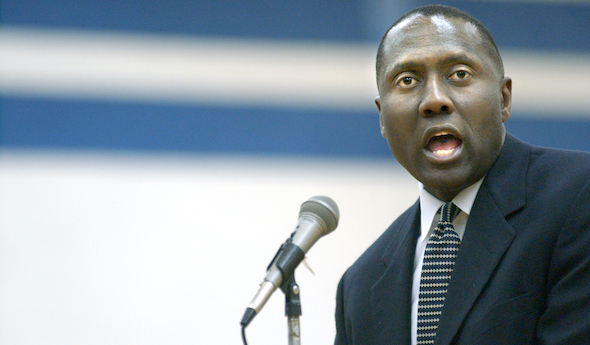
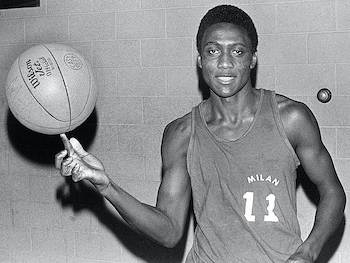
PHOTOS: (Top) Milan basketball legend Stan Joplin serves as an assistant principal at Sylvania Southview High School. (Middle) Joplin still owns the career scoring record at Milan.