

Casting Lines for Future Tournaments
August 12, 2016
By Jack Roberts
MHSAA Executive Director
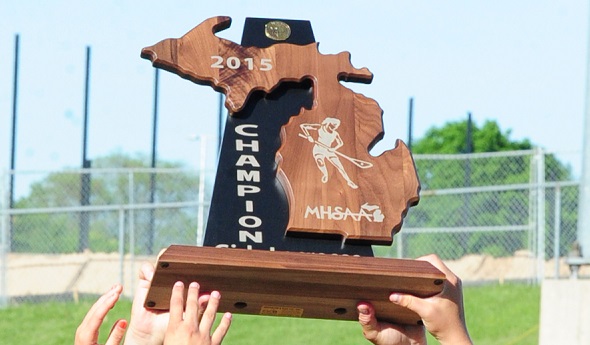
The MHSAA is best known to the public for the tournaments it conducts to conclude the fall, winter and spring seasons each school year.
These tournaments, the first and largest program of the MHSAA, have survived the Vietnam War, the Korean conflict and two World Wars. They have survived the technology bubble, the housing collapse, the energy crisis and the Great Depression.
MHSAA tournaments existed at the dawn of aviation and at the time of our nation’s lunar landing. Popes, presidents and governors have changed and changed again and again, and MHSAA tournaments roll on year after year.
But the sense of tradition and permanence and inevitability of MHSAA tournaments doesn’t dissuade us from asking questions about our tournaments, even some of the most basic questions. Here are two.
Question #1
I have long been and will always be an advocate for a Ryder Cup format for the MHSAA Golf Finals, and a team tennis approach to the MHSAA Tennis Finals; but 90 years of tradition is hard to overcome. Might this be a more exciting format? Could it be co-ed? Could it reverse the decline in boys tennis participation, and increase girls golf participation? Wouldn’t it be fun to try?
Periodically, the International Olympic Committee requires each of the designated Olympic sports to defend its status, to state its case why the sport should remain a part of the Olympic program. Then, after a series or votes that retain one sport at a time, the IOC drops the sport that makes the weakest case. It does so to make room for one of the previously unlisted sports that makes the best case for inclusion.
This would appear to keep the existing Olympic sports on their toes, and to keep the Olympic movement fresh and reflective of modern trends in sports.
While I would not enjoy the controversy, I can see the potential for some positive results if the MHSAA were to invoke the same policy for determining the 14 tournaments it will provide for girls and the 14 for boys.
This might cause us to consider more deeply what a high school sport should look like, or at least what an MHSAA tournament sport should stand for.
On the one hand, we might be inclined to drop tournaments for those sports that involve mostly non-faculty coaches and non-school venues, or require cooperative programs to generate enough participants to support a team, or resort almost entirely to non-school funding, or cater to individuals more than teams.
Or perhaps this process would cause policymakers to forget traditional thinking and ask: “In this day and age, should we shake off traditional notions of sport and consider more where modern kids are coming from?” That might mean fewer team sports and more individual sports, more “extreme” sports like snowboarding and skateboarding, and more lifetime sports, meaning not just golf and tennis and running sports, but also fishing and even shooting sports.
Currently, MHSAA policy states that the MHSAA will consider sponsorship of a tournament series for any sport which 64 member schools conduct on an interscholastic basis as a result of action by the governing boards of those schools.
Should the only question be how many schools sponsor a sport, or must an activity also have certain qualities and/or avoid certain “defects?” What should an MHSAA tournament sport look like and stand for?
Question #2
Bristling from criticism that his association is a money-grabbing exploiter of children, my counterpart in another state said, “If we were running our programs just to make money, we would do very many things very differently.” I knew exactly what he meant.
Because we care about the health and welfare of students, because we mean what we say that the athletic program needs to maximize the ways it enhances the school experience while minimizing academic conflicts, and because we try to model our claim that no sport is a minor sport when it comes to its potential to teach young people life lessons, we operate our programs in ways that make promoters, marketers and business entrepreneurs laugh, cry or cringe.
If money were the only object, we would seed and select sites to assure the teams that attracted the most spectators had the best chance to advance in our tournaments, regardless of the travel for any team or its fan base. If money were the only object, we would never schedule two tournaments to overlap and compete for public attention, much less tolerate three or four overlapping events. If money were the only object, we would allow signage like NASCAR events and promotions like minor league baseball games.
Those approaches to event sponsorship may not be all wrong; they’re just not all right for us. And we will live with the consequences of our belief system.
During a typical school year, more than 20 percent of the MHSAA’s 2,097 District, Regional and Final tournaments lose money. Not a single site in golf, skiing or tennis makes a single penny. In no sport did every District, Regional and Final site have revenue in excess of direct expenses.
In fact, in only three sports – boys and girls basketball and football – is revenue so much greater than direct expenses overall that it helps to pay for all the other tournaments in which the MHSAA invests.
That’s right: invests. When we present our budget to our board, we talk about the MHSAA’s investment in providing tournament opportunities in all those sports and all those places that cannot sustain the cost of those events on their own. How much is this investment worth to students, schools and society?
These two are core questions that require our focus far in advance of talk about scheduling, site selection, seeding and the myriad matters that too often hijack our time and attention.
Block Party: 2025 Girls Volleyball Semifinal Preview
By
Geoff Kimmerly
MHSAA.com senior editor
November 20, 2025
The final countdown has begun for another highlight-filled MHSAA Girls Volleyball Finals weekend at Battle Creek’s Kellogg Arena, and we’ll follow suit:
In Division 4, the top-four ranked teams at the end of the regular season make up the Semifinals field, and three of those teams are seeking a first championship.
In Division 3, four of the top-eight ranked teams advanced to this weekend, and Monroe St. Mary Catholic Central will play to repeat but with the field also including two contenders seeking to win for the first time.
In Division 2, we’re guaranteed a team playing in the championship match for the first time – Flat Rock and Fremont face off Friday for that opportunity – while Detroit Country Day also is seeking a repeat.
And in Division 1, four of the top-seven ranked teams advanced with two of those seeking first Finals titles, and Rockford aiming to finish this fall with just one loss and its first championship since 2011.
Action begins Thursday with Division 4 and 1 Semifinals, with Divisions 2 and 3 on Friday and all four title matches Saturday. Tickets cost $11 for both rounds, and one ticket is good for all four matches that day. All 12 matches also will be broadcast on MHSAA.tv. Find more information, including how to purchase tickets, on the Girls Volleyball page.
This weekend’s schedule:
Division 1 – Thursday
Farmington Hills Mercy vs. Byron Center, 4:30 p.m.
Bloomfield Hills vs. Rockford, 6:30 p.m.
Division 2 - Friday
Detroit Country Day vs. Grand Rapids Christian, Noon
Fremont vs. Flat Rock, 2 p.m.
Division 3 – Friday
Monroe St. Mary Catholic Central vs. Kingsley, 4:30 p.m.
Kalamazoo Christian vs. Saginaw Valley Lutheran, 6:30 p.m.
Division 4 – Thursday
Fowler vs. Crystal Falls Forest Park, Noon
Ubly vs. Mendon, 2 p.m.
Finals – Saturday
Division 1, Noon
Division 2, 2:30 p.m.
Division 3, 4:30 p.m.
Division 4, 10 a.m.
Below is a glance at all four contenders in each division. (Statistics are through Regional Finals.)
Division 1
BLOOMFIELD HILLS
Record/rank: 42-6-1, No. 2
Michigan Power Rating: No. 5
Coach: Brian Kim, first season (42-6-1)
League finish: First in Oakland Activities Association Red.
Championship history: Has never played in an MHSAA Final.
Players to watch: Kayla Nwabueze, 6-0 sr. OH (664 kills, .378 hitting %, 319 digs); Brynn Wilcox, 5-7 jr. S (1,207 assists, 111 kills); Allison Stakoe, 5-10 soph. OH (391 kills, .308 hitting %, 71 aces, 297 digs).
Finals forecast: Nwabueze, a finalist for the state’s Miss Volleyball Award and all-state first-teamer last season, has led Bloomfield Hills on its longest postseason run – which has included its first Regional title. The Black Hawks own wins over No. 3 Farmington Hills Mercy, No. 4 Bloomfield Hills Marian, No. 5 South Lyon East and Division 2 No. 1 North Branch and No. 2 Detroit Country Day among other ranked opponents. Freshman middle Emily Nwabueze (227 kills, .337 hitting %) has quickly become another player to contend with at the net, and although Kayla Nwabueze will be a big loss after this season, she’s the only senior starter.
BYRON CENTER
Record/rank: 37-5-2, honorable mention
Michigan Power Rating: No. 7
Coach: Missy Ritz-Johnson, fourth season (120-42)
League finish: First in Ottawa-Kent Conference Green
Championship history: Has never played in an MHSAA Final.
Players to watch: Mallory Johnson, 5-6 jr. OH (330 kills, 437 digs); Kenna Deters, 5-11 soph. MH (232 kills, .326 hitting %, 54 blocks); Raya Kooiker, 5-6 sr. S (482 assists, 224 digs).
Finals forecast: Byron Center will play in a Semifinal for the first time since 1993, when it was a Class C school. The Bulldogs have swept all five of their MHSAA Tournament matches and total are 23-1-2 since mid-September – with an Oct. 25 tie with Mercy, its next opponent. Mallory Johnson made the all-state first team last season as a libero, and she’s followed among hitters this fall by junior Caitlin Hartson with 279 kills plus a team-high 71 aces heading into the week. Junior Lele Froysland also has set the offense significantly and totaled a team-leading 488 assists. Byron Center should remain in the mix next season as well, as Kooiker and middle blocker Lainey VanTol are the team’s only senior starters.
FARMINGTON HILLS MERCY
Record/rank: 40-5-3, No. 3
Michigan Power Rating: No. 2
Coach: Loretta Vogel, 16th season (record N/A)
League finish: First in Catholic High School League Central
Championship history: Two MHSAA titles (most recent 2023), one runner-up finish.
Players to watch: Ella Andrews, 6-4 sr. MB (209 kills, .355 hitting %, 68 blocks); Kate Kalczynski, 6-1 jr. OH (471 kills, .314 hitting %, 257 digs); Kaelyn Easton, 5-9 fr. S (980 assists).
Finals forecast: Mercy is back at Battle Creek after ending last season with a Regional Semifinal loss to eventual champion Northville. The Marlins graduated 2024 Miss Volleyball Campbell Flynn and still brought back all-state first-teamer Andrews – a Miss Volleyball finalist this season – and second-teamer Kalczynski. Andrews and Cree Hollier (270 kills) are the only senior starters for another young team that no doubt is benefiting from the experience of this run. Mercy has defeated honorable mentions Orchard Lake St. Mary’s and South Lyon during the postseason, and Marian, Country Day, North Branch and No. 7 Utica Eisenhower among others on the way.
ROCKFORD
Record/rank: 46-1-1, No. 1
Michigan Power Rating: No. 1
Coach: Kelly Delacher, 21st season (817-323-16)
League finish: First in O-K Red
Championship history: Class A champion 2011, three runner-up finishes.
Players to watch: Liv Hosford, 6-0 sr. OH (428 kills, .364 hitting %, 321 digs); Izzie Delacher, 5-10 sr. S (1,207 assists, 244 digs, 124 kills); Mallory Wandel, 6-1 jr. OH (56 kills, .315 hitting %, 298 digs).
Finals forecast: Delacher has had his share of dominating teams over a total of 31 years with 1,251 wins across three stops. But this one has to be comparable to all, as the Rams’ only loss was to No. 5 South Lyon East and they’ve defeated the other eight teams ranked in the Division 1 top 10. Hosford was a Miss Volleyball finalist and with Wandel made the all-state first team last season, while Izzie Delacher made the third team as the Rams finished Division 1 runner-up. The South Lyon East defeat came in two sets Sept. 20; otherwise, Rockford has lost just five more sets the entire season.
Division 2
DETROIT COUNTRY DAY
Record/rank: 27-9, No. 2
Michigan Power Rating: No. 9
Coach: Kim Lockhart, 11th season (283-110-16)
League finish: Does not play in a conference.
Championship history: Division 2 champion 2024.
Players to watch: Elise Hiemstra, 6-0 sr. OH (391 kills, .321 hitting %, 60 aces); Payton Woodruff, 5-8 soph. S (836 assists, 54 aces); Leah Green, 5-11 jr. MH (193 kills, 72 blocks).
Finals forecast: Country Day has lost the first set twice during this tournament run but emerged to continue its repeat pursuit after winning its first championship a year ago. The Yellowjackets lost their first two sets to top-ranked North Branch in the Regional Final before coming all the way back. Hiemstra and Woodruff both made the all-state first team last season, and Hiemstra was a Miss Volleyball finalist this fall. All nine of the team’s losses this year came to Division 1 opponents as Country Day saw several of the best and earned a big win over Bloomfield Hills heading into the postseason.
FLAT ROCK
Record/rank: 38-8, No. 10
Michigan Power Rating: No. 6
Coach: Morgan Delhey, first season (38-8)
League finish: Tied for first in Huron League
Championship history: Has never played in an MHSAA Final.
Players to watch: Sarah Giroux, 5-10 jr. OH (526 kills, .340 hitting %, 334 digs); Hannah Hesse, 5-6 jr. S/RS (708 assists, 242 digs); Lily Klein, 6-3 jr. M (252 kills, .336 hitting %, 69 blocks).
Finals forecast: Flat Rock put itself on the map this season with a five-set win over Monroe St. Mary Catholic Central on Sept. 22, and ended up sweeping the Kestrels this fall on the way to sharing the league title. The Rams were swept by Milan, but then defeated Milan to clinch the program’s first Regional title. Giroux earned an all-state honorable mention last season and leads an all-junior starting lineup. Junior outside hitter Reagan Higdon has been another significant contributor with 252 kills, 105 aces and 313 digs.
FREMONT
Record/rank: 38-13, unranked
Michigan Power Rating: No. 48
Coach: Chris Bruggema, fourth season (151-61-5)
League finish: Tied for first in West Michigan Conference Lakes
Championship history: Has never played in an MHSAA Final.
Players to watch: Hallie Snyder, 5-9 sr. OH (282 kills, 175 digs); Taylor DeKuiper, 5-9 jr. MB (268 kills, .334 hitting %, 69 blocks); Brynna Barnhart, 5-8 sr. S (807 assists, 265 digs, 68 aces).
Finals forecast: Fremont also has advanced farther than any other team in program history, thanks to winning its Regional Final and Quarterfinal both in five sets. The Regional title was the program’s first and came as the Packers avenged a regular-season loss to Fruitport, and Fremont’s league championship share was a result of avenging a five-set loss to Ludington with a league tournament sweep four days later. Sophomore Ava Geers (229 kills) is another key hitter, and senior libero Grace Evans has paced the defense with 652 digs – to go with a team-high 86 aces – heading into this week.
GRAND RAPIDS CHRISTIAN
Record/rank: 36-9, No. 3
Michigan Power Rating: No. 1
Coach: Amy Huisken, fifth season (160-58-2)
League finish: Tied for first in O-K White
Championship history: Division 2 champion 2018, 2019 and 2020.
Players to watch: Grace Goodyke, 6-0 jr. OH (510 kills, .338 hitting %); Piper Cebulski, 6-2 jr. S/RS (491 assists, .318 hitting %, 102 kills); Mya McKinnon, 6-1 soph. MB (301 kills, .441 hitting %, 92 blocks).
Finals forecast: Grand Rapids Christian held on through a five-set Quarterfinal with No. 6 Tecumseh to reach the Semifinals for the fifth time in seven seasons but after missing a year ago. Goodyke made the all-state second team and Cebulski made the third last season, and they pace a lineup that also defeated No. 4 Grand Rapids Catholic Central, No. 5 Holland Christian and No. 8 Grand Rapids South Christian during this postseason run. All of the Eagles’ losses came to ranked or honorable mention Division 1 teams. Junior Taylor Frost (537 assists) joins Cebulski in setting the attack.
Division 3
KALAMAZOO CHRISTIAN
Record/rank: 29-11-3, No. 8
Michigan Power Rating: No. 12
Coach: Carlie Southland, fourth season (136-31-11)
League finish: First in Southwestern Athletic Conference Valley
Championship history: Division 3 champion 2023, two runner-up finishes.
Players to watch: Reagan Zuiderveen, 5-10 sr. S (966 assists, 52 aces, 51 blocks, 307 digs, 122 kills); Eliana Keller, 5-10 jr. OH (333 kills); Elliana VanDusen, 6-0 jr. OH (418 kills).
Finals forecast: Kalamazoo Christian is making a fourth-straight trip to the Semifinals and just missed playing for the championship last year, falling to Traverse City St. Francis in five sets. Zuiderveen made the all-state third team, and this fall has directed the offense but done some of everything else as well while one of only three seniors. Another, 6-foot middle blocker Maya Gaertner, was third on the team with 174 kills entering this week and topped the Comets with 95 blocks. A four-set Quarterfinal win over Pewamo-Westphalia followed a season-opening tournament split with the No. 9 Pirates.
KINGSLEY
Record/rank: 55-4-1, No. 3
Michigan Power Rating: No. 2
Coach: Dave Hall, 27th season (1,228-289-100)
League finish: First in Northern Shores Conference
Championship history: Class C runner-up 2004.
Players to watch: Jenna Middleton, 5-10 jr. OH (669 kills, .305 hitting %, 67 aces, 376 digs); Sarah Wooer, 5-4 sr. S (1,428 assists); Delaney Case, 5-9 jr. MH (259 kills, .361 hitting %, 74 blocks).
Finals forecast: Hall ranks 10th on the all-time coaching wins list for this sport, and he’s bringing Kingsley to the Semifinals for the first time since 2019. Wooer is moving up the MHSAA record book list for single-season assists, and she and libero Isabelle Seitz (604 digs, 63 aces) are the only senior starters. The Stags’ only Division 3 losses this season were a pair to top-ranked Roscommon, and Kingsley avenged them with a Regional Semifinal sweep. Junior outside hitter Aizlyn McKinley has been another key contributor in several ways, with 295 kills, 528 digs and 116 aces heading into this week.
MONROE ST. MARY CATHOLIC CENTRAL
Record/rank: 36-5-1, No. 5
Michigan Power Rating: No. 1
Coach: Kim Windham, second season (78-9-2)
League finish: Tied for first in Huron League
Championship history: Eight MHSAA titles (most recent 2024), four runner-up finishes.
Players to watch: Olivia Beaudrie, 5-6 sr. MH (176 kills, 169 digs, 46 blocks); Alexa Turner, 5-9 jr. S (632 assists, 294 digs); Madeline Dettling, 6-0 sr. OH (221 kills, .325 hitting %, 211 digs).
Finals forecast: Windham took over her alma mater last season and immediate led the Kestrels to their eighth Finals championship, and she’s guided them back to Battle Creek with postseason wins over No. 4 Hanover-Horton in the Regional Final and No. 2 Plymouth Christian Academy on Tuesday. Dettling made the all-state second team last season and Beaudrie earned an honorable mention, and they’re part of a balanced lineup that also saw senior outside hitter Adela Illes enter the week with a team-leading 274 kills and senior middle hitter Quinn Harrington second at 251. All four losses came to teams in Divisions 1 and 2.
SAGINAW VALLEY LUTHERAN
Record/rank: 51-10-3, No. 6
Michigan Power Rating: No. 8
Coach: Jon Frank, 20th season (699-286-83)
League finish: First in Tri-Valley Conference Blue
Championship history: Has never played in an MHSAA Final.
Players to watch: Kate Belt, 5-10 jr. S (1,271 assists, 337 digs); Reagan Webb, 5-7 jr. OH (422 kills, 302 digs, 73 aces); Braelin Rodammer, 5-10 soph. OH (453 kills).
Finals forecast: Valley Lutheran has won Regional titles five of the last seven seasons, and this time without a senior in the lineup. The Chargers played several ranked and larger opponents during the regular season and avenged three of their defeats – with an opportunity to avenge two more if they meet Kingsley in this weekend’s championship match. They also haven’t lost a set during the postseason. Sophomore Grace Parker (312 kills, 89 blocks) has been another major contributor at the net, and juniors Hayden Sherman (648 digs, 52 aces) and Elsie Hultberg (357/74) help pace the defense.
Division 4
CRYSTAL FALLS FOREST PARK
Record/rank: 42-1, No. 4
Michigan Power Rating: No. 1
Coach: Bobbie Jo Anderson, sixth season (152-31-6)
League finish: First in Skyline Central Conference
Championship history: Has never played in an MHSAA Final.
Players to watch: Ava Fischer, 5-7 sr. OH (467 kills, .350 hitting %, 351 digs, 56 aces); Elsie Williams, 5-5 sr. OH/S (502 assists, .340 hitting %, 196 kills, 55 aces, 286 digs); Harper Anderson, 5-6 soph. OH (132 kills, 89 aces, 236 digs).
Finals forecast: Forest Park avenged a 2024 Regional loss to No. 10 Hancock to return to the Semifinals for the third time in four seasons. Fischer made the all-state third team last season and joins Williams as the only seniors on the roster; both have been part of all three trips to Battle Creek. The Trojans’ run through the Upper Peninsula this fall included wins over Division 2 honorable mention Kingsford and Division 3 honorable mention Calumet as well, and the only loss came during a season-opening trip downstate as Forest Park split matches with Division 3 semifinalist Valley Lutheran. Junior setter Vienna Price (444 assists) joins Williams in directing the offense, and freshman middle Josie Anderson (188 kills) is another key hitter.
FOWLER
Record/rank: 34-8-2, No. 2
Michigan Power Rating: No. 3
Coach: Patty Feldpausch, 17th season (400-325-59)
League finish: First in Central Michigan Athletic Conference
Championship history: Class D runner-up 2017.
Players to watch: Rachel Wirth, 5-6 sr. L (550 digs, 57 aces); Neelah O’Rourke, 5-10 sr. S (902 assists, 206 digs, 58 aces, 132 kills); Paige Thelen, 5-10 sr. OH (440 kills).
Finals forecast: Fowler is making its first trip to the Semifinals since 2017 and after winning a Regional title for the first time since 2020 – and a second-straight league championship thanks in part to a sweep of Division 3 No. 9 Pewamo-Westphalia. Thelen made the all-state first team last season, and Wirth made the second, as the Eagles were stopped in 2024 by eventual champion Clarkston Everest Collegiate. Fowler avenged one of three losses to Division 4 teams this season, downing No. 5 Mount Pleasant Sacred Heart in the Regional Final, and can avenge two more if it meets No. 3 Ubly on Saturday.
MENDON
Record/rank: 37-6-1, No. 1
Michigan Power Rating: No. 6
Coach: Kenneth Herbert, fourth season (120-25-7)
League finish: First in Southern Central Athletic Association West and overall
Championship history: Five MHSAA titles (most recent 2019).
Players to watch: Jadyn Samson, 5-4 sr. L (566 digs, 75 aces); Cienna Nightingale, 5-9 sr. RS (335 kills, 288 digs); Gracie Schultz, 5-5 sr. OH (449 kills, 81 aces, 354 digs).
Finals forecast: Mendon is returning to the Semifinals for the first time since its most recent championship season in 2019, and after winning league and District titles both for the third-straight seasons. Samson made the all-state first team and Schultz and Nightingale made the third a year ago, and they’ve helped the Hornets make a run that’s seen their only losses to Division 1 and 3 opponents. Junior Karyssa Holtz (919 assists, 82 aces, 237 digs) sets an attack that also features 5-9 freshman middle Lashell Blair (204 kills, 62 blocks).
UBLY
Record/rank: 30-10-4, No. 3
Michigan Power Rating: No. 16
Coach: Rachel Sorenson, second season (67-18-4)
League finish: First in Big Thumb Conference Black
Championship history: Class C runner-up 2007 (Fall).
Players to watch: Addison Weber, 5-7 sr. OH (240 kills, 291 digs, 56 aces); Sadi Heleski, 5-8 sr. S (986 assists, 190 digs); Waverly Hagen, 6-1 jr. MB (425 kills, .332 hitting %, 66 blocks).
Finals forecast: After a fifth trip to the Quarterfinals over the last seven seasons, Ubly has broken through to reach its first Semifinals since the fall of 2007, and with a starting lineup with Sophi Heleski (170 kills, 62 aces) joining twin sister Sadi and libero Suzanne Smigielski (527 digs, 56 aces) as the only seniors. Weber earned an all-state honorable mention last season, and she and Hagen also get significant help at the net from 5-9 sophomore middle Brooke Badger (178 kills, 71 blocks). Ubly didn’t lose to a Division 4 opponent this season, and avenged its defeat against Division 3 Auburn Hills Oakland Christian three weeks later.
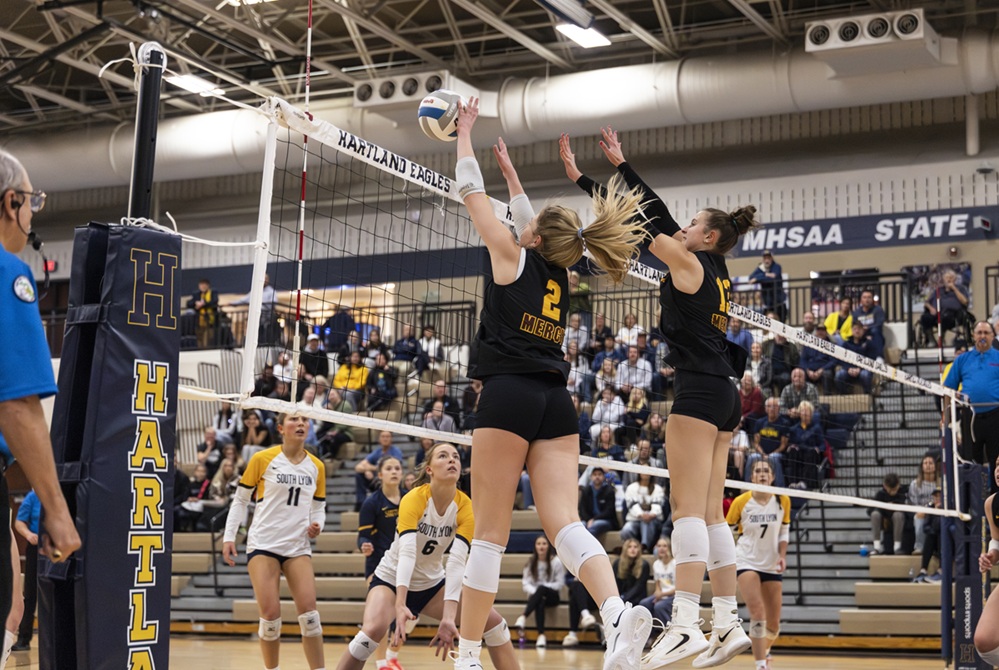
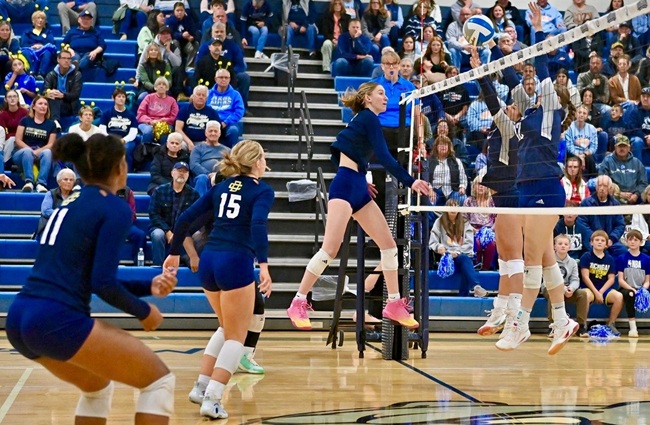
PHOTOS (Top) Farmington Hills Mercy's Kate Kalczynski (2) and Ella Andrews put up a block during a Regional Final win over South Lyon. (Middle) Country Day's Leah Green (14) sends a kill attempt toward a North Branch block during the Yellowjackets' Regional Final win. (Mercy/South Lyon photo by KMS Photography. Country Day/North Branch photo by Terry Lyons.)