

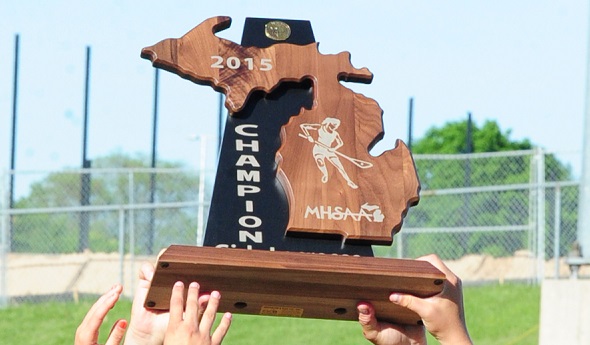
Casting Lines for Future Tournaments
August 12, 2016
By Jack Roberts
MHSAA Executive Director
The MHSAA is best known to the public for the tournaments it conducts to conclude the fall, winter and spring seasons each school year.
These tournaments, the first and largest program of the MHSAA, have survived the Vietnam War, the Korean conflict and two World Wars. They have survived the technology bubble, the housing collapse, the energy crisis and the Great Depression.
MHSAA tournaments existed at the dawn of aviation and at the time of our nation’s lunar landing. Popes, presidents and governors have changed and changed again and again, and MHSAA tournaments roll on year after year.
But the sense of tradition and permanence and inevitability of MHSAA tournaments doesn’t dissuade us from asking questions about our tournaments, even some of the most basic questions. Here are two.
Question #1
I have long been and will always be an advocate for a Ryder Cup format for the MHSAA Golf Finals, and a team tennis approach to the MHSAA Tennis Finals; but 90 years of tradition is hard to overcome. Might this be a more exciting format? Could it be co-ed? Could it reverse the decline in boys tennis participation, and increase girls golf participation? Wouldn’t it be fun to try?
Periodically, the International Olympic Committee requires each of the designated Olympic sports to defend its status, to state its case why the sport should remain a part of the Olympic program. Then, after a series or votes that retain one sport at a time, the IOC drops the sport that makes the weakest case. It does so to make room for one of the previously unlisted sports that makes the best case for inclusion.
This would appear to keep the existing Olympic sports on their toes, and to keep the Olympic movement fresh and reflective of modern trends in sports.
While I would not enjoy the controversy, I can see the potential for some positive results if the MHSAA were to invoke the same policy for determining the 14 tournaments it will provide for girls and the 14 for boys.
This might cause us to consider more deeply what a high school sport should look like, or at least what an MHSAA tournament sport should stand for.
On the one hand, we might be inclined to drop tournaments for those sports that involve mostly non-faculty coaches and non-school venues, or require cooperative programs to generate enough participants to support a team, or resort almost entirely to non-school funding, or cater to individuals more than teams.
Or perhaps this process would cause policymakers to forget traditional thinking and ask: “In this day and age, should we shake off traditional notions of sport and consider more where modern kids are coming from?” That might mean fewer team sports and more individual sports, more “extreme” sports like snowboarding and skateboarding, and more lifetime sports, meaning not just golf and tennis and running sports, but also fishing and even shooting sports.
Currently, MHSAA policy states that the MHSAA will consider sponsorship of a tournament series for any sport which 64 member schools conduct on an interscholastic basis as a result of action by the governing boards of those schools.
Should the only question be how many schools sponsor a sport, or must an activity also have certain qualities and/or avoid certain “defects?” What should an MHSAA tournament sport look like and stand for?
Question #2
Bristling from criticism that his association is a money-grabbing exploiter of children, my counterpart in another state said, “If we were running our programs just to make money, we would do very many things very differently.” I knew exactly what he meant.
Because we care about the health and welfare of students, because we mean what we say that the athletic program needs to maximize the ways it enhances the school experience while minimizing academic conflicts, and because we try to model our claim that no sport is a minor sport when it comes to its potential to teach young people life lessons, we operate our programs in ways that make promoters, marketers and business entrepreneurs laugh, cry or cringe.
If money were the only object, we would seed and select sites to assure the teams that attracted the most spectators had the best chance to advance in our tournaments, regardless of the travel for any team or its fan base. If money were the only object, we would never schedule two tournaments to overlap and compete for public attention, much less tolerate three or four overlapping events. If money were the only object, we would allow signage like NASCAR events and promotions like minor league baseball games.
Those approaches to event sponsorship may not be all wrong; they’re just not all right for us. And we will live with the consequences of our belief system.
During a typical school year, more than 20 percent of the MHSAA’s 2,097 District, Regional and Final tournaments lose money. Not a single site in golf, skiing or tennis makes a single penny. In no sport did every District, Regional and Final site have revenue in excess of direct expenses.
In fact, in only three sports – boys and girls basketball and football – is revenue so much greater than direct expenses overall that it helps to pay for all the other tournaments in which the MHSAA invests.
That’s right: invests. When we present our budget to our board, we talk about the MHSAA’s investment in providing tournament opportunities in all those sports and all those places that cannot sustain the cost of those events on their own. How much is this investment worth to students, schools and society?
These two are core questions that require our focus far in advance of talk about scheduling, site selection, seeding and the myriad matters that too often hijack our time and attention.
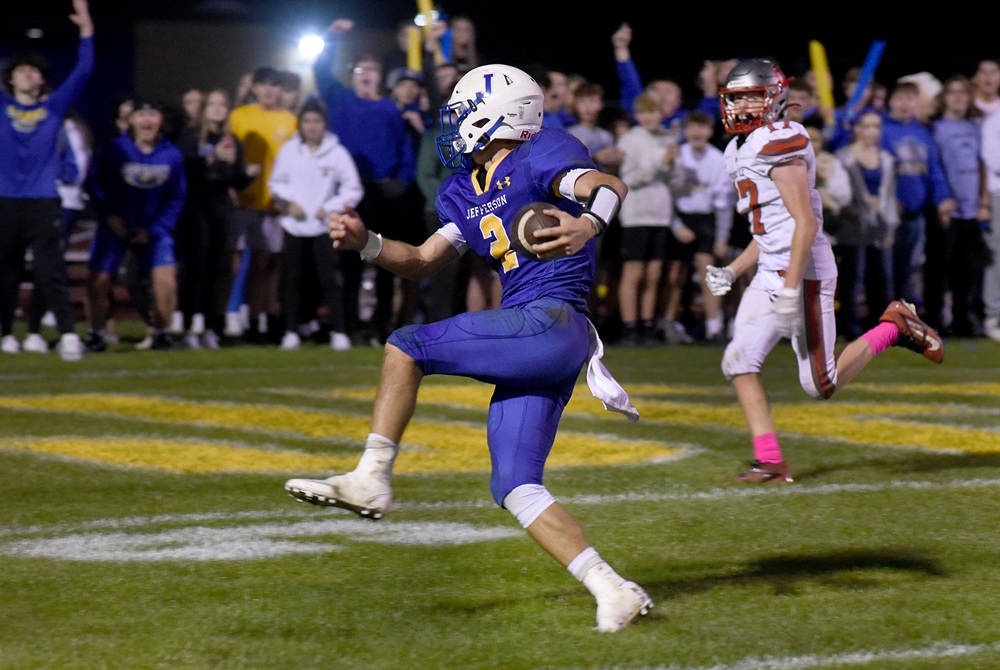
Beaudrie's Rebuild of Jefferson Football Gaining Speed with Fast Start
By
Doug Donnelly
Special for MHSAA.com
September 17, 2025
NEWPORT – Rob Beaudrie has found the secret formula to building a winning football team.
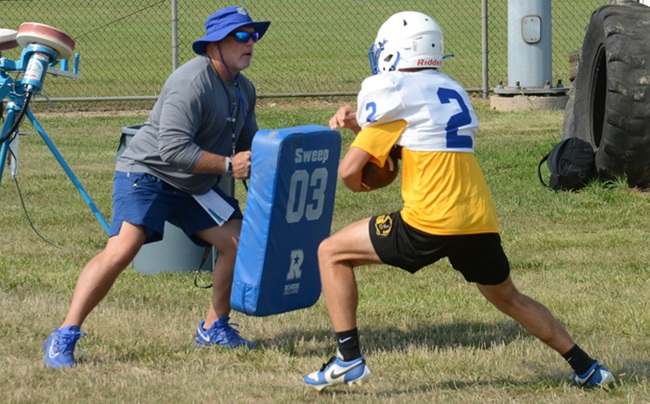
 Take over as head coach. Tap his freshman son (even if unexpectedly) as the starting quarterback. Mix in a couple of years hitting the weights, consistent offseason workouts and getting the underclassmen to buy into the playbook and new culture.
Oh, and winning a few games doesn’t hurt.
“Kids like to win,” Beaudrie said. “They don’t want to go out and practice two or three hours every day and go 0-9. It’s not fun for them. These kids have bought in. They’ve been playing football together since they were in youth football. It’s a good experience for them.”
Beaudrie is the head football coach at Monroe Jefferson, a Division 6 school in Newport, along the shores of Lake Erie and home to the Fermi 2 nuclear power plant. The Bears were once a football power, winning the Class BB championship in 1994, but have struggled for the last 20 years or so.
Being from the area, Beaudrie knew all about Jefferson. He took the job three seasons ago. He stayed on the course and things slowly improved.
This year, everything has come together as the Bears are off to a 3-0 start for the first time since 2006. One more win and they’ll have more victories than in any one season since 2016, which was the last time Jefferson qualified for the playoffs.
“We’ve come a long way,” Beaudrie said. “We are doing a lot of things right. We are attacking the ball, pursuing. We’re blocking together. There are still some growing pains. We are young in some areas, but they’ve come along well. They are very talented.”
Beaudrie inserted his son Luke, then a freshman, into the starting quarterback role his first year as head coach. It was an unexpected move because Luke had been a slot receiver or running back while playing youth football and middle school football. When the player Beaudrie expected to be the starting quarterback quit the team, Beaudrie turned to his son.
“He’s not a true quarterback, but he’s learning,” Beaudrie said. “He’s learned to understand the offense and read the defense. He’s a leader.”
In Jefferson’s 52-21 win over Milan on Friday, Luke Beaudrie returned a kickoff 99 yards, had touchdown runs of 65, 2, 50 and 32 and returned an interception 89 yards for a touchdown – all in the first half.
“He’s a special athlete,” Rob Beaudrie said. “He was never tackled in middle school. He’s very fast and has great vision.”
Luke said he has adapted to being the quarterback.
“When I first started, I didn’t think it was for me,” he said. “But you have to have the mindset ‘whatever is best for the team.’ I started learning it, and now I’m more comfortable.”
 Through three games, Beaudrie has 487 yards rushing, 243 yards passing and has scored 13 touchdowns.
The Beaudries have used this same game plan before, but at a different school. Rob was head coach at Erie Mason, a program that had struggled. His son Noah became the starting quarterback as a freshman, went through some growing pains, but developed into an all-stater his senior season as Mason won a league championship.
Noah went on to play college football at Mount Union University (Ohio) where he quarterbacked the Purple Raiders into the Division III national championship game last season. This year, Noah transferred to Adrian College where he is the starting quarterback and has the Bulldogs off to a 2-0 start.
Being close to home has allowed him to serve as an assistant coach for Jefferson.
“The schedules line up really well,” Rob Beaudrie said. “He can be at (our) practice just about every Sunday and Monday and can be at most of our games. He helps Luke out a lot. He’s brought a lot of college experiences with him to the playbook.”
Another former player Rob had at Mason, Tanner Herrera, is helping coach the Jefferson offense.
“I didn’t want to do it all,” Beaudrie said. “I offered him the OC (offensive coordinator) job, and he’s run with it.”
Beaudrie said he thought this could be the year Jefferson turned things around. The Bears still have a difficult Huron League schedule ahead of them. This week they take on Riverview, then have Flat Rock and Division 7 No. 1-ranked Monroe St. Mary Catholic Central.
“The good thing is, these kids don’t know what they don’t know,” Beaudrie said.
Roster numbers have gone up steadily since Beaudrie took over. His first season the Bears had 23 players in the entire program. Last year they had 36 players in all and no seniors. This year Jefferson counts 61 players – plenty enough for a JV and varsity program.
“That has been a huge help,” he said.
The first two years weren’t easy as he brought his system to Jefferson. He faced skepticism over the team’s passing attack. For years, even decades, Jefferson was known for its rushing offense; at one time, the Bears would go weeks without attempting a pass.
“This is all new at Jefferson. People would tell me, ‘They don’t know anything about passing the ball; you can’t do that,’” Beaudrie said. “I told them, ‘You’d be surprised what kids can learn.’ We came in and did our thing. We were out-manned a bit the first few years.
“Sometimes the first couple of years you get a new coach in, and some people don’t like what you are doing. It wasn’t going to ruffle my feathers. I have thick skin. There’s a plan, and you have to trust the process, trust the system.
“Now, the kids are excited, the parents are excited, everyone is excited. Everybody likes a winner. I’m excited to see what happens next year as well, but we are going to enjoy these wins right now.”
Jefferson athletic director Alyssa Eppler said the football success has brought excitement to the games and district.
"There’s an incredible buzz in our school and community right now, and it’s been building for a few years now,” she said. “It’s exciting to finally see it all come together. You can feel the energy in the hallways and see it in the stands on Friday nights. Or first home game truly had the atmosphere of a homecoming. We’re proud of the momentum and what it means for our kids."
Luke Beaudrie is happy with how things have worked out, even if he had to learn a new position.
“The first few years were a little rough,” he said. “Now, everyone is starting to buy in, and everyone expects some good things the next couple of years. It feels amazing. This hasn’t happened here in a while.”
 Doug Donnelly has served as a news and sports reporter at the Adrian Daily Telegram and the Monroe News for 30 years, including 10 years as city editor in Monroe. He's written a book on high school basketball in Monroe County and compiles record books for various schools in southeast Michigan. He is now publisher and editor of The Blissfield Advance, a weekly newspaper. E-mail him at [email protected] with story ideas for Jackson, Washtenaw, Hillsdale, Lenawee and Monroe counties.
PHOTOS (Top) Monroe Jefferson’s Luke Beaudrie sprints toward the end zone during a game last season. (Middle) Jefferson coach Rob Beaudrie holds a pad while Luke works on making a cut during practice. (Photos courtesy of the Monroe News.)