

Casting Lines for Future Tournaments
August 12, 2016
By Jack Roberts
MHSAA Executive Director
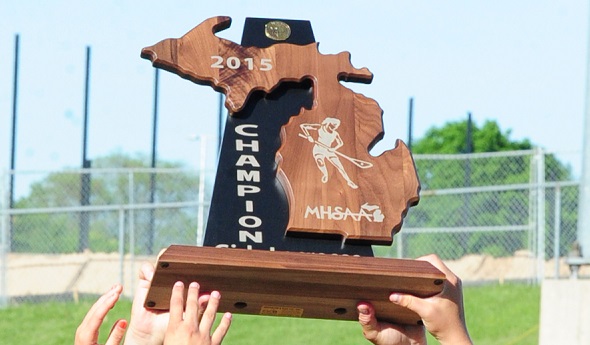
The MHSAA is best known to the public for the tournaments it conducts to conclude the fall, winter and spring seasons each school year.
These tournaments, the first and largest program of the MHSAA, have survived the Vietnam War, the Korean conflict and two World Wars. They have survived the technology bubble, the housing collapse, the energy crisis and the Great Depression.
MHSAA tournaments existed at the dawn of aviation and at the time of our nation’s lunar landing. Popes, presidents and governors have changed and changed again and again, and MHSAA tournaments roll on year after year.
But the sense of tradition and permanence and inevitability of MHSAA tournaments doesn’t dissuade us from asking questions about our tournaments, even some of the most basic questions. Here are two.
Question #1
I have long been and will always be an advocate for a Ryder Cup format for the MHSAA Golf Finals, and a team tennis approach to the MHSAA Tennis Finals; but 90 years of tradition is hard to overcome. Might this be a more exciting format? Could it be co-ed? Could it reverse the decline in boys tennis participation, and increase girls golf participation? Wouldn’t it be fun to try?
Periodically, the International Olympic Committee requires each of the designated Olympic sports to defend its status, to state its case why the sport should remain a part of the Olympic program. Then, after a series or votes that retain one sport at a time, the IOC drops the sport that makes the weakest case. It does so to make room for one of the previously unlisted sports that makes the best case for inclusion.
This would appear to keep the existing Olympic sports on their toes, and to keep the Olympic movement fresh and reflective of modern trends in sports.
While I would not enjoy the controversy, I can see the potential for some positive results if the MHSAA were to invoke the same policy for determining the 14 tournaments it will provide for girls and the 14 for boys.
This might cause us to consider more deeply what a high school sport should look like, or at least what an MHSAA tournament sport should stand for.
On the one hand, we might be inclined to drop tournaments for those sports that involve mostly non-faculty coaches and non-school venues, or require cooperative programs to generate enough participants to support a team, or resort almost entirely to non-school funding, or cater to individuals more than teams.
Or perhaps this process would cause policymakers to forget traditional thinking and ask: “In this day and age, should we shake off traditional notions of sport and consider more where modern kids are coming from?” That might mean fewer team sports and more individual sports, more “extreme” sports like snowboarding and skateboarding, and more lifetime sports, meaning not just golf and tennis and running sports, but also fishing and even shooting sports.
Currently, MHSAA policy states that the MHSAA will consider sponsorship of a tournament series for any sport which 64 member schools conduct on an interscholastic basis as a result of action by the governing boards of those schools.
Should the only question be how many schools sponsor a sport, or must an activity also have certain qualities and/or avoid certain “defects?” What should an MHSAA tournament sport look like and stand for?
Question #2
Bristling from criticism that his association is a money-grabbing exploiter of children, my counterpart in another state said, “If we were running our programs just to make money, we would do very many things very differently.” I knew exactly what he meant.
Because we care about the health and welfare of students, because we mean what we say that the athletic program needs to maximize the ways it enhances the school experience while minimizing academic conflicts, and because we try to model our claim that no sport is a minor sport when it comes to its potential to teach young people life lessons, we operate our programs in ways that make promoters, marketers and business entrepreneurs laugh, cry or cringe.
If money were the only object, we would seed and select sites to assure the teams that attracted the most spectators had the best chance to advance in our tournaments, regardless of the travel for any team or its fan base. If money were the only object, we would never schedule two tournaments to overlap and compete for public attention, much less tolerate three or four overlapping events. If money were the only object, we would allow signage like NASCAR events and promotions like minor league baseball games.
Those approaches to event sponsorship may not be all wrong; they’re just not all right for us. And we will live with the consequences of our belief system.
During a typical school year, more than 20 percent of the MHSAA’s 2,097 District, Regional and Final tournaments lose money. Not a single site in golf, skiing or tennis makes a single penny. In no sport did every District, Regional and Final site have revenue in excess of direct expenses.
In fact, in only three sports – boys and girls basketball and football – is revenue so much greater than direct expenses overall that it helps to pay for all the other tournaments in which the MHSAA invests.
That’s right: invests. When we present our budget to our board, we talk about the MHSAA’s investment in providing tournament opportunities in all those sports and all those places that cannot sustain the cost of those events on their own. How much is this investment worth to students, schools and society?
These two are core questions that require our focus far in advance of talk about scheduling, site selection, seeding and the myriad matters that too often hijack our time and attention.
Youngest Brother Bryan Closing Convertini Family's Memorable 13-Year Run at MCC
By
Tom Kendra
Special for MHSAA.com
May 8, 2025
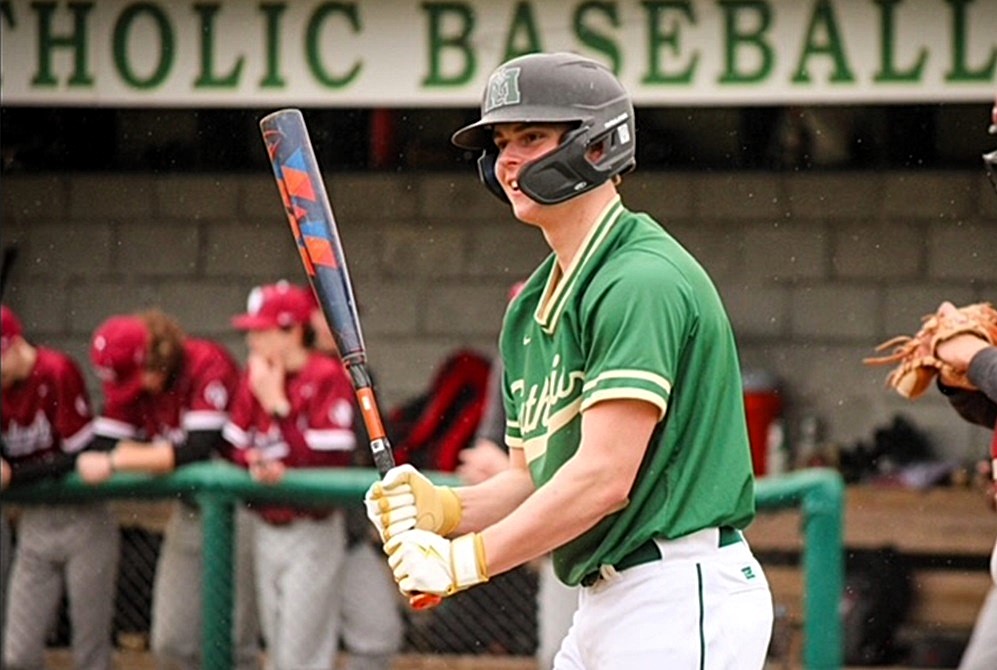
Bryan Convertini is nearing the end of an amazing four-year athletic career for Muskegon Catholic Central, but this swan song is not just about him.
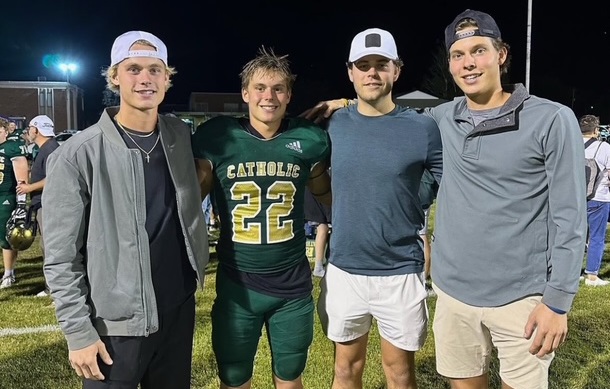
 Bryan is the last of the four “Convertini boys” at MCC, who collectively have provided Crusaders fans with plenty of big plays and thrilling wins – doing it all with their humble, no-nonsense leadership style – over the past 13 years.
“The Convertinis have really become the first family of Muskegon Catholic Central,” said MCC baseball coach Steve Schuitema, noting their father, Kolin, is an assistant varsity football coach and their mother, Jene, has served as the team mom for baseball and football for years.
“It will be different and a little sad to not have a Convertini out there for MCC anymore. All of them were leaders and a coach’s dream and really an extension of the coach on the field.”
Mason, 26, graduated in 2017 and set the sports tone for his three brothers, playing football, hockey as part of MCC’s cooperative team with Muskegon Reeths-Puffer, and baseball.
Nolan, 23, graduated in 2020 and, at 6-foot-2, is the tallest of the brothers. He played the same three sports as Mason, and was the most versatile of the boys, playing almost every position in football, including starting two games at quarterback.
Sam, 21, graduated in 2022, and also played football, hockey and baseball, but he opted to play basketball his senior year so he could play with his younger brother, Bryan.
Bryan, 18, will graduate June 1 after a standout, three-sport career, including the past three years as the starting varsity quarterback, before beginning college this fall at Grand Valley State.
“My memories at MCC go way back to when I was like 6 or 7 and the waterboy in football and the batboy in baseball,” said Bryan with a smile.
“The first word that comes to mind when I think about it is family. The whole school is like a big family that pushes and supports each other.”
Grandpa’s boys
The Convertini boys come from good stock, starting with their grandfathers.
On their mother’s side is Grandpa Bryan McLay who, at the age of 87, is still considered “Mr. Hockey” in Muskegon.
 McLay, a Kenora, Ontario, native who first came to Muskegon in 1960 (the same year that the downtown hockey arena opened), tallied more than 1,000 points over his 13 seasons with the Muskegon Zephyrs and later, the Mohawks.
McLay moved in with the family after his wife, Peggy, died four years ago, and regularly regales his grandsons with his “old-time hockey” stories.
Jene picked up her father’s passion for sports and has been a natural in the Crusaders’ “team mom” role – organizing meals, carpools, fundraisers and sending out emails for game and schedule changes, among other things.
On their father’s side is Grandpa Fred Convertini, a California native who played in the 1966 Rose Bowl as an offensive lineman at Michigan State – as part of what is considered the top offensive line in MSU history.
Kolin certainly inherited his father’s athletic ability, making first-team all-state in football (running back), wrestling and track & field (pole vault) during his senior year of 1989-1990. He went on to play defensive back at Eastern Michigan University.
He also picked up his father’s humility and toughness, the latter which was put to the test in 2014 when he was diagnosed with cancer.
“Kolin’s cancer really brought us together as a family,” explained Jene. “We didn’t know how long we had, and we decided we weren’t going to do travel sports any more. I didn’t want to be in Chicago and Kolin in Detroit for the weekend and then we say hi on the way out the door to work on Monday morning. We decided to spend more time together.”
Like their grandfathers and father, all four of the Convertini boys were known for their dependability, rarely if ever missing games due to sickness or injury.
In fact, Bryan suffered an injury in the opening football game of his junior season, then played the remaining 10 games on what was later determined to be a broken left ankle – and, by the way, he earned first-team all-state as a defensive back with five interceptions.
“It hurt so bad,” Bryan said, shaking his head. “But I needed to be out there. My team needed me to be out there.”
Home cooking
The Convertini house in Norton Shores has been a gathering place for MCC athletes for years.
It all started when the boys were little, wrestling between the couches and shooting pucks at the walls in the basement.
 Later on, that basement became the annual meeting spot for the MCC football team for “Selection Sunday,” when the team would learn its draw for the postseason playoffs.
Mason and Nolan, the two older boys, certainly enjoyed the most team success. Mason was part of three straight Division 8 championship football teams from 2014 to 2016. Nolan, meanwhile, played in three national championship games (with two titles) as a member of the Hope College men’s club hockey team.
The two younger boys had less team success, in large part because MCC really started struggling with numbers, but Sam and Bryan certainly did all they could and were rewarded with individual accolades.
Sam was the first of the brothers to make first-team all-state, earning the honor as a tight end in 2021. Bryan did one better, making all-state twice – after his junior year as a defensive back and his senior year as an “athlete” for his contributions all over the field.
Bryan also made first-team all-state last year in baseball, batting .478 as an outfielder.
In football, he rose above his broken ankle as a junior to rush for more than 800 yards and 11 touchdowns. In a win over Benton Harbor, he had a rushing TD, a passing TD, a receiving TD and returned an interception for yet another TD. This past fall as a senior, he threw for 880 yards and rushed for 621, while making a team-high 81 tackles in his first year at linebacker.
But when asked about the individual highlight of his football career, he doesn’t hesitate.
“That would have to be my freshman year, when I threw a halfback pass to my brother (Sam) for a touchdown,” recalled Bryan, noting a play that occurred in a victory over Muskegon Heights Academy during what ended as the 500th win in MCC football history.
Going out with a bang
Bryan hopes to tack on some additional highlights over the next month of baseball season, effectively writing a happy ending to the Convertini novel.
The Crusaders’ baseball team is off to an 11-4 start after a home sweep of Byron Center Zion Christian on Tuesday, during which MCC pitchers allowed just one run over two games.
 Bryan is currently batting .375 while playing the critical position of shortstop, out of need, since he is a natural outfielder.
He would love to have a repeat of his freshman year, when he batted leadoff and helped the Crusaders to District and Regional championships. MCC had won 11 straight Districts before falling short last spring, so he said avenging that District loss is a major priority.
That would also be an appropriate ending after an uncharacteristic football season when the young Crusaders (who started three 14-year-old freshmen on the offensive line) finished 1-7.
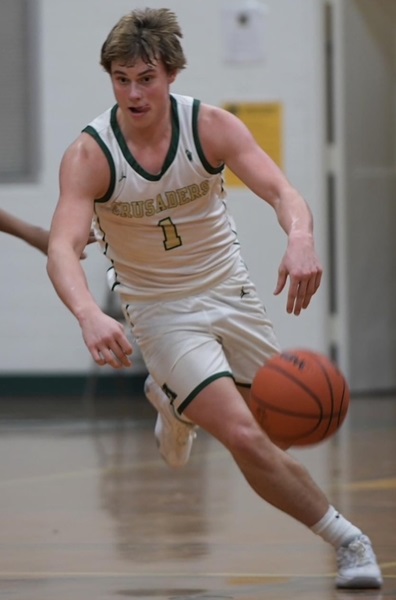
Things went much better in basketball, as Bryan teamed with all-stater Bradley Richards to help MCC to an 11-10 record, its first winning season in six years.
Through winning or losing, MCC football coach Steve Czerwon said the strong Catholic faith of the Convertini family is always front and center.
The family will gather to celebrate in early September, when Mason and his fiancée, Sophie, get married at St. Michael’s Church in Muskegon. That is about the same time that Bryan will be off to Grand Valley, and Czerwon and the MCC football program will begin the post-Convertini era.
“Bryan and all of his brothers have an inner strength which sets them apart,” said Czerwon, who took over as MCC’s head coach in 2013, which was Mason’s freshman year. “All of them respect authority and they want to learn and get better, which is all that you can ask.
“It’s been a pleasure working with their family. We are all going to miss them.”
 Tom Kendra worked 23 years at The Muskegon Chronicle, including five as assistant sports editor and the final six as sports editor through 2011. E-mail him at [email protected] with story ideas for Muskegon, Oceana, Mason, Lake, Oceola, Mecosta and Newaygo counties.
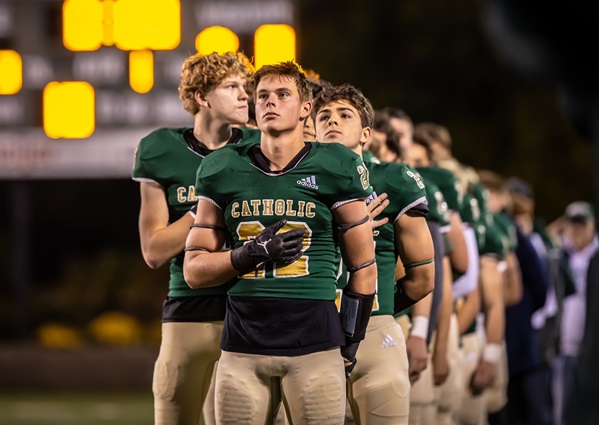
PHOTOS (Top) Muskegon Catholic Central’s Bryan Convertini takes a look down the third-base line during a baseball at bat. (2) The four Convertini boys take a photo together after one of Bryan’s football games in 2023. From left: Sam, Bryan, Mason and Nolan. (3) Convertini brings the ball upcourt during basketball season. (4) Convertini (22), stands for the national anthem this past fall. (Baseball and basketball photos by Michael Banka. Football photo by Tim Reilly. Family photo courtesy of Jene Convertini.)