

Casting Lines for Future Tournaments
August 12, 2016
By Jack Roberts
MHSAA Executive Director
The MHSAA is best known to the public for the tournaments it conducts to conclude the fall, winter and spring seasons each school year.
These tournaments, the first and largest program of the MHSAA, have survived the Vietnam War, the Korean conflict and two World Wars. They have survived the technology bubble, the housing collapse, the energy crisis and the Great Depression.
MHSAA tournaments existed at the dawn of aviation and at the time of our nation’s lunar landing. Popes, presidents and governors have changed and changed again and again, and MHSAA tournaments roll on year after year.
But the sense of tradition and permanence and inevitability of MHSAA tournaments doesn’t dissuade us from asking questions about our tournaments, even some of the most basic questions. Here are two.
Question #1
I have long been and will always be an advocate for a Ryder Cup format for the MHSAA Golf Finals, and a team tennis approach to the MHSAA Tennis Finals; but 90 years of tradition is hard to overcome. Might this be a more exciting format? Could it be co-ed? Could it reverse the decline in boys tennis participation, and increase girls golf participation? Wouldn’t it be fun to try?
Periodically, the International Olympic Committee requires each of the designated Olympic sports to defend its status, to state its case why the sport should remain a part of the Olympic program. Then, after a series or votes that retain one sport at a time, the IOC drops the sport that makes the weakest case. It does so to make room for one of the previously unlisted sports that makes the best case for inclusion.
This would appear to keep the existing Olympic sports on their toes, and to keep the Olympic movement fresh and reflective of modern trends in sports.
While I would not enjoy the controversy, I can see the potential for some positive results if the MHSAA were to invoke the same policy for determining the 14 tournaments it will provide for girls and the 14 for boys.
This might cause us to consider more deeply what a high school sport should look like, or at least what an MHSAA tournament sport should stand for.
On the one hand, we might be inclined to drop tournaments for those sports that involve mostly non-faculty coaches and non-school venues, or require cooperative programs to generate enough participants to support a team, or resort almost entirely to non-school funding, or cater to individuals more than teams.
Or perhaps this process would cause policymakers to forget traditional thinking and ask: “In this day and age, should we shake off traditional notions of sport and consider more where modern kids are coming from?” That might mean fewer team sports and more individual sports, more “extreme” sports like snowboarding and skateboarding, and more lifetime sports, meaning not just golf and tennis and running sports, but also fishing and even shooting sports.
Currently, MHSAA policy states that the MHSAA will consider sponsorship of a tournament series for any sport which 64 member schools conduct on an interscholastic basis as a result of action by the governing boards of those schools.
Should the only question be how many schools sponsor a sport, or must an activity also have certain qualities and/or avoid certain “defects?” What should an MHSAA tournament sport look like and stand for?
Question #2
Bristling from criticism that his association is a money-grabbing exploiter of children, my counterpart in another state said, “If we were running our programs just to make money, we would do very many things very differently.” I knew exactly what he meant.
Because we care about the health and welfare of students, because we mean what we say that the athletic program needs to maximize the ways it enhances the school experience while minimizing academic conflicts, and because we try to model our claim that no sport is a minor sport when it comes to its potential to teach young people life lessons, we operate our programs in ways that make promoters, marketers and business entrepreneurs laugh, cry or cringe.
If money were the only object, we would seed and select sites to assure the teams that attracted the most spectators had the best chance to advance in our tournaments, regardless of the travel for any team or its fan base. If money were the only object, we would never schedule two tournaments to overlap and compete for public attention, much less tolerate three or four overlapping events. If money were the only object, we would allow signage like NASCAR events and promotions like minor league baseball games.
Those approaches to event sponsorship may not be all wrong; they’re just not all right for us. And we will live with the consequences of our belief system.
During a typical school year, more than 20 percent of the MHSAA’s 2,097 District, Regional and Final tournaments lose money. Not a single site in golf, skiing or tennis makes a single penny. In no sport did every District, Regional and Final site have revenue in excess of direct expenses.
In fact, in only three sports – boys and girls basketball and football – is revenue so much greater than direct expenses overall that it helps to pay for all the other tournaments in which the MHSAA invests.
That’s right: invests. When we present our budget to our board, we talk about the MHSAA’s investment in providing tournament opportunities in all those sports and all those places that cannot sustain the cost of those events on their own. How much is this investment worth to students, schools and society?
These two are core questions that require our focus far in advance of talk about scheduling, site selection, seeding and the myriad matters that too often hijack our time and attention.
Novi Ace Set to Close Prep Career Among Wildcats' All-Time Greats
By
Keith Dunlap
Special for MHSAA.com
May 1, 2025
NOVI — Ironically, what’s likely to go down as one of the most accomplished baseball careers in Novi High School history began during football season.
 During a fall ball session back in 2021, Novi baseball coach Rick Green was summoned to watch a bullpen session of then-freshman left-hander Uli Fernsler, a player he and others on the coaching staff figured was pegged for a spot on the junior varsity roster.
“My pitching coach at the time said to ‘come down to the bullpen, you need to see this kid,’” Green said. “He was just so poised when he threw, especially with me there. He didn’t throw hard at the time, but he had good location.”
Come the following spring, Fernsler added some velocity and couldn’t be left off the varsity team. Since then, the Novi community has come to find out why he’ll soon graduate as one of the school’s all-time athletic greats.
So far this year, Fernsler has 55 strikeouts, four walks and just two earned runs allowed. It’s no wonder pro scouts have flocked to his starts, with Hometown Life reporting more than 20 showed up to watch him pitch against Canton in March.
Signed to play collegiately for Texas Christian, Fernsler has a shot to establish Novi school records for strikeouts and earned-run average depending on how the rest of the season unfolds.
However, his biggest claim to fame is that he was the winning pitcher for the Wildcats in both the 2023 Division 1 championship game and also Novi’s Semifinal win at McLane Stadium, something that has become rare since pitch-count limits were instituted in 2017.
In an 8-3 championship game win over Woodhaven, Fernsler tossed a complete game, striking out eight, walking none and allowing two earned runs.
However, his under-the-radar performance in the Semifinal was arguably more important.
In that game, Novi tied Mattawan 1-1 with two outs in the top of the seventh on an RBI single, and then starter Andrew Abler pitched a scoreless seventh to force extra innings.
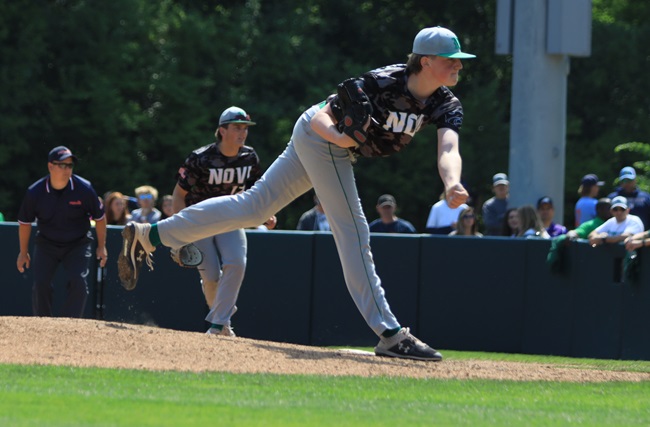 From there Fernsler took over, pitching three scoreless innings of relief under immense pressure. Novi didn’t score in the eighth and ninth innings, so Fernsler couldn’t afford to even let in one run or else the Wildcats’ dream would be over.
Fernsler held firm, and then after being staked to a three-run lead in the top of the 10th, shut the door in the bottom half to preserve a 4-1 Novi win. He allowed just one hit over his three innings of relief, and more importantly, did so efficiently enough to stay under the 49-pitch limit that would’ve prevented him from taking the mound in the championship game.
Fernsler recalls warming up in the bullpen with Novi still down 1-0, thinking that all he wanted was a chance to pitch on a college mound at Michigan State.
“I was just really hoping we would score a run, which we did,” he said. “There was definitely some nerves. But it wasn’t too bad. I had some confidence I could do what I was able to do.”
All in all, Fernsler allowed just nine hits, two earned runs and struck out 10 in 10 innings of work on the state’s biggest stage as a sophomore.
He also had an excellent junior year, but Novi’s hopes of repeating were derailed in a 3-1 loss to rival and eventual Division 1 champion Northville in a District Final.
He’s been dazzling so far as a senior, helped by a new pitch Green recommended he try after last season to complement his fastball, slider and changeup.
“I told him to try and throw a curveball to get another pitch to get hitters off-balance in addition to the changeup,” Green said. “We worked on it all summer, and he’s really done a nice job with it this year.”
Fernsler said coaches at TCU have come to see him throw a couple of times this season, but haven’t really offered advice or instructions and have pretty much let him do his thing.
Eventually, Fernsler hopes further doing his thing will result in leading Novi to another appearance at Michigan State for another Finals weekend, although the 2023 run is not familiar to the majority of Novi’s current roster.
“It’s kind of a new team,” Fernsler said. “I don’t think we are carrying momentum from that. We are just trying to figure out what we can do to get back.”
 Keith Dunlap has served in Detroit-area sports media for more than two decades, including as a sportswriter at the Oakland Press from 2001-16 primarily covering high school sports but also college and professional teams. His bylines also have appeared in USA Today, the Washington Post, the Detroit Free Press, the Houston Chronicle and the Boston Globe. He served as the administrator for the Oakland Activities Association’s website from 2017-2020. Contact him at [email protected] with story ideas for Oakland, Macomb and Wayne counties.
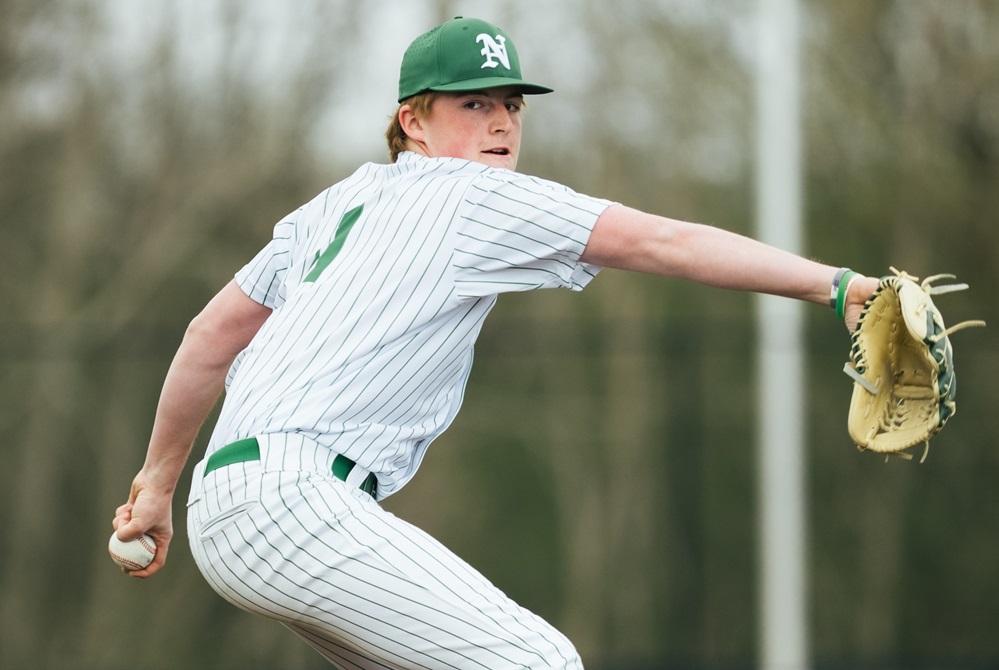
PHOTOS (Top) Novi pitcher Uli Fernsler makes his move toward the plate this season. (Middle) Fernsler follows through on a pitch during the 2023 Division 1 Final. (Top photo courtesy of the Novi athletic department.)