

Casting Lines for Future Tournaments
August 12, 2016
By Jack Roberts
MHSAA Executive Director
The MHSAA is best known to the public for the tournaments it conducts to conclude the fall, winter and spring seasons each school year.
These tournaments, the first and largest program of the MHSAA, have survived the Vietnam War, the Korean conflict and two World Wars. They have survived the technology bubble, the housing collapse, the energy crisis and the Great Depression.
MHSAA tournaments existed at the dawn of aviation and at the time of our nation’s lunar landing. Popes, presidents and governors have changed and changed again and again, and MHSAA tournaments roll on year after year.
But the sense of tradition and permanence and inevitability of MHSAA tournaments doesn’t dissuade us from asking questions about our tournaments, even some of the most basic questions. Here are two.
Question #1
I have long been and will always be an advocate for a Ryder Cup format for the MHSAA Golf Finals, and a team tennis approach to the MHSAA Tennis Finals; but 90 years of tradition is hard to overcome. Might this be a more exciting format? Could it be co-ed? Could it reverse the decline in boys tennis participation, and increase girls golf participation? Wouldn’t it be fun to try?
Periodically, the International Olympic Committee requires each of the designated Olympic sports to defend its status, to state its case why the sport should remain a part of the Olympic program. Then, after a series or votes that retain one sport at a time, the IOC drops the sport that makes the weakest case. It does so to make room for one of the previously unlisted sports that makes the best case for inclusion.
This would appear to keep the existing Olympic sports on their toes, and to keep the Olympic movement fresh and reflective of modern trends in sports.
While I would not enjoy the controversy, I can see the potential for some positive results if the MHSAA were to invoke the same policy for determining the 14 tournaments it will provide for girls and the 14 for boys.
This might cause us to consider more deeply what a high school sport should look like, or at least what an MHSAA tournament sport should stand for.
On the one hand, we might be inclined to drop tournaments for those sports that involve mostly non-faculty coaches and non-school venues, or require cooperative programs to generate enough participants to support a team, or resort almost entirely to non-school funding, or cater to individuals more than teams.
Or perhaps this process would cause policymakers to forget traditional thinking and ask: “In this day and age, should we shake off traditional notions of sport and consider more where modern kids are coming from?” That might mean fewer team sports and more individual sports, more “extreme” sports like snowboarding and skateboarding, and more lifetime sports, meaning not just golf and tennis and running sports, but also fishing and even shooting sports.
Currently, MHSAA policy states that the MHSAA will consider sponsorship of a tournament series for any sport which 64 member schools conduct on an interscholastic basis as a result of action by the governing boards of those schools.
Should the only question be how many schools sponsor a sport, or must an activity also have certain qualities and/or avoid certain “defects?” What should an MHSAA tournament sport look like and stand for?
Question #2
Bristling from criticism that his association is a money-grabbing exploiter of children, my counterpart in another state said, “If we were running our programs just to make money, we would do very many things very differently.” I knew exactly what he meant.
Because we care about the health and welfare of students, because we mean what we say that the athletic program needs to maximize the ways it enhances the school experience while minimizing academic conflicts, and because we try to model our claim that no sport is a minor sport when it comes to its potential to teach young people life lessons, we operate our programs in ways that make promoters, marketers and business entrepreneurs laugh, cry or cringe.
If money were the only object, we would seed and select sites to assure the teams that attracted the most spectators had the best chance to advance in our tournaments, regardless of the travel for any team or its fan base. If money were the only object, we would never schedule two tournaments to overlap and compete for public attention, much less tolerate three or four overlapping events. If money were the only object, we would allow signage like NASCAR events and promotions like minor league baseball games.
Those approaches to event sponsorship may not be all wrong; they’re just not all right for us. And we will live with the consequences of our belief system.
During a typical school year, more than 20 percent of the MHSAA’s 2,097 District, Regional and Final tournaments lose money. Not a single site in golf, skiing or tennis makes a single penny. In no sport did every District, Regional and Final site have revenue in excess of direct expenses.
In fact, in only three sports – boys and girls basketball and football – is revenue so much greater than direct expenses overall that it helps to pay for all the other tournaments in which the MHSAA invests.
That’s right: invests. When we present our budget to our board, we talk about the MHSAA’s investment in providing tournament opportunities in all those sports and all those places that cannot sustain the cost of those events on their own. How much is this investment worth to students, schools and society?
These two are core questions that require our focus far in advance of talk about scheduling, site selection, seeding and the myriad matters that too often hijack our time and attention.
Century of School Sports: Student Advisory Council Gives Voice to Athletes
By
Geoff Kimmerly
MHSAA.com senior editor
April 15, 2025
The Michigan High School Athletic Association, since its inception in December 1924, has sought to reflect the desires of its membership – at this time, 754 high schools and more than 750 middle schools – and for most of its history carried out that mission by acting on the ideas and concerns of administrators, coaches and game officials.
With the start of the 2006-07 school year, another constituency began supplying its voice to the MHSAA’s decision-making process.
That fall, the first Student Advisory Council began its tenure, made up of eight juniors – four girls and four boys – with those first eight setting the tone for 144 students total who have served over the last 18 years.
The Student Advisory Council, in essence, is that student voice that not only weighs in on topics regarding school sports that are being debated among MHSAA member schools, but also speaks to the benefits of school sports as ambassadors in their schools, leagues and across the state.
The SAC meets six times during the school year, plus once more for a 24-hour leadership camp, and discusses subjects connected with the core values of the MHSAA and educational athletics – scholarship, sportsmanship, safety and a sensible scope of athletic programs, with student leadership also a common topic. SAC members then promote those values through their assistance in the MHSAA’s annual Sportsmanship Summits, various leadership projects, and social media posts and videos.
Over the years, the Student Advisory Council has written two versions of the "MHSAA Captains 101" booklet which was delivered to every school in the state. Members have been featured in two versions of the National Federation of State High School Associations (NFHS) Captains Course, and the group has advised on changes to MHSAA trophies and medals and gear sold at Finals events.
SAC members also assist with medal ceremonies at MHSAA championship events and take on other projects throughout the school year; for example, the Student Advisory Council coordinated and judged the MHSAA’s Battle of the Fans student section contest during its 10-year run that ended in 2022, and this school year created the below statement on sportsmanship to be used during MHSAA broadcasts and live events.
The Student Advisory Council was the creation of MHSAA Assistant Director Andy Frushour and based at first on a similar program hosted by the Indiana High School Athletic Association.
The first Council included then-juniors Andria Baker of Constantine, Dustin Baker of St. Louis, Bryce Bilinski of Southgate Anderson, Brittany Bullock of Lansing Catholic, Rachel Gebauer of Alpena, Eric Howard of Hudsonville Freedom Christian, Blake Laethem of Caro and Molly Waterhouse of Vicksburg. Joining them in Year 2 were juniors Abby Cohen of Bloomfield Hills Cranbrook Kingswood, Willie Cruz of Harrison Township L’Anse Creuse, Michelle DeMuro of Muskegon Reeths-Puffer, Adam Dingman of Cedarville, Matt Herman of East Kentwood, Molley Lockwood of Fife Lake Forest Area, Jeff Petsch of Montague and CC Weber of Goodrich.
Including that group, there have been representatives from 136 schools – nearly 20 percent of the MHSAA’s high school membership.
Applications are being accepted through April 21 from candidates for the Class of 2027 – with those students, as juniors, to serve as part of the 20th Student Advisory Council. Click here for the application. Selections are made through a multi-part process that includes initial consideration of applicants by members of the MHSAA’s brand and student services team and then interviews with finalists.
The current Student Advisory Council includes seniors Cale Bell from Sault Ste. Marie, Drew Cady from Oxford, Macy Jenkins from Milford, Isaiah Kabban from Harbor Beach, Ella Knudsen from Leland, Kaylee Kranz from Clinton, Joey Spada from Kalamazoo Central, and Aynalem Zoet from Grandville Calvin Christian; and juniors Itzel Albarran from Bronson, Harper Barnhart from Brownstown Woodhaven, Diamond Cook from Southfield Christian, Henry Ewles from Pontiac Notre Dame Prep, Cole Haist from Big Rapids, Frannie Keeley from Jenison, Trey LaValley from Romeo, and Ethan Stine from Bridgman.
Previous "Century of School Sports" Spotlights
April 9: State's Storytellers Share Spring Memories - Read
April 2: Sharp Leadership Synonymous with MHSAA Success - Read
March 25: Athletic Directors Indispensable to Mission of School Sports - Read
March 18: 2025 Finals Begin Next Half-Century of Girls Hoops Championships - Read
March 11: Boys Basketball's Best 1st to Earn MHSAA Finals Titles - Read
March 5: Everything We Do Begins with Participation - Read
Feb. 25: Slogans & Logos Remain Unforgettable Parts of MHSAA History - Read
Feb. 19: MHSAA Tickets Continue to Provide Fan-Friendly Value - Read
Feb. 11: We Recognize Those Who Make Our Games Go - Read
Feb. 4: WISL Conference Continues to Inspire Aspiring Leaders - Read
Jan. 28: Michigan's National Impact Begins at NFHS' Start - Read
Jan. 21: Awards Celebrate Well-Rounded Educational Experience - Read
Jan. 14: Predecessors Laid Foundation for MHSAA's Formation - Read
Jan. 9: MHSAA Blazes Trail Into Cyberspace - Read
Dec. 31: State's Storytellers Share Winter Memories - Read
Dec. 17: MHSAA Over Time - Read
Dec. 10: On This Day, December 13, We Will Celebrate - Read
Dec. 3: MHSAA Work Guided by Representative Council - Read
Nov. 26: Finals Provide Future Pros Early Ford Field Glory - Read
Nov. 19: Connection at Heart of Coaches Advancement Program - Read
Nov. 12: Good Sports are Winners Then, Now & Always - Read
Nov. 5: MHSAA's Home Sweet Home - Read
Oct. 29: MHSAA Summits Draw Thousands to Promote Sportsmanship - Read
Oct. 23: Cross Country Finals Among MHSAA's Longest Running - Read
Oct. 15: State's Storytellers Share Fall Memories - Read
Oct. 8: Guided by 4 S's of Educational Athletics - Read
Oct. 1: Michigan Sends 10 to National Hall of Fame - Read
Sept. 25: MHSAA Record Books Filled with 1000s of Achievements - Read
Sept. 18: Why Does the MHSAA Have These Rules? - Read
Sept. 10: Special Medals, Patches to Commemorate Special Year - Read
Sept. 4: Fall to Finish with 50th Football Championships - Read
Aug. 28: Let the Celebration Begin - Read
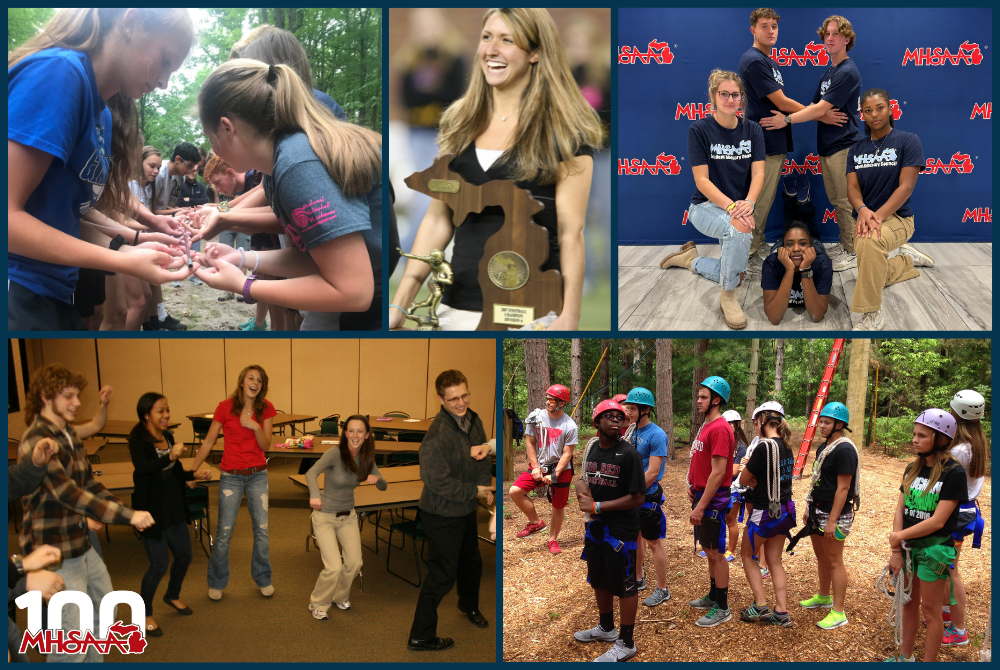
PHOTOS Student Advisory Council members over the years participate in challenges during an overnight camp, hand out championship trophies, take photos together at MHSAA leadership events, and take a few minutes for a dance-off during a monthly meeting.