

Casting Lines for Future Tournaments
August 12, 2016
By Jack Roberts
MHSAA Executive Director
The MHSAA is best known to the public for the tournaments it conducts to conclude the fall, winter and spring seasons each school year.
These tournaments, the first and largest program of the MHSAA, have survived the Vietnam War, the Korean conflict and two World Wars. They have survived the technology bubble, the housing collapse, the energy crisis and the Great Depression.
MHSAA tournaments existed at the dawn of aviation and at the time of our nation’s lunar landing. Popes, presidents and governors have changed and changed again and again, and MHSAA tournaments roll on year after year.
But the sense of tradition and permanence and inevitability of MHSAA tournaments doesn’t dissuade us from asking questions about our tournaments, even some of the most basic questions. Here are two.
Question #1
I have long been and will always be an advocate for a Ryder Cup format for the MHSAA Golf Finals, and a team tennis approach to the MHSAA Tennis Finals; but 90 years of tradition is hard to overcome. Might this be a more exciting format? Could it be co-ed? Could it reverse the decline in boys tennis participation, and increase girls golf participation? Wouldn’t it be fun to try?
Periodically, the International Olympic Committee requires each of the designated Olympic sports to defend its status, to state its case why the sport should remain a part of the Olympic program. Then, after a series or votes that retain one sport at a time, the IOC drops the sport that makes the weakest case. It does so to make room for one of the previously unlisted sports that makes the best case for inclusion.
This would appear to keep the existing Olympic sports on their toes, and to keep the Olympic movement fresh and reflective of modern trends in sports.
While I would not enjoy the controversy, I can see the potential for some positive results if the MHSAA were to invoke the same policy for determining the 14 tournaments it will provide for girls and the 14 for boys.
This might cause us to consider more deeply what a high school sport should look like, or at least what an MHSAA tournament sport should stand for.
On the one hand, we might be inclined to drop tournaments for those sports that involve mostly non-faculty coaches and non-school venues, or require cooperative programs to generate enough participants to support a team, or resort almost entirely to non-school funding, or cater to individuals more than teams.
Or perhaps this process would cause policymakers to forget traditional thinking and ask: “In this day and age, should we shake off traditional notions of sport and consider more where modern kids are coming from?” That might mean fewer team sports and more individual sports, more “extreme” sports like snowboarding and skateboarding, and more lifetime sports, meaning not just golf and tennis and running sports, but also fishing and even shooting sports.
Currently, MHSAA policy states that the MHSAA will consider sponsorship of a tournament series for any sport which 64 member schools conduct on an interscholastic basis as a result of action by the governing boards of those schools.
Should the only question be how many schools sponsor a sport, or must an activity also have certain qualities and/or avoid certain “defects?” What should an MHSAA tournament sport look like and stand for?
Question #2
Bristling from criticism that his association is a money-grabbing exploiter of children, my counterpart in another state said, “If we were running our programs just to make money, we would do very many things very differently.” I knew exactly what he meant.
Because we care about the health and welfare of students, because we mean what we say that the athletic program needs to maximize the ways it enhances the school experience while minimizing academic conflicts, and because we try to model our claim that no sport is a minor sport when it comes to its potential to teach young people life lessons, we operate our programs in ways that make promoters, marketers and business entrepreneurs laugh, cry or cringe.
If money were the only object, we would seed and select sites to assure the teams that attracted the most spectators had the best chance to advance in our tournaments, regardless of the travel for any team or its fan base. If money were the only object, we would never schedule two tournaments to overlap and compete for public attention, much less tolerate three or four overlapping events. If money were the only object, we would allow signage like NASCAR events and promotions like minor league baseball games.
Those approaches to event sponsorship may not be all wrong; they’re just not all right for us. And we will live with the consequences of our belief system.
During a typical school year, more than 20 percent of the MHSAA’s 2,097 District, Regional and Final tournaments lose money. Not a single site in golf, skiing or tennis makes a single penny. In no sport did every District, Regional and Final site have revenue in excess of direct expenses.
In fact, in only three sports – boys and girls basketball and football – is revenue so much greater than direct expenses overall that it helps to pay for all the other tournaments in which the MHSAA invests.
That’s right: invests. When we present our budget to our board, we talk about the MHSAA’s investment in providing tournament opportunities in all those sports and all those places that cannot sustain the cost of those events on their own. How much is this investment worth to students, schools and society?
These two are core questions that require our focus far in advance of talk about scheduling, site selection, seeding and the myriad matters that too often hijack our time and attention.
Century of School Sports: State's Storytellers Share Spring Memories
By
Geoff Kimmerly
MHSAA.com senior editor
April 8, 2025
With the start of spring sports, the MHSAA’s “Century of School Sports” celebration has begun its final lap.
Every week we’ve told at least a few stories from these last 100 years – and today, we present our third and final installment of favorite sports memories from statewide media, our historian and MHSAA staff.
Below are their most unforgettable moments from spring.
Homer Sets Standard with 56-Game Baseball Winning Streak
Ron Pesch, MHSAA historian
Recognizing the contrasting challenges that face teams in various eras to set or break records, it was great fun to track Homer's successful attempt to match, then exceed Grand Haven's 43-year-old record, then chase a national record for consecutive baseball victories.
There's something about the small-town excitement knitted into such a chase. Grand Haven set the mark back before an MHSAA-sponsored state tournament commenced in 1971. Inherently built into such an accomplishment is an evolving roster that spans multiple seasons, when a single season featured only 20 to 30 or so games. (Only one Buccaneer player was part of all the Buccaneers' 56-straight victories.)
Because of the postseason, Homer's annual slate featured more games, but came with the additional challenge of squaring off against more talented teams as the playoffs progressed. Homer's record-setting win came during a homefield doubleheader against Reading during the 2005 regular season – ironically against the school which gave the Trojans their last loss in the 2003 Regional Semifinal. Victorious in both games that day against Reading, Homer extended the run through 75-consecutive contests – a national record, since topped – that ended in June with a 7-6 loss to Saginaw Nouvel in the MHSAA Division 3 Final.
 Truly an Unforgettable Classic
Tim Staudt, WILX (Lansing), in 54th year of broadcasting
The one memory from the spring season that immediately jumps to mind is the 2006 Diamond Classic final between Homer and Grand Ledge. Grand Ledge would come back to win the game 7-6 with players from the Lansing Lugnuts in the dugout watching to see how the game was going to end.
This was one more remarkable Grand Ledge baseball achievement under coach Pat O’Keefe. It would be Homer’s only loss of the 2006 season, as they went 38-1 and won the Division 4 championship, a year after winning a then-national record 75 straight games.
Career Crosses Paths with State’s 2 Winningest on Baseball Diamond
Brian Calloway, Lansing State Journal
In two media markets I have worked in in the state, I’ve had the privilege to cover two of the state’s most decorated baseball coaches in Blissfield’s Larry Tuttle and Grand Ledge’s Pat O’Keefe, who are both members of the Michigan Baseball Hall of Fame.
I worked in Adrian when Larry Tuttle joined the 1,000-win club in June of 2008. After moving to the Lansing market, I got to document the final portion of O’Keefe’s special career that he ended as the all-time wins leader before eventually being passed by Tuttle.
Legendary Softball Team Ends Legendary Run
Geoff Kimmerly, MHSAA Communications Director and formerly of Lansing State Journal
I stepped into the Lansing State Journal fulltime lineup in January 2000 amid the senior years of two of the greatest athletes in local and statewide high school sports history – Lansing Waverly’s Marcus Taylor, who led his team to the Class A basketball title that March, and Okemos’ Jessica Beech, who had pitched her softball team to the Division 1 championship in 1999 and remains the most accomplished three-sport athlete in mid-Michigan history.
Dating back to that title run, Beech had earned an MHSAA-record 57 straight pitching victories heading into a Division 1 Regional Semifinal on June 10, 2000, at Lansing Everett. Up next was undefeated Portage Northern. Beech struck out 11 hitters against the team Okemos coach Dan Stolz called “the best his team has faced the past two seasons.” But Northern prevailed 2-0, with sophomore Anna Ollgaard throwing a one-hitter, and went on to finish the season 41-0 and Division 1 champion for the first of three consecutive seasons. The Huskies’ 52-game winning streak started that spring remains the second-longest in MHSAA softball history.
 Lectka Becomes Unstoppable in Leaving Livonia Franklin Legacy
Brad Emons, Detroit Free Press (formerly of Observer & Eccentric newspapers)
After falling to Mount Clemens L’Anse Creuse North in the 1985 championship game, 5-0, Livonia Franklin redeemed itself by beating Waterford Kettering, 1-0, in the 1986 Class A Softball Final for its first state title as senior pitcher Tracy Lectka’s threw a no-hitter at Lansing’s Ranney Park.
Lectka tossed back-to-back shutouts, including a 2-0 Semifinal win over South Lyon in a two-day continuation game halted by darkness where Lectka pitched all 20 innings to secure the victory.
Glen Lake’s Superwoman Finishes with Another Historic Run
Mick McCabe, Detroit Free Press since 1970
Heading into the 1992 Class D track & field state championships at Grand Rapids Forest Hills Northern, Maple City Glen Lake’s Marnie Peplinski had to balance the emotions of being confident without being overconfident.
She looked at the performances of the other girls in the Finals and compared them to her efforts. “I knew they were not going to make up two or three seconds in that one day unless they were Superwoman.”
Well, Superwoman did show up at the Finals that day, but she was wearing a Glen Lake uniform.
That day, her final day of being a Michigan high school athlete, Peplinski became the first girl in state history to win four state titles in consecutive years, helping Glen Lake to its second-straight team title. She set Finals records when she won the 100 hurdles (15.06 seconds) and 300 hurdles (44.80). She also won the long jump (17 feet, 5 inches) and was part of the winning 1,600 relay team (4:03.90). She also had won all of those events as a junior, and as a sophomore she won the 300 hurdles, the long jump and the 1,600 relay, which she was a part of as a freshman as well.
The day capped a brilliant high school career for Peplinski, who also earned first-team all-state honors in basketball and volleyball. She went on to compete in track & field and basketball at Central Michigan University.
Brother Rice Sets Standard in Boys Lacrosse
Perry Farrell, MHSAA.com and formerly of Detroit Free Press
Bloomfield Hills Brother Rice's run in lacrosse was a showcase of dominance as they started a stretch that saw them win 13 of the first 14 Division 1 championships starting in 2005.
Watch the 2017 Division 1 Final, which Brother Rice won over Detroit Catholic Central 8-7, on the NFHS Network, and see highlights below from that game from State Champs! Sports Network.
Beal City Provides Celebration to Remember
Greg Miller, formerly of 9&10 News (Cadillac)
The 2023 season for Beal City baseball was a special one that ended with a Division 4 championship celebration on the field at McLane Stadium in East Lansing. A year prior, the Aggies, who had been top-ranked nearly the entire season, fell short in the championship game, and they were back seeking redemption.
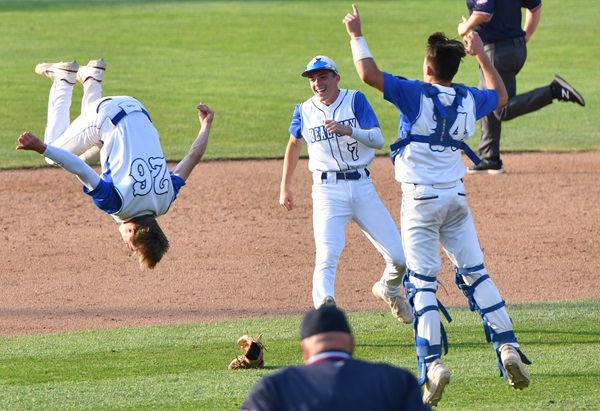 In a tightly-fought battle in the title game against Plymouth Christian Academy, Beal City answered after surrendering the game's first run in the fourth inning, tying the game in the bottom half of the frame. They then took the lead in the bottom of the sixth.
Star pitcher Cayden Smith, after hitting his pitch limit with one out in the seventh, moved to shortstop and was able to catch the final out of the game, performing a celebratory backflip on the infield grass before being mobbed by his teammates in one of the coolest celebration moments I ever witnessed.
Watch the 2023 Division 4 Final on the NFHS Network.
Previous "Century of School Sports" Spotlights
April 2: Sharp Leadership Synonymous with MHSAA Success - Read
March 25: Athletic Directors Indispensable to Mission of School Sports - Read
March 18: 2025 Finals Begin Next Half-Century of Girls Hoops Championships - Read
March 11: Boys Basketball's Best 1st to Earn MHSAA Finals Titles - Read
March 5: Everything We Do Begins with Participation - Read
Feb. 25: Slogans & Logos Remain Unforgettable Parts of MHSAA History - Read
Feb. 19: MHSAA Tickets Continue to Provide Fan-Friendly Value - Read
Feb. 11: We Recognize Those Who Make Our Games Go - Read
Feb. 4: WISL Conference Continues to Inspire Aspiring Leaders - Read
Jan. 28: Michigan's National Impact Begins at NFHS' Start - Read
Jan. 21: Awards Celebrate Well-Rounded Educational Experience - Read
Jan. 14: Predecessors Laid Foundation for MHSAA's Formation - Read
Jan. 9: MHSAA Blazes Trail Into Cyberspace - Read
Dec. 31: State's Storytellers Share Winter Memories - Read
Dec. 17: MHSAA Over Time - Read
Dec. 10: On This Day, December 13, We Will Celebrate - Read
Dec. 3: MHSAA Work Guided by Representative Council - Read
Nov. 26: Finals Provide Future Pros Early Ford Field Glory - Read
Nov. 19: Connection at Heart of Coaches Advancement Program - Read
Nov. 12: Good Sports are Winners Then, Now & Always - Read
Nov. 5: MHSAA's Home Sweet Home - Read
Oct. 29: MHSAA Summits Draw Thousands to Promote Sportsmanship - Read
Oct. 23: Cross Country Finals Among MHSAA's Longest Running - Read
Oct. 15: State's Storytellers Share Fall Memories - Read
Oct. 8: Guided by 4 S's of Educational Athletics - Read
Oct. 1: Michigan Sends 10 to National Hall of Fame - Read
Sept. 25: MHSAA Record Books Filled with 1000s of Achievements - Read
Sept. 18: Why Does the MHSAA Have These Rules? - Read
Sept. 10: Special Medals, Patches to Commemorate Special Year - Read
Sept. 4: Fall to Finish with 50th Football Championships - Read
Aug. 28: Let the Celebration Begin - Read
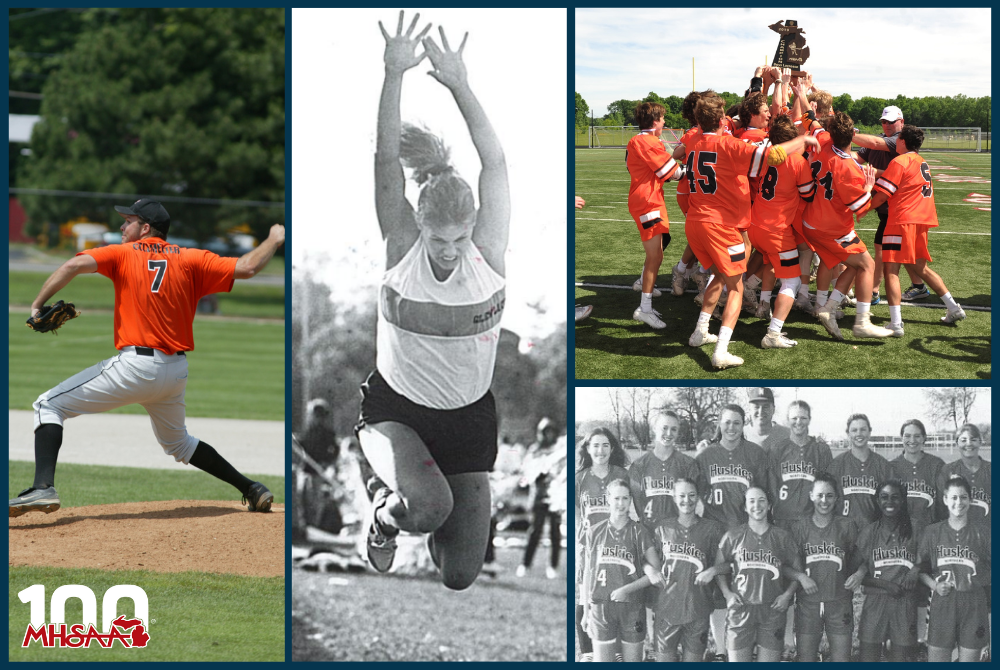
PHOTOS (Top) From left: Homer's Josh Collmenter throws a pitch during the 2004 Finals, Maple City Glen Lake's Marnie Peplinski long jumps in 1992, the Brother Rice boys lacrosse team celebrates its 2019 championship, and the Portage Northern softball team takes a photo after finishing an undefeated 2000 season. (2) The Lansing State Journal sports section details Grand Ledge's comeback to defeat Homer at the Diamond Classic in Lansing. (3) Livonia Franklin's softball team takes a team photo after finishing its 1986 Class A title run. (4) Cayden Smith's backflip kicks off Beal City's 2023 championship celebration. (MHSAA file photos.)