

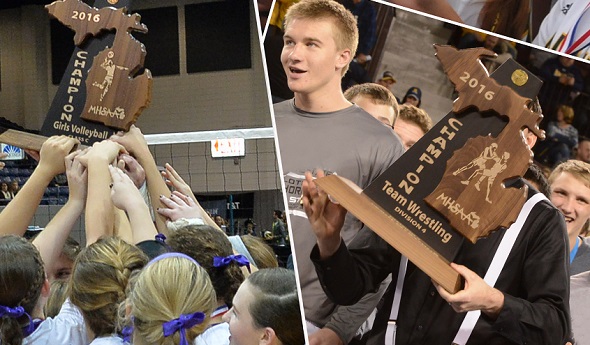
Class in Session: A History in Classification
July 24, 2017
By Rob Kaminski
MHSAA benchmarks editor
This is the first part in a series on MHSAA tournament classification, past and present, that will be published over the next two weeks. This series originally ran in this spring's edition of MHSAA benchmarks.
Conversation and discussion at the March 2017 MHSAA Representative Council Meeting leaned heavily toward the subject of 8-Player Football and how to properly balance its tournament with the growing number of schools sponsoring the sport.
While the proposal to split the tournament into two divisions beginning with the 2017 school year was adopted, the MHSAA then faced questions such as when to set the divisions, how to determine qualifiers and where to host the championship games.
The topic continues to create a buzz in Class D schools across both peninsulas, and likely will do into the start of school this fall.
Likewise, the lone holdouts still conducting tournaments by class – MHSAA Boys and Girls Basketball and Girls Volleyball – took center stage at the May Council discussion, and following the 2017-18 school year, class is out for good. Both genders of basketball, and girls volleyball, will move to divisional formats thereafter.
There is much to be decided to be sure; but as those in education are well aware, history is the best teacher.
Fortunately for the sports in flux and for all sports under the governance of the MHSAA, the Association more or less wrote the book on the subject of sport classification. Following is a history lesson, with a little advanced division thrown in.
Class structure
Credited with being the first state with multiple tournament classifications, Michigan’s attention to trends and shifts in philosophy aimed at fair play and equal tournament opportunity can be traced from 80 years ago to the present.
In the earliest years of the MHSAA, there were four classifications for elections and tournaments – Classes A, B, C and D. Classes C and D had far more schools than Classes A and B. For example, 80 years ago (1937), there were only 58 schools in Class A, 94 schools in Class B, 297 schools in Class C and 253 schools in Class D.
Gradually through the years, as Michigan’s major cities spawned suburbs, there was a shift in the other direction to the point 30 years ago (1987) when school size became more balanced: 173 Class A schools, 178 Class B schools, 179 Class C schools and 182 Class D schools.
Up until 1987, the MHSAA published the dividing line between each classification, after which schools submitted their enrollments. Then, for 1988 and thereafter, the MHSAA adopted the plan of gathering all enrollments first and then placing 25 percent of the schools in each of four classes. This completed the equalization of the number of schools in each class for elections.
However, the change for 1988 did nothing to equalize the number of teams actually entered by each class in each sport. And unlike the early years of the Association when there were many more Class C and D teams than A and B teams, there were more Class A and B teams than C and D teams entering MHSAA tournaments decades later.
Moreover, the difference in number of teams entered in the different classifications for a sport continued to increase as many small schools, the fastest growing portion of the MHSAA's membership, sponsor only a few sports, or they sponsor no sports at all but enter into cooperative programs with other schools.
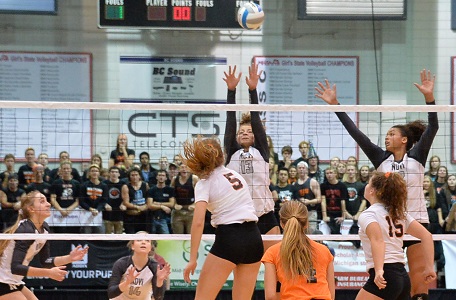 Because of these differences, Class A or B schools sometimes had to win twice as many games as Class C or D schools to reach the MHSAA Finals in a sport. At times, the larger classifications had District Tournaments, even rat-tail games, and/or a Quarterfinal game, and the smaller classifications did not. Most Class D Districts have had four teams (some only three), while Class A Districts often had seven or eight teams. In Regional levels of individual sports, the number of entries in the larger classification once greatly outnumbered those in the smaller classifications of the tournament for the same sport.
Over the years, these dividing lines between classes escalated gradually, as did the differences in enrollments of largest and small schools in each class. In 1937 the dividing lines were 700, 300 and 100 between Class A and B, B and C, and C and D, respectively. By 1987, the dividing lines were 1,129, 571 and 298, respectively, leading to the current method of collecting enrollments and then setting the classification.
With the pendulum swinging well past center by the late 1980s, coaches associations, MHSAA sport committees, tournament managers and school administrators began discussion and offered proposals to correct what many believed had become a flawed system of MHSAA tournament classification.
At the 1996 MHSAA Update Meetings, ¾ of 858 respondents to that year’s annual survey indicated they favored a system that would divide schools which actually sponsor each sport into two, three or four nearly equal divisions.
Problem solving
At its meeting May 4-6, 1997, the Representative Council defeated a motion that would have adopted in one action a coordinated plan of reclassification for all sports to equalize the number of schools in each tournament for each respective sport. Instead, the Council discussed and voted on each proposal that had been presented from sport committees.
This resulted in the Representative Council adopting four equal divisions for baseball and softball, four equal divisions for boys and girls tennis, four equal divisions for boys soccer and three equal divisions for girls soccer, effective with the 1997-98 school year. Helping in the decision was the success of the 1995-96 MHSAA Wrestling season, which saw the sport move to four divisions for its tournament structure
The Council delayed action on similar proposals for football and boys golf at that time to glean additional input. The same decision was made with respect to a proposal from the Ice Hockey Committee that would have split the Class A schools in two divisions and left the Class B/C/D Tournament unchanged.
“The gist of the move from classes to divisions was to equalize the path to championships for students of all schools, regardless of the size of those schools,” said MHSAA Executive Director Jack Roberts.
While the restructuring accomplished that goal for the majority of competitors, opposition exists now as it did then. The primary argument in opposition to the changes is that, in some sports, it increases the range between largest and smallest schools in the division for smallest schools, even as the range is usually reduced for other divisions.
Larger schools offered a counterpoint.
“The larger schools suggested that while they may have more students, they also attempt to sponsor more sports than the smaller schools, in some cases spreading the enrollment as thin as a much smaller school with fewer sports,” Roberts said.
“Even today, the idea of four equal divisions can be unpopular among some Class D schools which feel especially burdened by the equal division concept,” Roberts said. “There was enough opposition in 1997 that equal divisions were rejected for boys and girls basketball and girls volleyball, and some of that opposition remains.”
The numbers of schools sponsoring each MHSAA tournament are still close to the totals today, with the exception of soccer in both genders, which has enjoyed substantial increases. This spring, 466 girls teams were scheduled to compete in the MHSAA Soccer Tournament, while 473 boys teams will suit up this fall.
Since the beginning of MHSAA divisions in 1996 with wrestling, 147 additional team champions have been crowned and countless individuals have known the thrill of victory due to an extra level of Finals in various sports. Girls soccer has seen the most growth in opportunity, moving from two classes in 1987 to three divisions the following year, and then four divisions in 2000. Boys soccer had enjoyed four classes for two years prior to the new four-division format, and it was the sport of soccer that helped to create a caveat in the nearly equal division movement.
Lower Peninsula boys and girls swimming & diving expanded from two to three divisions in 2008, while boys and girls bowling are the most recent sports to enjoy increased tournament opportunity, adding a fourth division in 2010.
“Fairness is in the eye of the beholder. While having the same number of schools in each division is one kind of fairness, holding in check the enrollment range between the largest and smallest schools in Division 4 is another kind of fairness that is dear to a great number of people,” Roberts said. “Because more schools sponsor basketball and volleyball than other sports, Class D schools would have been least affected by the equal divisions concept in those sports; but that, and ‘tradition,’ did not dissuade the opponents in the 1990s.”
The shift to divisions not only paved the way for student-athletes, but also assisted administrators and schools hosting tournaments. MHSAA tournament mangers looked to equal divisions to more closely equalize the number of schools in District or Regional Tournaments and to better equalize the length of day required for these rounds of tournaments, both for management and participating teams and individuals.
Pinning down an answer
Wrestling became the first MHSAA Tournament to be conducted in nearly equal divisions when team and individual champions were crowned in Divisions 1, 2, 3 and 4 rather than Classes A, B, C/D for the 1996 winter championships.
The movement was well received, as schools saw more opportunity for success: four champions where there once were three at the District, Regional and Final levels, and a smaller range of enrollment between the smallest and largest school in all four tournaments, leading to the impetus for the Fall 1996 Update Meeting Survey of schools regarding similar movement in other sports.
Team champions that year were Holt (D1), Petoskey (D2), Middleville Thornapple Kellogg (D3) and Dundee (D4).
Getting their kicks
When the "equal divisions" concept was approved by the Representative Council for most MHSAA Tournaments for the 1997-98 school year, there was opposition from the smallest schools which, under the equal divisions, are forced to play against larger schools than reside in Class D. Compelling arguments were made – and still are – that an enrollment difference between schools with smaller enrollments (e.g., Class D) is more difficult to overcome in athletic competition than an even larger enrollment difference between schools with larger enrollments (e.g., Class A).
The opposition was most intense in soccer because of the number of students needed to field a team and the physical nature of the sport. As a result, from 2000-01 through 2010-11, soccer operated with a “20-percent modification.” This placed 20 percent of all schools that actually sponsored soccer in Division 4, and the remaining 80 percent were placed equally in Divisions 1, 2 and 3.
At the time the 20 percent modification was adopted, it was also established that soccer would return to four equal divisions when the largest Division 4 soccer school had an enrollment equal to or smaller than the mid point for Class C schools. That occurred in 2010.
Last class on the schedule
In the same volume of “history being the best teacher,” one can also find the adage, “times change.” While the division format was a welcome change in some sports, others were left to hold class without change.
 In the sports of boys and girls basketball, and girls volleyball, the number of schools sponsoring the sports were so close to the overall membership of the MHSAA that divisions were not necessary; the enrollment breakdowns themselves were enough to delineate equal opportunity for tournament success.
That is no longer the case, according to MHSAA membership. The last move from classes to divisions occurred for the 2006-07 school year following Council action. Before this May, that is. Action at the most recent Representative Council meeting, May 2017, called for the shift to divisions for MHSAA Boys and Girls Basketball, and Girls Volleyball, beginning with the 2018-19 season.
“Because the MHSAA Volleyball Committee had requested this change several times a number of years ago, and because the Council felt the change inevitable, there should not be further delay,” Roberts said. “It is an important detail that the Class D maximum has dropped 50 students over the past decade so the objection that much larger schools would be competing in Division 4 isn’t very strong now.”
Using the 2017-18 enrollment figures, just eight Class C schools would be competing in Division 4 for boys basketball, 11 for girls basketball and 14 for girls volleyball.
Good things came of the previous most-recent switches in 2006-07. Competitive Cheer was re-classified from Class A, B and C-D into four equal divisions assisting in the rapid growth of sponsoring schools (approximately 80 schools per division). Alpine skiing was changed from Class A and B-C D to two equal divisions.
At that time, the MHSAA Basketball Committee had recommended to the Council the study of increased classifications, but status quo remained.
Back on the grid
As such, MHSAA Basketball and Volleyball remained the only holdovers of the MHSAA class structure. Discussion resurfaced periodically during the last two decades to bring those tournaments in line with the other MHSAA sports.
Regular-season football-playing schools are separated by class, then are reshuffled by divisions for the playoffs. Football, as we know, underwent a significant postseason facelift in the late 1990s.
While MHSAA Football also remained a class sport through 1998, it had expanded from four to eight classes from 1990-98, becoming the first MHSAA sport to crown more than four team champions. Member schools were asked to consider a pair of options in November of 1997. One called for eight equal divisions, and the second would leave Class D by itself as division 8, and split Class A, B and C schools into seven nearly equal divisions.
After much discussion, retooling, and crunching of formulas, the MHSAA unveiled its revised Football Playoff model that continues to roll today, nearly 20 years later. It was determined that 256 teams would qualify for the tournament based first on a minimum of six wins, then by Playoff Points determined by formula. From there, the field would be divided into eight divisions, with the field being filled out by a nearly equal number of five-win teams in each division as needed to reach 256.
Eight championships would indeed be enough, until football sponsorship among the MHSAA’s smallest schools – some with rich football traditions – began to trend downward. The MHSAA again went to the drawing board, examining the viability of 8-player football. After an experimental year in 2010 without a tournament, the 8-player game was playoff-ready for 2011, with a field of 16 qualifiers embarking on a four-week tournament.
Not only did the 8-player option restore recently canceled programs, but it also created teams in schools which previously had none, and convinced some 11-player schools that this new division was the best path to take.
What did this do for the Class D holdovers staying in the traditional 11-player game? Well, a couple of things, positive and negative. As two and three dozen Class D schools opted for the 8-player game, the remaining 11-player Class D schools at times found themselves in disrupted leagues and had to travel further to complete schedules. They also competed against larger teams in Division 8 of the 11-player MHSAA Football Playoffs.
However, the growth of the 8-player game among the smallest schools also resulted in more Class D schools qualifying for the MHSAA Football Playoffs than ever before. In 2012, an all-time high 44 percent of Class D schools sponsoring football qualified for either the 8-player tournament or Division 8 of the 11-player tournament. That compared to 42.2 percent of Class C schools, 44.9 percent of Class B schools and 41.6 percent of Class A schools which qualified for the 2012 playoffs.
Much is to be determined in the most recent chapter of MHSAA Tournament expansion as the 8-Player Football Playoffs welcome a second division. As the past illustrates, there will be pluses and minuses. History also shows that the MHSAA has received maximum input from its constituents, researched all possibilities, and will find solutions to questions still in the balance before an additional group of athletes hoists a new trophy in November.
Through the Years
A chronology of when which sports moved from Class to Division in the MHSAA.
1995-96: LP Wrestling
1997-98: Baseball, Boys Soccer, Girls Soccer, Softball, LP Girls Tennis, LP Boys Tennis
1998-99: LP Boys Golf, LP Girls Golf
1999-2000: Ice Hockey, LP Boys Track & Field, LP Girls Track & Field
2000-01: LP Boys Cross Country, LP Girls Cross Country, UP Boys Cross Country, UP Girls Cross Country, UP Boys Golf, UP Girls Golf, UP Boys Tennis, UP Girls Tennis, UP Boys Track & Field, UP Girls Track & Field
2002-03: LP Girls Swimming & Diving, LP Boys Swimming & Diving
2005-06: Boys Bowling, Girls Bowling
2006-07: Girls Competitive Cheer, Boys Skiing, Girls Skiing
2018-19: Boys Basketball, Girls Basketball, Girls Volleyball
Note: Boys and Girls Lacrosse has been a divisional sport since it began in during the 2004-05 school year.
Century of School Sports: State's Storytellers Share Winter Memories
By
Geoff Kimmerly
MHSAA.com senior editor
December 31, 2024
As part of our school year-long celebration of a “Century of School Sports” and the MHSAA’s 100th anniversary, we’re connecting every season with members of Michigan’s sports media, our historian and longtime communications staff to present some of what they remember most from their time covering our games.
Below is our second installment, covering several of their winter sports memories.
Never Underestimate How Much These Moments Mean
Jack Doles, WOOD TV (Grand Rapids)
In one of my first years covering sports for WOOD-TV in Grand Rapids, Allendale High School went on a deep run in the 1991 basketball tournament. Joe Modderman was the star player for Allendale. He played his heart out, but the team ended up losing (in the Class D Final, 62-48 to Ann Arbor Father Gabriel Richard). During our postgame interview, Joe got very emotional. I saw just how important this game was to him. Joe ended up playing at Iowa State and eventually Grand Valley, so he knew he had a lot of basketball left to play. His tears were for his teammates, who had played their final game.
I still bump into Joe and we talk about that moment we shared afterward. It was a great lesson in how impactful those moments are.
Memorable All-Time Matchup, Unforgettable Scores
Tim Staudt, WILX (Lansing), in 53rd year of broadcasting
Picking one from the winter is easy – the District-opening game of the 1977 state basketball tournament at Don Johnson Fieldhouse and Lansing Everett’s Earvin Johnson versus Eastern’s Jay Vincent. Everett won 63-41 after losing 70-62 to Eastern in Jenison Field House before 10,000 fans the previous Friday to end the regular season. Both those scores I still remember to this day.
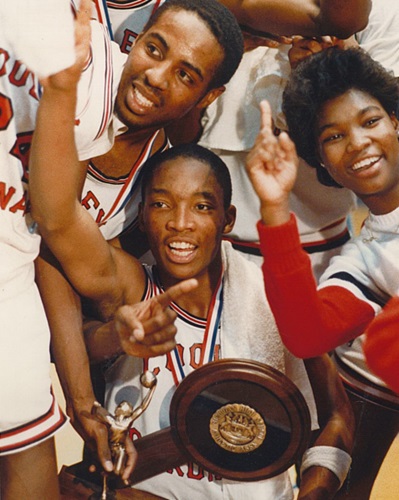 ‘C-O-O, L-E-Y, Cooley, Cooley, Cooley High’
Mick McCabe, Detroit Free Press since 1970
March 28, 1987, Crisler Arena
Detroit Cooley 82, Detroit Southwestern 77, OT.
This time it was in the bag. Losers in five consecutive state championship games, Southwestern was certain to win its first state championship against a Cooley team that seemed to have no business playing in the state finals. After all, Southwestern had already beaten Cooley twice and the second victory came only a month earlier when the Prospectors destroyed Cooley by 35 points in the Detroit Public School League title game. Yes, 35 points!
But behind the play of sophomore Michael Talley (23 points) and senior Rafeal Peterson (22 points), Cooley took control early and led by 11 points at halftime The Cardinals led by eight heading into the fourth quarter and thought they had the game won before Doyle Callahan scored for the Prospectors an instant before the buzzer to force overtime. Southwestern scored the first basket in overtime and it would have been the perfect time for Cooley to call it an afternoon. But Peterson countered with the biggest basket of the day to tie the score and kept Southwestern from extending its lead. Instead, Southwestern had consecutive turnovers, missed a shot and committed a foul as Cooley took a five-point lead with 38 seconds remaining as chants of: “C-O-O, L-E-Y, Cooley, Cooley, Cooley High” reigned down from the Crisler rafters. It was the first of three straight Class A state championships for Cooley and Talley, who as a senior went on to become the Hal Schram Mr. Basketball Award winner.
Future U-M Teammates Face Off to Finish High School Careers
Greg Miller, formerly of 9&10 News (Cadillac)
The girls basketball Class C state championship game in 2011 pitted future college teammates Nicole Elmblad (St. Ignace) and Madison Ristovski (Grosse Pointe Woods University Liggett) in a shootout for the ages. Ristovski scored 30 points, while Elmblad put up 33 points to go along with a 19-rebound effort, as the Saints pulled away in the fourth quarter to earn a 65-54 victory. Elmblad scored 14 of her 33 points in the deciding quarter to lead St. Ignace to the championship. It was a great back-and-forth matchup of two evenly-matched teams led by two outstanding athletes. The following year, the pair began to play as teammates at the University of Michigan and were both part of some of the winningest teams in program history.
Coles' Shot Goes the Distance
Perry Farrell, MHSAA.com and formerly of Detroit Free Press
I didn't cover the event, but Saginaw Buena Vista's Chris Coles made a shot from about 65 feet in the Class B state boys championship basketball game to defeat arch-rival Flint Beecher 33-32. It is the greatest shot in Michigan high school basketball history. And being a graduate of Buena Vista it was one of the highlights of our school.
Competitive Cheer Finals Atmosphere has Few Rivals
Geoff Kimmerly, MHSAA Communications Director and formerly of Lansing State Journal
I moved to the MHSAA during the 2011-12 school year after more than a decade at the Lansing State Journal, where among other areas of coverage we produced team-by-team previews for all of our area varsity sports – including the addition of a competitive cheer preview as that sport began to gain popularity and participation in the mid-Michigan area. But before leaving the LSJ, I had never covered a competition.
The new job, and a new venture of covering all of our MHSAA Finals for our previous Second Half website, brought me to the Grand Rapids Delta Plex on a Friday night in early March, 2012. I had covered Finals in several other MHSAA sports – although 2011-12 would also see my debut at lacrosse, swimming & diving, gymnastics, cross country, hockey and bowling championship events – so I’d been around some of the larger and loudest crowds for high school competitions over the previous decade or more.
But WOW. The Division 1 crowd, which reached into the Delta Plex rafters, was as charged as anything I’d seen at Ford Field or the Silverdome, or Breslin aside from the oft-recalled Detroit Renaissance/Wyoming Park boys basketball game in 2004. Coming close on atmosphere were some of the Team Wrestling Finals I’d experienced. But this night had people seemingly piled so high I thought they might roll out of the stands onto us. Dads were leading full sections in chants, and when their teams took the mat they were even more electric, and all of that took the typical emotions of a season-ending event to another level.
And of course, the competition was outstanding. Southgate Anderson won its first of what would be three straight Division 1 titles (and if you still don’t credit this as being a sport, try to do anything these athletes make happen on the mat). I was definitely a little awestruck by the whole evening, and left with a whole new appreciation for how another of our sports energizes its community.
Vikings Find Stride at Tournament Time
Brian Calloway, Lansing State Journal
Watching Lansing Everett defy the odds and make an improbable run to the boys basketball state Semifinals at Breslin Center in 2016 is one of the most notable things I observed from the winter sports season. Everett lost 10 regular-season games that year and at that time had become the first team in a decade to reach the state Semifinals despite double-digit losses in the regular season. Everett wound up falling to North Farmington in the Semifinal in what was its second-straight appearance in the final four in Class A.
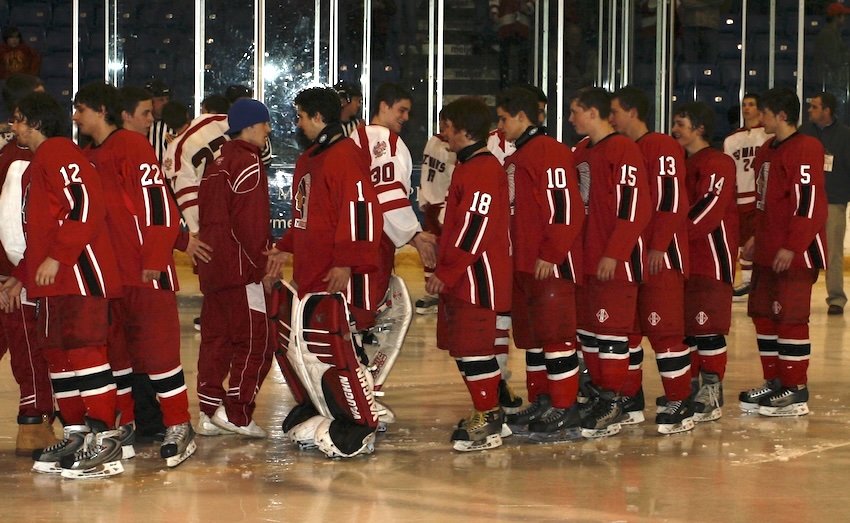
Never-Ending 2008 Hockey Championship Game Ends with 2 Champions
John Johnson, MHSAA Communications Director from 1987-2020
On the ice that night, the busiest championship weekend the MHSAA has known came to an end with the longest game in the history of the Finals. Marquette and Orchard Lake St. Mary’s skated for 109 minutes and eight overtimes before administrators ruled the game a 1-1 tie and awarded co-championships in the name of safety for two exhausted teams who had earned victory. Ironically, the contest was just 1:32 from ending (in regulation) when Tim Hooker of St. Mary's knotted the score at 1-1. His tally equaled a power-play goal by Marquette’s Mike Peterson in the second period.
Coming home at the end of the weekend, and feeling like everything was wrapped up as I got closer to Lansing, I’ll never forget my phone blowing up with calls from folks wondering about what was happening with hockey. And then rushing into the house to punch up the audio of the game on the computer, I listened to a very hoarse John Kreger announcing that co-champions had been declared.
Evans’ Game-Winner Still Unbelievable
Lorne Plant – State Champs!
I had the opportunity to get to know then-head coach at Detroit Rogers Steve Hall when I did a State Champs! feature on Brenda Gatlin, who was the first woman to be head coach of a PSL boys basketball team in the (19)80s at Cass Tech. Just so happened, Steve Hall was a player on her team. That took place during the 2002-2003 basketball season, which was the first winter season in the State Champs! era. Two years later, Detroit Rogers had won the state championship the previous two years, so you can only imagine how hard it is to try and win three in a row. As far as I could tell, only two teams had won Class D state titles three times in a row. Chassell did it in the mid 50s, and Detroit East Catholic did it in the late 70s and early 80s. It had been a while. Strange that what only happened three times in 79 years has happened three more times in the last 20 (Class D/Division 4 state champions by a single team three times in a row. No one's ever won four in a row, but I digress).
Back to the '05 final, when the ball went out of bounds with three seconds left in OT and the ball was given to Rogers down a point, I settled in for the final shot. Then the refs overturned the call and gave it to Bellaire, and I thought to myself, "You had a nice run, Steve." And then, the freshman Eric Evans made one of the most incredible plays I've ever seen. He stole the ball and in the same motion threw it up towards the basket and it went in, I couldn't believe it. I will never forget that play.
1 Reporter's Take on Boys Basketball “Games of the Decade”
Brad Emons, Detroit Free Press (formerly of Observer & Eccentric newspapers)
March 6, 1986: In a Class A District Semifinal before an overflow crowd of 2,000 at Alumni Arena, host Wayne Memorial (18-3) took eventual state champ Romulus (25-2) and Mr. Basketball Terry Mills to two overtimes before falling, 93-92. The 6-foot-9 Mills, who later starred at Michigan and played 10 seasons in the NBA, scored 37 points, including 11 in the second OT. The Eagles, who also featured DI players Steve Glenn (Austin Peay) – who added 19 points – and Juan Street (Bowling Green), went on to defeat Detroit Southwestern for the state title at U-M’s Crisler Arena, 72-65. Wayne, which gave up an average height of five inches per man, had three players foul out. The Zebras got a team-high 27 points from Mark Robinson, while Spence Williams and Rod Sommons added 18 and 14, respectively.
March, 18, 1978: Orchard Lake St. Mary’s capped a perfect 27-0 season with a 67-52 Class D championship win over Detroit St. Martin dePorres at U-M’s Crisler Arena. Just a day earlier at MSU’s Jenison Field House, St. Mary’s ousted Mio Au Sable and the state’s all-time career scorer Jay Smith (2,841 points) in convincing fashion, 77-52. In the Quarterfinals at Corunna, OLSM thwarted Saranac and 6-8 MSU recruit Ben Tower, 71-53. The Eaglets’ starting lineup featured Dominican Republic native Evaristo Perez (MSU), Jim Paciorek (Michigan), Barry Bugaj, Dave Kay and Gregg Williamson. After the Semifinal win over Mio, St. Mary’s coach Bob Shoemaker lauded the play of Paciorek saying, “They couldn’t stop Jim even with a blow torch.”
Avoiding Pin, Mason's Jackson Becomes Championship Hero
Rob Kaminski, MHSAA communications coordinator since 1999
During my quarter-century here with the MHSAA, Team Wrestling has always been one of my favorite tournaments. The venue, whether Kellogg Arena in Battle Creek or Wings Event Center in Kalamazoo, is the perfect size for the event, and the crowds are raucous and enthusiastic with the Finals often packed to the rafters.
At one time, the format always began with the lightest weights wrestling first, finishing with the heaviest weights. The format then changed, with the starting weight being drawn right before the competition began, so there was a greater emphasis on strategy: which wrestlers would coaches send out for each weight class?
Such was the case in 2003 at Kellogg Arena. The Division 2 Final between Mason and Lapeer West not only featured two schools always near the top of their sport at the time, but also one of the top individuals in MHSAA history in Lapeer West’s Roger Kish, already a three-time individual champion who ruled the 189-pound weight class.
When 215 was drawn as the starting weight for the Final, the stage was set for a potential dramatic finish as Kish would face Mason’s Tom McDiarmid in the last bout of the meet. However, thinking that Kish would have an easier time against Mason’s 215-pounder and possible getting six points for a fall, Lapeer West sent Kish out for the first match of the dual against Mason’s Kody Jackson. An audible murmur filled the arena, as fans from the other divisions began to take notice of the strategy while also wanting to see one of the best wrestlers in MHSAA history. It seemed as though the first matches on the other three mats might as well have been taking place on Mars, as everyone focused on the D2 circle.
Kish did win the bout, 26-15, but the deafening roar from Mason’s crowd – and other non-partisans in the arena – for Jackson’s effort was something I’ll never forget. The young man had stayed off his back, avoided a pin, and Lapeer West got two points less than it had gambled for.
When it came time for McDiarmid’s turn at 189 to end the meet, Mason trailed 27-25. McDiarmid then took care of business with a 14-1 major decision to give Mason the title, 29-27, and send the crowd into a frenzy.
A week later, Kish and McDiarmid did indeed meet, this time in the MHSAA Individual Finals at 189, where Kish posted a 26-11 technical fall to secure his fourth MHSAA individual crown, and second straight at that weight.
#11 Never Forgotten
Jack Doles, WOOD TV (Grand Rapids)
The last story I'll share deals with a high school athlete who played multiple sports at Grandville high school and left a legacy, not with his play, but his actions.
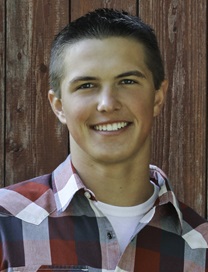 Ryan Fischer played football and hockey at Grandville. He was a captain and the unquestioned leader of the team. Ryan was also beloved by his classmates, because he was an active listener and friend to everyone in the hallways. Sadly, Ryan died unexpectedly during the (2014) hockey playoffs (on the morning of the team's Division 1 Semifinal against Detroit Catholic Central). The team wasn't sure if they could play, but as they waited outside the Fischer home, Ryan's father brought his jersey to the team and told them Ryan would want them to play.
Grandville lost in the (Semifinal), but they fought and made a community proud. At the end of the game, the team took a knee to say a quick prayer, and then Detroit Catholic Central joined them. An incredible level of sportsmanship. Not long after the Fishers buried their son, they started a scholarship in his name. The scholarship is given to the athlete that embodies Ryan's values and spirit. In a story we did, his brother Connor told us his goal was to win that scholarship. He did, and now he serves in the United States Army. Meanwhile, the Grandville and Wyoming communities hand out an award each year called the 11.
Ryan wore number 11. His legacy lives on around West Michigan and beyond.
Previous "Century of School Sports" Spotlights
Dec. 17: MHSAA Over Time - Read
Dec. 10: On This Day, December 13, We Will Celebrate - Read
Dec. 3: MHSAA Work Guided by Representative Council - Read
Nov. 26: Finals Provide Future Pros Early Ford Field Glory - Read
Nov. 19: Connection at Heart of Coaches Advancement Program - Read
Nov. 12: Good Sports are Winners Then, Now & Always - Read
Nov. 5: MHSAA's Home Sweet Home - Read
Oct. 29: MHSAA Summits Draw Thousands to Promote Sportsmanship - Read
Oct. 23: Cross Country Finals Among MHSAA's Longest Running - Read
Oct. 15: State's Storytellers Share Fall Memories - Read
Oct. 8: Guided by 4 S's of Educational Athletics - Read
Oct. 1: Michigan Sends 10 to National Hall of Fame - Read
Sept. 25: MHSAA Record Books Filled with 1000s of Achievements - Read
Sept. 18: Why Does the MHSAA Have These Rules? - Read
Sept. 10: Special Medals, Patches to Commemorate Special Year - Read
Sept. 4: Fall to Finish with 50th Football Championships - Read
Aug. 28: Let the Celebration Begin - Read
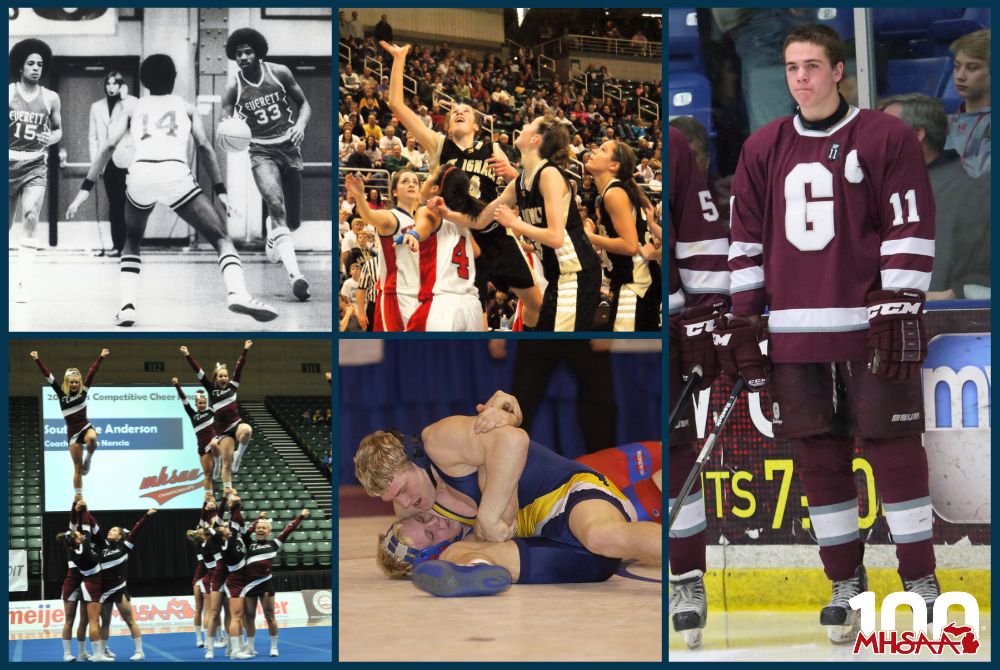
PHOTOS Clockwise from top left: (1) Earvin Johnson brings the ball upcourt for Lansing Everett. (2) Nicole Emblad gets a shot up for St. Ignace. (3) A Grandville teammate of Ryan Fischer wears his jersey for the Division 1 Semifinal after Fischer died that morning. (4) Southgate Anderson competes at the 2012 Competitive Cheer Final. (5) Mason's Kory Jackson (red) and Lapeer West's Roger Kish wrestle during the 2003 Division 2 Final. (Middle) Detroit Cooley celebrates its 1987 Class A boys basketball championship. (Below) Marquette and Orchard Lake St. Mary's hockey players shake hands after their record-setting championship game. (MHSAA file photos.)