

Class in Session: A History in Classification
July 24, 2017
By Rob Kaminski
MHSAA benchmarks editor
This is the first part in a series on MHSAA tournament classification, past and present, that will be published over the next two weeks. This series originally ran in this spring's edition of MHSAA benchmarks.
Conversation and discussion at the March 2017 MHSAA Representative Council Meeting leaned heavily toward the subject of 8-Player Football and how to properly balance its tournament with the growing number of schools sponsoring the sport.
While the proposal to split the tournament into two divisions beginning with the 2017 school year was adopted, the MHSAA then faced questions such as when to set the divisions, how to determine qualifiers and where to host the championship games.
The topic continues to create a buzz in Class D schools across both peninsulas, and likely will do into the start of school this fall.
Likewise, the lone holdouts still conducting tournaments by class – MHSAA Boys and Girls Basketball and Girls Volleyball – took center stage at the May Council discussion, and following the 2017-18 school year, class is out for good. Both genders of basketball, and girls volleyball, will move to divisional formats thereafter.
There is much to be decided to be sure; but as those in education are well aware, history is the best teacher.
Fortunately for the sports in flux and for all sports under the governance of the MHSAA, the Association more or less wrote the book on the subject of sport classification. Following is a history lesson, with a little advanced division thrown in.
Class structure
Credited with being the first state with multiple tournament classifications, Michigan’s attention to trends and shifts in philosophy aimed at fair play and equal tournament opportunity can be traced from 80 years ago to the present.
In the earliest years of the MHSAA, there were four classifications for elections and tournaments – Classes A, B, C and D. Classes C and D had far more schools than Classes A and B. For example, 80 years ago (1937), there were only 58 schools in Class A, 94 schools in Class B, 297 schools in Class C and 253 schools in Class D.
Gradually through the years, as Michigan’s major cities spawned suburbs, there was a shift in the other direction to the point 30 years ago (1987) when school size became more balanced: 173 Class A schools, 178 Class B schools, 179 Class C schools and 182 Class D schools.
Up until 1987, the MHSAA published the dividing line between each classification, after which schools submitted their enrollments. Then, for 1988 and thereafter, the MHSAA adopted the plan of gathering all enrollments first and then placing 25 percent of the schools in each of four classes. This completed the equalization of the number of schools in each class for elections.
However, the change for 1988 did nothing to equalize the number of teams actually entered by each class in each sport. And unlike the early years of the Association when there were many more Class C and D teams than A and B teams, there were more Class A and B teams than C and D teams entering MHSAA tournaments decades later.
Moreover, the difference in number of teams entered in the different classifications for a sport continued to increase as many small schools, the fastest growing portion of the MHSAA's membership, sponsor only a few sports, or they sponsor no sports at all but enter into cooperative programs with other schools.
 Because of these differences, Class A or B schools sometimes had to win twice as many games as Class C or D schools to reach the MHSAA Finals in a sport. At times, the larger classifications had District Tournaments, even rat-tail games, and/or a Quarterfinal game, and the smaller classifications did not. Most Class D Districts have had four teams (some only three), while Class A Districts often had seven or eight teams. In Regional levels of individual sports, the number of entries in the larger classification once greatly outnumbered those in the smaller classifications of the tournament for the same sport.
Over the years, these dividing lines between classes escalated gradually, as did the differences in enrollments of largest and small schools in each class. In 1937 the dividing lines were 700, 300 and 100 between Class A and B, B and C, and C and D, respectively. By 1987, the dividing lines were 1,129, 571 and 298, respectively, leading to the current method of collecting enrollments and then setting the classification.
With the pendulum swinging well past center by the late 1980s, coaches associations, MHSAA sport committees, tournament managers and school administrators began discussion and offered proposals to correct what many believed had become a flawed system of MHSAA tournament classification.
At the 1996 MHSAA Update Meetings, ¾ of 858 respondents to that year’s annual survey indicated they favored a system that would divide schools which actually sponsor each sport into two, three or four nearly equal divisions.
Problem solving
At its meeting May 4-6, 1997, the Representative Council defeated a motion that would have adopted in one action a coordinated plan of reclassification for all sports to equalize the number of schools in each tournament for each respective sport. Instead, the Council discussed and voted on each proposal that had been presented from sport committees.
This resulted in the Representative Council adopting four equal divisions for baseball and softball, four equal divisions for boys and girls tennis, four equal divisions for boys soccer and three equal divisions for girls soccer, effective with the 1997-98 school year. Helping in the decision was the success of the 1995-96 MHSAA Wrestling season, which saw the sport move to four divisions for its tournament structure
The Council delayed action on similar proposals for football and boys golf at that time to glean additional input. The same decision was made with respect to a proposal from the Ice Hockey Committee that would have split the Class A schools in two divisions and left the Class B/C/D Tournament unchanged.
“The gist of the move from classes to divisions was to equalize the path to championships for students of all schools, regardless of the size of those schools,” said MHSAA Executive Director Jack Roberts.
While the restructuring accomplished that goal for the majority of competitors, opposition exists now as it did then. The primary argument in opposition to the changes is that, in some sports, it increases the range between largest and smallest schools in the division for smallest schools, even as the range is usually reduced for other divisions.
Larger schools offered a counterpoint.
“The larger schools suggested that while they may have more students, they also attempt to sponsor more sports than the smaller schools, in some cases spreading the enrollment as thin as a much smaller school with fewer sports,” Roberts said.
“Even today, the idea of four equal divisions can be unpopular among some Class D schools which feel especially burdened by the equal division concept,” Roberts said. “There was enough opposition in 1997 that equal divisions were rejected for boys and girls basketball and girls volleyball, and some of that opposition remains.”
The numbers of schools sponsoring each MHSAA tournament are still close to the totals today, with the exception of soccer in both genders, which has enjoyed substantial increases. This spring, 466 girls teams were scheduled to compete in the MHSAA Soccer Tournament, while 473 boys teams will suit up this fall.
Since the beginning of MHSAA divisions in 1996 with wrestling, 147 additional team champions have been crowned and countless individuals have known the thrill of victory due to an extra level of Finals in various sports. Girls soccer has seen the most growth in opportunity, moving from two classes in 1987 to three divisions the following year, and then four divisions in 2000. Boys soccer had enjoyed four classes for two years prior to the new four-division format, and it was the sport of soccer that helped to create a caveat in the nearly equal division movement.
Lower Peninsula boys and girls swimming & diving expanded from two to three divisions in 2008, while boys and girls bowling are the most recent sports to enjoy increased tournament opportunity, adding a fourth division in 2010.
“Fairness is in the eye of the beholder. While having the same number of schools in each division is one kind of fairness, holding in check the enrollment range between the largest and smallest schools in Division 4 is another kind of fairness that is dear to a great number of people,” Roberts said. “Because more schools sponsor basketball and volleyball than other sports, Class D schools would have been least affected by the equal divisions concept in those sports; but that, and ‘tradition,’ did not dissuade the opponents in the 1990s.”
The shift to divisions not only paved the way for student-athletes, but also assisted administrators and schools hosting tournaments. MHSAA tournament mangers looked to equal divisions to more closely equalize the number of schools in District or Regional Tournaments and to better equalize the length of day required for these rounds of tournaments, both for management and participating teams and individuals.
Pinning down an answer
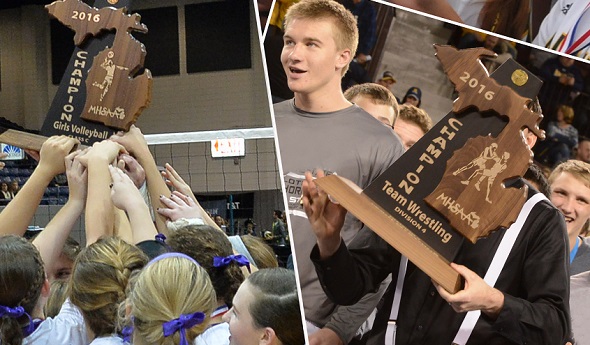
Wrestling became the first MHSAA Tournament to be conducted in nearly equal divisions when team and individual champions were crowned in Divisions 1, 2, 3 and 4 rather than Classes A, B, C/D for the 1996 winter championships.
The movement was well received, as schools saw more opportunity for success: four champions where there once were three at the District, Regional and Final levels, and a smaller range of enrollment between the smallest and largest school in all four tournaments, leading to the impetus for the Fall 1996 Update Meeting Survey of schools regarding similar movement in other sports.
Team champions that year were Holt (D1), Petoskey (D2), Middleville Thornapple Kellogg (D3) and Dundee (D4).
Getting their kicks
When the "equal divisions" concept was approved by the Representative Council for most MHSAA Tournaments for the 1997-98 school year, there was opposition from the smallest schools which, under the equal divisions, are forced to play against larger schools than reside in Class D. Compelling arguments were made – and still are – that an enrollment difference between schools with smaller enrollments (e.g., Class D) is more difficult to overcome in athletic competition than an even larger enrollment difference between schools with larger enrollments (e.g., Class A).
The opposition was most intense in soccer because of the number of students needed to field a team and the physical nature of the sport. As a result, from 2000-01 through 2010-11, soccer operated with a “20-percent modification.” This placed 20 percent of all schools that actually sponsored soccer in Division 4, and the remaining 80 percent were placed equally in Divisions 1, 2 and 3.
At the time the 20 percent modification was adopted, it was also established that soccer would return to four equal divisions when the largest Division 4 soccer school had an enrollment equal to or smaller than the mid point for Class C schools. That occurred in 2010.
Last class on the schedule
In the same volume of “history being the best teacher,” one can also find the adage, “times change.” While the division format was a welcome change in some sports, others were left to hold class without change.
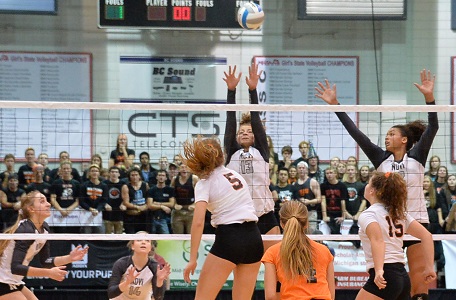
 In the sports of boys and girls basketball, and girls volleyball, the number of schools sponsoring the sports were so close to the overall membership of the MHSAA that divisions were not necessary; the enrollment breakdowns themselves were enough to delineate equal opportunity for tournament success.
That is no longer the case, according to MHSAA membership. The last move from classes to divisions occurred for the 2006-07 school year following Council action. Before this May, that is. Action at the most recent Representative Council meeting, May 2017, called for the shift to divisions for MHSAA Boys and Girls Basketball, and Girls Volleyball, beginning with the 2018-19 season.
“Because the MHSAA Volleyball Committee had requested this change several times a number of years ago, and because the Council felt the change inevitable, there should not be further delay,” Roberts said. “It is an important detail that the Class D maximum has dropped 50 students over the past decade so the objection that much larger schools would be competing in Division 4 isn’t very strong now.”
Using the 2017-18 enrollment figures, just eight Class C schools would be competing in Division 4 for boys basketball, 11 for girls basketball and 14 for girls volleyball.
Good things came of the previous most-recent switches in 2006-07. Competitive Cheer was re-classified from Class A, B and C-D into four equal divisions assisting in the rapid growth of sponsoring schools (approximately 80 schools per division). Alpine skiing was changed from Class A and B-C D to two equal divisions.
At that time, the MHSAA Basketball Committee had recommended to the Council the study of increased classifications, but status quo remained.
Back on the grid
As such, MHSAA Basketball and Volleyball remained the only holdovers of the MHSAA class structure. Discussion resurfaced periodically during the last two decades to bring those tournaments in line with the other MHSAA sports.
Regular-season football-playing schools are separated by class, then are reshuffled by divisions for the playoffs. Football, as we know, underwent a significant postseason facelift in the late 1990s.
While MHSAA Football also remained a class sport through 1998, it had expanded from four to eight classes from 1990-98, becoming the first MHSAA sport to crown more than four team champions. Member schools were asked to consider a pair of options in November of 1997. One called for eight equal divisions, and the second would leave Class D by itself as division 8, and split Class A, B and C schools into seven nearly equal divisions.
After much discussion, retooling, and crunching of formulas, the MHSAA unveiled its revised Football Playoff model that continues to roll today, nearly 20 years later. It was determined that 256 teams would qualify for the tournament based first on a minimum of six wins, then by Playoff Points determined by formula. From there, the field would be divided into eight divisions, with the field being filled out by a nearly equal number of five-win teams in each division as needed to reach 256.
Eight championships would indeed be enough, until football sponsorship among the MHSAA’s smallest schools – some with rich football traditions – began to trend downward. The MHSAA again went to the drawing board, examining the viability of 8-player football. After an experimental year in 2010 without a tournament, the 8-player game was playoff-ready for 2011, with a field of 16 qualifiers embarking on a four-week tournament.
Not only did the 8-player option restore recently canceled programs, but it also created teams in schools which previously had none, and convinced some 11-player schools that this new division was the best path to take.
What did this do for the Class D holdovers staying in the traditional 11-player game? Well, a couple of things, positive and negative. As two and three dozen Class D schools opted for the 8-player game, the remaining 11-player Class D schools at times found themselves in disrupted leagues and had to travel further to complete schedules. They also competed against larger teams in Division 8 of the 11-player MHSAA Football Playoffs.
However, the growth of the 8-player game among the smallest schools also resulted in more Class D schools qualifying for the MHSAA Football Playoffs than ever before. In 2012, an all-time high 44 percent of Class D schools sponsoring football qualified for either the 8-player tournament or Division 8 of the 11-player tournament. That compared to 42.2 percent of Class C schools, 44.9 percent of Class B schools and 41.6 percent of Class A schools which qualified for the 2012 playoffs.
Much is to be determined in the most recent chapter of MHSAA Tournament expansion as the 8-Player Football Playoffs welcome a second division. As the past illustrates, there will be pluses and minuses. History also shows that the MHSAA has received maximum input from its constituents, researched all possibilities, and will find solutions to questions still in the balance before an additional group of athletes hoists a new trophy in November.
Through the Years
A chronology of when which sports moved from Class to Division in the MHSAA.
1995-96: LP Wrestling
1997-98: Baseball, Boys Soccer, Girls Soccer, Softball, LP Girls Tennis, LP Boys Tennis
1998-99: LP Boys Golf, LP Girls Golf
1999-2000: Ice Hockey, LP Boys Track & Field, LP Girls Track & Field
2000-01: LP Boys Cross Country, LP Girls Cross Country, UP Boys Cross Country, UP Girls Cross Country, UP Boys Golf, UP Girls Golf, UP Boys Tennis, UP Girls Tennis, UP Boys Track & Field, UP Girls Track & Field
2002-03: LP Girls Swimming & Diving, LP Boys Swimming & Diving
2005-06: Boys Bowling, Girls Bowling
2006-07: Girls Competitive Cheer, Boys Skiing, Girls Skiing
2018-19: Boys Basketball, Girls Basketball, Girls Volleyball
Note: Boys and Girls Lacrosse has been a divisional sport since it began in during the 2004-05 school year.
2024 Scholar-Athlete Award Recipients Announced in Class A
By
Geoff Kimmerly
MHSAA.com senior editor
February 20, 2024
The Michigan High School Athletic Association has selected 13 student-athletes from Class A member schools to receive scholarships through the MHSAA/Farm Bureau Insurance Scholar-Athlete Award program.
 Farm Bureau Insurance, in its 35th year of sponsoring the award, will give $2,000 college scholarships to 32 individuals who represent their member schools in at least one sport in which the Association sponsors a postseason tournament. The first 30 scholarships are awarded proportionately by school classification and the number of student-athletes involved in those classes; also, there are two at-large honorees who can come from any classification.
Students applying for the Scholar-Athlete Award must be carrying at least a 3.5 (on a 4.0 scale) grade-point average and have previously won a letter in a varsity sport in which the Michigan High School Athletic Association sponsors a postseason tournament. Other requirements for the applicants were to show active participation in other school and community activities and produce an essay on the importance of sportsmanship in educational athletics.
The 32 scholarship recipients will be recognized March 16 during the MHSAA Boys Basketball Finals at the Breslin Student Events Center in East Lansing.
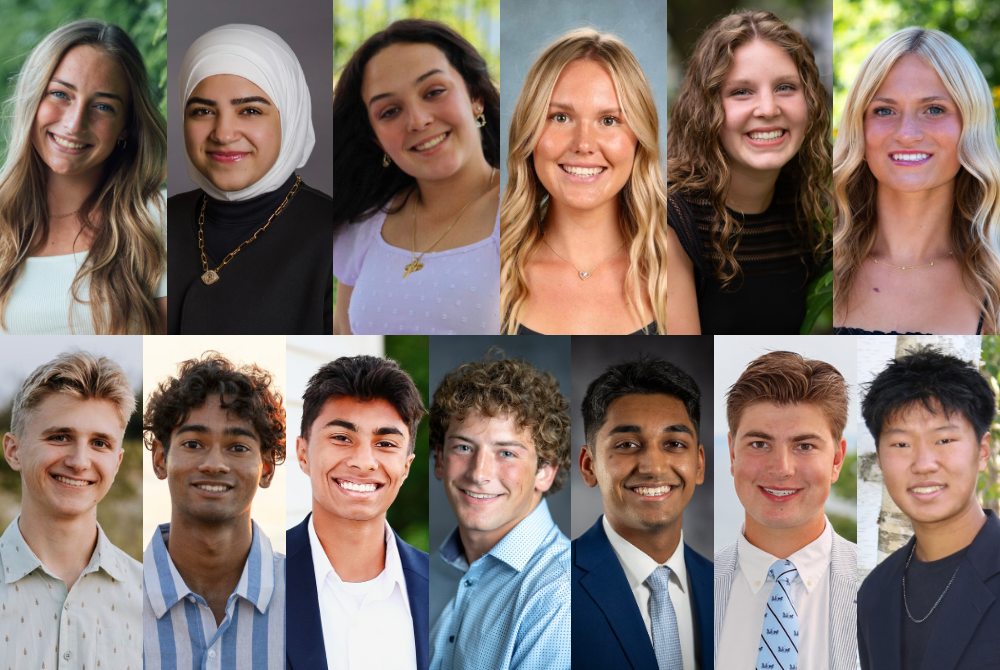
The Class A Scholar-Athlete Award honorees are Bella Adams, Battle Creek Lakeview; Aya Moughni, Dearborn; Arianna Pate, Gibraltar Carlson; Cecilia Ruchti, St. Joseph; Lily Sackrider, St. Johns; Katherine Slazinski, Birmingham Seaholm; Willem DeGood, Traverse City West; Abrar Hossen, Portage Central; Anirudh Krishnan, Plymouth; AJ Martel, Mason; Jaden Reji, Livonia Churchill; Charlie Seufert, East Grand Rapids; and Logan Yu, Midland Dow.
Overviews of the scholarship recipients of the Class A Scholar-Athlete Award follow. A quote from each recipient's essay also is included:
 Bella Adams, Battle Creek Lakeview
Played three seasons of varsity volleyball and is competing in fourth of track & field this spring. Helped volleyball team to two District championships and earned academic all-state in that sport three times. Earned all-league and all-region in track and also earned academic all-state three times in that sport. Served as captain of both teams. Participating in fourth year of student government and serving as class vice president. Participating in second year of National Honor Society and has attended Battle Creek Area Math & Science Center throughout high school. Participated in multiple initiatives to promote STEM education including Phoenix Gives Back as a junior, Kellanova’s high school program as a senior and the BCAMSC’s Kindness Club the last two years. Participated in church’s Battle Creek Mission Trip throughout high school. Serving on staff of school’s TV channel for first time as senior and coached elementary and middle school volleyball summer camps the last two years. Is undecided where she will attend college, but intends to study biology.
Essay Quote: “The single most important component of sportsmanship, and even in the world, is compassion. Being compassionate is not just how you treat your closest friends, but treating everybody as a friend. Compassion is what helps the lonely, hurt teenage girl feel secure, the timid new basketball player feel at home. All successful student-athletes carry the foundation of compassion through sportsmanship.”
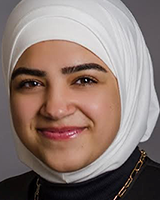 Aya Moughni, Dearborn
Ran three seasons of cross country and played two of varsity volleyball, will play her second of varsity soccer and compete in fourth of track & field this spring, and also played varsity basketball as a sophomore. Earned league multi-sport recognition and scholar-athlete honors multiple years. Served as captain for soccer, basketball and volleyball junior varsity teams and substitute captain for cross country and track & field varsities. Participating in second year of National Honor Society and third on Superintendent’s Student Advisory Council, and served as class vice president as sophomore. Founded Right to Play Club and serves as president, and also serves as president of Social Justice Club and treasurer of Gay-Straight Alliance. Served as Key Club vice president and director of outreach for Dearborn Youth Affairs Commission. Participating in first year of Business Professionals of America and as secretary, and qualified for state competition in multiple contests. Earned profile in courage award and multiple honors for voter registration. Is undecided where she will attend college but intends to pursue a career as a neurosurgeon.
Essay Quote: “In this vast arena of athletic education, sportsmanship stands as the unsung anthem for the underdog, the celebration of diversity, and the unyielding belief that fair play is the ultimate victory. It transforms the field into a space where young minds not only refine their physical abilities but also nurture the values that will shape them as future leaders, team players, and contributors to society.”
 Arianna Pate, Gibraltar Carlson
Ran four seasons of cross country, playing third season of varsity basketball and will compete in fourth season of track & field this spring. Earned all-league honors in cross country and track and all-area honorable mention in basketball, and helped basketball team to league championship as a sophomore. Serving as basketball team captain this season. Earned AP Scholar Award and honors from National African American Recognition Program and National Hispanic Recognition Program. Participating in second year of National Honor Society and as chapter president after serving as vice president as a junior. Serving fourth year on student council and as executive board secretary for second year after two years as class treasurer. Participating in fourth years of Earth Club and Inclusivity Club, second as part of Marauder Captains and third on Student Empowerment Team. Volunteered for three years as part of Red Cross blood drive. Will attend University of Michigan and study nursing.
Essay Quote: “It’s not just about helping someone up off of the ground, or saying “good game” in the handshake line after a competition. It’s about separating yourself from aggressive competition and instead showing empathy and care towards your fellow athletes whom you are lucky enough to share a playing field with. Especially in the realm of high school athletics, sportsmanship is one of the most important qualities that an athlete can have.”
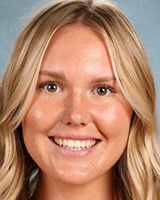 Cecilia Ruchti, St. Joseph
Ran four years of cross country and will play her fourth season of varsity tennis this spring. Earned all-state in tennis and reached No. 1 doubles semifinals at 2023 Lower Peninsula Division 2 Finals as team tied for sixth place. Earned all-league and all-region in cross country and helped that team to MHSAA Finals three times, also earning academic all-state in that sport. Served as captain of both teams multiple seasons. Participating in fourth year of student senate and as president, and also in fourth year as part of student foundation and as vice president. Serving as assistant teacher in third year of AP leadership course and also in third years as National Honor Society and writing center tutor. Served as tennis coach and camp instructor throughout high school and as athletic department intern as a senior. Is undecided where she will attend college, but intends to study marketing and design.
Essay Quote: “Walking away from Cross Country and Tennis State Finals, a lot of gratitude has washed over me. It’s been incredible to watch both my teammates and former teammates succeed. The time I shared with high-performing athletes and leaders influenced a lot of growth. I've observed extraordinary sportsmanship around me. I'm lucky to have coaches who have great integrity and preach hard work ethic. High school sports taught effective sportsmanship – on and off the course and court.”
 Lily Sackrider, St. Johns
Ran four seasons of cross country, is playing her third season of varsity basketball and will compete in her fourth season of track & field in the spring. Earned all-conference and academic all-state in cross country helping that team to one league and two Regional titles. Earned all-state as part of a track relay as a junior. Served as captain of all three teams. Carries 4.0 grade-point average. Participating in second year of National Honor Society and as chapter co-president, and has participated on Youth Action Committee throughout high school and Tri-County Youth Advisory Council the last two years and served as officer for both. Also has served on school’s athletic student leadership team three years. Played in school marching band throughout high school and as part of drum line the last three years, as section leader of the latter. Serves as voting member on St. Johns Area Community Fund Board. Participated three years with school’s Peer Assisted PALS and two with Compassion Club. Will attend Hope College or University of Michigan and study on a premedical track.
Essay Quote: “Therein lies the real value in educational athletics; the civic education it provides. The totality of sportsmanship prepares student athletes to be the absolute best people we can be when venturing into adult life. … Once we have mastered sportsmanship, we become capable of taking our acquired traits of compromise, accountability and kindness and weaving them into everyday life.”
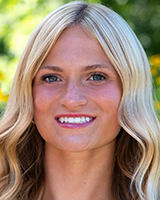 Katherine Slazinski, Birmingham Seaholm
Played two seasons of golf including on varsity this past fall, and will play fourth season of varsity tennis in the spring; also played two seasons of junior varsity volleyball. Earned all-state in tennis the last two seasons in helping team to 2023 Lower Peninsula Division 2 title and 2022 runner-up finish, winning No. 2 doubles flight as a junior. Served as tennis team captain. Earned AP Scholar with Distinction and National Merit Scholarship Commended Student recognition. Participating in third year of DECA, qualifying twice for state competition and serving as vice president of community service and social events the last two years. Participating in third year of National Honor Society and second of Spanish National Honor Society. Serving second year in multiple mentoring programs and second year as blood drive coordinator. Participated in YoungLife and as tennis coach and tournament assistant director throughout high school, and also is serving as marketing intern this year for Birmingham Education Foundation.
Essay Quote: “A major part of sportsmanship is putting the feelings of teammates or competitors before your own emotions. At times, this requires showing excitement for your teammates and all their hard work paying off, even when you are at your lowest points. At other times, this requires showing empathy to an opponent even when your first reaction is to celebrate your victory.”
 Willem DeGood, Traverse City West
Ran four seasons of cross country and will participate in fourth of track & field this spring; also competed on school’s Nordic/cross country skiing team all four years. Earned all-league and all-region in cross country and qualified for MHSAA Finals all four seasons. Competed at MHSAA Finals in track first three seasons and helped that team to three Regional titles. Earned academic all-state two years. Served as co-captain of both cross country and track teams. Earned AP Scholar with Distinction honor and participating in second years of National Honor Society and Spanish National Honor Society. Played in school’s concert and marching bands throughout high school and as part of philharmonic orchestra as a senior. Served as section leader and principal player, earned first-division solo recognition and selected to perform at Michigan Music Conference. Participating in second years of school’s global studies and arts community groups, and also serves as a math tutor and track club volunteer. Is undecided where he will attend college, but intends to major in international studies.
Essay Quote: “When competing, even for different teams, we are all stronger when we respect each other as good sportsmen and lift each other up. On the start line of every race, I always wish the runners next to me good luck because I know how much it means to know the people you’re facing on the track want the best for you, too.”
 Abrar Hossen, Portage Central
Ran three seasons of varsity cross country and will compete in his fourth of track & field this spring. Earned all-league honors in both sports, qualified for MHSAA Finals in both and served as captain of both teams as well. Earned AP Scholar with Distinction honor and named National Merit Scholarship Commended Student. Participating in second year of DECA and earned state championship, and served as chapter’s public relations director. Participating in third year on Kalamazoo Area Math & Science Center student senate, and participated in global battery solution research at Western Michigan University. Participating in second years of computer science club and Kids in Science club, as instructor for both to younger students in those topics, and has served as tutor throughout high school for students with learning disabilities. Founded school’s cultural dance group and serving as president of Health Occupations Students of America chapter. Is undecided where he will attend college but intends to study on a premedical track.
Essay Quote: “Although my time with my teammates is nearing its end, the fact that any of them can come to me for support will never change. The act of running sparks conversations, new connections, and brings communities together. These are acts of sportsmanship that often go unnoticed. A team cannot be expected to respect other teams when they are not yet close enough to respect each other.”
 Anirudh Krishnan, Plymouth
Ran four years of varsity cross country and will compete in fourth of track & field this spring. Also trained in taekwondo during first three years of high school and participated in Unified Sports basketball as a junior. Earned all-state honors in both cross country and track and academic all-state for both sports as well. Holds school race records in both sports and served as team leader for both. Earned third-degree black belt in taekwondo and taught that martial art. Founded and serves as director of AK Friendship Circle nonprofit organization supporting young adults with disabilities, and earned Ted Lindsay Foundation Family Courage Award for contributions toward autism education. Served two years on student council and participated in University of Michigan’s Youth Dialogues on Race and Ethnicity in Metropolitan Detroit. Will attend Johns Hopkins University and study applied mathematics and statistics.
Essay Quote: “In the journey to building good sportsmanship, coaches are key mentors. Sometimes in the heat of intense competition, winning seems to be the only thing that matters. However, having a coach who can provide a sense of balance and guide athletes to have a positive mindset and attitude is critical for educational athletics. In every sporting event, someone wins, and someone loses. Accepting victory with joy while not gloating over your opponents, and accepting defeat with grace while not being antagonistic to the winner reflects on the character of an athlete.”
 AJ Martel, Mason
Played four seasons of varsity football, wrestling for fourth season and competing in second of diving this winter, and will compete in third season of track & field this spring. Earned all-state in football multiple seasons and finished as school’s all-time leading rusher, and helped team to four league and three Regional titles and Division 3 runner-up finish this past fall. Helped wrestling team to Regional title this season for second time, earned all-league first three seasons and placed at Individual Finals as a freshman. Earned all-state in multiple events in track and won 300-meter hurdles at 2023 Lower Peninsula Division 2 Finals, helping team to runner-up finish. Earned all-league in diving and helped team to league title in 2023. Earned academic all-state in wrestling and football and academic all-league in track and diving. Participating in third year of National Honor Society and serving as senior class officer. Served as volunteer flag football coach and official and youth wrestling tournament worker. Participated in LINK program as a junior and serves as head of school’s athletics social media. Will attend Hope College and intends to study on a premedical track.
Essay Quote: “I realized that every person on the field was just a high school student who wanted the chance to play football. I didn’t have to detest (our rivals) because they attended a different school. I could appreciate the moment to compete against them while remembering that good sportsmanship benefits both teams.”
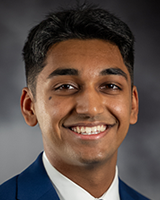 Jaden Reji, Livonia Churchill
Played three seasons of varsity soccer and playing third season of varsity basketball. Earned all-conference multiple seasons in soccer and captained that team, and earned academic all-state in basketball. Named National Merit Scholarship semifinalist and AP Scholar with Distinction. Participating in third year of Spanish National Honor Society, as chapter president, and second year of Science National Honor Society, as vice president. Participating in third year of DECA, as chapter president, and was founding member of school’s chapter of Health Occupations Students of America and won a first place at HOSA International Leadership Conference. Participated in robotics throughout high school on team that twice qualified for world championships, and served as captain. Serving as Bible study leader for church youth group and as hospital volunteer and patient/family advisory council ambassador. Volunteered for school district’s summer Early Literacy Program. Participated in two years of debate and served as team secretary. Is undecided where he will attend college, but intends to study neuroscience on a premedical track.
Essay Quote: “Sportsmanship also requires humility and appreciation. I learned this from my experience in debate, where I present and clash with different opinions and perspectives. There is always something to learn from the other side, even if I disagree with them. I learned to acknowledge their strengths, address their arguments, and concede their points when warranted. I also learned to thank them for the opportunity to engage in a constructive dialogue and to improve my own skills.”
 Charlie Seufert, East Grand Rapids
Played three seasons of varsity tennis, will play third season of varsity golf this spring, and also played two seasons of subvarsity basketball. Earned all-state in doubles tennis, helping team to Regional championship and third-place Finals finish in the fall, and earned all-conference in golf as a junior. Served as captain of both teams. Participating in fourth year of Latin club, and as president, and serving third year on student council. A heart transplant recipient, serves as speaker and ambassador for American Heart Association. Participating in third year of school’s Leadership Youth Development group and as leader. Participated two years in We the People competition including on state championship team, and as coach, and two years on Model United Nations team. Volunteered and served as First Tee West Michigan lead coach, and participating in second year as elementary school mentor. Also serving as writer for school newspaper. Is undecided where he will attend college, but intends to pursue a career in public health.
Essay Quote: “Sportsmanship has always been important to be. As a golfer and tennis player, I have exhibited good sportsmanship on and off the course/court. However, it was not until I received my heart transplant did I truly understood the meaning of this word. … Persevering through these difficulties has forever changed the athlete that I am. I now understand that sportsmanship does not just mean treating opponents with respect, but also forming connections with others on and off the course.”
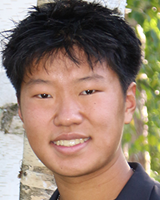 Logan Yu, Midland Dow
Played four seasons of varsity tennis, earning all-state the last two and winning the Lower Peninsula Division 2 Finals title at No. 3 singles as senior in helping Dow win second-straight team championship. Earned academic all-state as senior and was part of four academic all-state teams. Served as team captain as senior. Participating in second year of National Honor Society and served as vice president. Participating in third year of DECA and twice qualified for state competition and last year for International Career Development Conference. Playing violin for second year as part of symphony & honors orchestra and qualified for the Michigan Music Conference as sophomore, and has played piano for more than 13 years qualifying for State Achievement Testing semifinals four times. Serving third year on Midland Youth Action Council and participating in second year of church youth group and as worship leader. Is undecided where he will attend college, but intends to study business analytics and information systems.
Essay Quote: “… As a freshman, I began looking up to one of the leading figures in my life, my coach, who displayed amazing acts of sportsmanship throughout our season. When we won, he celebrated privately with us. When we lost, he congratulated the other coach and pushed us to work harder. I began to see why he was such an effective coach and leader. … Now, I see every match as an opportunity to display sportsmanship, inspire others, and grow myself.”
Other Class A girls finalists for the Scholar-Athlete Award were Yan Yee Adler, Ann Arbor Pioneer; Sam M. Peot, East Grand Rapids; Julia Holt, Farmington Hills Mercy; Tori Briggs, Fowlerville; Cameron Herman, Hartland; Brooke Pedersen, Holland West Ottawa; Ella Chatfield, Jenison; Meghan Ford, Mason; Lauren VanSumeren, Midland Dow; Addison Raffle, Northville; Ella Boyd, Oxford; Abigail DeGraw, Rochester Hills Stoney Creek; Anna Lassan, South Lyon East; Addison Booher, Traverse City Central; Ava King, Traverse City West; London Williams, Trenton; Sarah Fromm, Utica; and Ryah Dewey, Walled Lake Western.
Other Class A boys finalists for the Scholar-Athlete Award were Viraj Nautiyal, Birmingham Seaholm; Dylan Shoresh, Birmingham Seaholm; Charles Howell, Cadillac; Erik Giedeman, Dearborn; Joseph Stachelek, Detroit U-D Jesuit; Charlie Lentz, East Grand Rapids; Chris Piwowarczyk, Fenton; TJ Silvernale, Grand Rapids Forest Hills Northern; Jack Ryan, Grosse Pointe South; Connor Curtis, Livonia Stevenson; Jonathan Song, Midland Dow; Jaxson Whitaker, Muskegon Reeths-Puffer; Kyle Brown, Northville; Sean Wilson, Oxford; Andrew Miller, Saline; Jack Carlisle, Stevensville Lakeshore; and Vansh Jvalit Baxi, Troy Athens.
The Class C and D scholarship award recipients were announced Feb. 6, and the Class B honorees were announced Feb. 13.
Farm Bureau Insurance of Michigan was founded in 1949 by Michigan farmers who wanted an insurance company that worked as hard as they did. Those values still guide the company today and are a big reason why it is known as Michigan’s Insurance Company, dedicated to protecting the farms, families, and businesses of this great state. Farm Bureau Insurance agents across Michigan provide a full range of insurance services — life, home, auto, farm, business, retirement, Lake Estate®, and more — protecting nearly 500,000 Michigan policyholders.
The MHSAA is a private, not-for-profit corporation of voluntary membership by more than 1,500 public and private senior high schools and junior high/middle schools which exists to develop common rules for athletic eligibility and competition. No government funds or tax dollars support the MHSAA, which was the first such association nationally to not accept membership dues or tournament entry fees from schools. Member schools which enforce these rules are permitted to participate in MHSAA tournaments, which attract more than 1.4 million spectators each year.