

Class in Session: A History in Classification
July 24, 2017
By Rob Kaminski
MHSAA benchmarks editor
This is the first part in a series on MHSAA tournament classification, past and present, that will be published over the next two weeks. This series originally ran in this spring's edition of MHSAA benchmarks.
Conversation and discussion at the March 2017 MHSAA Representative Council Meeting leaned heavily toward the subject of 8-Player Football and how to properly balance its tournament with the growing number of schools sponsoring the sport.
While the proposal to split the tournament into two divisions beginning with the 2017 school year was adopted, the MHSAA then faced questions such as when to set the divisions, how to determine qualifiers and where to host the championship games.
The topic continues to create a buzz in Class D schools across both peninsulas, and likely will do into the start of school this fall.
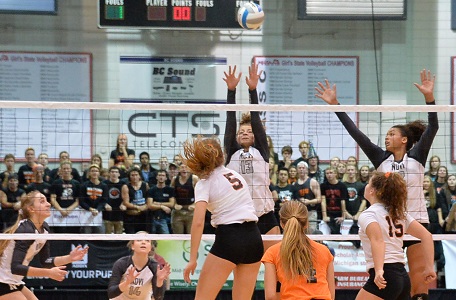
Likewise, the lone holdouts still conducting tournaments by class – MHSAA Boys and Girls Basketball and Girls Volleyball – took center stage at the May Council discussion, and following the 2017-18 school year, class is out for good. Both genders of basketball, and girls volleyball, will move to divisional formats thereafter.
There is much to be decided to be sure; but as those in education are well aware, history is the best teacher.
Fortunately for the sports in flux and for all sports under the governance of the MHSAA, the Association more or less wrote the book on the subject of sport classification. Following is a history lesson, with a little advanced division thrown in.
Class structure
Credited with being the first state with multiple tournament classifications, Michigan’s attention to trends and shifts in philosophy aimed at fair play and equal tournament opportunity can be traced from 80 years ago to the present.
In the earliest years of the MHSAA, there were four classifications for elections and tournaments – Classes A, B, C and D. Classes C and D had far more schools than Classes A and B. For example, 80 years ago (1937), there were only 58 schools in Class A, 94 schools in Class B, 297 schools in Class C and 253 schools in Class D.
Gradually through the years, as Michigan’s major cities spawned suburbs, there was a shift in the other direction to the point 30 years ago (1987) when school size became more balanced: 173 Class A schools, 178 Class B schools, 179 Class C schools and 182 Class D schools.
Up until 1987, the MHSAA published the dividing line between each classification, after which schools submitted their enrollments. Then, for 1988 and thereafter, the MHSAA adopted the plan of gathering all enrollments first and then placing 25 percent of the schools in each of four classes. This completed the equalization of the number of schools in each class for elections.
However, the change for 1988 did nothing to equalize the number of teams actually entered by each class in each sport. And unlike the early years of the Association when there were many more Class C and D teams than A and B teams, there were more Class A and B teams than C and D teams entering MHSAA tournaments decades later.
Moreover, the difference in number of teams entered in the different classifications for a sport continued to increase as many small schools, the fastest growing portion of the MHSAA's membership, sponsor only a few sports, or they sponsor no sports at all but enter into cooperative programs with other schools.
 Because of these differences, Class A or B schools sometimes had to win twice as many games as Class C or D schools to reach the MHSAA Finals in a sport. At times, the larger classifications had District Tournaments, even rat-tail games, and/or a Quarterfinal game, and the smaller classifications did not. Most Class D Districts have had four teams (some only three), while Class A Districts often had seven or eight teams. In Regional levels of individual sports, the number of entries in the larger classification once greatly outnumbered those in the smaller classifications of the tournament for the same sport.
Over the years, these dividing lines between classes escalated gradually, as did the differences in enrollments of largest and small schools in each class. In 1937 the dividing lines were 700, 300 and 100 between Class A and B, B and C, and C and D, respectively. By 1987, the dividing lines were 1,129, 571 and 298, respectively, leading to the current method of collecting enrollments and then setting the classification.
With the pendulum swinging well past center by the late 1980s, coaches associations, MHSAA sport committees, tournament managers and school administrators began discussion and offered proposals to correct what many believed had become a flawed system of MHSAA tournament classification.
At the 1996 MHSAA Update Meetings, ¾ of 858 respondents to that year’s annual survey indicated they favored a system that would divide schools which actually sponsor each sport into two, three or four nearly equal divisions.
Problem solving
At its meeting May 4-6, 1997, the Representative Council defeated a motion that would have adopted in one action a coordinated plan of reclassification for all sports to equalize the number of schools in each tournament for each respective sport. Instead, the Council discussed and voted on each proposal that had been presented from sport committees.
This resulted in the Representative Council adopting four equal divisions for baseball and softball, four equal divisions for boys and girls tennis, four equal divisions for boys soccer and three equal divisions for girls soccer, effective with the 1997-98 school year. Helping in the decision was the success of the 1995-96 MHSAA Wrestling season, which saw the sport move to four divisions for its tournament structure
The Council delayed action on similar proposals for football and boys golf at that time to glean additional input. The same decision was made with respect to a proposal from the Ice Hockey Committee that would have split the Class A schools in two divisions and left the Class B/C/D Tournament unchanged.
“The gist of the move from classes to divisions was to equalize the path to championships for students of all schools, regardless of the size of those schools,” said MHSAA Executive Director Jack Roberts.
While the restructuring accomplished that goal for the majority of competitors, opposition exists now as it did then. The primary argument in opposition to the changes is that, in some sports, it increases the range between largest and smallest schools in the division for smallest schools, even as the range is usually reduced for other divisions.
Larger schools offered a counterpoint.
“The larger schools suggested that while they may have more students, they also attempt to sponsor more sports than the smaller schools, in some cases spreading the enrollment as thin as a much smaller school with fewer sports,” Roberts said.
“Even today, the idea of four equal divisions can be unpopular among some Class D schools which feel especially burdened by the equal division concept,” Roberts said. “There was enough opposition in 1997 that equal divisions were rejected for boys and girls basketball and girls volleyball, and some of that opposition remains.”
The numbers of schools sponsoring each MHSAA tournament are still close to the totals today, with the exception of soccer in both genders, which has enjoyed substantial increases. This spring, 466 girls teams were scheduled to compete in the MHSAA Soccer Tournament, while 473 boys teams will suit up this fall.
Since the beginning of MHSAA divisions in 1996 with wrestling, 147 additional team champions have been crowned and countless individuals have known the thrill of victory due to an extra level of Finals in various sports. Girls soccer has seen the most growth in opportunity, moving from two classes in 1987 to three divisions the following year, and then four divisions in 2000. Boys soccer had enjoyed four classes for two years prior to the new four-division format, and it was the sport of soccer that helped to create a caveat in the nearly equal division movement.
Lower Peninsula boys and girls swimming & diving expanded from two to three divisions in 2008, while boys and girls bowling are the most recent sports to enjoy increased tournament opportunity, adding a fourth division in 2010.
“Fairness is in the eye of the beholder. While having the same number of schools in each division is one kind of fairness, holding in check the enrollment range between the largest and smallest schools in Division 4 is another kind of fairness that is dear to a great number of people,” Roberts said. “Because more schools sponsor basketball and volleyball than other sports, Class D schools would have been least affected by the equal divisions concept in those sports; but that, and ‘tradition,’ did not dissuade the opponents in the 1990s.”
The shift to divisions not only paved the way for student-athletes, but also assisted administrators and schools hosting tournaments. MHSAA tournament mangers looked to equal divisions to more closely equalize the number of schools in District or Regional Tournaments and to better equalize the length of day required for these rounds of tournaments, both for management and participating teams and individuals.
Pinning down an answer
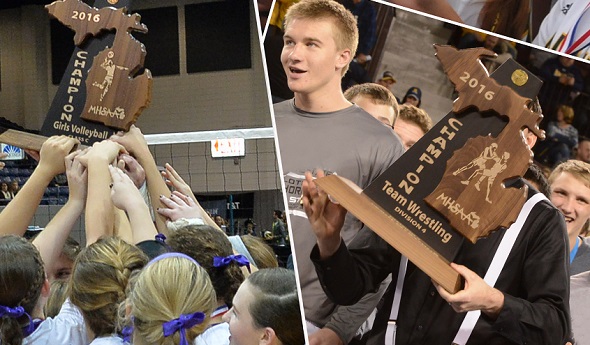
Wrestling became the first MHSAA Tournament to be conducted in nearly equal divisions when team and individual champions were crowned in Divisions 1, 2, 3 and 4 rather than Classes A, B, C/D for the 1996 winter championships.
The movement was well received, as schools saw more opportunity for success: four champions where there once were three at the District, Regional and Final levels, and a smaller range of enrollment between the smallest and largest school in all four tournaments, leading to the impetus for the Fall 1996 Update Meeting Survey of schools regarding similar movement in other sports.
Team champions that year were Holt (D1), Petoskey (D2), Middleville Thornapple Kellogg (D3) and Dundee (D4).
Getting their kicks
When the "equal divisions" concept was approved by the Representative Council for most MHSAA Tournaments for the 1997-98 school year, there was opposition from the smallest schools which, under the equal divisions, are forced to play against larger schools than reside in Class D. Compelling arguments were made – and still are – that an enrollment difference between schools with smaller enrollments (e.g., Class D) is more difficult to overcome in athletic competition than an even larger enrollment difference between schools with larger enrollments (e.g., Class A).
The opposition was most intense in soccer because of the number of students needed to field a team and the physical nature of the sport. As a result, from 2000-01 through 2010-11, soccer operated with a “20-percent modification.” This placed 20 percent of all schools that actually sponsored soccer in Division 4, and the remaining 80 percent were placed equally in Divisions 1, 2 and 3.
At the time the 20 percent modification was adopted, it was also established that soccer would return to four equal divisions when the largest Division 4 soccer school had an enrollment equal to or smaller than the mid point for Class C schools. That occurred in 2010.
Last class on the schedule
In the same volume of “history being the best teacher,” one can also find the adage, “times change.” While the division format was a welcome change in some sports, others were left to hold class without change.
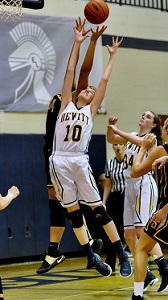 In the sports of boys and girls basketball, and girls volleyball, the number of schools sponsoring the sports were so close to the overall membership of the MHSAA that divisions were not necessary; the enrollment breakdowns themselves were enough to delineate equal opportunity for tournament success.
That is no longer the case, according to MHSAA membership. The last move from classes to divisions occurred for the 2006-07 school year following Council action. Before this May, that is. Action at the most recent Representative Council meeting, May 2017, called for the shift to divisions for MHSAA Boys and Girls Basketball, and Girls Volleyball, beginning with the 2018-19 season.
“Because the MHSAA Volleyball Committee had requested this change several times a number of years ago, and because the Council felt the change inevitable, there should not be further delay,” Roberts said. “It is an important detail that the Class D maximum has dropped 50 students over the past decade so the objection that much larger schools would be competing in Division 4 isn’t very strong now.”
Using the 2017-18 enrollment figures, just eight Class C schools would be competing in Division 4 for boys basketball, 11 for girls basketball and 14 for girls volleyball.
Good things came of the previous most-recent switches in 2006-07. Competitive Cheer was re-classified from Class A, B and C-D into four equal divisions assisting in the rapid growth of sponsoring schools (approximately 80 schools per division). Alpine skiing was changed from Class A and B-C D to two equal divisions.
At that time, the MHSAA Basketball Committee had recommended to the Council the study of increased classifications, but status quo remained.
Back on the grid
As such, MHSAA Basketball and Volleyball remained the only holdovers of the MHSAA class structure. Discussion resurfaced periodically during the last two decades to bring those tournaments in line with the other MHSAA sports.
Regular-season football-playing schools are separated by class, then are reshuffled by divisions for the playoffs. Football, as we know, underwent a significant postseason facelift in the late 1990s.
While MHSAA Football also remained a class sport through 1998, it had expanded from four to eight classes from 1990-98, becoming the first MHSAA sport to crown more than four team champions. Member schools were asked to consider a pair of options in November of 1997. One called for eight equal divisions, and the second would leave Class D by itself as division 8, and split Class A, B and C schools into seven nearly equal divisions.
After much discussion, retooling, and crunching of formulas, the MHSAA unveiled its revised Football Playoff model that continues to roll today, nearly 20 years later. It was determined that 256 teams would qualify for the tournament based first on a minimum of six wins, then by Playoff Points determined by formula. From there, the field would be divided into eight divisions, with the field being filled out by a nearly equal number of five-win teams in each division as needed to reach 256.
Eight championships would indeed be enough, until football sponsorship among the MHSAA’s smallest schools – some with rich football traditions – began to trend downward. The MHSAA again went to the drawing board, examining the viability of 8-player football. After an experimental year in 2010 without a tournament, the 8-player game was playoff-ready for 2011, with a field of 16 qualifiers embarking on a four-week tournament.
Not only did the 8-player option restore recently canceled programs, but it also created teams in schools which previously had none, and convinced some 11-player schools that this new division was the best path to take.
What did this do for the Class D holdovers staying in the traditional 11-player game? Well, a couple of things, positive and negative. As two and three dozen Class D schools opted for the 8-player game, the remaining 11-player Class D schools at times found themselves in disrupted leagues and had to travel further to complete schedules. They also competed against larger teams in Division 8 of the 11-player MHSAA Football Playoffs.
However, the growth of the 8-player game among the smallest schools also resulted in more Class D schools qualifying for the MHSAA Football Playoffs than ever before. In 2012, an all-time high 44 percent of Class D schools sponsoring football qualified for either the 8-player tournament or Division 8 of the 11-player tournament. That compared to 42.2 percent of Class C schools, 44.9 percent of Class B schools and 41.6 percent of Class A schools which qualified for the 2012 playoffs.
Much is to be determined in the most recent chapter of MHSAA Tournament expansion as the 8-Player Football Playoffs welcome a second division. As the past illustrates, there will be pluses and minuses. History also shows that the MHSAA has received maximum input from its constituents, researched all possibilities, and will find solutions to questions still in the balance before an additional group of athletes hoists a new trophy in November.
Through the Years
A chronology of when which sports moved from Class to Division in the MHSAA.
1995-96: LP Wrestling
1997-98: Baseball, Boys Soccer, Girls Soccer, Softball, LP Girls Tennis, LP Boys Tennis
1998-99: LP Boys Golf, LP Girls Golf
1999-2000: Ice Hockey, LP Boys Track & Field, LP Girls Track & Field
2000-01: LP Boys Cross Country, LP Girls Cross Country, UP Boys Cross Country, UP Girls Cross Country, UP Boys Golf, UP Girls Golf, UP Boys Tennis, UP Girls Tennis, UP Boys Track & Field, UP Girls Track & Field
2002-03: LP Girls Swimming & Diving, LP Boys Swimming & Diving
2005-06: Boys Bowling, Girls Bowling
2006-07: Girls Competitive Cheer, Boys Skiing, Girls Skiing
2018-19: Boys Basketball, Girls Basketball, Girls Volleyball
Note: Boys and Girls Lacrosse has been a divisional sport since it began in during the 2004-05 school year.
1st & Goal: 2023 11-Player Finals Preview
By
Geoff Kimmerly
MHSAA.com senior editor
November 22, 2023
There’s plenty of new to this weekend’s MHSAA 11-Player Football Finals, and it goes far beyond the four teams making their first appearances in a championship game.
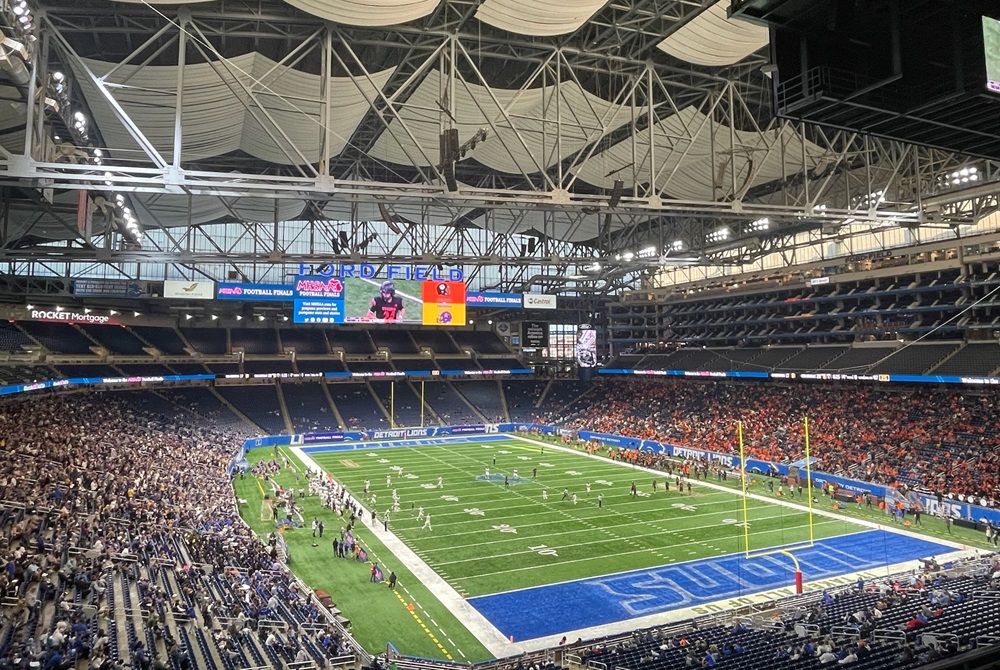
 This time, the Finals will be played on Saturday and Sunday – shifted by Michigan State playing Penn State on Friday at Ford Field. And the traditional order of games also has been switched up a bit – both days will conclude with the largest schools playing that day, the Division 2 teams facing off to finish Saturday and the Division 1 Final concluding the weekend Sunday night. Also necessary to note for Sunday – games will begin 30 minutes earlier than the usual schedule, with the opener in Division 7 that morning kicking off at 9:30.
After that, there’s a lot of familiar about this weekend’s lineup. Five champions are playing to repeat, and three 2022 runners-up are hoping to take the next step. The Division 8 Final is a rematch from a year ago, and several individual standouts will be returning to Ford Field as well – including star Belleville quarterback Bryce Underwood, finishing off a third season as one of the main topics of statewide football conversation.
Here's the full schedule for Saturday and Sunday's games:
Saturday, Nov. 25
Division 8 – Ubly (13-0) vs. Ottawa Lake Whiteford (13-0)– 10 a.m.
Division 4 – Grand Rapids South Christian (10-3) vs. Harper Woods (10-3) – 1 p.m.
Division 6 – Kingsley (11-2) vs. Almont (12-1) – 4:30 p.m.
Division 2 – Muskegon (11-2) vs. Warren De La Salle Collegiate (11-2) – 7:30 p.m.
Sunday, Nov. 26
Division 7 – Menominee (11-2) vs. Jackson Lumen Christi (12-1) – 9:30 a.m.
Division 3 – Grand Rapids Forest Hills Central (12-1) vs. Mason (13-0) – 12:30 p.m.
Division 5 – Grand Rapids Catholic Central (12-1) vs. Corunna (13-0) – 4 p.m.
Division 1 – Belleville (13-0) vs. Southfield Arts & Technology (12-1) – 7 p.m.
All games will be broadcast live on Bally Sports Detroit’s primary channel except the Division 3 Final, which will be broadcast on Bally Sports Detroit Extra, and all eight also will be available via the Bally Sports Detroit website and Bally Sports app. Additionally, all eight championship games will be available for listening from the MHSAA Network at MHSAANetwork.com. Links to purchase tickets and more are available on the Football page.
Below is a glance at all eight matchups. Statistics are through Semifinals unless noted.
 Division 1
BELLEVILLE
Record/Rank: 13-0, No. 1
Coach: Calvin Norman, first season (13-0)
League finish: First in Kensington Lakes Activities Association East
Championship history: Division 1 champion 2022 and 2021.
Best wins: 63-21 over No. 3 Davison in Semifinal, 49-7 (Regional Final) and 42-0 over No. 6 Northville, 65-14 over No. 5 Saline in District Final, 35-28 over River Rouge.
Players to watch: QB Bryce Underwood, 6-3/190 jr. (3,155 yards/40 TDs passing, 7 TDs rushing); RB/LB Jeremiah Beasley, 6-2/220 sr. (787 yards/13 TDs rushing); WR/DB Kevin Simes, 5-9/175 sr. (1,053 yards/12 TDs receiving); OL/DL Ronald Jackson, 6-1/270 sr.
Outlook: Belleville has won the last two Division 1 championships and 38 straight games – tied for the seventh-longest winning streak in MHSAA football history – and has dominated all but its first opponent of the season, Rouge, which reached the Division 3 Regional Finals. The offense gets high praise, and rightfully so – Underwood and Beasley were all-state first-teamers last season and are among the nation’s elite at their positions, with Beasley committed to sign with Michigan. But Beasley also keys a defense that has allowed just 95 points (7.3 per game), that average increasing to only 12 ppg during the playoffs despite a strong group of opponents. Senior running back Colbey Reed (5-foot-9/210 pounds) is another talented offensive contributor – he’s run for 715 yards and nine touchdowns, including 228 and four, respectively, in the Semifinal.
SOUTHFIELD ARTS & TECHNOLOGY
Record/Rank: 12-1, No. 8
Coach: Aaron Marshall, third season (22-11)
League finish: First in Oakland Activities Association White
Championship history: Has never played in an MHSAA Final.
Best wins: 40-35 over No. 9 West Bloomfield in Semifinal, 31-21 over No. 10 Clinton Township Chippewa Valley in Regional Final, 36-25 (Regional Semifinal) and 29-27 over Detroit Cass Tech, 20-17 over Clarkston, 42-35 over Division 2 No. 9 Birmingham Groves.
Players to watch: QB Isiah Marshall, 6-0/205 sr. (2,833 yards/37 TDs passing, 1,373 yards/15 TDs rushing); WR Xavi Bowman, 6-0/195 sr. (769 yards/10 TDs receiving); WR Tashi Braceful, 6-2/184 sr. (921 yards/13 TDs receiving); DB Jalen Todd, 6-1/178 sr.
Outlook: This will be the first championship game appearance for any part of this program, including the former Southfield High and Southfield-Lathrup from which A&T was formed in 2016. The Warriors are led by another of the state’s most dynamic quarterbacks, with Marshall throwing for nearly 3,000 yards and also totaling more than half of the team’s rushing yards this season (averaging 11.3 per carry) and set to sign with Kansas. Todd was an all-state first-team selection last season and also will sign with Kansas, while senior defensive back Wendell Smith is set to sign with Eastern Michigan and Braceful with Toledo. Braceful and Bowman are only two of a talented receiving group helping Marshall stretch the field; senior Jawon Jarrett (513 yards/6 TDs) is another. The West Bloomfield win last week avenged a 31-20 loss in Week 8.
 Division 2
WARREN DE LA SALLE COLLEGIATE
Record/Rank: 11-2, No. 1
Coach: Dan Rohn, fourth season (42-8)
League finish: Second in Detroit Catholic High School League Central
Championship history: Five MHSAA titles (most recent 2022), three runner-up finishes.
Best wins: 40-28 over No. 2 Muskegon, 45-19 over Waterford Mott in Semifinal, 34-14 over Roseville in Regional Final, 14-7 over Detroit Catholic Central.
Players to watch: QB/TE Sante Gasperoni, 6-2/215 jr. (2,141 yards/23 TDs passing, 926 yards/15 TDs rushing); WR/DB Damion King IV, 5-8/155 soph. (723 yards/9 TDs receiving); WR/DB Phoenix Glassnor, 6-1/180 jr. (626 yards/7 TDs receiving); LB/RB Sam Wakula, 6-0/210 sr.
Outlook: Several of the top contributors are new for De La Salle this season, but the results have been the same as the Pilots pursue a third-straight Division 2 championship. Gasperoni has stepped in at quarterback and shined, and King has been another key after leading the team in receiving at last year’s Final as a freshman. Gasperoni also has a ton of help up front from a line including senior guard Ryan Ross (6-2/290) and senior tight end Caden Campbell (6-3/235). The lone losses were in the season opener to eventual Division 1 semifinalist Davison – which was followed by the Muskegon win – and in Week 4 to eventual Catholic League Central champion Toledo Central Catholic. De La Salle has given up only 75 points total over its nine-game winning streak.
MUSKEGON
Record/Rank: 11-2, No. 2
Coach: Shane Fairfield, 13th season (153-29)
League finish: First in Ottawa-Kent Conference Green
Championship history: Six MHSAA championships (most recent 2017), seven runner-up finishes.
Best wins: 42-7 over East Lansing in Semifinal, 42-14 over No. 8 Saginaw Heritage in Regional Final, 42-28 (District Final) and 42-21 over No. 5 Muskegon Mona Shores, 28-13 over Muskegon Reeths-Puffer, 22-16 over Zeeland West.
Players to watch: QB/DB M’Khi Guy, 5-8/175 sr. (1,721 yards/23 TDs, 535 yards/8 TDs passing); RB/LB Jakob Price, 5-6/180 sr. (1,150 yards/21 TDs rushing); SL/DB Destin Piggee, 5-7/170 sr. (981 yards/10 TDs rushing); DL Chris Jones, 5-9/240 sr.
Outlook: After finishing Division 3 runner-up a year ago, Muskegon returns in Division 2 to play its ninth Final over the last 12 years. Guy, Price and Piggee all are familiar with Ford Field after combining to gain all of the team’s yards in last season’s trip, and the offense as a whole has been even better this fall averaging nearly 41 points per game and even upping that average by a point during the playoffs. The Big Reds opened with losses to Division 1 Rockford and De La Salle, but have given up only 10.8 points per game since. Junior inside linebackers Darekeo Speech and Adrian Rankin Jr. and senior defensive end Stanley Cunningham have stood out as well defensively, and they were among the team’s leading tacklers during last season’s championship game. Guy and Piggee made the Division 2 all-state second team last season.
 Division 3
MASON
Record/Rank: 13-0, No. 1
Coach: Gary Houghton, seventh season (59-17)
League finish: First in Capital Area Activities Conference Red
Championship history: Has never played in an MHSAA Final.
Best wins: 44-41 OT (Regional Final) and 30-7 over No. 6 Walled Lake Western, 26-20 over Detroit Martin Luther King in Semifinal, 42-7 (District Final) and 42-23 over No. 8 DeWitt, 35-20 over Haslett.
Players to watch: WR/LB Kaleb Parrish, 6-5/220 sr. (601 yards/12 TDs receiving); QB/CB Cason Carswell, 6-3/185 jr. (2,589 yards/32 TDs passing); WR/LB Derek Badgley, 6-1/205 sr. (570 yards/2 TDs receiving); RB/FS AJ Martell, 5-9/185 sr. (1,378 yards/26 TDs rushing). (Statistics do not include Semifinal.)
Outlook: After reaching the Semifinals and falling to King both of the last two seasons, Mason broke through last weekend to earn a historic trip with nearly the identical lineup as a year ago. Carswell is a three-year starter at quarterback and also had run for nearly 300 yards and three scores heading into last weekend, and Martel is a four-year starter and the program’s all-time leading rusher. Parrish made the all-state first team last season at linebacker, and Carswell made the second. Parrish is one of six two-way starters as is senior Tyler Baker, the team's leader in receiving yardage (720, 6 TDs). Nine of Mason’s wins came against opponents with winning records this fall, and both Walled Lake Western victories and the first DeWitt win were on the road. The Bulldogs have another important scoring option in soccer all-state junior Collin Winters, who has made 62 of 66 extra-point tries and four field goals in five attempts.
GRAND RAPIDS FOREST HILLS CENTRAL
Record/Rank: 12-1, No. 3
Coach: Tim Rogers, 12th season (88-41)
League finish: Tied for first in O-K White
Championship history: Division 2 runner-up 2022, Class A runner-up 1994.
Best wins: 18-14 over Zeeland West in Semifinal, 33-7 over No. 2 Gaylord in Regional Final, 45-21 over No. 4 Mount Pleasant in District Final, 20-0 over No. 5 East Grand Rapids, 26-6 over Division 2 No. 7 Portage Central.
Players to watch: QB/DB Mason McDonald, 6-0/180 sr. (1,455 yards/18 TDs passing, 743 yards/11 TDs rushing); DB/WR Ty Hudkins, 6-0/185 sr. (690 yards/7 TDs receiving); LB/RB JT Hartman, 5-9/190 sr. (1,307 yards/17 TDs rushing); LB/TE Max Richardson, 6-3/215 jr.
Outlook: Forest Hills Central also brings back several main contributors from last season’s Division 2 runner-up run, with Hartman and Hudkins again the team’s leading rusher and receiver, respectively, and McDonald directing the offense after stepping in for the injured starter during the playoffs to get the Rangers to Ford Field a year ago. FHC is a 15-14 Week 5 loss to Division 2 No. 4 Byron Center from a perfect record, and the defense especially has been masterful giving up only nine points per game and more than 15 only twice. Hudkins has committed to sign with Purdue and Richardson has committed to Stanford, and they are among six who start on both offense and defense.
 Division 4
HARPER WOODS
Record/Rank: 10-3, unranked
Coach: Rod Oden, seventh season (35-28)
League finish: Third in OAA White
Championship history: Has never played in an MHSAA Final.
Best wins: 35-24 over No. 4 Goodrich in Semifinal, 46-19 over No. 8 Carleton Airport in Regional Final, 24-7 over Roseville, 34-7 over Clarkston.
Players to watch: RB Colby Bailey, 5-9/175 jr. (1,100 yards rushing); WR/DB Dakota Guerrant, 6-0/190 fr. (1,086 yards receiving); QB Nate Rocheleau, 5-10/170 soph. (1,836 yards/23 TDs passing); WR/DB Jacob Oden, 6-1/197 sr. (Statistics do not include Semifinal.)
Outlook: Harper Woods was just 3-6 a year ago and started this season 3-3 but has found its stride despite playing one of the toughest schedules certainly of any Division 4 team if not statewide with the losses to Division 1 Southfield A&T and Lake Orion and Division 2 Groves. Rocheleau and senior Stephone Buford Jr. provide multiple looks splitting time at quarterback, Buford with 10 touchdown passes, seven touchdown catches and 11 touchdown runs this season (including the Semifinal). Jacob Oden has committed to sign with Michigan, and senior linebacker Willie Powell is another top contributor on defense and has committed to play at Air Force. Rod Oden formerly coached successful programs at Detroit Crockett and East English Village.
GRAND RAPIDS SOUTH CHRISTIAN
Record/Rank: 10-3, No. 9
Coach: Danny Brown, fifth season (46-14)
League finish: Tied for second in O-K Gold
Championship history: Four MHSAA titles (most recent 2022), four runner-up finishes.
Best wins: 21-6 over No. 3 Portland in Semifinal, 55-35 over Big Rapids in Regional Final, 22-14 (District Final) and 32-29 over Ada Forest Hills Eastern, 34-7 over Wayland in District Semifinal.
Players to watch: WR/DB Jake Vermaas, 6-2/185 sr. (1,548 yards/20 TDs receiving); RB/LB Charlie Schreur, 5-8/170 sr. (594 yards/11 TDs rushing); QB Carson Vis, 6-4/185 jr. (2,531 yards/32 TDs passing, 867 yards/15 TDs rushing); OL/DL Cam VanSolkema, 6-4/270 sr.
Outlook: The reigning Division 4 champion Sailors seemed on the verge of something big again through the regular season, losing to Division 3 No. 5 East Grand Rapids only 23-21 in Week 2, Division 5 top-ranked Grand Rapids Catholic Central just 21-12 in Week 8 and then Wayland 49-40 in Week 9. They took that next step to start the playoffs, avenging with a big win over Wayland to start this march back to Ford Field. Vermaas was among stars of last season’s 28-0 Finals win over Goodrich and VanSolkema is a returning second-team all-stater. Vermaas also was a standout for the South Christian basketball team that finished Division 2 runner-up in March, and Vis was the leading scorer on that team and has made an impressive comeback after injuries ended his hoops season in the Regional Final.
 Division 5
CORUNNA
Record/Rank: 13-0, No. 4
Coach: Steve Herrick, eighth season (56-28)
League finish: First in Flint Metro League Stars
Championship history: Has never played in an MHSAA Final.
Best wins: 28-17 over No. 3 Pontiac Notre Dame Prep in District Final, 45-7 over No. 8 Flint Hamady in District Semifinal, 35-7 over Division 4 No. 4 Goodrich.
Players to watch: QB/DB Wyatt Bower, 6-1/180 sr. (2,261 yards/26 TDs passing, 994 yards/15 TDs rushing); RB/LB Jaden Edington, 5-11/210 sr. (1,034 yards/22 TDs rushing, 104 tackles/16 tackles for loss); WR/DB Tarick Bower, 6-1/170 sr. (1,314 yards/19 TDs receiving); OL/DL AJ Brieger, 6-3/240 jr.
Outlook: Corunna steadily has been building to this point, increasing its win total each of the last five seasons including going 8-3 a year ago. Its first two wins of this playoffs came over undefeated Hamady and Notre Dame Prep, and the 11-point victory over NDP was the Cavaliers’ closest game as they’ve outscored opponents by an average of 45-7. Senior running back Parker Isham (572 yards/8 TDs rushing) and junior receiver Bryce Edington (604 yards/4 TDs receiving) are two more options as Wyatt Bower directs the offense. The defense has created plenty of miscues with 13 interceptions and 10 fumble recoveries.
GRAND RAPIDS CATHOLIC CENTRAL
Record/Rank: 12-1, No. 1
Coach: Todd Kolster, 12th season (137-16)
League finish: First in O-K Gold
Championship history: Seven MHSAA titles (most recent 2019), two runner-up finishes.
Best wins: 35-0 over No. 5 Frankenmuth in Semifinal, 30-28 over No. 2 Grand Rapids West Catholic in Regional Final, 21-12 over Division 4 No. 9 Grand Rapids South Christian, 38-6 over River Rouge.
Players to watch: WR Jamison Williams, 6-5/180 jr. (703 yards/7 TDs receiving); QB/FS Connor Wolf, 6-3/190 sr. (2,568 yards/26 TDs passing, 475 yards/7 TDs rushing); WR/DB Mill Coleman III, 5-11/175 sr. (503 yards/6 TDs receiving); TB/DB Kellen Russell-Dixon, 5-10/190 sr. (1,607 yards/24 TDs rushing, 4 TDs receiving).
Outlook: After a season away, Grand Rapids Catholic Central will play in its sixth Final over the last eight years, it’s only loss this fall in the opener to Chicago Loyola. Williams made the all-state second team last season and is among several contributors to a balanced attack that has scored 42 or more points in eight games. After falling 45-7 to Loyola, only West Catholic two weeks ago has scored more than 14 points on the Cougars this season, and GRCC has been especially limiting to passing offenses allowing fewer than 100 yards per game and only three touchdowns total through the air.
 Division 6
ALMONT
Record/Rank: 12-1, No. 3
Coach: James Leusby, ninth season (72-25)
League finish: First in Blue Water Area Conference
Championship history: Division 5 runner-up 2019.
Best wins: 49-24 over Detroit Edison in Regional Final, 40-38 (OT) over No. 1 Warren Michigan Collegiate in District Final, 30-20 over Croswell-Lexington, 39-0 over Marysville.
Players to watch: RB/DB Ayden Ferqueron, 6-1/195 sr. (106 tackles); RB/LB Chase Battani, 5-10/175 jr. (1,169 yards/18 TDs rushing, 85 tackles/11 tackles for loss); LB Cohen Ferqueron, 6-0/175 soph. (92 tackles); QB Chase Davedowski, 6-0/165 sr. (431 yards/8 TDs passing). (Only Battani’s offensive stats include Semifinal.)
Outlook: One of the state’s most consistently successful programs – Almont has made the playoffs 17 of the last 18 seasons – is back at Ford Field for the second time in five years. The team’s only loss was 21-7 to Division 5 Ogemaw Heights in Week 9, and the Raiders bounced right back and actually are averaging five points a game (42) more in the playoffs than for the season as a whole. Almont’s defense is giving up 14 points per game, but more than half of the 192 allowed this season were scored during the fourth quarter after the team has built a nice lead – and the Raiders have allowed only 67 points during first halves. Nearly all of the offense comes on the ground, but from a variety of sources after Battani including junior Luke Winkler (5-9/155), who has run for eight touchdowns, caught two scoring passes and returned three kicks and two punts for TDs as well.
KINGSLEY
Record/Rank: 11-2, No. 4
Coach: Tim Wooer, 15th season (126-39)
League finish: Second in Northern Michigan Football Conference Legends
Championship history: Division 6 champion 2005.
Best wins: 37-7 (Semifinal) and 46-12 over Reed City, 51-27 over No. 7 Gladstone in Regional Final, 37-18 over No. 9 Manistee in District Final.
Players to watch: RB/DB Eli Graves, 6-3/175 sr. (1,654 yards/20 TDs rushing, 448 yards/5 TDs receiving); RB/LB Skylar Workman, 6-1/165 sr. (521 yards/9 TDs rushing, 3 TDs receiving); QB/DB Gavyn Merchant, 5-8/150, sr. (1,205 yards/17 TDs passing); OL/DL Caleb Bott, 6-0/195 sr. (Statistics do not include Semifinals.)
Outlook: Kingsley’s first Semifinal since 2019 has turned into its first championship game trip in nearly two decades as the Stags improved to a combined 58-11 since Wooer returned to lead the program in 2018 – he previously coached Kingsley from 1999-2007 before taking over at Traverse City West for a decade. The Stags finished second in the NMFC Legends to Ogemaw Heights, losing 35-12 in Week 7 in their matchup with an Almont common opponent, and also fell just short 42-39 to Division 3 Gaylord in Week 2. No other opponent has gotten close, and the four playoff games alone have been won on average by 31 points. Workman scored four more rushing touchdowns in the Semifinal win over Reed City, and while Graves has done most of the damage this season five Kingsley runners have rushed for at least five touchdowns and four have caught at least three touchdown passes.
 Division 7
MENOMINEE
Record/Rank: 11-2, No. 9
Coach: Chad Brandt, second season (17-7)
League finish: Tied for third in Western Peninsula Athletic Conference Copper
Championship history: Three MHSAA titles (most recent 2007), two runner-up finishes.
Best wins: 32-21 over No. 2 North Muskegon in Semifinal, 50-14 over No. 7 Charlevoix in District Final, 44-26 over Division 6 No. 7 Gladstone.
Players to watch: RB/DE Landan Bardowski, 5-9/180 sr. (1,431 yards rushing/27 TDs); WR/DB Tanner Theuerkauf, 6-3/175 soph. (392/7 TDs receiving); QB/DB Trevor Theuerkauf, 5-11/175 sr. (1,636 yards/21 TDs passing, 1,133 yards/17 TDs rushing); TE/LB Eli Beal, 6-2/190, sr. (343 yards/4 TDs receiving).
Outlook: Menominee is headed back to the Finals for the first time since 2016, when it finished Division 5 runner-up, and gives the West-PAC a finalist for the second year in a row after Negaunee finished Division 6 runner-up last season. The Maroons’ only losses this fall were to the Miners and Division 5 Kingsford, and Menominee opened this season with one of the most impressive defensive stretches in the state giving up only six points with four shutouts over its first five games. All 11 wins were by at least 11 points.
JACKSON LUMEN CHRISTI
Record/Rank: 12-1, No. 1
Coach: Herb Brogan, 44th season (407-95)
League finish: First in Detroit Catholic High School League AA
Championship history: 12 MHSAA titles (most recent 2022), three runner-up finishes.
Best wins: 35-7 over No. 3 Millington in Semifinal, 21-14 over No. 6 Clinton in Regional Final, 26-0 over No. 4 Napoleon in District Final, 41-0 over Division 6 No. 10 Michigan Center.
Players to watch: RB/DB Kadale Williams, 6-1/180 jr. (1,641 yards/30 TDs rushing); QB Timmy Crowley, 6-2/180 jr. (1,177 yards/11 TDs passing); OL/DL Luke Smith, 6-4/225 sr.; OL/DL Aiden Pastoriza, 6-7/260 sr.
Outlook: The reigning Division 7 champion also will be playing in its sixth Final in eight seasons, its only loss 24-21 to Division 3 Gaylord in Week 8. The Titans statistically have outperformed last year’s team on both sides of the ball, scoring more points with a game to play and giving up 69 fewer – just 7.1 per game. Junior Isaac Rehberg (5-8/185) is another contributor on both sides of the ball, starting at fullback and defensive tackle and rushing for 12 touchdowns, while senior receiver Gabe King (5-8/165) has rushed for three scores and caught four.
 Division 8
OTTAWA LAKE WHITEFORD
Record/Rank: 13-0, No. 1
Coach: Todd Thieken, second season (27-0)
League finish: First in Tri-County Conference
Championship history: Two MHSAA titles (most recent 2022), one runner-up finish.
Best wins: 54-6 over No. 8 White Pigeon in Regional Final, 24-14 over No. 10 Hudson in District Final, 45-7 over Union City.
Players to watch: QB/S Tre Eitniear, 5-10/165 fr. (995 yards/15 TDs passing); RB/CB Hunter DeBarr, 6-1/165 sr. (832 yards/12 TDs rushing, 4 TDs receiving); TE/S Kolby Masserant, 6-2/195 sr. (956 yards/13 TDs receiving); RB/LB Jake Iott, 6-1/185 sr. (897 yards/9 TDs rushing).
Outlook: Whiteford has won 27 straight games in reaching its fourth Final over the last eight seasons and haven’t played a single-digit game since Week 3 – and only two all fall. The Bobcats have given up single-digit points eight of the last nine games, led in part by Iott, an all-state first-teamer at linebacker last season. Masserant has six interceptions and DeBarr and senior running back/defensive tackle Drew Knaggs are among other two-way standouts – Knaggs has run for 645 yards and 11 scores, and DeBarr made the all-state second team at running back in 2022. Senior Ryin Ruddy (6-1/185) steps in at quarterback as well and has run for 417 yards and seven touchdowns and thrown for 462 yards and five scores.
UBLY
Record/Rank: 13-0, No. 2
Coach: Eric Sweeney, fourth season (47-5)
League finish: First in Greater Thumb Conference East
Championship history: Three MHSAA runner-up finishes (most recent 2022).
Best wins: 24-6 over No. 9 Beal City in Semifinal, 41-20 over No. 3 Ithaca in Regional Final, 35-14 (District Final) and 56-20 over Harbor Beach.
Players to watch: QB/DB Evan Peruski, 5-11/185 sr. (389 yards/4 TDs passing, 441 yards/4 TDs rushing); TE/K/P Brett Mueller, 6-2/210 sr. (461 yards/6 TDs receiving, 72-78 XP); RB/LB Canden Peruski, 6-0/210 sr. (1,558 yards/21 TDs rushing); RB/DE Seth Maurer, 6-0/190 sr. (967 yards/18 TDs rushing)
Outlook: Ubly will be playing in its third Final in four seasons, and Evan Peruski started at quarterback during his freshman year trip as well. Last week’s 18-point win over Beal City was the Bearcats’ closest game this season as they’ve outscored their opponents on average 44-10. Mueller became the MHSAA career extra point record holder this fall and added a 54-yard field goal in the Semifinal. Canden Peruski made the all-state first team on defense last season and is one of eight two-way starters. Juniors Collin Osantowski (530 yards/12 TDs rushing) and Luke Volmering (599/11) also have shouldered good shares of a rushing attack that’s gained more than 4,400 yards.
MHSAA.com's weekly “1st & Goal” previews and reviews are powered by MI Student Aid, a part of the Office of Postsecondary Financial Planning located within the Michigan Department of Treasury. MI Student Aid encourages students to pursue postsecondary education by providing access to student financial resources and information. MI Student Aid administers the state’s 529 college savings programs (MET/MESP), as well as scholarship and grant programs that help make college Accessible, Affordable and Attainable for you. Connect with MI Student Aid at www.michigan.gov/mistudentaid and find more information on Facebook and X (Twitter) @mistudentaid.