

Class in Session: A History in Classification
July 24, 2017
By Rob Kaminski
MHSAA benchmarks editor
This is the first part in a series on MHSAA tournament classification, past and present, that will be published over the next two weeks. This series originally ran in this spring's edition of MHSAA benchmarks.
Conversation and discussion at the March 2017 MHSAA Representative Council Meeting leaned heavily toward the subject of 8-Player Football and how to properly balance its tournament with the growing number of schools sponsoring the sport.
While the proposal to split the tournament into two divisions beginning with the 2017 school year was adopted, the MHSAA then faced questions such as when to set the divisions, how to determine qualifiers and where to host the championship games.
The topic continues to create a buzz in Class D schools across both peninsulas, and likely will do into the start of school this fall.
Likewise, the lone holdouts still conducting tournaments by class – MHSAA Boys and Girls Basketball and Girls Volleyball – took center stage at the May Council discussion, and following the 2017-18 school year, class is out for good. Both genders of basketball, and girls volleyball, will move to divisional formats thereafter.
There is much to be decided to be sure; but as those in education are well aware, history is the best teacher.
Fortunately for the sports in flux and for all sports under the governance of the MHSAA, the Association more or less wrote the book on the subject of sport classification. Following is a history lesson, with a little advanced division thrown in.
Class structure
Credited with being the first state with multiple tournament classifications, Michigan’s attention to trends and shifts in philosophy aimed at fair play and equal tournament opportunity can be traced from 80 years ago to the present.
In the earliest years of the MHSAA, there were four classifications for elections and tournaments – Classes A, B, C and D. Classes C and D had far more schools than Classes A and B. For example, 80 years ago (1937), there were only 58 schools in Class A, 94 schools in Class B, 297 schools in Class C and 253 schools in Class D.
Gradually through the years, as Michigan’s major cities spawned suburbs, there was a shift in the other direction to the point 30 years ago (1987) when school size became more balanced: 173 Class A schools, 178 Class B schools, 179 Class C schools and 182 Class D schools.
Up until 1987, the MHSAA published the dividing line between each classification, after which schools submitted their enrollments. Then, for 1988 and thereafter, the MHSAA adopted the plan of gathering all enrollments first and then placing 25 percent of the schools in each of four classes. This completed the equalization of the number of schools in each class for elections.
However, the change for 1988 did nothing to equalize the number of teams actually entered by each class in each sport. And unlike the early years of the Association when there were many more Class C and D teams than A and B teams, there were more Class A and B teams than C and D teams entering MHSAA tournaments decades later.
Moreover, the difference in number of teams entered in the different classifications for a sport continued to increase as many small schools, the fastest growing portion of the MHSAA's membership, sponsor only a few sports, or they sponsor no sports at all but enter into cooperative programs with other schools.
 Because of these differences, Class A or B schools sometimes had to win twice as many games as Class C or D schools to reach the MHSAA Finals in a sport. At times, the larger classifications had District Tournaments, even rat-tail games, and/or a Quarterfinal game, and the smaller classifications did not. Most Class D Districts have had four teams (some only three), while Class A Districts often had seven or eight teams. In Regional levels of individual sports, the number of entries in the larger classification once greatly outnumbered those in the smaller classifications of the tournament for the same sport.
Over the years, these dividing lines between classes escalated gradually, as did the differences in enrollments of largest and small schools in each class. In 1937 the dividing lines were 700, 300 and 100 between Class A and B, B and C, and C and D, respectively. By 1987, the dividing lines were 1,129, 571 and 298, respectively, leading to the current method of collecting enrollments and then setting the classification.
With the pendulum swinging well past center by the late 1980s, coaches associations, MHSAA sport committees, tournament managers and school administrators began discussion and offered proposals to correct what many believed had become a flawed system of MHSAA tournament classification.
At the 1996 MHSAA Update Meetings, ¾ of 858 respondents to that year’s annual survey indicated they favored a system that would divide schools which actually sponsor each sport into two, three or four nearly equal divisions.
Problem solving
At its meeting May 4-6, 1997, the Representative Council defeated a motion that would have adopted in one action a coordinated plan of reclassification for all sports to equalize the number of schools in each tournament for each respective sport. Instead, the Council discussed and voted on each proposal that had been presented from sport committees.
This resulted in the Representative Council adopting four equal divisions for baseball and softball, four equal divisions for boys and girls tennis, four equal divisions for boys soccer and three equal divisions for girls soccer, effective with the 1997-98 school year. Helping in the decision was the success of the 1995-96 MHSAA Wrestling season, which saw the sport move to four divisions for its tournament structure
The Council delayed action on similar proposals for football and boys golf at that time to glean additional input. The same decision was made with respect to a proposal from the Ice Hockey Committee that would have split the Class A schools in two divisions and left the Class B/C/D Tournament unchanged.
“The gist of the move from classes to divisions was to equalize the path to championships for students of all schools, regardless of the size of those schools,” said MHSAA Executive Director Jack Roberts.
While the restructuring accomplished that goal for the majority of competitors, opposition exists now as it did then. The primary argument in opposition to the changes is that, in some sports, it increases the range between largest and smallest schools in the division for smallest schools, even as the range is usually reduced for other divisions.
Larger schools offered a counterpoint.
“The larger schools suggested that while they may have more students, they also attempt to sponsor more sports than the smaller schools, in some cases spreading the enrollment as thin as a much smaller school with fewer sports,” Roberts said.
“Even today, the idea of four equal divisions can be unpopular among some Class D schools which feel especially burdened by the equal division concept,” Roberts said. “There was enough opposition in 1997 that equal divisions were rejected for boys and girls basketball and girls volleyball, and some of that opposition remains.”
The numbers of schools sponsoring each MHSAA tournament are still close to the totals today, with the exception of soccer in both genders, which has enjoyed substantial increases. This spring, 466 girls teams were scheduled to compete in the MHSAA Soccer Tournament, while 473 boys teams will suit up this fall.
Since the beginning of MHSAA divisions in 1996 with wrestling, 147 additional team champions have been crowned and countless individuals have known the thrill of victory due to an extra level of Finals in various sports. Girls soccer has seen the most growth in opportunity, moving from two classes in 1987 to three divisions the following year, and then four divisions in 2000. Boys soccer had enjoyed four classes for two years prior to the new four-division format, and it was the sport of soccer that helped to create a caveat in the nearly equal division movement.
Lower Peninsula boys and girls swimming & diving expanded from two to three divisions in 2008, while boys and girls bowling are the most recent sports to enjoy increased tournament opportunity, adding a fourth division in 2010.
“Fairness is in the eye of the beholder. While having the same number of schools in each division is one kind of fairness, holding in check the enrollment range between the largest and smallest schools in Division 4 is another kind of fairness that is dear to a great number of people,” Roberts said. “Because more schools sponsor basketball and volleyball than other sports, Class D schools would have been least affected by the equal divisions concept in those sports; but that, and ‘tradition,’ did not dissuade the opponents in the 1990s.”
The shift to divisions not only paved the way for student-athletes, but also assisted administrators and schools hosting tournaments. MHSAA tournament mangers looked to equal divisions to more closely equalize the number of schools in District or Regional Tournaments and to better equalize the length of day required for these rounds of tournaments, both for management and participating teams and individuals.
Pinning down an answer
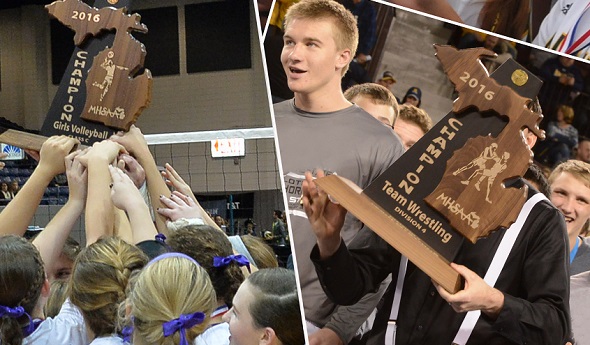
Wrestling became the first MHSAA Tournament to be conducted in nearly equal divisions when team and individual champions were crowned in Divisions 1, 2, 3 and 4 rather than Classes A, B, C/D for the 1996 winter championships.
The movement was well received, as schools saw more opportunity for success: four champions where there once were three at the District, Regional and Final levels, and a smaller range of enrollment between the smallest and largest school in all four tournaments, leading to the impetus for the Fall 1996 Update Meeting Survey of schools regarding similar movement in other sports.
Team champions that year were Holt (D1), Petoskey (D2), Middleville Thornapple Kellogg (D3) and Dundee (D4).
Getting their kicks
When the "equal divisions" concept was approved by the Representative Council for most MHSAA Tournaments for the 1997-98 school year, there was opposition from the smallest schools which, under the equal divisions, are forced to play against larger schools than reside in Class D. Compelling arguments were made – and still are – that an enrollment difference between schools with smaller enrollments (e.g., Class D) is more difficult to overcome in athletic competition than an even larger enrollment difference between schools with larger enrollments (e.g., Class A).
The opposition was most intense in soccer because of the number of students needed to field a team and the physical nature of the sport. As a result, from 2000-01 through 2010-11, soccer operated with a “20-percent modification.” This placed 20 percent of all schools that actually sponsored soccer in Division 4, and the remaining 80 percent were placed equally in Divisions 1, 2 and 3.
At the time the 20 percent modification was adopted, it was also established that soccer would return to four equal divisions when the largest Division 4 soccer school had an enrollment equal to or smaller than the mid point for Class C schools. That occurred in 2010.
Last class on the schedule
In the same volume of “history being the best teacher,” one can also find the adage, “times change.” While the division format was a welcome change in some sports, others were left to hold class without change.
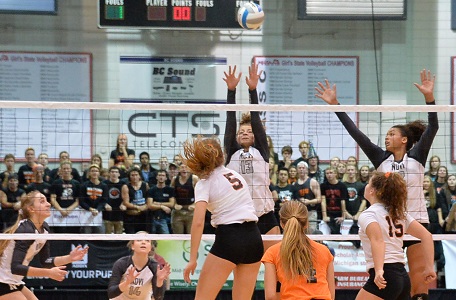
 In the sports of boys and girls basketball, and girls volleyball, the number of schools sponsoring the sports were so close to the overall membership of the MHSAA that divisions were not necessary; the enrollment breakdowns themselves were enough to delineate equal opportunity for tournament success.
That is no longer the case, according to MHSAA membership. The last move from classes to divisions occurred for the 2006-07 school year following Council action. Before this May, that is. Action at the most recent Representative Council meeting, May 2017, called for the shift to divisions for MHSAA Boys and Girls Basketball, and Girls Volleyball, beginning with the 2018-19 season.
“Because the MHSAA Volleyball Committee had requested this change several times a number of years ago, and because the Council felt the change inevitable, there should not be further delay,” Roberts said. “It is an important detail that the Class D maximum has dropped 50 students over the past decade so the objection that much larger schools would be competing in Division 4 isn’t very strong now.”
Using the 2017-18 enrollment figures, just eight Class C schools would be competing in Division 4 for boys basketball, 11 for girls basketball and 14 for girls volleyball.
Good things came of the previous most-recent switches in 2006-07. Competitive Cheer was re-classified from Class A, B and C-D into four equal divisions assisting in the rapid growth of sponsoring schools (approximately 80 schools per division). Alpine skiing was changed from Class A and B-C D to two equal divisions.
At that time, the MHSAA Basketball Committee had recommended to the Council the study of increased classifications, but status quo remained.
Back on the grid
As such, MHSAA Basketball and Volleyball remained the only holdovers of the MHSAA class structure. Discussion resurfaced periodically during the last two decades to bring those tournaments in line with the other MHSAA sports.
Regular-season football-playing schools are separated by class, then are reshuffled by divisions for the playoffs. Football, as we know, underwent a significant postseason facelift in the late 1990s.
While MHSAA Football also remained a class sport through 1998, it had expanded from four to eight classes from 1990-98, becoming the first MHSAA sport to crown more than four team champions. Member schools were asked to consider a pair of options in November of 1997. One called for eight equal divisions, and the second would leave Class D by itself as division 8, and split Class A, B and C schools into seven nearly equal divisions.
After much discussion, retooling, and crunching of formulas, the MHSAA unveiled its revised Football Playoff model that continues to roll today, nearly 20 years later. It was determined that 256 teams would qualify for the tournament based first on a minimum of six wins, then by Playoff Points determined by formula. From there, the field would be divided into eight divisions, with the field being filled out by a nearly equal number of five-win teams in each division as needed to reach 256.
Eight championships would indeed be enough, until football sponsorship among the MHSAA’s smallest schools – some with rich football traditions – began to trend downward. The MHSAA again went to the drawing board, examining the viability of 8-player football. After an experimental year in 2010 without a tournament, the 8-player game was playoff-ready for 2011, with a field of 16 qualifiers embarking on a four-week tournament.
Not only did the 8-player option restore recently canceled programs, but it also created teams in schools which previously had none, and convinced some 11-player schools that this new division was the best path to take.
What did this do for the Class D holdovers staying in the traditional 11-player game? Well, a couple of things, positive and negative. As two and three dozen Class D schools opted for the 8-player game, the remaining 11-player Class D schools at times found themselves in disrupted leagues and had to travel further to complete schedules. They also competed against larger teams in Division 8 of the 11-player MHSAA Football Playoffs.
However, the growth of the 8-player game among the smallest schools also resulted in more Class D schools qualifying for the MHSAA Football Playoffs than ever before. In 2012, an all-time high 44 percent of Class D schools sponsoring football qualified for either the 8-player tournament or Division 8 of the 11-player tournament. That compared to 42.2 percent of Class C schools, 44.9 percent of Class B schools and 41.6 percent of Class A schools which qualified for the 2012 playoffs.
Much is to be determined in the most recent chapter of MHSAA Tournament expansion as the 8-Player Football Playoffs welcome a second division. As the past illustrates, there will be pluses and minuses. History also shows that the MHSAA has received maximum input from its constituents, researched all possibilities, and will find solutions to questions still in the balance before an additional group of athletes hoists a new trophy in November.
Through the Years
A chronology of when which sports moved from Class to Division in the MHSAA.
1995-96: LP Wrestling
1997-98: Baseball, Boys Soccer, Girls Soccer, Softball, LP Girls Tennis, LP Boys Tennis
1998-99: LP Boys Golf, LP Girls Golf
1999-2000: Ice Hockey, LP Boys Track & Field, LP Girls Track & Field
2000-01: LP Boys Cross Country, LP Girls Cross Country, UP Boys Cross Country, UP Girls Cross Country, UP Boys Golf, UP Girls Golf, UP Boys Tennis, UP Girls Tennis, UP Boys Track & Field, UP Girls Track & Field
2002-03: LP Girls Swimming & Diving, LP Boys Swimming & Diving
2005-06: Boys Bowling, Girls Bowling
2006-07: Girls Competitive Cheer, Boys Skiing, Girls Skiing
2018-19: Boys Basketball, Girls Basketball, Girls Volleyball
Note: Boys and Girls Lacrosse has been a divisional sport since it began in during the 2004-05 school year.

Rep Council Adjusts, Expands Out-of-State Competition Opportunities at Spring Meeting
By
Geoff Kimmerly
MHSAA.com senior editor
May 12, 2023
Substantial changes to the rules governing out-of-state competition by Michigan High School Athletic Association member schools were among the most notable actions taken by the MHSAA’s Representative Council during its annual Spring Meeting, May 6-7 in Gaylord.
The Spring Meeting of the 19-member legislative body of the Association’s more than 1,500 member schools is generally the busiest of its sessions each year. The Council considered 31 committee proposals and dealt with a variety of eligibility rule, postseason tournament and operational issues.
The most far-reaching changes approved by the Council shifts the MHSAA rules regarding competitions against out-of-state opponents. Moving forward, MHSAA member schools may continue to compete against teams from Illinois, Indiana, Ohio, Minnesota, Wisconsin and Ontario – but also may compete against teams from elsewhere in the United States as long as those competitions take place in Michigan, one of those five contiguous states or Ontario. The Council voted to remove the allowance for MHSAA member schools to travel up to 300 miles to play an out-of-state opponent; MHSAA member schools still can compete against those opponents, but competition must take place in Michigan or one of the states/province listed above. Any event including schools from outside of Michigan or those contiguous states/province must receive approval by the MHSAA and each state high school association with a team involved in order for MHSAA member schools to be allowed to participate.
In an effort to strengthen the undue influence regulation, the Council approved a change making it a violation for coaches or their representatives to connect via social media with students from another high school or with a student prior to ninth grade who has not yet enrolled in a high school or participated in an athletic practice or competition as a high school student. Violations of this rule include connecting via social media with a “follow,” “friend request” or “direct message” to a student. The Council also expanded the portion of the undue influence regulation that doesn’t allow coaches and representatives to visit prospective athletes and their families at the families’ homes to not allow them to visit athletes and families at “other locations” as well.
The Council approved an expansion in the use of video to determine penalties when there is a bench-clearing situation or other incident where team members enter the area of competition during an altercation. MHSAA staff, based on video evidence, will be allowed to assess additional penalties including ejections and suspensions to team members, coaches and other staff who enter those areas to participate or engage in such an altercation.
Concerning specific sports, changes to three stand out from several adopted by the Council.
The Council approved three Bowling Committee recommendations affecting postseason competition in that sport. The first reorganizes Regional competition to eight sites, with each qualifying the top two teams and top seven singles for both girls and boys competitions to the Finals (instead of the previous six sites qualifying three teams and 10 singles for both girls and boys). The Council also approved a proposal to change the Team Finals match play to a head-to-head, best-of-five Baker game format. Finally, the Council approved a proposal to adopt the Phantom II oil pattern for all MHSAA Tournament competitions.
In girls volleyball, the Council approved a Volleyball Committee recommendation to begin seeding the top two teams in each District beginning with the 2024-25 school year. As is done currently with girls and boys basketball and girls and boys soccer, the top-two seeded teams in each District will be placed on opposite sides of the bracket, guaranteeing they will not play each other before the District Final. Seeding will be determined using the Michigan Power Rating (MPR) formula which takes into account regular-season success and strength of schedule. MPR is used to seed Districts in the same way in basketball and soccer.
In wrestling, the Council approved a Wrestling Committee recommendation adding two regular-season dual meets to the allowed number of wrestling contest dates. These must be dual meets and may not be converted into three-team (tri) or four-team (quad) meets. Teams and individuals now will be allowed 16 days of competition with no more than eight of those days allowed for tournament-type events where a wrestler competes more than twice.
Here is a summary of other notable actions taken by the Representative Council at the Spring Meeting, which will take effect during the 2023-24 school year unless noted:
Regulations
• The Council approved a classification-related change for the MHSAA’s smallest member schools, allowing them to request participation of eighth and seventh-grade students, based on the high school’s enrollment. Schools with fewer than 125 students (instead of the previous 100) may request an MHSAA Executive Committee waiver to use eighth-grade students in all sports except football, ice hockey and wrestling. Schools with fewer than 75 students (instead of the previous 50) may make the same request to use seventh and eighth-grade students in all sports except those three. Schools requesting a waiver must show cause and rationale for those students’ participation.
Sports Medicine
• The Council approved a Sports Medicine Advisory Committee proposal requiring middle school head coaches to have valid, current CPR certification. Similar to the high school requirements for head coaches at all levels, this addition at the middle school level will ensure each team has at least one coach at each level present who is CPR-certified. This requirement will take effect with the 2024-25 school year, and schools will attest to its completion by the established deadline for each season.
Officials
• The Council approved an Officials Review Committee recommendation adjusting the minimum requirements for postseason consideration in wrestling, competitive cheer and soccer. In wrestling, officials must receive 75 coaches ratings (instead of the previous 100) to be considered for working a postseason meet. In girls competitive cheer, judges must be members in good standing of a Local Approved Association. In soccer, officials must work a minimum of five regular-season games (down from the previous 10) to be considered for the postseason.
• The Council also approved a Committee recommendation increasing the amount paid when an official arrives on site prior to a competition before receiving notice that competition has been canceled due to an “act of God” including weather that results in unplayable conditions. In these situations, officials will receive one-half of the contract fee (instead of the previous one-third).
Sport Matters
• For baseball, the Council approved a change to when trophies will be awarded to Regional champions. Those trophies will be presented to both Regional champions after the Quarterfinal is concluded, as Regional Finals and the ensuing Quarterfinal are played at the same site on the same day and both Quarterfinal participants will have earned a Regional championship earlier that day.
• In addition to the Regional and Finals changes for bowling explained above, the Council also approved a Bowling Committee proposal seeking common start dates for practice and competition for Lower and Upper Peninsula teams. For the 2023-24 season, bowling teams in both peninsulas will begin practice Nov. 9 and competition Nov. 25. Previously, Upper Peninsula teams were allowed to begin their seasons slightly earlier – this past season four days sooner for practice and a week earlier for competition than their Lower Peninsula counterparts.
• The Council also approved a start date change in girls competitive cheer, proposed by the Competitive Cheer Committee, moving the practice start date to the second Monday before Thanksgiving. This shortens the season by one week, but also allows a more comfortable gap between the fall sideline cheer and winter competitive cheer seasons. This change will take effect with the 2024-25 school year.
• Also in cheer, the Council approved a Committee recommendation that adjusts the restricted period at the end of competitive cheer season to the Monday following Memorial Day, which will allow athletes to try out for sideline cheerleading for the upcoming season after the completion of the majority of spring-sport competitions.
• Additionally, the Council approved an exception to the MHSAA’s all-star regulation that will allow for individual competitive cheer and sideline cheer athletes to participate in an event that is “all-star” in name only as long as the selection components of the event comply with MHSAA regulations.
• In cross country and track & field, the Council approved Cross Country/Track & Field Committee recommendations to eliminate a pair of uniform-related rules adaptations designating the types of head attire that previously could be worn during cross country races and body adornments that previously were allowed to be worn during competitions in both sports.
• In golf, the Council approved a Golf Committee recommendation to require athletes to participate in at least four competitions for the high school team prior to representing that athlete’s school team in an MHSAA postseason golf competition. Those four regular-season competitions may be 9 or 18-hold events.
• A Council action in gymnastics will better define how athletes are assigned a division for the individual portion of the MHSAA Finals. Athletes are assigned either Division 1 or Division 2 based on past experience and skill level – Division 1 for those with the most – and the Council approved the allowance of the Xcel levels of Sapphire and Diamond to be part of the determining criteria. Athletes who have previously competed in a non-school event at either of these levels would be required to compete in the Division 1 level for MHSAA postseason competition.
• In tennis, the Council approved a Tennis Committee recommendation allowing in the Lower Peninsula for a No. 1 doubles pair from a non-qualifying team to advance from Regional to Finals competition if that pair finishes first or second at the Regional and the No. 1 singles player from that team also has qualified for the Finals individually by finishing first or second in Regional play. (Upper Peninsula tennis does not play a Regional.)
• The Council approved a Swimming & Diving Committee recommendation restructuring how qualifying times for Finals are determined in an effort to provide more entries in swimming events at the championship level. Moving forward, qualifying times will be determined based on the past five years of MHSAA race data, but also will account for past numbers of qualifiers in each swim race; qualifying times will be shifted to allow for more athletes to advance to the Finals in events where fields have not been full over the previous five seasons.
• The second swimming & diving recommendation approved by the Council assigned specific breaks during Finals competitions. During Friday preliminaries (swam in the Lower Peninsula only), 10-minute breaks will be placed between the 200-yard medley relay and 200 freestyle races, and between the 200 freestyle relay and 100 backstroke, with a 15-minute break between the 50 freestyle and 100 butterfly. The same 10-minute breaks will be mandated for Saturday Finals competitions, with a 15-minute break during Finals coming between the conclusion of diving and 100 butterfly races.
• For girls volleyball, the Council also approved a Volleyball Committee recommendation to permit the Michigan Interscholastic Volleyball Coaches Association (MIVCA) a 3-minute on-court presentation during the MHSAA Finals to recognize that season’s Miss Volleyball Award winner. The presentation will take place between the second and third sets of the Division 1 championship match.
Junior High/Middle School
• The Council voted to make permanent cross country and track & field competitions that have been conducted at a Regional level as part of a pilot program during the 2021-22 and 2022-23 school years. The Council also voted to expand the number of sites per Junior High/Middle School Regional to allow for large-school (Divisions 1 and 2) and small-school (Divisions 3 and 4) meets for each of the eight Zones. Each participating junior high and middle school will be classified for its Regional meet based on the enrollment of the high school with which the junior high/middle school is connected.
The Council also reviewed reports on membership, with 750 senior high schools and 767 junior high/middle schools in 2022-22 plus 63 elementary schools with 6th-grader participation; cooperative programs, with 376 high school programs for 692 teams during 2023-23; eligibility advancement applications, which totaled three; the use of Educational Transfer Forms, of which there were 127; school violations, attendance at athletic director in-service workshops and Coaches Advancement Program sessions; officials’ registrations, rules meetings attendance and officials reports submitted for the past three sports seasons. The Association’s $13.3 million budget for the 2023-24 school year also was approved.
The Representative Council is the 19-member legislative body of the MHSAA. All but five are elected by member schools. Four members are appointed by the Council to facilitate representation of females and minorities, and the 19th position is occupied by the Superintendent of Public Instruction or designee.
The MHSAA is a private, not-for-profit corporation of voluntary membership by more than 1,500 public and private senior high schools and junior high/middle schools which exists to develop common rules for athletic eligibility and competition. No government funds or tax dollars support the MHSAA, which was the first such association nationally to not accept membership dues or tournament entry fees from schools. Member schools which enforce these rules are permitted to participate in MHSAA tournaments, which attract more than 1.3 million spectators each year.