

Class in Session: A History in Classification
July 24, 2017
By Rob Kaminski
MHSAA benchmarks editor
This is the first part in a series on MHSAA tournament classification, past and present, that will be published over the next two weeks. This series originally ran in this spring's edition of MHSAA benchmarks.
Conversation and discussion at the March 2017 MHSAA Representative Council Meeting leaned heavily toward the subject of 8-Player Football and how to properly balance its tournament with the growing number of schools sponsoring the sport.
While the proposal to split the tournament into two divisions beginning with the 2017 school year was adopted, the MHSAA then faced questions such as when to set the divisions, how to determine qualifiers and where to host the championship games.
The topic continues to create a buzz in Class D schools across both peninsulas, and likely will do into the start of school this fall.
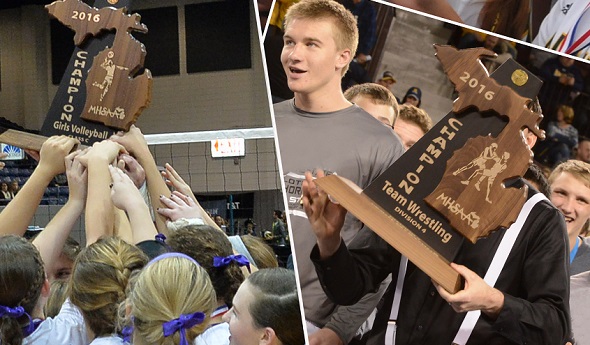
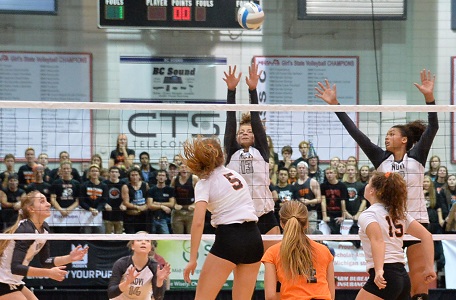
Likewise, the lone holdouts still conducting tournaments by class – MHSAA Boys and Girls Basketball and Girls Volleyball – took center stage at the May Council discussion, and following the 2017-18 school year, class is out for good. Both genders of basketball, and girls volleyball, will move to divisional formats thereafter.
There is much to be decided to be sure; but as those in education are well aware, history is the best teacher.
Fortunately for the sports in flux and for all sports under the governance of the MHSAA, the Association more or less wrote the book on the subject of sport classification. Following is a history lesson, with a little advanced division thrown in.
Class structure
Credited with being the first state with multiple tournament classifications, Michigan’s attention to trends and shifts in philosophy aimed at fair play and equal tournament opportunity can be traced from 80 years ago to the present.
In the earliest years of the MHSAA, there were four classifications for elections and tournaments – Classes A, B, C and D. Classes C and D had far more schools than Classes A and B. For example, 80 years ago (1937), there were only 58 schools in Class A, 94 schools in Class B, 297 schools in Class C and 253 schools in Class D.
Gradually through the years, as Michigan’s major cities spawned suburbs, there was a shift in the other direction to the point 30 years ago (1987) when school size became more balanced: 173 Class A schools, 178 Class B schools, 179 Class C schools and 182 Class D schools.
Up until 1987, the MHSAA published the dividing line between each classification, after which schools submitted their enrollments. Then, for 1988 and thereafter, the MHSAA adopted the plan of gathering all enrollments first and then placing 25 percent of the schools in each of four classes. This completed the equalization of the number of schools in each class for elections.
However, the change for 1988 did nothing to equalize the number of teams actually entered by each class in each sport. And unlike the early years of the Association when there were many more Class C and D teams than A and B teams, there were more Class A and B teams than C and D teams entering MHSAA tournaments decades later.
Moreover, the difference in number of teams entered in the different classifications for a sport continued to increase as many small schools, the fastest growing portion of the MHSAA's membership, sponsor only a few sports, or they sponsor no sports at all but enter into cooperative programs with other schools.
 Because of these differences, Class A or B schools sometimes had to win twice as many games as Class C or D schools to reach the MHSAA Finals in a sport. At times, the larger classifications had District Tournaments, even rat-tail games, and/or a Quarterfinal game, and the smaller classifications did not. Most Class D Districts have had four teams (some only three), while Class A Districts often had seven or eight teams. In Regional levels of individual sports, the number of entries in the larger classification once greatly outnumbered those in the smaller classifications of the tournament for the same sport.
Over the years, these dividing lines between classes escalated gradually, as did the differences in enrollments of largest and small schools in each class. In 1937 the dividing lines were 700, 300 and 100 between Class A and B, B and C, and C and D, respectively. By 1987, the dividing lines were 1,129, 571 and 298, respectively, leading to the current method of collecting enrollments and then setting the classification.
With the pendulum swinging well past center by the late 1980s, coaches associations, MHSAA sport committees, tournament managers and school administrators began discussion and offered proposals to correct what many believed had become a flawed system of MHSAA tournament classification.
At the 1996 MHSAA Update Meetings, ¾ of 858 respondents to that year’s annual survey indicated they favored a system that would divide schools which actually sponsor each sport into two, three or four nearly equal divisions.
Problem solving
At its meeting May 4-6, 1997, the Representative Council defeated a motion that would have adopted in one action a coordinated plan of reclassification for all sports to equalize the number of schools in each tournament for each respective sport. Instead, the Council discussed and voted on each proposal that had been presented from sport committees.
This resulted in the Representative Council adopting four equal divisions for baseball and softball, four equal divisions for boys and girls tennis, four equal divisions for boys soccer and three equal divisions for girls soccer, effective with the 1997-98 school year. Helping in the decision was the success of the 1995-96 MHSAA Wrestling season, which saw the sport move to four divisions for its tournament structure
The Council delayed action on similar proposals for football and boys golf at that time to glean additional input. The same decision was made with respect to a proposal from the Ice Hockey Committee that would have split the Class A schools in two divisions and left the Class B/C/D Tournament unchanged.
“The gist of the move from classes to divisions was to equalize the path to championships for students of all schools, regardless of the size of those schools,” said MHSAA Executive Director Jack Roberts.
While the restructuring accomplished that goal for the majority of competitors, opposition exists now as it did then. The primary argument in opposition to the changes is that, in some sports, it increases the range between largest and smallest schools in the division for smallest schools, even as the range is usually reduced for other divisions.
Larger schools offered a counterpoint.
“The larger schools suggested that while they may have more students, they also attempt to sponsor more sports than the smaller schools, in some cases spreading the enrollment as thin as a much smaller school with fewer sports,” Roberts said.
“Even today, the idea of four equal divisions can be unpopular among some Class D schools which feel especially burdened by the equal division concept,” Roberts said. “There was enough opposition in 1997 that equal divisions were rejected for boys and girls basketball and girls volleyball, and some of that opposition remains.”
The numbers of schools sponsoring each MHSAA tournament are still close to the totals today, with the exception of soccer in both genders, which has enjoyed substantial increases. This spring, 466 girls teams were scheduled to compete in the MHSAA Soccer Tournament, while 473 boys teams will suit up this fall.
Since the beginning of MHSAA divisions in 1996 with wrestling, 147 additional team champions have been crowned and countless individuals have known the thrill of victory due to an extra level of Finals in various sports. Girls soccer has seen the most growth in opportunity, moving from two classes in 1987 to three divisions the following year, and then four divisions in 2000. Boys soccer had enjoyed four classes for two years prior to the new four-division format, and it was the sport of soccer that helped to create a caveat in the nearly equal division movement.
Lower Peninsula boys and girls swimming & diving expanded from two to three divisions in 2008, while boys and girls bowling are the most recent sports to enjoy increased tournament opportunity, adding a fourth division in 2010.
“Fairness is in the eye of the beholder. While having the same number of schools in each division is one kind of fairness, holding in check the enrollment range between the largest and smallest schools in Division 4 is another kind of fairness that is dear to a great number of people,” Roberts said. “Because more schools sponsor basketball and volleyball than other sports, Class D schools would have been least affected by the equal divisions concept in those sports; but that, and ‘tradition,’ did not dissuade the opponents in the 1990s.”
The shift to divisions not only paved the way for student-athletes, but also assisted administrators and schools hosting tournaments. MHSAA tournament mangers looked to equal divisions to more closely equalize the number of schools in District or Regional Tournaments and to better equalize the length of day required for these rounds of tournaments, both for management and participating teams and individuals.
Pinning down an answer
Wrestling became the first MHSAA Tournament to be conducted in nearly equal divisions when team and individual champions were crowned in Divisions 1, 2, 3 and 4 rather than Classes A, B, C/D for the 1996 winter championships.
The movement was well received, as schools saw more opportunity for success: four champions where there once were three at the District, Regional and Final levels, and a smaller range of enrollment between the smallest and largest school in all four tournaments, leading to the impetus for the Fall 1996 Update Meeting Survey of schools regarding similar movement in other sports.
Team champions that year were Holt (D1), Petoskey (D2), Middleville Thornapple Kellogg (D3) and Dundee (D4).
Getting their kicks
When the "equal divisions" concept was approved by the Representative Council for most MHSAA Tournaments for the 1997-98 school year, there was opposition from the smallest schools which, under the equal divisions, are forced to play against larger schools than reside in Class D. Compelling arguments were made – and still are – that an enrollment difference between schools with smaller enrollments (e.g., Class D) is more difficult to overcome in athletic competition than an even larger enrollment difference between schools with larger enrollments (e.g., Class A).
The opposition was most intense in soccer because of the number of students needed to field a team and the physical nature of the sport. As a result, from 2000-01 through 2010-11, soccer operated with a “20-percent modification.” This placed 20 percent of all schools that actually sponsored soccer in Division 4, and the remaining 80 percent were placed equally in Divisions 1, 2 and 3.
At the time the 20 percent modification was adopted, it was also established that soccer would return to four equal divisions when the largest Division 4 soccer school had an enrollment equal to or smaller than the mid point for Class C schools. That occurred in 2010.
Last class on the schedule
In the same volume of “history being the best teacher,” one can also find the adage, “times change.” While the division format was a welcome change in some sports, others were left to hold class without change.
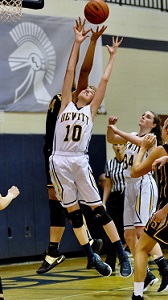 In the sports of boys and girls basketball, and girls volleyball, the number of schools sponsoring the sports were so close to the overall membership of the MHSAA that divisions were not necessary; the enrollment breakdowns themselves were enough to delineate equal opportunity for tournament success.
That is no longer the case, according to MHSAA membership. The last move from classes to divisions occurred for the 2006-07 school year following Council action. Before this May, that is. Action at the most recent Representative Council meeting, May 2017, called for the shift to divisions for MHSAA Boys and Girls Basketball, and Girls Volleyball, beginning with the 2018-19 season.
“Because the MHSAA Volleyball Committee had requested this change several times a number of years ago, and because the Council felt the change inevitable, there should not be further delay,” Roberts said. “It is an important detail that the Class D maximum has dropped 50 students over the past decade so the objection that much larger schools would be competing in Division 4 isn’t very strong now.”
Using the 2017-18 enrollment figures, just eight Class C schools would be competing in Division 4 for boys basketball, 11 for girls basketball and 14 for girls volleyball.
Good things came of the previous most-recent switches in 2006-07. Competitive Cheer was re-classified from Class A, B and C-D into four equal divisions assisting in the rapid growth of sponsoring schools (approximately 80 schools per division). Alpine skiing was changed from Class A and B-C D to two equal divisions.
At that time, the MHSAA Basketball Committee had recommended to the Council the study of increased classifications, but status quo remained.
Back on the grid
As such, MHSAA Basketball and Volleyball remained the only holdovers of the MHSAA class structure. Discussion resurfaced periodically during the last two decades to bring those tournaments in line with the other MHSAA sports.
Regular-season football-playing schools are separated by class, then are reshuffled by divisions for the playoffs. Football, as we know, underwent a significant postseason facelift in the late 1990s.
While MHSAA Football also remained a class sport through 1998, it had expanded from four to eight classes from 1990-98, becoming the first MHSAA sport to crown more than four team champions. Member schools were asked to consider a pair of options in November of 1997. One called for eight equal divisions, and the second would leave Class D by itself as division 8, and split Class A, B and C schools into seven nearly equal divisions.
After much discussion, retooling, and crunching of formulas, the MHSAA unveiled its revised Football Playoff model that continues to roll today, nearly 20 years later. It was determined that 256 teams would qualify for the tournament based first on a minimum of six wins, then by Playoff Points determined by formula. From there, the field would be divided into eight divisions, with the field being filled out by a nearly equal number of five-win teams in each division as needed to reach 256.
Eight championships would indeed be enough, until football sponsorship among the MHSAA’s smallest schools – some with rich football traditions – began to trend downward. The MHSAA again went to the drawing board, examining the viability of 8-player football. After an experimental year in 2010 without a tournament, the 8-player game was playoff-ready for 2011, with a field of 16 qualifiers embarking on a four-week tournament.
Not only did the 8-player option restore recently canceled programs, but it also created teams in schools which previously had none, and convinced some 11-player schools that this new division was the best path to take.
What did this do for the Class D holdovers staying in the traditional 11-player game? Well, a couple of things, positive and negative. As two and three dozen Class D schools opted for the 8-player game, the remaining 11-player Class D schools at times found themselves in disrupted leagues and had to travel further to complete schedules. They also competed against larger teams in Division 8 of the 11-player MHSAA Football Playoffs.
However, the growth of the 8-player game among the smallest schools also resulted in more Class D schools qualifying for the MHSAA Football Playoffs than ever before. In 2012, an all-time high 44 percent of Class D schools sponsoring football qualified for either the 8-player tournament or Division 8 of the 11-player tournament. That compared to 42.2 percent of Class C schools, 44.9 percent of Class B schools and 41.6 percent of Class A schools which qualified for the 2012 playoffs.
Much is to be determined in the most recent chapter of MHSAA Tournament expansion as the 8-Player Football Playoffs welcome a second division. As the past illustrates, there will be pluses and minuses. History also shows that the MHSAA has received maximum input from its constituents, researched all possibilities, and will find solutions to questions still in the balance before an additional group of athletes hoists a new trophy in November.
Through the Years
A chronology of when which sports moved from Class to Division in the MHSAA.
1995-96: LP Wrestling
1997-98: Baseball, Boys Soccer, Girls Soccer, Softball, LP Girls Tennis, LP Boys Tennis
1998-99: LP Boys Golf, LP Girls Golf
1999-2000: Ice Hockey, LP Boys Track & Field, LP Girls Track & Field
2000-01: LP Boys Cross Country, LP Girls Cross Country, UP Boys Cross Country, UP Girls Cross Country, UP Boys Golf, UP Girls Golf, UP Boys Tennis, UP Girls Tennis, UP Boys Track & Field, UP Girls Track & Field
2002-03: LP Girls Swimming & Diving, LP Boys Swimming & Diving
2005-06: Boys Bowling, Girls Bowling
2006-07: Girls Competitive Cheer, Boys Skiing, Girls Skiing
2018-19: Boys Basketball, Girls Basketball, Girls Volleyball
Note: Boys and Girls Lacrosse has been a divisional sport since it began in during the 2004-05 school year.
1970-1995: Detroit, Flint Ruled Class A Boys Basketball
By
Ron Pesch
MHSAA historian
March 7, 2022
Geographic domination.
It really hasn’t happened on the basketball court in the MHSAA’s top classification since the mid-1990s.
Class A state titles – designated Division 1 in basketball since 2019 – have bounced around Michigan over the last 25-plus years like, well, an over-inflated wayward basketball. Kalamazoo Central, Pontiac Northern, and Clarkston grabbed back-to-back titles between 1996 and 2021. The Saginaw area locked down five Class A crowns within that stretch; Arthur Hill snagged one in 2006, while Saginaw High immediately followed with two in a row in 2007 and 2008. The Trojans also won in 1996 and 2012. Greater Lansing has three titles – one by Lansing Everett, another by Lansing Waverly, then one by Holt High School – about eight miles outside the city limits.
 Then it’s single titles to Grand Rapids Ottawa Hills, Rockford, Muskegon, Ann Arbor Pioneer, and Ypsilanti Lincoln. Metro Detroit schools Romulus, Pershing, Central, Western, and U-D Jesuit also have single championships during that span.
But from 1970 to 1995, a trip to the Finals to watch the ‘A’ title game meant – with rare exception – you were watching a team from Flint or Greater Detroit. Or both.
Flint: Home of the Vikings
Opened in the fall of 1928, Flint Northern had been the Vehicle City’s top basketball school, winning Class A titles in 1933, 1936, 1939, and 1940 under coach Jim Barclay, then another in 1947 under Les Ehrbright. The Vikings also advanced to the state championship game in 1954 under Carl Stelter, losing to Muskegon Heights in overtime, 43-41.
Then, things went mostly quiet for the next decade and a half.
Jack Marlette was only the fourth varsity basketball coach in school history. Since arriving at Northern in 1949, he had served as head coach in tennis and golf, sophomore coach in basketball and football, junior varsity coach in basketball and football, equipment manager, and head trainer.
Midseason 1955, he replaced Stelter as the varsity basketball coach, when Stelter was named a principal within the Flint school district.
“Marlette coached teams posted a record of 112 victories and 99 defeats,” stated Len Hoyes in the Flint Journal when the coach stepped down in March 1967. “Included are six city championships, two districts, and a Saginaw Valley Conference crown in 1956.” His 1957 team reached the MHSAA Quarterfinals, losing to East Detroit.
With the announcement, Northern wooed 36-year-old Dick Dennis to take his spot come the 1967-68 season. Dennis’ teams had posted an impressive 105-21 varsity record at Alpena High School over seven seasons. Perhaps more impressively, his teams had beaten two of the Flint area’s finest in the MHSAA Regional round in 1966.
Dennis agreed to the move to Northern, “but had one important request,” stated reporter Bruce Johns in the Journal. “He wanted Bill Frieder as the junior varsity coach.”
Frieder, who would ultimately become a legendary basketball figure in Michigan, had landed his first basketball job as JV coach under Dennis at Alpena during the 1965-66 school year.
“… (A) son-in-law of Larry Laeding, former Saginaw High coach and a former player for the Trojans, Freiders (sic) had a 20-11 JV record for two years,” noted the Journal at the time of the hiring. (Laeding’s Saginaw team had won the Class A basketball championship in 1962.)
Dennis’ varsity squad posted an 11-6 record that first year, followed by a 13-6 mark in 1968-69, the program’s best season in 10 years. Frieder’s 1967-68 JV Vikings finished with a 13-3 mark, earning a share of the Saginaw Valley Conference’s title. In his second year, Frieder’s squad went a flawless 16-0.
But a teacher’s strike in Flint the following school year caused Frieder to resign from his position.
“At this point, I want to emphasize that I am highly opposed to teachers’ striking as I feel it sets a poor example for children and such an act reflects upon me personally,” stated Frieder in a letter of resignation to the Flint Board of Education.
Unable to work around it, he stepped aside.
Another shake-up
After three seasons at the helm, in May 1970, Dennis accepted an assistant principal position within the district. Northern administration interviewed nine “capable” candidates for the opening, including the former JV coach.
“Out of the candidates, we felt that Bill was the best qualified,” Northern athletic director Jim Fowler told the Journal’s Dean Howe 22 days later. “Bill is familiar with our situation at Northern, he’s familiar with the kids and unquestionably a fine coach.
“… it was Dennis’s strong recommendation that finally swung the gavel Frieder’s way,” stated Howe.
“Bill has a tremendous ability to get along with the kids,” Dennis had told the Journal in 1969. “… there are some coaches who never accomplish this. Bill’s two outstanding characteristics are his loyalty to the job and kids and his tremendous amount of pride.
“He just loves the game. Bill works just as hard at developing good citizens as he does to winning.”
Under Frieder, the Vikings quickly returned to the state spotlight, winning two straight MHSAA Class A championships in 1971 and 1972.
 For the first time since 1954, Northern enjoyed final round success. Frieder’s 1971 Vikings, powered by senior Tom McGill and the Britt brothers, Wayman and James, clipped the taller – and favored – crew from Detroit Kettering, led by Lindsay Hairston, 79-78.
A year later, Frieder’s team beat Pontiac Central, a squad it had defeated twice during the regular season, 74-71. It was the Vikings’ 33rd-straight victory.
Frieder returned for the 1972-73 season. The Vikings posted an 18-7 record and won a District title. In July, his JV coach from the past two seasons, Grover Kirkland, was named head basketball coach at Flint Northwestern. In August, Frieder resigned. Rumors had been flying that he might go to the University of Michigan as an assistant. A Saginaw native, Frieder stated his “retiring is a result of many things.” Primarily, he planned to return to Saginaw to go into the produce business with his father.
The rumors, it turned out, were true. A little over a month later, the University of Michigan appointed Frieder as assistant basketball coach.
“We think it’s very fine to have a man of Bill’s caliber on our staff,” said Johnny Orr, Michigan’s head men’s basketball coach.
“If at this point in my life, I could describe the job I wanted most, the thing I wanted most to do in my life, this would fit it to a tee,” said Frieder at the time of the announcement.
Bill Troesken, 29, who had stepped down in June of 1973 after three years as varsity coach at Flint Powers Catholic, was hired by Northern to replace Frieder. His team would grab another Class A championship in March 1978.
A Long Drought
Flint’s oldest high school, Flint Central, was opened in 1875. Incredibly, the boys basketball team never won a state title – or even appeared in a championship game – until coach Stan Gooch arrived on the scene.
“Gooch, who starred in basketball at Flint Tech High, Flint Junior College, and Central Michigan (University), began his coaching career as bench boss of the sophomore team at Central High in 1959,” recalled Brendan Savage for MLive in 2008 at the time of his induction into the National High School Athletic Coaches Association Hall of Fame. “He took over the reins of the junior varsity the following year and was promoted to varsity coach in 1966.” Gooch guided Flint Central to its first state championship game in 1967, but Central was trounced by Detroit Pershing, a PSL squad considered by many to be the greatest basketball team in Michigan prep history. Guided by coach Will Robinson, the Doughboys were led on the court by future NBA players Spencer Haywood and Ralph Simpson.
Gooch resigned following the 1967-68 season to become head coach at Flint Junior College (which was converted into a countywide college, and rebranded as Genesee Community College in 1969, then renamed Mott Community College in 1973). After 10 seasons, Gooch stepped down, and within months, he replaced his replacement at Flint Central, Clif Turner, who had guided the program through the 1977-78 season.
Central then won three straight Class A titles from 1981-83, helping to build the legend of Flint basketball.
Then it was Northwestern’s turn. In both 1984 and 1985, Coach Kirkland’s Wildcats beat Detroit Southwestern. With those wins, the Flint city schools had now won six of the last eight titles.
“City of Champions defies explanation” trumpeted the Journal at the end of March 1985, after Northwestern had won Class A and Flint Beecher had won the boys title in Class B.
“No single factor can be pinpointed as the reason Flint has dominated,” wrote Phil Pierson under the headline, “while metropolitan Detroit, an area approximately 10 times larger, has failed to win a Class A Championship since 1979.”
Northwestern’s Glen Rice “became the area’s first recipient of the Mr. Basketball award presented by the Michigan High School Basketball Coaches Association and has been named to the Parade and Basketball Weekly All-American teams. (Beecher’s Roy Marble finished second, while Central’s Terence Greene finished fourth in Mr. Basketball balloting).
Was this success the opportunity to play year-round, asked Pierson. Coaching? The talent on the court?
Other areas across the state featured these same strengths, concluded the writer. “It may just be that the reason for Flint’s success is too obvious to be considered by the philosophers: the cyclical nature of high school sports.
“There was nothing wrong with Flint basketball from 1948-70 when there were no state Class A or B championships. Other teams and programs were just better.”
The Return of the PSL
It took five years after the return to the MHSAA Tournament before the PSL earned a Class A title with that ’67 Pershing squad. The next arrived in 1970, again by Pershing, then in 1973 by Southwestern, and again in 1979 by Mackenzie. Class A was won by Metro Detroit in 1974, by Birmingham Brother Rice, in 1975 by Highland Park, and in 1976 by Detroit Catholic Central.
From 1971 to 1985, Flint’s public school champions had defeated Pontiac Central twice, and PSL teams from Kettering, Murray-Wright, and, famously, Southwestern, on four straight occasions between 1982 and 1985.
On only two occasions between 1975 and 1995 did the Class A crown leave the city of Flint or Metro Detroit. In both instances, it landed in Lansing. In 1977, the Lansing Everett Vikings, led by Earvin Johnson – nicknamed “Magic” by the press – wrestled it away by downing Brother Rice in a 60-56 overtime thriller. In 1980, Lansing Eastern, powered by the state’s first Mr. Basketball winner, Sam Vincent, did the same, with a 64-53 victory over Highland Park.
The Cycle of Basketball
As soon as the ink dried on Pierson’s words, it seems, the cycle rotated.
Romulus took down Southwestern in ’86 before the PSL took control of Class A beginning with the 1987 season. Cooley, coached by Ben Kelso, snagged the first of three straight that year. After finishing as runner-up in seven of the previous eight title games, Southwestern, coached by Perry Watson, grabbed back-to-back victories in ’90 and ’91. Coach Johnny Goston’s Pershing teams beat Benton Harbor for consecutive titles in 1992 and 1993. Then Murray -Wright, coached by Robert Smith, captured its first crown in 1994.
On four of the eight occasions between 1987 and 1994, the Class A game featured an all-PSL card.
 The 1995 Class A final wrapped the amazing run as No. 1-ranked Flint Northern, powered by Mateen Cleaves’ game-leading 28 points and Antonio Smith’s 24 points and 15 rebounds, decimated No. 2 Pershing, 86-64 before a crowd of 11,179 at the Breslin Center. Northern had trailed 44-37 at the half.
It was Northern’s first title since 1978. It would also be the program’s last. The introduction of “school of choice” in Michigan in 1996, combined with plunging birth rates in the U.S. that peaked in 1978, meant upheaval in enrollment across the state’s public schools. In Flint, declining enrollment – also impacted by the pending closure of a massive automotive manufacturing complex operated by General Motors known as “Buick City” – forced the closure of Central following the 2008-09 school year. Northern closed in 2013. Following the 2017-18 school year, Northwestern and Flint Southwestern merged, leaving Southwestern as the city’s lone high school.
In Detroit, Northern, Mackenzie, and Murray-Wright were among four high schools closed by the Detroit Public Schools in 2007 due to cost constraints and declining enrollments. Cooley was shuttered in 2010. Southwestern, dedicated in 1922, and Kettering, opened in 1965, both closed in 2012.
Of the 26 Class A title games waged between 1970 and 1995, Flint City Schools and the PSL teams each won nine of those contests. On 15 occasions, the championship game featured a match-up of Flint and Detroit PSL teams. On only seven occasions did schools from outside Wayne, Oakland, or Genesee counties ever crash the championship party. Saginaw High School ended with runner-up honors in 1973, 1976, and 1990, with Lansing and Benton Harbor High Schools being the only others.
Parade of Talent
Basketball junkies attending title games during those years watched an incredible collection of talent come out of those teams from Flint, the PSL and metropolitan Detroit during the span.
On the coaching side:
► Frieder ended up as head coach at Michigan with the 1980-81 season, then Arizona State in 1989.
► Gooch compiled over 400 varsity wins and 86 JV victories during his time at Flint Central.
► Kirkland ended his basketball coaching career in 2000 as Flint’s all-time winningest varsity coach, compiling a 518-148 mark. His Wildcats compiled 60-straight wins between January 1984 and February 1986 and presently rank No. 3 in consecutive wins in state history. In 2020, Detroit Free Press writer Mick McCabe named Northwestern’s 28-0 team from 1985 as the greatest boys basketball team he covered in his 50 years of reporting.
► Southwestern’s Watson served as an assistant at Michigan for two seasons, then guided the men’s basketball team at the University of Detroit Mercy from 1993 to 2008, compiling a 258-185 record over 15 seasons.
► Kelso, a Flint Southwestern graduate who did not play high school basketball but ended up as the all-time scorer at Central Michigan when he graduated in 1973, would be a finalist for the head coaching spot at CMU in 1997. At Cooley from 1984 through 1998, he later served as an assistant basketball coach at Kansas State in 2005-06.
► Kettering’s Charles Nichols, on hand since the school opened, coached tennis, football, and track during his first years at the school. With the 1970-71 season, he took over basketball coaching duties from Walt Jenkins, guiding the team for four campaigns. In December 1974, he joined Dick Vitale’s coaching staff at the University of Detroit for parts of two seasons. He returned to Kettering in 1978 as athletic director, then later served as assistant director of the PSL until his retirement in 2002.
The players included:
Flint
► Central’s Eric Turner, Marty Emery, Mark Harris, Keith Gray, Terence Green, and Darryl Johnson.
► Northern’s Terry Furlow, Dennis Johnson, Gary Pool, Antonio Smith, and Mateen Cleaves.
► Northwestern’s James Person, Jeff Grayer, Glen Rice, Andre Rison, Anthony Pendleton, and Daryl Miller.
Detroit PSL
► Cass Tech’s Tony Jamison and William Mayfield.
► Cooley’s Yamen Sanders, Earl Stark, Rafael Peterson, Michael Talley, and Daniel Lyton.
► Kettering’s Lindsay Hairston, Joe Johnson, Eric Money, and Coniel ‘Connie’ Norman.
► Mackenzie’s Steve Caldwell and Dave Traylor.
► Murray-Wright’s Willis Carter and Robert Traylor.
► Northern’s Katu Davis and Leonard Bush.
► Pershing’s Phil Paige, Robert Hawkins, Calvin Harper, Willie Mitchell, Carlos Williams, Todd Burgan, and Winfred Walton.
► Southwestern’s Darryl Robertson, Antoine Joubert, Clarence Jones, Sam Sillmon, Tarence Wheeler, Anderson Hunt, Loren Clyburn, James Hunter, Jalen Rose, Voshon Lenard, and Howard Eisley.
Metro Detroit
► Birmingham Brother Rice’s Will Franklin, Kevin Smith, and Tim Andree.
► Detroit Catholic Central’s Mike Prince and David Abel.
► Highland Park’s Terry Duerod, Percy Cooper, and Renardo Brown.
► Pontiac Central’s brothers Campy, Larry and Walker D. Russell; Larry Cole, Tim Marshall, and Clyde Corley.
► Romulus’s Terry Mills, and Stevie Glenn.
 Ron Pesch has taken an active role in researching the history of MHSAA events since 1985 and began writing for MHSAA Finals programs in 1986, adding additional features and "flashbacks" in 1992. He inherited the title of MHSAA historian from the late Dick Kishpaugh following the 1993-94 school year, and resides in Muskegon. Contact him at [email protected] with ideas for historical articles.
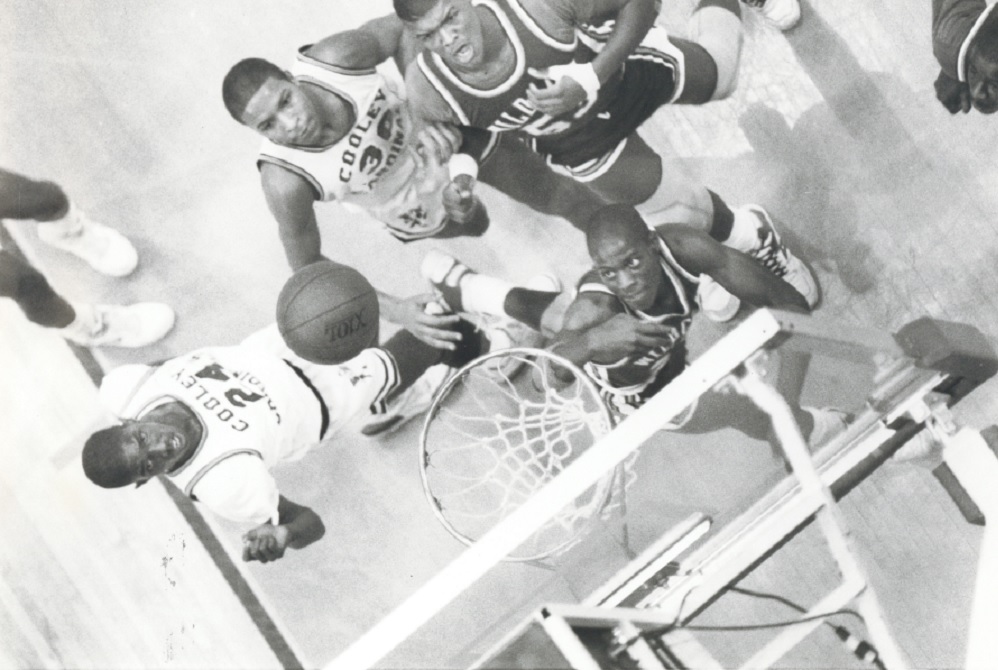
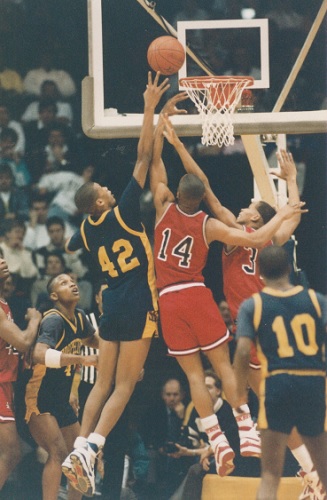
PHOTOS (1) Detroit Cooley's Rafael Peterson (24) and Benson Maurice match up with Flint Northwestern's Archie Munerlyn (53) and Reggie Richardson during the 1988 Class A Final. (2) The Class A/Division 1 championship has been won by teams across the southern half of the Lower Peninsula over the last 25 years. (3) Grover Kirkland, here in 1975, built Flint Northwestern into a power. (4) Detroit Southwestern's Jalen Rose (42) and Cooley's Michael Talley (14) work to grab a loose ball during the 1989 Class A Final. (Photos courtesy of the Detroit News [1] and Gary Shook [4], or collected by Ron Pesch.)