

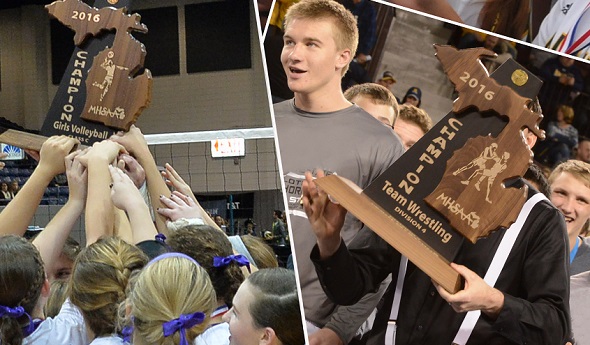
Class in Session: A History in Classification
July 24, 2017
By Rob Kaminski
MHSAA benchmarks editor
This is the first part in a series on MHSAA tournament classification, past and present, that will be published over the next two weeks. This series originally ran in this spring's edition of MHSAA benchmarks.
Conversation and discussion at the March 2017 MHSAA Representative Council Meeting leaned heavily toward the subject of 8-Player Football and how to properly balance its tournament with the growing number of schools sponsoring the sport.
While the proposal to split the tournament into two divisions beginning with the 2017 school year was adopted, the MHSAA then faced questions such as when to set the divisions, how to determine qualifiers and where to host the championship games.
The topic continues to create a buzz in Class D schools across both peninsulas, and likely will do into the start of school this fall.
Likewise, the lone holdouts still conducting tournaments by class – MHSAA Boys and Girls Basketball and Girls Volleyball – took center stage at the May Council discussion, and following the 2017-18 school year, class is out for good. Both genders of basketball, and girls volleyball, will move to divisional formats thereafter.
There is much to be decided to be sure; but as those in education are well aware, history is the best teacher.
Fortunately for the sports in flux and for all sports under the governance of the MHSAA, the Association more or less wrote the book on the subject of sport classification. Following is a history lesson, with a little advanced division thrown in.
Class structure
Credited with being the first state with multiple tournament classifications, Michigan’s attention to trends and shifts in philosophy aimed at fair play and equal tournament opportunity can be traced from 80 years ago to the present.
In the earliest years of the MHSAA, there were four classifications for elections and tournaments – Classes A, B, C and D. Classes C and D had far more schools than Classes A and B. For example, 80 years ago (1937), there were only 58 schools in Class A, 94 schools in Class B, 297 schools in Class C and 253 schools in Class D.
Gradually through the years, as Michigan’s major cities spawned suburbs, there was a shift in the other direction to the point 30 years ago (1987) when school size became more balanced: 173 Class A schools, 178 Class B schools, 179 Class C schools and 182 Class D schools.
Up until 1987, the MHSAA published the dividing line between each classification, after which schools submitted their enrollments. Then, for 1988 and thereafter, the MHSAA adopted the plan of gathering all enrollments first and then placing 25 percent of the schools in each of four classes. This completed the equalization of the number of schools in each class for elections.
However, the change for 1988 did nothing to equalize the number of teams actually entered by each class in each sport. And unlike the early years of the Association when there were many more Class C and D teams than A and B teams, there were more Class A and B teams than C and D teams entering MHSAA tournaments decades later.
Moreover, the difference in number of teams entered in the different classifications for a sport continued to increase as many small schools, the fastest growing portion of the MHSAA's membership, sponsor only a few sports, or they sponsor no sports at all but enter into cooperative programs with other schools.
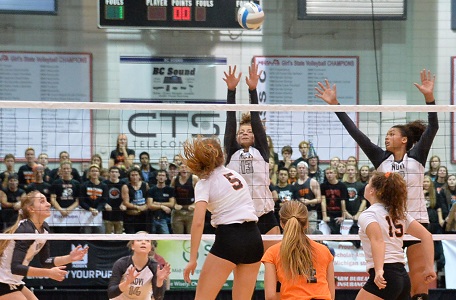 Because of these differences, Class A or B schools sometimes had to win twice as many games as Class C or D schools to reach the MHSAA Finals in a sport. At times, the larger classifications had District Tournaments, even rat-tail games, and/or a Quarterfinal game, and the smaller classifications did not. Most Class D Districts have had four teams (some only three), while Class A Districts often had seven or eight teams. In Regional levels of individual sports, the number of entries in the larger classification once greatly outnumbered those in the smaller classifications of the tournament for the same sport.
Over the years, these dividing lines between classes escalated gradually, as did the differences in enrollments of largest and small schools in each class. In 1937 the dividing lines were 700, 300 and 100 between Class A and B, B and C, and C and D, respectively. By 1987, the dividing lines were 1,129, 571 and 298, respectively, leading to the current method of collecting enrollments and then setting the classification.
With the pendulum swinging well past center by the late 1980s, coaches associations, MHSAA sport committees, tournament managers and school administrators began discussion and offered proposals to correct what many believed had become a flawed system of MHSAA tournament classification.
At the 1996 MHSAA Update Meetings, ¾ of 858 respondents to that year’s annual survey indicated they favored a system that would divide schools which actually sponsor each sport into two, three or four nearly equal divisions.
Problem solving
At its meeting May 4-6, 1997, the Representative Council defeated a motion that would have adopted in one action a coordinated plan of reclassification for all sports to equalize the number of schools in each tournament for each respective sport. Instead, the Council discussed and voted on each proposal that had been presented from sport committees.
This resulted in the Representative Council adopting four equal divisions for baseball and softball, four equal divisions for boys and girls tennis, four equal divisions for boys soccer and three equal divisions for girls soccer, effective with the 1997-98 school year. Helping in the decision was the success of the 1995-96 MHSAA Wrestling season, which saw the sport move to four divisions for its tournament structure
The Council delayed action on similar proposals for football and boys golf at that time to glean additional input. The same decision was made with respect to a proposal from the Ice Hockey Committee that would have split the Class A schools in two divisions and left the Class B/C/D Tournament unchanged.
“The gist of the move from classes to divisions was to equalize the path to championships for students of all schools, regardless of the size of those schools,” said MHSAA Executive Director Jack Roberts.
While the restructuring accomplished that goal for the majority of competitors, opposition exists now as it did then. The primary argument in opposition to the changes is that, in some sports, it increases the range between largest and smallest schools in the division for smallest schools, even as the range is usually reduced for other divisions.
Larger schools offered a counterpoint.
“The larger schools suggested that while they may have more students, they also attempt to sponsor more sports than the smaller schools, in some cases spreading the enrollment as thin as a much smaller school with fewer sports,” Roberts said.
“Even today, the idea of four equal divisions can be unpopular among some Class D schools which feel especially burdened by the equal division concept,” Roberts said. “There was enough opposition in 1997 that equal divisions were rejected for boys and girls basketball and girls volleyball, and some of that opposition remains.”
The numbers of schools sponsoring each MHSAA tournament are still close to the totals today, with the exception of soccer in both genders, which has enjoyed substantial increases. This spring, 466 girls teams were scheduled to compete in the MHSAA Soccer Tournament, while 473 boys teams will suit up this fall.
Since the beginning of MHSAA divisions in 1996 with wrestling, 147 additional team champions have been crowned and countless individuals have known the thrill of victory due to an extra level of Finals in various sports. Girls soccer has seen the most growth in opportunity, moving from two classes in 1987 to three divisions the following year, and then four divisions in 2000. Boys soccer had enjoyed four classes for two years prior to the new four-division format, and it was the sport of soccer that helped to create a caveat in the nearly equal division movement.
Lower Peninsula boys and girls swimming & diving expanded from two to three divisions in 2008, while boys and girls bowling are the most recent sports to enjoy increased tournament opportunity, adding a fourth division in 2010.
“Fairness is in the eye of the beholder. While having the same number of schools in each division is one kind of fairness, holding in check the enrollment range between the largest and smallest schools in Division 4 is another kind of fairness that is dear to a great number of people,” Roberts said. “Because more schools sponsor basketball and volleyball than other sports, Class D schools would have been least affected by the equal divisions concept in those sports; but that, and ‘tradition,’ did not dissuade the opponents in the 1990s.”
The shift to divisions not only paved the way for student-athletes, but also assisted administrators and schools hosting tournaments. MHSAA tournament mangers looked to equal divisions to more closely equalize the number of schools in District or Regional Tournaments and to better equalize the length of day required for these rounds of tournaments, both for management and participating teams and individuals.
Pinning down an answer
Wrestling became the first MHSAA Tournament to be conducted in nearly equal divisions when team and individual champions were crowned in Divisions 1, 2, 3 and 4 rather than Classes A, B, C/D for the 1996 winter championships.
The movement was well received, as schools saw more opportunity for success: four champions where there once were three at the District, Regional and Final levels, and a smaller range of enrollment between the smallest and largest school in all four tournaments, leading to the impetus for the Fall 1996 Update Meeting Survey of schools regarding similar movement in other sports.
Team champions that year were Holt (D1), Petoskey (D2), Middleville Thornapple Kellogg (D3) and Dundee (D4).
Getting their kicks
When the "equal divisions" concept was approved by the Representative Council for most MHSAA Tournaments for the 1997-98 school year, there was opposition from the smallest schools which, under the equal divisions, are forced to play against larger schools than reside in Class D. Compelling arguments were made – and still are – that an enrollment difference between schools with smaller enrollments (e.g., Class D) is more difficult to overcome in athletic competition than an even larger enrollment difference between schools with larger enrollments (e.g., Class A).
The opposition was most intense in soccer because of the number of students needed to field a team and the physical nature of the sport. As a result, from 2000-01 through 2010-11, soccer operated with a “20-percent modification.” This placed 20 percent of all schools that actually sponsored soccer in Division 4, and the remaining 80 percent were placed equally in Divisions 1, 2 and 3.
At the time the 20 percent modification was adopted, it was also established that soccer would return to four equal divisions when the largest Division 4 soccer school had an enrollment equal to or smaller than the mid point for Class C schools. That occurred in 2010.
Last class on the schedule
In the same volume of “history being the best teacher,” one can also find the adage, “times change.” While the division format was a welcome change in some sports, others were left to hold class without change.
 In the sports of boys and girls basketball, and girls volleyball, the number of schools sponsoring the sports were so close to the overall membership of the MHSAA that divisions were not necessary; the enrollment breakdowns themselves were enough to delineate equal opportunity for tournament success.
That is no longer the case, according to MHSAA membership. The last move from classes to divisions occurred for the 2006-07 school year following Council action. Before this May, that is. Action at the most recent Representative Council meeting, May 2017, called for the shift to divisions for MHSAA Boys and Girls Basketball, and Girls Volleyball, beginning with the 2018-19 season.
“Because the MHSAA Volleyball Committee had requested this change several times a number of years ago, and because the Council felt the change inevitable, there should not be further delay,” Roberts said. “It is an important detail that the Class D maximum has dropped 50 students over the past decade so the objection that much larger schools would be competing in Division 4 isn’t very strong now.”
Using the 2017-18 enrollment figures, just eight Class C schools would be competing in Division 4 for boys basketball, 11 for girls basketball and 14 for girls volleyball.
Good things came of the previous most-recent switches in 2006-07. Competitive Cheer was re-classified from Class A, B and C-D into four equal divisions assisting in the rapid growth of sponsoring schools (approximately 80 schools per division). Alpine skiing was changed from Class A and B-C D to two equal divisions.
At that time, the MHSAA Basketball Committee had recommended to the Council the study of increased classifications, but status quo remained.
Back on the grid
As such, MHSAA Basketball and Volleyball remained the only holdovers of the MHSAA class structure. Discussion resurfaced periodically during the last two decades to bring those tournaments in line with the other MHSAA sports.
Regular-season football-playing schools are separated by class, then are reshuffled by divisions for the playoffs. Football, as we know, underwent a significant postseason facelift in the late 1990s.
While MHSAA Football also remained a class sport through 1998, it had expanded from four to eight classes from 1990-98, becoming the first MHSAA sport to crown more than four team champions. Member schools were asked to consider a pair of options in November of 1997. One called for eight equal divisions, and the second would leave Class D by itself as division 8, and split Class A, B and C schools into seven nearly equal divisions.
After much discussion, retooling, and crunching of formulas, the MHSAA unveiled its revised Football Playoff model that continues to roll today, nearly 20 years later. It was determined that 256 teams would qualify for the tournament based first on a minimum of six wins, then by Playoff Points determined by formula. From there, the field would be divided into eight divisions, with the field being filled out by a nearly equal number of five-win teams in each division as needed to reach 256.
Eight championships would indeed be enough, until football sponsorship among the MHSAA’s smallest schools – some with rich football traditions – began to trend downward. The MHSAA again went to the drawing board, examining the viability of 8-player football. After an experimental year in 2010 without a tournament, the 8-player game was playoff-ready for 2011, with a field of 16 qualifiers embarking on a four-week tournament.
Not only did the 8-player option restore recently canceled programs, but it also created teams in schools which previously had none, and convinced some 11-player schools that this new division was the best path to take.
What did this do for the Class D holdovers staying in the traditional 11-player game? Well, a couple of things, positive and negative. As two and three dozen Class D schools opted for the 8-player game, the remaining 11-player Class D schools at times found themselves in disrupted leagues and had to travel further to complete schedules. They also competed against larger teams in Division 8 of the 11-player MHSAA Football Playoffs.
However, the growth of the 8-player game among the smallest schools also resulted in more Class D schools qualifying for the MHSAA Football Playoffs than ever before. In 2012, an all-time high 44 percent of Class D schools sponsoring football qualified for either the 8-player tournament or Division 8 of the 11-player tournament. That compared to 42.2 percent of Class C schools, 44.9 percent of Class B schools and 41.6 percent of Class A schools which qualified for the 2012 playoffs.
Much is to be determined in the most recent chapter of MHSAA Tournament expansion as the 8-Player Football Playoffs welcome a second division. As the past illustrates, there will be pluses and minuses. History also shows that the MHSAA has received maximum input from its constituents, researched all possibilities, and will find solutions to questions still in the balance before an additional group of athletes hoists a new trophy in November.
Through the Years
A chronology of when which sports moved from Class to Division in the MHSAA.
1995-96: LP Wrestling
1997-98: Baseball, Boys Soccer, Girls Soccer, Softball, LP Girls Tennis, LP Boys Tennis
1998-99: LP Boys Golf, LP Girls Golf
1999-2000: Ice Hockey, LP Boys Track & Field, LP Girls Track & Field
2000-01: LP Boys Cross Country, LP Girls Cross Country, UP Boys Cross Country, UP Girls Cross Country, UP Boys Golf, UP Girls Golf, UP Boys Tennis, UP Girls Tennis, UP Boys Track & Field, UP Girls Track & Field
2002-03: LP Girls Swimming & Diving, LP Boys Swimming & Diving
2005-06: Boys Bowling, Girls Bowling
2006-07: Girls Competitive Cheer, Boys Skiing, Girls Skiing
2018-19: Boys Basketball, Girls Basketball, Girls Volleyball
Note: Boys and Girls Lacrosse has been a divisional sport since it began in during the 2004-05 school year.
Rematch of Champs Brings Classic Conclusion to D1 Finals
By
Drew Ellis
Special for MHSAA.com
March 5, 2022
DETROIT – It was fitting that Josh Barr versus Manuel Rojas was the last bout of the night at Saturday’s Division 1 Individual Wrestling Finals, because that’s the match everyone was most excited to see.
Two of the best in the country at 171 pounds, with a combined four state titles between them, Davison’s Barr emerged victorious with a 5-2 win over Detroit Catholic Central’s Rojas, with all eyes on them.
“This is what I’ve been talking about for a long time. I couldn’t wait to be part of something like this. Practically main eventing the state championships against one of the best wrestlers in the state, it’s amazing,” Barr said. “Having all these people around watching, it was awesome.”
Barr (28-1), a junior, set the tone right away with a takedown in the first period to lead 2-0.
Rojas (37-3) managed an escape in the first and another in the second to even the match at 2-2. Barr would answer with an escape to start the third and then drive home the win with a takedown in the final minute to earn his third title.
“It means a lot,” Barr said of his third championship. “It means what we’re doing is right, it’s working. Going to bed early, waking up early, eating clean. It all adds up.”
Rojas had just two losses in-state during his senior season, both coming to Barr over the last eight days. Barr edged Rojas 4-3 in last weekend’s Division 1 Team Final while leading Davison to a 29-21 victory.
“I think it just shows my character. I got right back to it last week. Winning that team state title was cool, but as soon as I got in my car, it was over,” Barr said. “I started training again right away. I knew (Rojas) was going to be sitting here waiting for me, so I got right back to it.”
103
Champion: Conor McAlary, Hudsonville, Fr. (45-1)
Decision, 4-2 (OT), over Ozia Wilson, Macomb Dakota, Fr. (47-1)
In a thrilling finish, McAlary scored a takedown in sudden victory to hand Wilson his only loss of the season.
“I knew going into this match that I had to take (Wilson) into deep waters to win this match,” McAlary said. “Heading into overtime, my coach told me this is right where we wanted to be. I knew I had it.”
The first two periods were scoreless, but McAlary got a takedown in the third to counter a pair of escapes from Wilson. It then came down to a quick takedown from McAlary in OT to earn the state title.
“I still can’t believe it,” he said. “The goal is always to win, but sometimes you can’t really wrap your head around it even after you win. I don’t really know what to feel. It’s wild.”
112
Champion: Caleb Weiand, Macomb Dakota, Jr. (48-0)
Decision, 3-1, over Mariano Lopez, Holt, Jr. (35-5)
After suffering his only loss of the 2021 season in a championship match, Weiand was determined not to suffer the same fate this year.
“Losing in the state finals was the worst feeling I ever had. I didn’t want to experience that again,” Weiand said.
His takedown in the first period proved to be the difference, as he held off a game Lopez over the final minutes.
“I just had to stay tough,” Weiand said. “I knew I could ride him out for most of the period. I feel very confident on top.”
119
Champion: Drew Heethuis, Detroit Catholic Central, Jr. (32-3)
Decision, 4-1, over Justin Gates, Davison, Soph. (30-4)
In a match that featured a pair of 2021 champions, Heethuis scored a takedown in the first period and a reversal in the second to secure his second title.
“It’s awesome. I had a couple of bumps in the road earlier in the year, and I wasn’t in the right mindset,” Heethuis said. “Over the past couple of months, because of my coaches, I was able to dial it in for the last half of the year. It feels great.”
The two met in last week’s Division 1 Team Final, with Heethuis grinding out a 2-1 victory over Gates.
“We wrestled last weekend and I knew it would be a tough match this time, too,” Heethuis said. “I knew that if I was able to get into a good attack in the first, it would be key.”
125
Champion: Cade Horwath, Davison, Jr. (30-0)
Decision, 10-5, over Fritz Mueller, Macomb Dakota, Sr. (40-7)
Horvath earned his 100th career win and locked up his third championship while also capping his second-consecutive undefeated season.
“This one means a little more,” Horwath said of his third title. “We had some team adversity this year, so it took a lot of hard work by the team to get everyone at their best.”
Horwath scored two takedowns early in the first period to set the tone and never trailed in the match.
“Honestly, I just wanted to have fun and score some points,” Horwath said. “It was a nice environment, being able to wrestle in front of my family and fans.”
130
Champion: Clayton Jones, Detroit Catholic Central, Jr. (36-3)
Decision, 9-2, over Elijah Bunn, Rockford, Jr. (42-2)
Jones secured his first championship with a dominant effort at 130 pounds, earning a 9-2 win over the top-seeded Bunn.
“I’m just thinking that all the hard work that we’ve been putting in got (me) the state championship,” Jones said.
Jones came out aggressive with an early takedown in the first and added two more in the second to keep in control.
“I made sure to get the first takedown,” Jones said. “I came out the gates and just kept going at him, going at him.”
135
Champion: Aidan Smith, Brighton, Sr. (44-1)
Decision, 8-4, over Caleb Youngblood, Romeo, Sr. (26-4)
Smith added his name to Brighton’s championship history with a hard-fought win.
“I have waited for this for a very long time,” Smith said. “I had previous teammates ahead of me that won state titles, and that was a lot of pressure on me. I just feel like all of that pressure has been lifted.”
Smith never trailed, as he scored the opening takedown and sprinkled in a few more throughout the bout.
“I knew the match was going to be tough. I just had to wrestle all six minutes hard,” he said. “I felt like I was getting into my attacks really well, and I just kept chain wrestling. I was really happy with my performance.”
140
Champion: Dylan Gilcher, Detroit Catholic Central, Jr. (39-0)
Decision, 7-1, over Evan Herriman, Davison, Jr. (20-4)
A quiet and composed Gilcher won his third championship at a third different weight class Saturday.
After winning at 112 pounds in 2020 and 135 pounds in 2021, Gilcher controlled his match from start-to-finish to earn the 140-pound crown.
This Finals matchup was a rematch from the 135-pound final in 2021. Gilcher won that 3-0. These two also met in last weekend’s D1 Team Final, a 7-5 victory for Gilcher.
“I had him last week and last year. I’ve been wrestling him since we were little, growing up. He was always kind of bigger than me, so he could beat me up a little bit,” Gilcher said. “It feels good.”
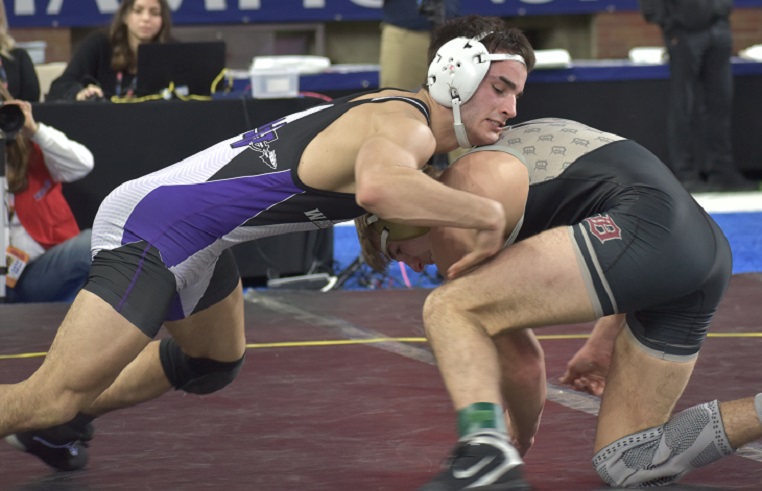
145
Champion: Nathan Jerore, Brownstown Woodhaven, Sr. (38-1)
Decision, 8-4, over Owen Payne, Davison, Sr. (15-2)
After seeing previous title bids ended prematurely by injuries and the pandemic, Jerore now can call himself a Finals champion.
“I literally can’t believe it. I wanted it so bad. It’s been taken from me for so long,” Jerore said. “Injuries and COVID, it’s been crazy, but I just kept working toward this goal.”
Jerore scored four takedowns in the match and was relentless on his feet against Payne.
“I knew he was going to be tough, but I knew that if I was as tough as I can be, anyone that I wrestled I could break,” Jerore said. “That’s what happened.”
152
Champion: Darius Marines, Detroit Catholic Central, Soph. (35-4)
Decision, 1-0, over Tatum Bunn, Detroit Catholic Central, Jr. (25-12)
For the second consecutive season, Marines had to face a teammate in a championship match.
For the second consecutive season, Marines came out victorious.
“It’s unfortunate, but it had to happen,” Marines said of facing a teammate in the final again. “(Bunn) was one of my best friends on the team. It kind of hurt. But, I had to set all that stuff aside.”
The match didn’t have much action. Marines rode out Bunn in the second period and then earned an escape in the third for the lone point.
“I felt pretty good (after the second period),” Marines said. “I’ve worked my whole life for this, so it feels pretty good (to win).”
160
Champion: Rollie Denker, Temperance Bedford, Sr. (55-2)
Decision, 3-1, over Brayden Mirjavadi, Romeo, Jr. (41-4)
A takedown in the closing second of the third period broke a 1-1 tie and gave Denker his first championship.
Mirjavadi got an escape in the second to take a 1-0 lead, and Denker answered with an escape of his own to start the third. He then turned up the heat late in the match to earn his title.
“I knew late in matches, we all get tired, but I knew (Mirjavadi) would be the exception, so I had to keep going and eventually I just got him,” Denker said.
189
Champion: Remey Cotton, Davison, Jr. (27-3)
Decision, 7-4, over Aidan Wardell, Midland Dow, Sr. (44-4)
Cotton got a takedown early in the bout and built a 5-1 lead in the second period before hanging on for the victory.
“I’ve trained for this my whole life,” Cotton said of the win. “Being able to come out here and get it done just feels amazing.”
Along with his first championship, Cotton also avenged a prior loss to Wardell to cap off his season.
“I practice every day to win every match,” Cotton said. “If I lose one match, I just look forward to the next one to be able to move that to the past.”
215
Champion: Jimmy Colley, Davison, Sr. (32-2)
Decision, 14-7, over Avery Dickerson, Hartland, Sr. (45-2)
Colley collected his second consecutive championship at 215 pounds in a wild scramble of a match.
“It feels great to come back here and end your career as a state champ two times in a row, as well as a team champ two times in a row,” Colley said. “It shows you are one of the best.”
The two contenders traded position often, but it was Colley who found himself with the advantage more consistently. He led 8-5 after two periods and then handled his business in the third.
“We both had that same funky style, and we always put on an exciting match,” Colley said. “You never know what (Dickerson) is going to do. It looks like we are just rolling around sometimes.”
285
Champion: Joshua Terrill, Holt, Sr. (43-2)
Decision, 6-2, over Giulian Bodiu, Canton, Sr. (28-1)
After finishing runner-up in 2021, Terrill grinded his way to a championship.
“I just kept telling myself to not be content. I wasn’t content, and I just won a state title,” Terrill said.
After a scoreless opening period, Terrill turned up the aggression and scored a pair of takedowns in the second period to take control. He credited his coaches for his strong finish.
“This means a whole lot to me, but this really goes to my coaches,” Terrill said. “None of this is about me, it’s about the coaches that got me here.”
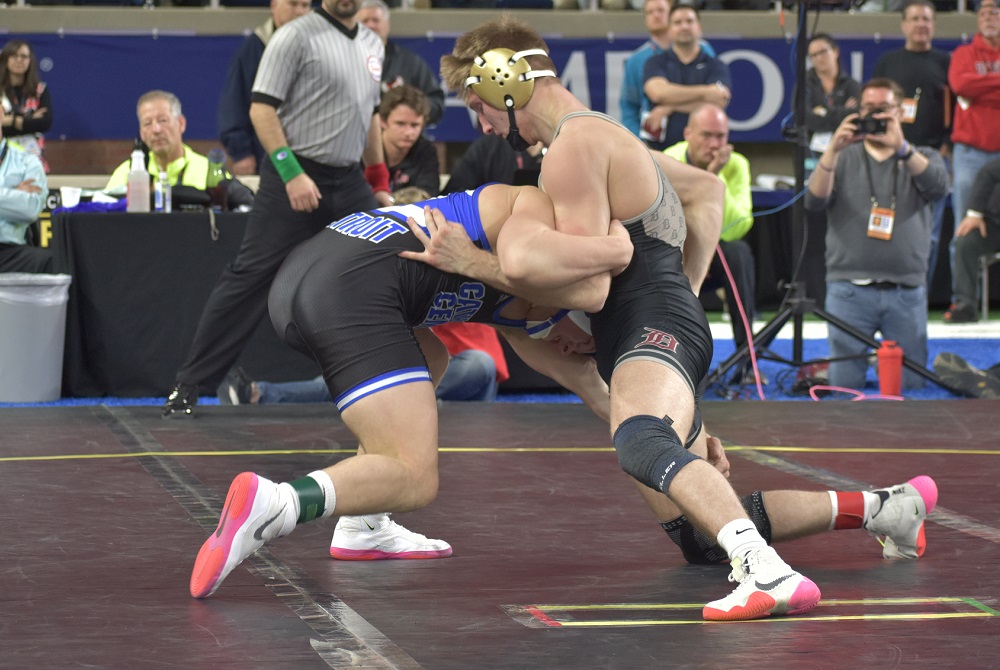
PHOTOS (Top) Davison’s Josh Barr (right) and Detroit Catholic Central’s Manuel Rojas contend for the 171-pound title Saturday at Ford Field. (Middle) Woodhaven’s Nathan Jerore, left, works toward a win at 145 pounds. (Click for more from HighSchoolSportsScene.com.)