

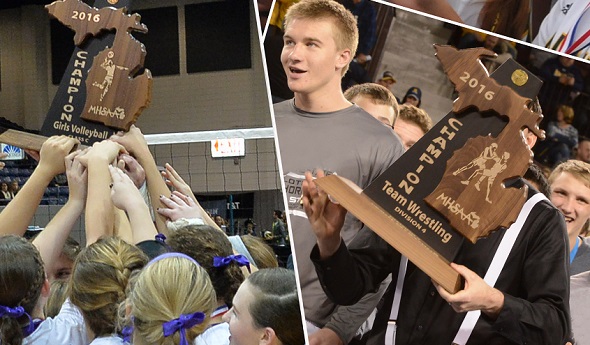
Class in Session: A History in Classification
July 24, 2017
By Rob Kaminski
MHSAA benchmarks editor
This is the first part in a series on MHSAA tournament classification, past and present, that will be published over the next two weeks. This series originally ran in this spring's edition of MHSAA benchmarks.
Conversation and discussion at the March 2017 MHSAA Representative Council Meeting leaned heavily toward the subject of 8-Player Football and how to properly balance its tournament with the growing number of schools sponsoring the sport.
While the proposal to split the tournament into two divisions beginning with the 2017 school year was adopted, the MHSAA then faced questions such as when to set the divisions, how to determine qualifiers and where to host the championship games.
The topic continues to create a buzz in Class D schools across both peninsulas, and likely will do into the start of school this fall.
Likewise, the lone holdouts still conducting tournaments by class – MHSAA Boys and Girls Basketball and Girls Volleyball – took center stage at the May Council discussion, and following the 2017-18 school year, class is out for good. Both genders of basketball, and girls volleyball, will move to divisional formats thereafter.
There is much to be decided to be sure; but as those in education are well aware, history is the best teacher.
Fortunately for the sports in flux and for all sports under the governance of the MHSAA, the Association more or less wrote the book on the subject of sport classification. Following is a history lesson, with a little advanced division thrown in.
Class structure
Credited with being the first state with multiple tournament classifications, Michigan’s attention to trends and shifts in philosophy aimed at fair play and equal tournament opportunity can be traced from 80 years ago to the present.
In the earliest years of the MHSAA, there were four classifications for elections and tournaments – Classes A, B, C and D. Classes C and D had far more schools than Classes A and B. For example, 80 years ago (1937), there were only 58 schools in Class A, 94 schools in Class B, 297 schools in Class C and 253 schools in Class D.
Gradually through the years, as Michigan’s major cities spawned suburbs, there was a shift in the other direction to the point 30 years ago (1987) when school size became more balanced: 173 Class A schools, 178 Class B schools, 179 Class C schools and 182 Class D schools.
Up until 1987, the MHSAA published the dividing line between each classification, after which schools submitted their enrollments. Then, for 1988 and thereafter, the MHSAA adopted the plan of gathering all enrollments first and then placing 25 percent of the schools in each of four classes. This completed the equalization of the number of schools in each class for elections.
However, the change for 1988 did nothing to equalize the number of teams actually entered by each class in each sport. And unlike the early years of the Association when there were many more Class C and D teams than A and B teams, there were more Class A and B teams than C and D teams entering MHSAA tournaments decades later.
Moreover, the difference in number of teams entered in the different classifications for a sport continued to increase as many small schools, the fastest growing portion of the MHSAA's membership, sponsor only a few sports, or they sponsor no sports at all but enter into cooperative programs with other schools.
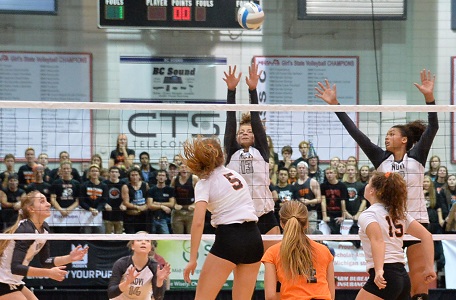 Because of these differences, Class A or B schools sometimes had to win twice as many games as Class C or D schools to reach the MHSAA Finals in a sport. At times, the larger classifications had District Tournaments, even rat-tail games, and/or a Quarterfinal game, and the smaller classifications did not. Most Class D Districts have had four teams (some only three), while Class A Districts often had seven or eight teams. In Regional levels of individual sports, the number of entries in the larger classification once greatly outnumbered those in the smaller classifications of the tournament for the same sport.
Over the years, these dividing lines between classes escalated gradually, as did the differences in enrollments of largest and small schools in each class. In 1937 the dividing lines were 700, 300 and 100 between Class A and B, B and C, and C and D, respectively. By 1987, the dividing lines were 1,129, 571 and 298, respectively, leading to the current method of collecting enrollments and then setting the classification.
With the pendulum swinging well past center by the late 1980s, coaches associations, MHSAA sport committees, tournament managers and school administrators began discussion and offered proposals to correct what many believed had become a flawed system of MHSAA tournament classification.
At the 1996 MHSAA Update Meetings, ¾ of 858 respondents to that year’s annual survey indicated they favored a system that would divide schools which actually sponsor each sport into two, three or four nearly equal divisions.
Problem solving
At its meeting May 4-6, 1997, the Representative Council defeated a motion that would have adopted in one action a coordinated plan of reclassification for all sports to equalize the number of schools in each tournament for each respective sport. Instead, the Council discussed and voted on each proposal that had been presented from sport committees.
This resulted in the Representative Council adopting four equal divisions for baseball and softball, four equal divisions for boys and girls tennis, four equal divisions for boys soccer and three equal divisions for girls soccer, effective with the 1997-98 school year. Helping in the decision was the success of the 1995-96 MHSAA Wrestling season, which saw the sport move to four divisions for its tournament structure
The Council delayed action on similar proposals for football and boys golf at that time to glean additional input. The same decision was made with respect to a proposal from the Ice Hockey Committee that would have split the Class A schools in two divisions and left the Class B/C/D Tournament unchanged.
“The gist of the move from classes to divisions was to equalize the path to championships for students of all schools, regardless of the size of those schools,” said MHSAA Executive Director Jack Roberts.
While the restructuring accomplished that goal for the majority of competitors, opposition exists now as it did then. The primary argument in opposition to the changes is that, in some sports, it increases the range between largest and smallest schools in the division for smallest schools, even as the range is usually reduced for other divisions.
Larger schools offered a counterpoint.
“The larger schools suggested that while they may have more students, they also attempt to sponsor more sports than the smaller schools, in some cases spreading the enrollment as thin as a much smaller school with fewer sports,” Roberts said.
“Even today, the idea of four equal divisions can be unpopular among some Class D schools which feel especially burdened by the equal division concept,” Roberts said. “There was enough opposition in 1997 that equal divisions were rejected for boys and girls basketball and girls volleyball, and some of that opposition remains.”
The numbers of schools sponsoring each MHSAA tournament are still close to the totals today, with the exception of soccer in both genders, which has enjoyed substantial increases. This spring, 466 girls teams were scheduled to compete in the MHSAA Soccer Tournament, while 473 boys teams will suit up this fall.
Since the beginning of MHSAA divisions in 1996 with wrestling, 147 additional team champions have been crowned and countless individuals have known the thrill of victory due to an extra level of Finals in various sports. Girls soccer has seen the most growth in opportunity, moving from two classes in 1987 to three divisions the following year, and then four divisions in 2000. Boys soccer had enjoyed four classes for two years prior to the new four-division format, and it was the sport of soccer that helped to create a caveat in the nearly equal division movement.
Lower Peninsula boys and girls swimming & diving expanded from two to three divisions in 2008, while boys and girls bowling are the most recent sports to enjoy increased tournament opportunity, adding a fourth division in 2010.
“Fairness is in the eye of the beholder. While having the same number of schools in each division is one kind of fairness, holding in check the enrollment range between the largest and smallest schools in Division 4 is another kind of fairness that is dear to a great number of people,” Roberts said. “Because more schools sponsor basketball and volleyball than other sports, Class D schools would have been least affected by the equal divisions concept in those sports; but that, and ‘tradition,’ did not dissuade the opponents in the 1990s.”
The shift to divisions not only paved the way for student-athletes, but also assisted administrators and schools hosting tournaments. MHSAA tournament mangers looked to equal divisions to more closely equalize the number of schools in District or Regional Tournaments and to better equalize the length of day required for these rounds of tournaments, both for management and participating teams and individuals.
Pinning down an answer
Wrestling became the first MHSAA Tournament to be conducted in nearly equal divisions when team and individual champions were crowned in Divisions 1, 2, 3 and 4 rather than Classes A, B, C/D for the 1996 winter championships.
The movement was well received, as schools saw more opportunity for success: four champions where there once were three at the District, Regional and Final levels, and a smaller range of enrollment between the smallest and largest school in all four tournaments, leading to the impetus for the Fall 1996 Update Meeting Survey of schools regarding similar movement in other sports.
Team champions that year were Holt (D1), Petoskey (D2), Middleville Thornapple Kellogg (D3) and Dundee (D4).
Getting their kicks
When the "equal divisions" concept was approved by the Representative Council for most MHSAA Tournaments for the 1997-98 school year, there was opposition from the smallest schools which, under the equal divisions, are forced to play against larger schools than reside in Class D. Compelling arguments were made – and still are – that an enrollment difference between schools with smaller enrollments (e.g., Class D) is more difficult to overcome in athletic competition than an even larger enrollment difference between schools with larger enrollments (e.g., Class A).
The opposition was most intense in soccer because of the number of students needed to field a team and the physical nature of the sport. As a result, from 2000-01 through 2010-11, soccer operated with a “20-percent modification.” This placed 20 percent of all schools that actually sponsored soccer in Division 4, and the remaining 80 percent were placed equally in Divisions 1, 2 and 3.
At the time the 20 percent modification was adopted, it was also established that soccer would return to four equal divisions when the largest Division 4 soccer school had an enrollment equal to or smaller than the mid point for Class C schools. That occurred in 2010.
Last class on the schedule
In the same volume of “history being the best teacher,” one can also find the adage, “times change.” While the division format was a welcome change in some sports, others were left to hold class without change.
 In the sports of boys and girls basketball, and girls volleyball, the number of schools sponsoring the sports were so close to the overall membership of the MHSAA that divisions were not necessary; the enrollment breakdowns themselves were enough to delineate equal opportunity for tournament success.
That is no longer the case, according to MHSAA membership. The last move from classes to divisions occurred for the 2006-07 school year following Council action. Before this May, that is. Action at the most recent Representative Council meeting, May 2017, called for the shift to divisions for MHSAA Boys and Girls Basketball, and Girls Volleyball, beginning with the 2018-19 season.
“Because the MHSAA Volleyball Committee had requested this change several times a number of years ago, and because the Council felt the change inevitable, there should not be further delay,” Roberts said. “It is an important detail that the Class D maximum has dropped 50 students over the past decade so the objection that much larger schools would be competing in Division 4 isn’t very strong now.”
Using the 2017-18 enrollment figures, just eight Class C schools would be competing in Division 4 for boys basketball, 11 for girls basketball and 14 for girls volleyball.
Good things came of the previous most-recent switches in 2006-07. Competitive Cheer was re-classified from Class A, B and C-D into four equal divisions assisting in the rapid growth of sponsoring schools (approximately 80 schools per division). Alpine skiing was changed from Class A and B-C D to two equal divisions.
At that time, the MHSAA Basketball Committee had recommended to the Council the study of increased classifications, but status quo remained.
Back on the grid
As such, MHSAA Basketball and Volleyball remained the only holdovers of the MHSAA class structure. Discussion resurfaced periodically during the last two decades to bring those tournaments in line with the other MHSAA sports.
Regular-season football-playing schools are separated by class, then are reshuffled by divisions for the playoffs. Football, as we know, underwent a significant postseason facelift in the late 1990s.
While MHSAA Football also remained a class sport through 1998, it had expanded from four to eight classes from 1990-98, becoming the first MHSAA sport to crown more than four team champions. Member schools were asked to consider a pair of options in November of 1997. One called for eight equal divisions, and the second would leave Class D by itself as division 8, and split Class A, B and C schools into seven nearly equal divisions.
After much discussion, retooling, and crunching of formulas, the MHSAA unveiled its revised Football Playoff model that continues to roll today, nearly 20 years later. It was determined that 256 teams would qualify for the tournament based first on a minimum of six wins, then by Playoff Points determined by formula. From there, the field would be divided into eight divisions, with the field being filled out by a nearly equal number of five-win teams in each division as needed to reach 256.
Eight championships would indeed be enough, until football sponsorship among the MHSAA’s smallest schools – some with rich football traditions – began to trend downward. The MHSAA again went to the drawing board, examining the viability of 8-player football. After an experimental year in 2010 without a tournament, the 8-player game was playoff-ready for 2011, with a field of 16 qualifiers embarking on a four-week tournament.
Not only did the 8-player option restore recently canceled programs, but it also created teams in schools which previously had none, and convinced some 11-player schools that this new division was the best path to take.
What did this do for the Class D holdovers staying in the traditional 11-player game? Well, a couple of things, positive and negative. As two and three dozen Class D schools opted for the 8-player game, the remaining 11-player Class D schools at times found themselves in disrupted leagues and had to travel further to complete schedules. They also competed against larger teams in Division 8 of the 11-player MHSAA Football Playoffs.
However, the growth of the 8-player game among the smallest schools also resulted in more Class D schools qualifying for the MHSAA Football Playoffs than ever before. In 2012, an all-time high 44 percent of Class D schools sponsoring football qualified for either the 8-player tournament or Division 8 of the 11-player tournament. That compared to 42.2 percent of Class C schools, 44.9 percent of Class B schools and 41.6 percent of Class A schools which qualified for the 2012 playoffs.
Much is to be determined in the most recent chapter of MHSAA Tournament expansion as the 8-Player Football Playoffs welcome a second division. As the past illustrates, there will be pluses and minuses. History also shows that the MHSAA has received maximum input from its constituents, researched all possibilities, and will find solutions to questions still in the balance before an additional group of athletes hoists a new trophy in November.
Through the Years
A chronology of when which sports moved from Class to Division in the MHSAA.
1995-96: LP Wrestling
1997-98: Baseball, Boys Soccer, Girls Soccer, Softball, LP Girls Tennis, LP Boys Tennis
1998-99: LP Boys Golf, LP Girls Golf
1999-2000: Ice Hockey, LP Boys Track & Field, LP Girls Track & Field
2000-01: LP Boys Cross Country, LP Girls Cross Country, UP Boys Cross Country, UP Girls Cross Country, UP Boys Golf, UP Girls Golf, UP Boys Tennis, UP Girls Tennis, UP Boys Track & Field, UP Girls Track & Field
2002-03: LP Girls Swimming & Diving, LP Boys Swimming & Diving
2005-06: Boys Bowling, Girls Bowling
2006-07: Girls Competitive Cheer, Boys Skiing, Girls Skiing
2018-19: Boys Basketball, Girls Basketball, Girls Volleyball
Note: Boys and Girls Lacrosse has been a divisional sport since it began in during the 2004-05 school year.
Norris Honoree Continues Setting Standards on Track, as Mentor
By
Geoff Kimmerly
MHSAA.com senior editor
May 19, 2021
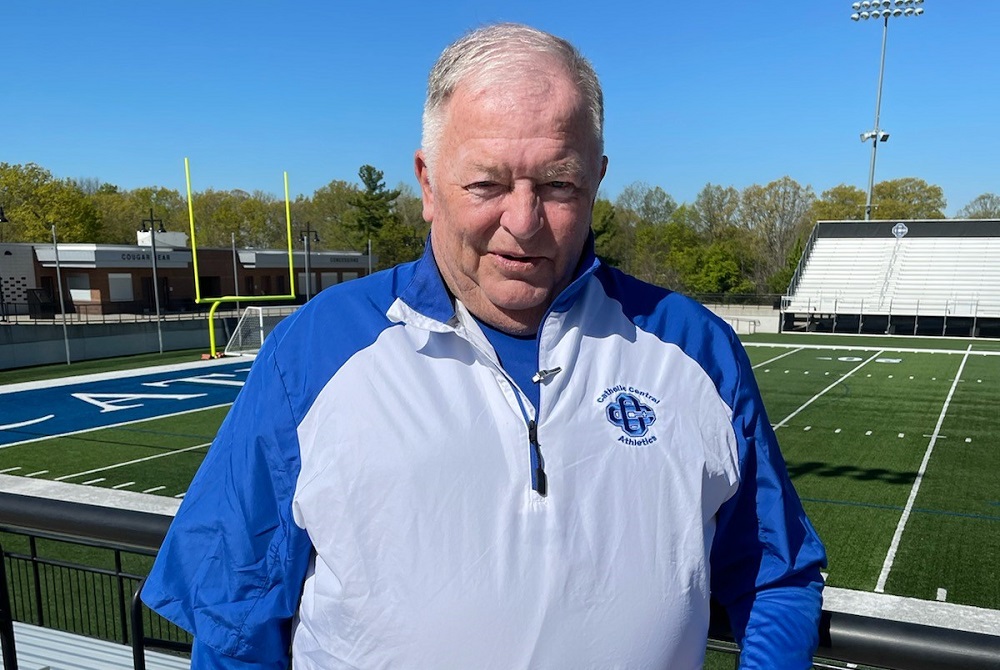
A staple of Michigan High School Athletic Association postseason track & field events for more than three decades, Grand Rapids’ Lewis Clingman continues to serve as an easily-recognizable host of Regionals and Finals in that sport for teams from all over the Lower Peninsula each spring.
But his tireless service to school sports stretches across the entire school year and is rooted in 53 years as an MHSAA-registered game official, and those contributions are being celebrated with his selection for this year’s MHSAA Vern L. Norris Award.
The Norris Award is presented annually to a veteran official who has been active in a local officials association, has mentored other officials, and has been involved in officials’ education. It is named for Vern L. Norris, who served as executive director of the MHSAA from 1978-86 and was well-respected by officials on the state and national levels.
Clingman was to be honored with his Norris Award this month at the MHSAA’s 41st Officials’ Awards & Alumni Banquet. However, the banquet was canceled for the second-straight year due to safety concerns because of COVID-19. He instead will accept his award as part of a virtual banquet to be published on the MHSAA Website and social media feeds later this spring.
Clingman first registered as an MHSAA official for the 1968-69 school year, to work track & field, basketball, baseball and softball. He has registered for track & field throughout his 53-year officiating tenure, and added cross country during the 2009-10 school year. He has officiated nine cross country and four track & field MHSAA Finals.
But that just scratches the surface of his many contributions. He is noted by many as a mentor – 2018 Norris Award honoree Jill Baker-Cooley that year specifically recognized Clingman among those who assisted her in getting started in the avocation. He also has been a catalyst of the MHSAA Lower Peninsula Track & Field Finals’ two-decade run in the Grand Rapids area, where as a meet manager he continues to schedule and organize officials for all four locations of the season-ending series.
“I love being with the kids. It’s for the kids. And that’s why we’re here,” Clingman said. “The camaraderie with the other professionals that I’m with, and just watching the successes that go on. … But I love being with the kids. My kids are all gone; they’re all over the country, my grandkids are around the country. This is a great way to substitute (by serving) the kids who are here.
“If you’re in this for ego, you’re in the wrong business. And if you’re in this to make a lot of money and retire, you’re in the wrong business. When you think about it, 50 years of officiating, there’s a lot of (officials) who don’t last that long – they don’t because they’re not in the right business. But there’s a lot of people in this area, that are officiating, have been officiating, who will be (longtime officials) because they do it for the right reason.”
Clingman is a longtime member of the Association of Track Officials of Michigan (ATOM) and has received its Bob Bloomer Award, Bernie Abrams President’s Leadership Award, Art Jevert/Bruce Jacobs Distinguished Service Award, and three times its Past President’s Service Award. He also is a member of the West Michigan Officials Association.
Clingman also has served more than 40 years as an administrator, teacher and coach. He began his career at Holy Trinity Catholic School in Comstock Park, serving as middle school athletic director and basketball coach while also coaching football and track at Comstock Park High School. He served as head boys basketball and track coach and football assistant at Grand Rapids Kenowa Hills during the second half of the 1970s and after also serving as head basketball coach for five seasons at St. Joseph’s Prep in Grand Rapids.
He moved on to serve as athletic director at East Grand Rapids High School, then after a brief stint in the business world began a 20-year tenure teaching middle school for Grand Rapids Public Schools before retiring from GRPS in 2011. During that time he became the spring event manager at Houseman Field, where at its peak he hosted on average a combined nine high school and college track meets per week. He also during his time at GRPS served as an assistant coach in football, basketball and track at Grand Rapids Catholic Central. He joined the staff at Catholic Central seven years ago and continues to serve as event manager and assistant to the athletic director.
Clingman was added to the Grand Rapids Catholic Central Wall of Honor in 2016 and has received a GRPS service award.
“Lew has been someone who has given tirelessly, most of all of his time, over the years to really benefit not just officiating but school sports as a whole,” MHSAA Executive Director Mark Uyl said. “The work Lew has done, specifically recruiting and training track & field officials – providing for a sport we don’t think of very often as having those needs – and the work he’s done with ATOM has just been incredible. There’s been nobody more important to the track & field and cross country officiating community than Lew Clingman.”
Clingman graduated from Grand Rapids Catholic Central in 1965 and with bachelor’s degrees in history, physical education and English from Aquinas College in 1969. He earned a master’s in secondary administration from Michigan State University in 1978.
In addition to his continued service to Catholic Central, Clingman serves on the Aquinas Hall of Fame Committee and Alumni Association board, and on the Grand Rapids Public Schools committee for Houseman Field renovation. He also serves as an official for local Special Olympics events.
Clingman and his wife Cindy have been married 52 years. They have four children, 13 grandchildren and one great-grandchild.
Previous recipients of the Norris Award:
1992 – Ted Wilson, East Detroit
1993 – Fred Briggs, Burton
1994 – Joe Brodie, Flat Rock
1995 – Jim Massar, Flint
1996 – Jim Lamoreaux, St. Ignace
1997 – Ken Myllyla, Escanaba
1998 – Blake Hagman, Kalamazoo
1999 – Richard Kalahar, Jackson
2000 – Barb Beckett, Traverse City; Karl Newingham, Bay City
2001 – Herb Lipschultz, Kalamazoo
2002 – Robert Scholie, Hancock
2003 – Ron Nagy, Hazel Park
2004 – Carl Van Heck, Grand Rapids
2005 – Bruce Moss, Alma
2006 – Jeanne Skinner, Grand Rapids
2007 – Terry Wakeley, Grayling
2008 – Will Lynch, Honor
2009 – James Danhoff, Richland
2010 – John Juday Sr., Petoskey
2011 – Robert Williams, Redford
2012 – Lyle Berry, Rockford
2013 – Tom Minter, Okemos
2014 – Hugh R. Jewell, West Bloomfield
2015 – Sam Davis, Lansing
2016 – Linda Hoover, Marshall
2017 – Michael Gentry, Shelby Township
2018 – Jill Baker-Cooley, Big Rapids
2019 – David Buck, St. Joseph
2020 – Hugh Matson, Saginaw
High school game officials with 20, 30, 40, 45 and 50 years of service also are being honored with service awards. Twenty-three officials with 50 years of service are being honored, along with 49 officials with 45 years. A 40-year award is being presented to 40 officials. In addition, 98 officials with 30 years and 181 officials with 20 years of experience are being honored.
MICHIGAN HIGH SCHOOL ATHLETIC ASSOCIATION
20, 30, 40, 45 & 50-YEAR OFFICIALS
The officials on this list are receiving their 20, 30, 40, 45 or 50-year service awards.
20-YEAR OFFICIALS
Ada - Carl J. Cress
Alto - Joseph E. Geroux
Alto - Jeff A. Harp
Ann Arbor - Dana P. Fuller
Ann Arbor - Thomas R. Sumner
Armada - David R. Coenen
Battle Creek - Douglas R. Jones
Battle Creek - Steven C. Peine
Battle Creek - Ronald D. Stewart
Battle Creek - Pete A. Zapata
Bay City - Robert A. Bluhm Jr.
Bay City - Brad G. Champagne
Bay City - William R. Walter
Belleville - Rodney M. Sullens
Belmont - Duncan Powell
Berkley - Tony A. Beaulieu
Breckenridge - Gerald W. Saunders
Brighton - Melissa M. Flores
Brockway - Dennis L. Gerlach
Brownstown - Larry D. Pierce
Brownstown - Michael V. Roach
Brownstown Township - Joseph P. Ciaravino
Brownstown Township - Franco Gonzalez Jr.
Bruce Township - Nicholas G. Nowakowski
Burt - William J. Carstens
Burt - Ryan D. Galloway
Cadillac - Steve W. Fuhst
Caledonia - Daniel A. Stockel
Canton - Robert L. Altizer
Canton - Steve Nesovski
Cheboygan - Gail N. Scharffe III
Chesaning - Leonard L. Strait Jr.
Clinton Township - Arthur D. Jones
Clinton Township - Rachel M. Krone
Clinton Township - David T. Ryall
Coldwater - Scott D. Galloway
Crystal Falls - Thomas P. Courchaine
Davison - Joseph Whitman
Dearborn - Joseph D. Corso
Dearborn Heights - Stan M. Karchefske
Deford - Larry R. Barrons
Detroit - Michael G. Byrd
Detroit - Brian K. Smith
Detroit - Gaylon B. Williams
DeWitt - Quentin V. Alverson
Dexter - Robert J. Leadley
Dowagiac - Jim R. Nate
Drummond Island - Jack K. Miles
Empire - Charles M. Leduc
Essexville - Gary P. Schulz
Flint - Matt S. Kateman
Flushing - Todd J. Willis
Frankenmuth - Mark C. Jarlock
Freeland - Jerry J. Haines
Fremont - John H. Pell
Garden City - Lawrence P. Mills
Grand Haven - John F. Jakubiec
Grand Rapids - Steven E. Hedke
Grand Rapids - Michael James
Grand Rapids - Kevin B. Krauss
Grand Rapids - Timothy J. Likens
Grand Rapids - Megan J. Pell
Grand Rapids - Thomas D. Siver
Grand Rapids - Ronald D. Masters
Grandville - Richard J. Funk
Grandville - Troy A. Ungrey
Grawn - Kenneth C. Koehler
Grayling - Timothy J. Swope
Greenville - Martin A. Taylor
Grosse Ile - Raymond D. Geist
Grosse Pointe Farms - William C. Cunningham
Hastings - Andrew L. Discher
Hastings - Pattrick M. Jansens
Hillsdale - Keven D. Wolcott
Holland - Jeffrey A. Carper
Holland - George W. Kantz Jr.
Holland - Michael B. Torrey
Holt - Troy Gladstone
Hubbard Lake - Gary A. Medland
Hudsonville - John D. Wiercinski
Iron Mountain - William D. Edberg
Iron River - Robert P. Busakowski
Ironwood - Don J. Cvengros
Jackson - Nathan A. Gross
Jackson - Scott S. Maurer
Kalamazoo - Timothy J. Eastman
Kalamazoo - Janelle B. Holland
Kalamazoo - Robert A. King
Kalamazoo - Deborah L. Noble
Kalamazoo - Robert V. Wagley
Kalamazoo - Keith Williams
Kaleva - James K. Frizzell Sr.
Kent City - Rick D. Stockhill
Kentwood - Jermaine C. Jennings
Kentwoood - Donell R. Jones
Kingsford - Nicholas L. Gayan
Lake Orion - Michael J. Ley
Lansing - Gary N. Simpson
Lansing - Anthony D. Winston
Lenox Township - John J. Essenmacher
Leslie - Robert V. Barrett
Leslie - Jerry E. Miller
Linwood - Brad T. Wehner
Livonia - Ken Lauer
Lowell - Mark T. Bradburn
Lowell - Paul P. Durkee
Lowell - Chris T. German
Macomb - Gordon Machleit
Macomb Township - Ronald K. Jacobs
Madison Heights - Amy Bessler
Madison Heights - David B. McPhail
Manistee - Curtis J. Mathieu
Marcellus - Wade L. Bent
Marinette - Robert Deschaine Jr.
Marysville - Kevin T. Leeman
Metamora - Noelle R. Cole
Monroe - Kevin J. Holden
Montrose - Mark A. Emmendorfer
Mount Pleasant - Roger L. Lintemuth
Mt. Morris - Robert P. Emery
Mullett Lake - Alan J. Granger
Muskegon Heights - Ronald S. Jenkins
Nashville - Keith H. Jones
Negaunee - Christopher O. Sholander
New Baltimore - Mark W. Masters
North Muskegon - Michael J. Belmonte
Northville - Mark J. Parrinello
Oak Park - Mario Blocton
Oakland - Robert L. Zbytowski
Ontonagon - Jeffery M. Rule
Owosso - Brian L. Mendyk
Paw Paw - Alton J. Laupp
Paw Paw - Rick Jay Mitchell
Perrinton - Dan L. Sweet
Pontiac - John Cantu
Pontiac - Vance L. Hardiman
Portland - Adam J. Schrauben
Portland - Anthony J. Costello
Ravenna - Ted F. May
Remus - John S. Mayer
Rochester - Barbara Gemellaro
Rockford - Michael C. VanDyke
Rockford - John A. Woods
Roscommon - David E. Hansen
Royal Oak - Perry A. Brunetti
Saginaw - Patrick A. Campbell
Saginaw - Felipe Echeverria
Saginaw - Thomas A. Lewis
Saginaw - Daniel A. McIntyre
Saginaw - Barb A. Streeter
Saginaw - Jason R. Wildey
Sebewaing - Cheri L. Nitz
Sebewaing - Holly A. Roth-Guza
Sheridan - James Forton
South Lyon - Christopher R. Duprey
South Lyon - John C. Lindeman
Southfield - Eric V. Lee
St. Helen - Donald W. Clements
St. Johns - Chris H. Hyzer
St. Johns - Penny L. Keener
St. Joseph - Ronald L. Scudder
Stanton - Frank P. Marinello
Sturgis - Jean E. LaClair
Swartz Creek - Bill A. Dean
Swartz Creek - Dennis D. Simnitch
Swartz Creek - Derick R. Woodworth
Temperance - Kevin V. Brown
Three Rivers - Rebecca M. Neff
Three Rivers - Ed M. Smith
Traverse City - Dave R. Jones
Trenton - Eric J. Hoerle
Troy - Darrin Millar
Wakefield - Paul E. Harley
Warren - Roman R. Jablonski
Washington - Douglas H. Lutkenhoff Sr.
Waterford - Dwayne E. Little
Westland - Sharvon M. McNab
White Lake - David J. Schoenegge
White Lake - Keith M. Verellen
Williamston - Aaron L. Porter
Woodland - Kevin J. Duits
30-YEAR OFFICIALS
Adrian - Michael K. Stevenson Jr.
Allegan - Kevin Lawrence Gilligan
Allen Park - James C. Marker
Ann Arbor - Edward J. Mcconnell
Battle Creek - Cary P. Grant
Battle Creek - Roger L. Steele
Battle Creek - Chad D. Jackson
Bay City - Laurence E. Jacobs III
Belding - Francis Mason
Bellevue - Candice J. Whitney
Benton Harbor - Robert A. Edelberg Sr.
Benton Harbor - Larry Edwards
Bessemer - Sandra J. Muzzy
Beulah - Tammy A. Sedlar-Wing
Bridgman - Paul J. Pantaleo
Cadillac - Penny L. McDonald
Caledonia - David J. Driscoll
Cass City - David W. Hoard
Charlevoix - Dennis A. Phelps
Charlevoix - Randy K. Tarzwell
Clark Lake - Mike J. Jordon
Clinton Township - Robert M. Cichowski
Concord - Michael G. Ogden
Dansville - Charles H. Barrett
Detroit - Darlene J. Barber
Detroit - Kathleen S. Bridge
Detroit - Michael J. Dobson
Dowagiac - Randall G. Gross Sr.
East Jordan - Norman J. Vogt
Eastpointe - Jerry VandeVyver
Flat Rock - Theodore M. Wegienka
Flint - Michael D. Moreau
Freeland - Thomas E. Behmlander
Gaylord - David M. Becker
Grand Haven - Scott A. Vanderberg
Grand Rapids - Gene S. Debbaudt
Grand Rapids - Thomas M. Farley
Grand Rapids - Chris LaMange
Grand Rapids - Scott L. Smith
Grand Rapids - Mark D. Swets
Grosse Pointe Farms - Robert B. Conway
Hartford - Jason D. Meachum
Hastings - Stephen J. Laubaugh
Hillsdale - Scott E. Chase
Holland - Steven S. Bredeweg
Holland - William L. Lawton
Holland - Raymond G. Thomas Jr.
Holland - Mark A. Volkers
Holt - John D. Greathouse
Iron Mountain - Edward D. St. Arnauld
Iron River - Curtis J. Olexa
Jenison - Laurie A. DeWitt
Kalamazoo - Chris L. Grimes
Kaleva - Dixie L. Hoeh
Kalkaska - Diane L. Buttermore
Laurium - Matthew Vertin
Lincoln - Tim Paul Somers
Livonia - John P. Morris
Macomb - Douglas J. Rizzi
Mattawan - Michael W. Walters
Midland - John W. Day
Monroe - Douglas Boylan
Mount Pleasant - Brian J. Gould
Mount Pleasant - John Straight
Muskegon - Clinton A. Todd Jr.
Northville - Clinton C. Lawrence
Northville - Aaron M. Woodbury
Norton Shores - Jim P. Adrian
Ottawa Lake - Richard L. Deisler
Plainwell - Pete J. Boyd
Portage - Kevin L. Haun
Portland - Brian D. Russell
Redford - Anthony Johnson
Reed City - Earl G. Kage
Rock - Robert J. VanDamme
Rockford - Brooks McIntyre
Rogers City - Mary E. Fairbanks
Roscommon - Brian W. Reicks
Roseville - Glenn A. Jablonowski
Royal Oak - Raymond L. Smith
Saginaw - Cornelius Walker Jr.
Sault Ste. Marie - Murray J. Meehan
Shelby Township - John M. Rakowski
Southfield - Wallace L. Whitfield
St. Joseph - Kenneth R. Nolte
St. Joseph - Michael J. Petlick
Sterling Heights - Robert M. Iwasko
Stevensville - Howard L. Jackson
Swartz Creek - Richard E. Hunt
Warren - Steve C. Miller
Waterford - Michael Blom
Wayland - Robert J. Wolf
Webberville - Troy B. Perkins
West Branch - Douglas B. Grezeszak
White Lake - Charles E. Johnson Sr.
Wyandotte - Robert C. Wolsek
Wyoming - Carol L. Ross
Zeeland - Gretchen J. Galloway
40-YEAR OFFICIALS
Allen Park - James C. Bales
Battle Creek - David L. Eubank
Battle Creek - Edward B. Smith
Canton - Jeanne L. Martin
Canton - John O. Wright Jr.
Constantine - Marge Caid
Davison - Mitchell J. Olejniczak
Deerfield - William P. Gomoluch
Detroit - Robert W. Kirkland
DeWitt - Mark A. Robinson
Evart - Tom W. Adams
Flushing - Gerald Marenkewicz
Grand Blanc - Curtis L. Williams
Grand Rapids - Michael J. Duffy
Grand Rapids - Thomas D. Shearer
Grand Rapids - Jeffrey A. Wierzbicki
Grosse Pointe Park - Kelvin W. Wise
Grosse Pointe Shores - James L. Valliere
Holt - Lee Rodgers
Howell - Jim A. Murray
Ionia - Michael S. Antonides
Ionia - Mike A. Fuller
Iron Mountain - John N. Meyer
Kentwood - Rick S. Hazel
Lansing - Mark S. Ditsworth
Lapeer - Gordon L. Bade
Livonia - Brian R. Dinsmore
Ludington - John F. Shears
Madison Heights - Wilford J. Laveirge
Maple City - Joseph F. Dechow
Mayville - Clare L. Kreger
Muskegon - Onesiphorus B. Burrel Sr.
Muskegon - Melville B. Foster
Muskegon - Todd R. Geerlings
New Hudson - Dennis E. Evans
Norton Shores - Randall S. Martinus
Okemos - Michael J. Maisner
Plymouth - William R. Baumgart
Portage - Jerry A. Mais
Quincy - Robert C. Coward
Rogers City - Roger M. Wenzel
Roscommon - William A. Root
Smiths Creek - James D. Evans
Spring Lake - Robert L. Mol
Sterling Heights - Philip J. Lieblang
Traverse City - Dennis W. Hall
Troy - Jerald J. Sosnowski
West Branch - Matt Emerick
Wixom - Patrick L. Beagle
Zeeland - Linda S. Schmidt
45-YEAR OFFICIALS
Baraga - James L. Holm
Bloomfield Hills - Dennis F. King
Bloomfield Hills - W. Jack Morris
Bowling Green - Thomas L. Ford
Cadillac - William J. Allen
Caledonia - George B. Watterson
Clarkston - Dale A. Kutchey
Clinton Township - Dennis G. Clark
Essexville - William L. Post
Fairgrove - Jerry L. Lasceski
Flat Rock - Robert J. Brodie
Fort Gratiot - Julius A. Traub
Freeland - Kim D. Heisler
Gaylord - George-Tom T. Johnson
Gaylord - Kevin M. Leary
Gladstone - Wayne W. Marshall
Gladwin - Michael E. Steinkraus
Grand Rapids - Patricia A. Treman
Hancock - John D. Vaara
Hermansville - Robert J. Maule
Highland - Evan H. Lehto
Holland - Mary F. Colenbrander
Holland - Thomas J. Kruithoff
Holland - Barbara A. Shelley
Holland - David W. Smits
Iron Mountain - Jerry Reddinger
Jackson - Ardis Jill Conat
Kaleva - David K. Hoeh
Lansing - Karen L. Yanna
Livonia - Laura J. Alves
Manitou Beach - Allen L. Schuch
McMillan - Cliff J. Fossitt
Michigan Center - Daniel C. Bentschneider
Newberry - Thomas J. Rahilly
Northville - Edward K. Gabrys
Norton Shores - Duane A. VandenHeuvel
Oconto - Peter C. Pericolosi
Pontiac - Jerome C. Chaumley
Portage - Frank S. Gawkowski
Portage - Timothy J. Osterman
Posen - Kenneth Wozniak
Saginaw - John C. Flukes
Saginaw - John E. Oczepek
Sturgis - Raymond Martin
Swartz Creek - David J. Sutton
Three Rivers - Kim D. Losik
Traverse City - Michael J. Muldowney
Troy - James J. Stone
Wyoming - Sandra K. Noto
50-YEAR OFFICIALS
Battle Creek - Richard L. Randle
Bessemer - Henry E. Aapala
Caro - John H. Amend
Comstock Park - Riley S. Swinehart
Delton - Gregory W. Nikitas
Detroit - Richard L. Miller
Grand Rapids - James J. Aalderink
Grand Rapids - George H. Kniola
Holt - John S. Malatinsky
Howell - John S. Hardy
Jackson - Ozzie L. Hashley
Macomb - Chet W. Boss
Marcellus - Deborah L. Schug
Mesick - Paul G. Williams
Owosso - Paul A. Chaffee
Owosso - Edwin L. Rappuhn
Plymouth - Don A. Vogt
Prudenville - Robert J. Studer
Spring Lake - Joseph G. Popiel
Tecumseh - Nancy A. Hebert
Troy - Mike Luttenberger
Warren - Collette C. Hallberg
Warren - William Upina