

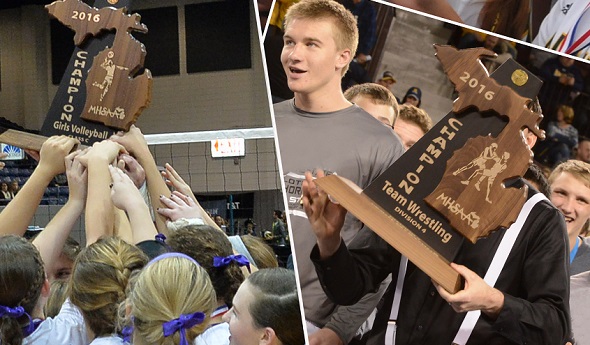
Class in Session: A History in Classification
July 24, 2017
By Rob Kaminski
MHSAA benchmarks editor
This is the first part in a series on MHSAA tournament classification, past and present, that will be published over the next two weeks. This series originally ran in this spring's edition of MHSAA benchmarks.
Conversation and discussion at the March 2017 MHSAA Representative Council Meeting leaned heavily toward the subject of 8-Player Football and how to properly balance its tournament with the growing number of schools sponsoring the sport.
While the proposal to split the tournament into two divisions beginning with the 2017 school year was adopted, the MHSAA then faced questions such as when to set the divisions, how to determine qualifiers and where to host the championship games.
The topic continues to create a buzz in Class D schools across both peninsulas, and likely will do into the start of school this fall.
Likewise, the lone holdouts still conducting tournaments by class – MHSAA Boys and Girls Basketball and Girls Volleyball – took center stage at the May Council discussion, and following the 2017-18 school year, class is out for good. Both genders of basketball, and girls volleyball, will move to divisional formats thereafter.
There is much to be decided to be sure; but as those in education are well aware, history is the best teacher.
Fortunately for the sports in flux and for all sports under the governance of the MHSAA, the Association more or less wrote the book on the subject of sport classification. Following is a history lesson, with a little advanced division thrown in.
Class structure
Credited with being the first state with multiple tournament classifications, Michigan’s attention to trends and shifts in philosophy aimed at fair play and equal tournament opportunity can be traced from 80 years ago to the present.
In the earliest years of the MHSAA, there were four classifications for elections and tournaments – Classes A, B, C and D. Classes C and D had far more schools than Classes A and B. For example, 80 years ago (1937), there were only 58 schools in Class A, 94 schools in Class B, 297 schools in Class C and 253 schools in Class D.
Gradually through the years, as Michigan’s major cities spawned suburbs, there was a shift in the other direction to the point 30 years ago (1987) when school size became more balanced: 173 Class A schools, 178 Class B schools, 179 Class C schools and 182 Class D schools.
Up until 1987, the MHSAA published the dividing line between each classification, after which schools submitted their enrollments. Then, for 1988 and thereafter, the MHSAA adopted the plan of gathering all enrollments first and then placing 25 percent of the schools in each of four classes. This completed the equalization of the number of schools in each class for elections.
However, the change for 1988 did nothing to equalize the number of teams actually entered by each class in each sport. And unlike the early years of the Association when there were many more Class C and D teams than A and B teams, there were more Class A and B teams than C and D teams entering MHSAA tournaments decades later.
Moreover, the difference in number of teams entered in the different classifications for a sport continued to increase as many small schools, the fastest growing portion of the MHSAA's membership, sponsor only a few sports, or they sponsor no sports at all but enter into cooperative programs with other schools.
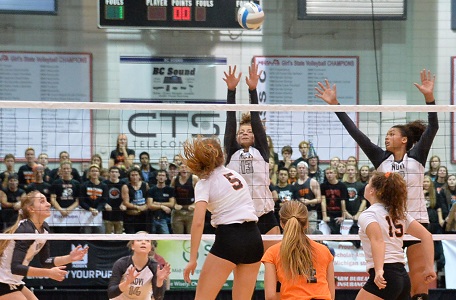 Because of these differences, Class A or B schools sometimes had to win twice as many games as Class C or D schools to reach the MHSAA Finals in a sport. At times, the larger classifications had District Tournaments, even rat-tail games, and/or a Quarterfinal game, and the smaller classifications did not. Most Class D Districts have had four teams (some only three), while Class A Districts often had seven or eight teams. In Regional levels of individual sports, the number of entries in the larger classification once greatly outnumbered those in the smaller classifications of the tournament for the same sport.
Over the years, these dividing lines between classes escalated gradually, as did the differences in enrollments of largest and small schools in each class. In 1937 the dividing lines were 700, 300 and 100 between Class A and B, B and C, and C and D, respectively. By 1987, the dividing lines were 1,129, 571 and 298, respectively, leading to the current method of collecting enrollments and then setting the classification.
With the pendulum swinging well past center by the late 1980s, coaches associations, MHSAA sport committees, tournament managers and school administrators began discussion and offered proposals to correct what many believed had become a flawed system of MHSAA tournament classification.
At the 1996 MHSAA Update Meetings, ¾ of 858 respondents to that year’s annual survey indicated they favored a system that would divide schools which actually sponsor each sport into two, three or four nearly equal divisions.
Problem solving
At its meeting May 4-6, 1997, the Representative Council defeated a motion that would have adopted in one action a coordinated plan of reclassification for all sports to equalize the number of schools in each tournament for each respective sport. Instead, the Council discussed and voted on each proposal that had been presented from sport committees.
This resulted in the Representative Council adopting four equal divisions for baseball and softball, four equal divisions for boys and girls tennis, four equal divisions for boys soccer and three equal divisions for girls soccer, effective with the 1997-98 school year. Helping in the decision was the success of the 1995-96 MHSAA Wrestling season, which saw the sport move to four divisions for its tournament structure
The Council delayed action on similar proposals for football and boys golf at that time to glean additional input. The same decision was made with respect to a proposal from the Ice Hockey Committee that would have split the Class A schools in two divisions and left the Class B/C/D Tournament unchanged.
“The gist of the move from classes to divisions was to equalize the path to championships for students of all schools, regardless of the size of those schools,” said MHSAA Executive Director Jack Roberts.
While the restructuring accomplished that goal for the majority of competitors, opposition exists now as it did then. The primary argument in opposition to the changes is that, in some sports, it increases the range between largest and smallest schools in the division for smallest schools, even as the range is usually reduced for other divisions.
Larger schools offered a counterpoint.
“The larger schools suggested that while they may have more students, they also attempt to sponsor more sports than the smaller schools, in some cases spreading the enrollment as thin as a much smaller school with fewer sports,” Roberts said.
“Even today, the idea of four equal divisions can be unpopular among some Class D schools which feel especially burdened by the equal division concept,” Roberts said. “There was enough opposition in 1997 that equal divisions were rejected for boys and girls basketball and girls volleyball, and some of that opposition remains.”
The numbers of schools sponsoring each MHSAA tournament are still close to the totals today, with the exception of soccer in both genders, which has enjoyed substantial increases. This spring, 466 girls teams were scheduled to compete in the MHSAA Soccer Tournament, while 473 boys teams will suit up this fall.
Since the beginning of MHSAA divisions in 1996 with wrestling, 147 additional team champions have been crowned and countless individuals have known the thrill of victory due to an extra level of Finals in various sports. Girls soccer has seen the most growth in opportunity, moving from two classes in 1987 to three divisions the following year, and then four divisions in 2000. Boys soccer had enjoyed four classes for two years prior to the new four-division format, and it was the sport of soccer that helped to create a caveat in the nearly equal division movement.
Lower Peninsula boys and girls swimming & diving expanded from two to three divisions in 2008, while boys and girls bowling are the most recent sports to enjoy increased tournament opportunity, adding a fourth division in 2010.
“Fairness is in the eye of the beholder. While having the same number of schools in each division is one kind of fairness, holding in check the enrollment range between the largest and smallest schools in Division 4 is another kind of fairness that is dear to a great number of people,” Roberts said. “Because more schools sponsor basketball and volleyball than other sports, Class D schools would have been least affected by the equal divisions concept in those sports; but that, and ‘tradition,’ did not dissuade the opponents in the 1990s.”
The shift to divisions not only paved the way for student-athletes, but also assisted administrators and schools hosting tournaments. MHSAA tournament mangers looked to equal divisions to more closely equalize the number of schools in District or Regional Tournaments and to better equalize the length of day required for these rounds of tournaments, both for management and participating teams and individuals.
Pinning down an answer
Wrestling became the first MHSAA Tournament to be conducted in nearly equal divisions when team and individual champions were crowned in Divisions 1, 2, 3 and 4 rather than Classes A, B, C/D for the 1996 winter championships.
The movement was well received, as schools saw more opportunity for success: four champions where there once were three at the District, Regional and Final levels, and a smaller range of enrollment between the smallest and largest school in all four tournaments, leading to the impetus for the Fall 1996 Update Meeting Survey of schools regarding similar movement in other sports.
Team champions that year were Holt (D1), Petoskey (D2), Middleville Thornapple Kellogg (D3) and Dundee (D4).
Getting their kicks
When the "equal divisions" concept was approved by the Representative Council for most MHSAA Tournaments for the 1997-98 school year, there was opposition from the smallest schools which, under the equal divisions, are forced to play against larger schools than reside in Class D. Compelling arguments were made – and still are – that an enrollment difference between schools with smaller enrollments (e.g., Class D) is more difficult to overcome in athletic competition than an even larger enrollment difference between schools with larger enrollments (e.g., Class A).
The opposition was most intense in soccer because of the number of students needed to field a team and the physical nature of the sport. As a result, from 2000-01 through 2010-11, soccer operated with a “20-percent modification.” This placed 20 percent of all schools that actually sponsored soccer in Division 4, and the remaining 80 percent were placed equally in Divisions 1, 2 and 3.
At the time the 20 percent modification was adopted, it was also established that soccer would return to four equal divisions when the largest Division 4 soccer school had an enrollment equal to or smaller than the mid point for Class C schools. That occurred in 2010.
Last class on the schedule
In the same volume of “history being the best teacher,” one can also find the adage, “times change.” While the division format was a welcome change in some sports, others were left to hold class without change.
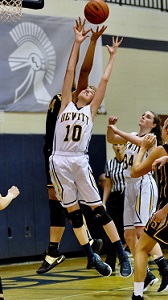 In the sports of boys and girls basketball, and girls volleyball, the number of schools sponsoring the sports were so close to the overall membership of the MHSAA that divisions were not necessary; the enrollment breakdowns themselves were enough to delineate equal opportunity for tournament success.
That is no longer the case, according to MHSAA membership. The last move from classes to divisions occurred for the 2006-07 school year following Council action. Before this May, that is. Action at the most recent Representative Council meeting, May 2017, called for the shift to divisions for MHSAA Boys and Girls Basketball, and Girls Volleyball, beginning with the 2018-19 season.
“Because the MHSAA Volleyball Committee had requested this change several times a number of years ago, and because the Council felt the change inevitable, there should not be further delay,” Roberts said. “It is an important detail that the Class D maximum has dropped 50 students over the past decade so the objection that much larger schools would be competing in Division 4 isn’t very strong now.”
Using the 2017-18 enrollment figures, just eight Class C schools would be competing in Division 4 for boys basketball, 11 for girls basketball and 14 for girls volleyball.
Good things came of the previous most-recent switches in 2006-07. Competitive Cheer was re-classified from Class A, B and C-D into four equal divisions assisting in the rapid growth of sponsoring schools (approximately 80 schools per division). Alpine skiing was changed from Class A and B-C D to two equal divisions.
At that time, the MHSAA Basketball Committee had recommended to the Council the study of increased classifications, but status quo remained.
Back on the grid
As such, MHSAA Basketball and Volleyball remained the only holdovers of the MHSAA class structure. Discussion resurfaced periodically during the last two decades to bring those tournaments in line with the other MHSAA sports.
Regular-season football-playing schools are separated by class, then are reshuffled by divisions for the playoffs. Football, as we know, underwent a significant postseason facelift in the late 1990s.
While MHSAA Football also remained a class sport through 1998, it had expanded from four to eight classes from 1990-98, becoming the first MHSAA sport to crown more than four team champions. Member schools were asked to consider a pair of options in November of 1997. One called for eight equal divisions, and the second would leave Class D by itself as division 8, and split Class A, B and C schools into seven nearly equal divisions.
After much discussion, retooling, and crunching of formulas, the MHSAA unveiled its revised Football Playoff model that continues to roll today, nearly 20 years later. It was determined that 256 teams would qualify for the tournament based first on a minimum of six wins, then by Playoff Points determined by formula. From there, the field would be divided into eight divisions, with the field being filled out by a nearly equal number of five-win teams in each division as needed to reach 256.
Eight championships would indeed be enough, until football sponsorship among the MHSAA’s smallest schools – some with rich football traditions – began to trend downward. The MHSAA again went to the drawing board, examining the viability of 8-player football. After an experimental year in 2010 without a tournament, the 8-player game was playoff-ready for 2011, with a field of 16 qualifiers embarking on a four-week tournament.
Not only did the 8-player option restore recently canceled programs, but it also created teams in schools which previously had none, and convinced some 11-player schools that this new division was the best path to take.
What did this do for the Class D holdovers staying in the traditional 11-player game? Well, a couple of things, positive and negative. As two and three dozen Class D schools opted for the 8-player game, the remaining 11-player Class D schools at times found themselves in disrupted leagues and had to travel further to complete schedules. They also competed against larger teams in Division 8 of the 11-player MHSAA Football Playoffs.
However, the growth of the 8-player game among the smallest schools also resulted in more Class D schools qualifying for the MHSAA Football Playoffs than ever before. In 2012, an all-time high 44 percent of Class D schools sponsoring football qualified for either the 8-player tournament or Division 8 of the 11-player tournament. That compared to 42.2 percent of Class C schools, 44.9 percent of Class B schools and 41.6 percent of Class A schools which qualified for the 2012 playoffs.
Much is to be determined in the most recent chapter of MHSAA Tournament expansion as the 8-Player Football Playoffs welcome a second division. As the past illustrates, there will be pluses and minuses. History also shows that the MHSAA has received maximum input from its constituents, researched all possibilities, and will find solutions to questions still in the balance before an additional group of athletes hoists a new trophy in November.
Through the Years
A chronology of when which sports moved from Class to Division in the MHSAA.
1995-96: LP Wrestling
1997-98: Baseball, Boys Soccer, Girls Soccer, Softball, LP Girls Tennis, LP Boys Tennis
1998-99: LP Boys Golf, LP Girls Golf
1999-2000: Ice Hockey, LP Boys Track & Field, LP Girls Track & Field
2000-01: LP Boys Cross Country, LP Girls Cross Country, UP Boys Cross Country, UP Girls Cross Country, UP Boys Golf, UP Girls Golf, UP Boys Tennis, UP Girls Tennis, UP Boys Track & Field, UP Girls Track & Field
2002-03: LP Girls Swimming & Diving, LP Boys Swimming & Diving
2005-06: Boys Bowling, Girls Bowling
2006-07: Girls Competitive Cheer, Boys Skiing, Girls Skiing
2018-19: Boys Basketball, Girls Basketball, Girls Volleyball
Note: Boys and Girls Lacrosse has been a divisional sport since it began in during the 2004-05 school year.
Pershing Sends Robinson Into History with Historic Title Run
By
Ron Pesch
MHSAA historian
March 4, 2021
Just 48 hours before the kickoff of the 45th annual MHSAA Basketball Finals, Illinois State University broke the news that it would hire Detroit Pershing high school coach Will Robinson as the new head of its men’s basketball team.
Before the days of Good Morning America, CNN and ESPN, there was no immediate mention that ISU and the 58-year-old North Carolina native had broken a color line.
Robinson had played high school sports in Steubenville, Ohio, where he won 14 letters in five sports. He then earned a combined 15 letters and served as captain of the football, baseball and gymnastics teams at West Virginia State College, noted the ISU student newspaper, The Vidette, and then served five years as athletic director for YMCA in Pittsburgh and Chicago.
He followed by embarking on a high school school coaching career that would include more than a quarter-century at Detroit schools before he'd move on to become, at ISU, the first African-American head coach of an NCAA Division I college program.
But before beginning that history-making tenure, he guided what remains one of the most memorable, and unexpected, championship triumphs in Michigan high school hoops history.
Coach Rob
“It was shortly after the race riots of 1943 that Warren Bow, then the superintendent of schools, lured Robinson from DuSable High of Chicago,” stated veteran sportswriter Hal Schram of the Detroit Free Press years later. With the arrival of the 1969-70 season, Robinson had spent the previous 26 years as coach in Detroit, arriving at Detroit Miller in 1944. He moved to Detroit Cass Tech in the fall of 1957 when Miller became a junior high, then to Detroit Pershing in the fall of 1961.
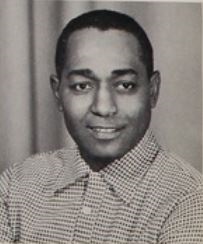 “We had plenty of applicants and interviews from nearly 100 men,” Milt Weisbecker, athletic director at ISU, told the press about the hire on Saturday, Feb. 28. “We feel Will is the man we want. He impressed us with his sincerity and his desire to succeed. We feel he’ll be an excellent recruiter.”
Robinson’s departure for the college ranks would depend on how long his Pershing team hung around the state tournament. The Doughboys had ended the 1969-70 regular season with an 8-4 record.
“Pershing is not one of the favorites,” noted Schram, “but neither was it in (1961-62) when Robinson took a team with a 4-8 record to the Class A semifinals. Then in 1967 Pershing went all the way to a State title with Spencer Haywood and Ralph Simpson as its top stars.”
Earlier in the year, Schram had reminded readers of the Detroit Public School League’s self-imposed boycott that kept city schools away from outstate competition and the MHSAA postseason tournament from 1930-1961.
“For many years, Detroit’s public schools (considered themselves) the best in Michigan,” he explained. “The boast could not be answered, because until 1961 the Detroit teams were not permitted (by school administration) to leave their area. In the years since their return to the state tournament, however, the locals have done little to support the earlier boast. With one exception (they’ve) fallen flat in the State tournament.”
That one team was Robinson’s 1967 champs.
Wealth of Talent
While, as usual, four basketball teams would finish 1970 as Finals champs, Class A was of particular interest to many around the state. The classification was packed with court talent. While the senior class included players of wide-ranging skills, a collection of incredible underclassmen would have the most impact on the postseason.
Based on Schram’s season-ending rankings, Ferndale was his pick to win it all in Class A. The Eagles had previously grabbed titles in 1963 and 1966 in the MHSAA’s classification featuring the schools with the largest enrollments. Each championship had come under current coach Roy Burkhart’s leadership.
“Ferndale has one major challenger – Pontiac Central,” said Schram. “This has been a Ferndale-Pontiac Central year in Class A,” he noted in his pre-tournament preview. “Both own 16-0 records. Providing they both survive district, regional and quarter-final eliminations these two rivals could tangle in either the semifinals or finals …”
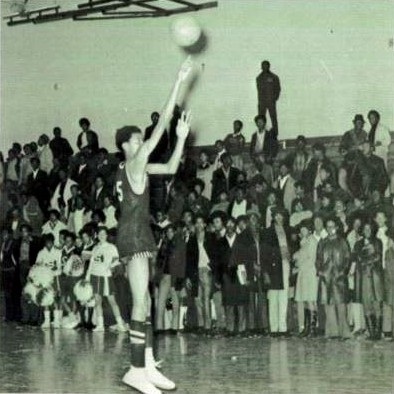 He acknowledged “second-line challengers” could be found among Birmingham Seaholm, his third-ranked team; Detroit Kettering, the top team in the PSL, led by 6-foot-4 senior Floyd Haywood (Spencer’s brother) and junior Lindsay Hairston; Detroit Martin Luther King, second in the PSL and powered by senior George ‘Twiggy’ Gervin (named one of the 50 greatest players in NBA history in 1996 - ‘The Iceman’ nickname would come later); Detroit Northeastern and star guard Mike Robinson (who would go on to set a Michigan State University all-time scoring mark and twice lead the conference in scoring despite previous doubts of if, at 5-foot-10, he could play Big Ten basketball), Battle Creek Central, with all-state selection Dave Freeman; Grand Rapids Union, featuring 6-foot-5 senior Gerald Edwards; Grand Rapids Ottawa Hills, seeking its third-straight Class A crown; and twice-beaten Flint Central, led by Mike DeCou and Bob Stone.
“A successful tournament run by any other Class A quintet,” said Schram, “would be a major upset.”
Both The Associated Press and United Press International agreed with the Free Press on the top two schools, but each named Pontiac Central, led by Campanella ‘Campy’ Russell, as the top team in Class A in their respective regular-season polls, with Ferndale finishing second in the rankings.
“Take it from a couple college coaches who should know,” wrote Bob Gross from the Lansing State Journal, “the best Class A high school basketball teams in Michigan are Pontiac Central and Detroit Kettering. Michigan State’s Gus Ganakas likes Pontiac and 6-6 junior Campy Russell while Michigan’s Johnny Orr leans toward Kettering and 6-7 Lindsay Hairston.”
“I’ve seen a lot of outstanding teams,” Ganakas told Gross, “but Pontiac is solid. In Russell, they have a player who is tremendously strong on the boards as well as scoring.”
“Kettering looks very strong to me,” noted Orr. “I haven’t seen Pontiac or Ferndale but my assistants have and they tell me both are excellent teams. … Ypsilanti and Battle Creek Central also are fine teams.”
Kettering had finished third in the AP poll, fourth according to UPI but eighth in Schram’s “Top Ten.”
Ypsilanti, noted Gross, had lost to Ottawa Hills in the Class A title game a year before, and was coming on strong. The Bearcats of Battle Creek Central, had “sailed through the Six-A League and posted a 16-1 record losing only to Ann Arbor Huron in one of the state’s biggest upsets.” The Bearcats finished the regular season at No. 3 according to UPI, and were ranked No. 4 by both the AP and the Free Press.
Change in Format
The 1970 tournament would mark the end of a three-week postseason format that had been in place since Michigan State’s Jenison Field House had opened in 1940. Beginning the following March, the playoffs would expand to a four-week schedule with the Semifinals and Final contests played over separate weekends. In addition, the annual championship games would begin alternating annually between Jenison and Crisler Arena at the University of Michigan.
“Our major interest is to use the best possible facilities,” said Allen Bush, executive director of the East Lansing-based MHSAA, no doubt smiling with his next statement. “After all, Michigan is also a state school.”
Bush had earned multiple bachelor’s degrees from Western Michigan University and his master’s in school administration from U-M.
Crisler Arena, opened in 1967, could handle a crowd of 14,000.
Typical of the era, the more than 12,000 available tickets for the pending four championship games at Jenison were already sold out or were being held for distribution to the schools competing in the finals.
Tipping Off the Tournament
The Class A casualties to favorites during the opening week of play were minimal. Seaholm, with two regular-season defeats – both to unbeaten Ferndale – departed in its playoff opener against Birmingham Groves.
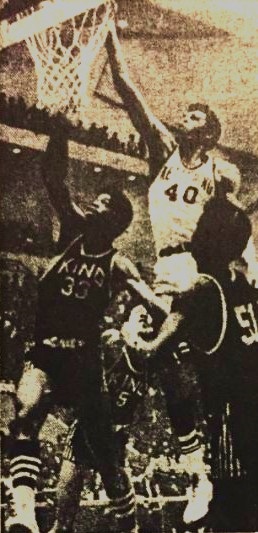 Fouls and turnovers nearly cost Ferndale its tournament life in its opener against Oak Park. With stars Tyrone Lewis and Billy Screws both in early foul trouble, the Eagles clung to a slim 35-33 lead with five minutes remaining, before escaping with a 45-39 win.
Kettering met Northeastern in a much-anticipated thriller in the District Final. Northeastern, with 15 of its 17 players now seniors, had advanced to the Class A Semifinals in March 1969. The teams had split their regular-season matchups in 1969-70. Boasting a distinct height advantage, Kettering had won by two points at Northeastern, 87-85, in mid-December with Hairston scoring 35 points, but the speedy Falcons, double-teaming Hairston, downed Kettering by eight points 86-78 at Kettering in a February rematch. Robinson scored 27 points and Mike Weaver, who later played at Michigan, notched 19 for Northeastern while Haywood tallied 27 for Kettering. Hairston was held to 14.
“We deserved to lose that game,” Kettering coach Walt Jenkins told the Free Press. “They got us to play their game instead of ours. I don’t think it will happen again ...”
Kettering blew a nine-point lead after one period but fought back to win 96-93 as Hairston scored 42 and pulled down 25 rebounds. Robinson finished with 41 points. “Northeastern’s hopes of upsetting Kettering were hampered when three players fouled out in the second half.”
Week 2
The Regional round brought much more excitement.
Ferndale escaped the Regional Semifinal “with a heart-pounding 66-64 victory” over Detroit Cooley. The Cardinals, 7-4 on the regular season, used their height advantage to create problems for Ferndale. Deadlocked at the end of both the first and second quarters, the Eagles led by 10 late in the fourth quarter before Cooley’s press interrupted things. Cooley cut the lead to two with nine seconds remaining before Ferndale was able to run out the clock. Lewis finished with 26 to lead the victors.
Ypsilanti fell on the same night, 76-70, to Detroit Catholic Central in overtime. Leading 67-64 with 16 seconds remaining, four points by DCC’s Frank Tanana Jr., including a layup with eight seconds left, knotted the score at 67-67 to force overtime. A pair of clutch field goals by Mark Barczuk in the extra frame ended Ypsilanti’s season. Tanana and Terry Frye both finished with 24 points on the night.
The Regional Final round tossed a few more favorites to the sidelines.
“Unrated and unsung … an also-ran in Public School League play, Will Robinson and his Pershing High Doughboys burst the Ferndale basketball bubble Saturday night” wrote Schram in the Free Press.
A crowd of 2,200 packed Southfield High’s gymnasium for Ferndale’s Regional Final game with Pershing.
The Eagles opened a quick 8-0 lead, and upped the lead to 10 points with three minutes to go in the first half before Pershing cut the margin to two, 41-39, at the break. By night’s end, 6-foot-4 sophomore Robert Hawkins had tallied 39 points, while 6-foot-8 junior Calvin Harper added 19 and 17 rebounds as Pershing scored a 90-88 upset.
In other Regional Final action, the Tractors of Dearborn Fordson, 17-3 on the year, held high-scoring George Gervin scoreless in the third quarter and to 17 points overall to upended Detroit Martin Luther King’s run, 64-62, while Ottawa Hills succumbed to Union. The Red Hawks had defeated the reigning champ twice during the regular season. Tradition-rich Benton Harbor upset Battle Creek Central, 88-85 in overtime.
 Also among the surprises, Flint Central, beaten by Pontiac Central by just 10 points early in the year, fell to unranked Midland 72-71 on a tip-in by Chemics senior guard John Reding with seven seconds remaining in their Regional Final. The teams had split a two-game series during the regular season.
Pontiac Central trounced Birmingham Brother Rice, 60-39 in a game filled with offensive stalls by Rice.
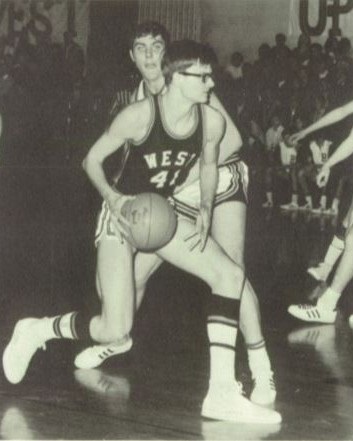
Garden City West, led by 6-foot-7½ senior Rick Drewitz, were the tournament’s heart attack kids. Undefeated during the regular season, the Tigers finished at No. 6 according to the UPI poll, ninth in the Free Press, and 10th by AP. West had advanced to the MHSAA Regional Finals in 1969 when its line-up also included Rick’s older brother Duane, but, for whatever reason, the Tigers weren’t initially mentioned as a threat in 1970.
Following an easy 62-37 win over Livonia Franklin in their District opener, indeed it seemed that it was only a matter of time before West departed from the postseason.
Drewitz poured in an eye-popping 48 points in the team’s 71-67 victory over Livonia Bentley, but it had taken overtime and a last-second field goal in regulation to get there. Drewitz’s jumper off the free throw line at the buzzer had knotted the game, 64-64.
In the District Final, with Drewitz benched with fouls, junior Dennis Leszczynski drilled a field goal and a pair of free throws over the final 32 seconds to give West a 58-55 win over Livonia Stevenson.
Garden City had opened up a 40-30 third quarter lead over Ann Arbor Huron in its Regional opener when Drewitz was whistled for his fourth personal and headed for the bench. Huron quickly grabbed the lead, 44-43 before the big center returned in the final frame. Drewitz, who ended with 19 points, sank two key free throws with 90 seconds left, allowing the Tigers a 55-52 win over the River Rats, who finished the year at 10-10.
The Tigers slipped past Detroit Catholic Central 72-71 in the Regional Final – a foul-filled contest. Drewitz, who would play his college ball at Kentucky, was held to only five field goals, but nailed 20 of 25 free throws to lead all scorers with 30 points. Tanana, dealing with a bad ankle, limped through much of the match, and was held to 10 points. West sank 38 of 52 free throws on the night as officials called 55 infractions during the contest. A total of six players fouled out.
Quarterfinals
Upwards of 75,000 fans were expected to witness the four classes of MHSAA Quarterfinals hosted at 14 centers around the state. But without question, Crisler Arena was the place to be on that Wednesday night. The lone site with two Class A contests, Pershing would face Fordson in the 4:30 opener. The dream matchup between Pontiac Central and Detroit Kettering, and “the finest two big men to come out of the state in recent years,” juniors Russell and Hairston, was set for an 8 p.m. tipoff. Separate tickets were needed for each game, and the event had been sold out since the start of the month.
The matchup, won by Pontiac Central, 76-73, was everything it was expected to be. High drama came late in the third period when Russell, who finished with 32 points – 22 in the first half – twisted an ankle. But, as Jack Saylor told Free Press readers, “it was a pair of free throws by Jerry Ratliff with 42 seconds left that provided the Chiefs with their victory margin.”
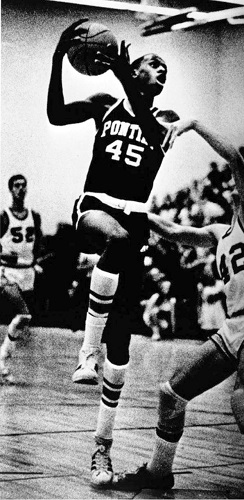 “After Ratliff’s foul shots had given Central a 74-70 lead, (Kettering’s) Floyd Haywood rammed in a rebound and completed a three-point play with a foul shot. Fifteen seconds remained, the Chiefs were out of time outs and Kettering (down by a point) was applying frantic pressure.”
Kettering’s defeat was sealed when Pontiac guard Bill Glover, boxed in following the inbound pass, spotted Russell, who had returned to action with six minutes remaining, at the other end of the Crisler court. Glover’s intended pass was off the mark, instead falling “through the hoop, fully 85 feet away.”
“Until then, the game belonged to Russell, who had a clear margin over Lindsay Hairston in the battle of junior All-Staters.” Hairston led Kettering with 18 points, followed by Joe Johnson (who would play college ball at U-M) with 11. Ratliff added 18 for the Chiefs.
The game was the last for Kettering coach Jenkins, who had played football for Will Robinson at Miller and was now moving into administration as a high school principal.
Pershing’s starters went the distance, with four of the five scoring in double figures, ending Dearborn Fordson’s run, 73-61. Harper led Pershing with 24 points. Behind an outstanding all-around performance, Fordson’s Steve Burke, a 6-foot-3½ forward, topped all scorers with 26 points.
Garden City West easily turned back Benton Harbor in the Quarterfinals, 82-66. Drewitz grabbed 19 rebounds, scored 13 of 14 from the charity stripe and totaled 39 points on the night. “Benton Harbor’s fast break and full-court press troubled West most of the first half,” stated Curt Sylvester of the Free Press, “but strength on the boards and ability to get the ball in to Drewitz for his soft left-handed jumpers finally tipped the balance for Garden City.”
“(Drewitz is) everything they said he was,” Benton Harbor coach Ace Eisner told the Benton Harbor News-Palladium. “He rebounds well, he has a nice touch and he goes to the basket. Defensively, we just couldn’t stop him …”
A 15-foot bucket with 38 seconds remaining by John Reding followed by a Jeff Paulus free throw with seven ticks left on the clock gave Midland a 71-68 upset of Grand Rapids Union. Gerald Edwards finished with 21 points for Union, while Tom Pruss’ 19 points led the Chemics. It was a season to remember for Midland, as it nearly didn’t take place. According to John Kennett, a reserve on the Chemics team and later a part-time sportswriter for the Midland Daily News “ … residents of Midland had voted down a millage proposal earlier in the year. As a result, all extra-curricular activities were to be eliminated. Fortunately, a group of citizens and students banded together to raise enough funds to maintain the extra-curricular activities.”
‘The Last Extravaganza’
“They’re calling this State Tournament the last of the great extravaganzas,” wrote Free Press sports editor and columnist Joe Falls. “It’s the last time they’re having this two-day carnival in Jenison Fieldhouse. Next year they’re changing the format, and the site. … They’re spreading the tournament over four weeks instead of three and there is going to be no Friday-Saturday climax in East Lansing.
“Half of the fun is planning a big weekend in East Lansing. The mad scene here is something else. You can feel the swirl of excitement everywhere … in the hotel lobbies, the restaurants, the hamburg stands, the bars … as everyone is talking about these kids and the games they play …
“If anything, U-M’s, facility, the gleaming new Crisler Arena, is far superior to old Jenison Fieldhouse, where the fans sit on benches rather than in seats and the game is only a rumor in some corners of the end court sections.”
The Marathon
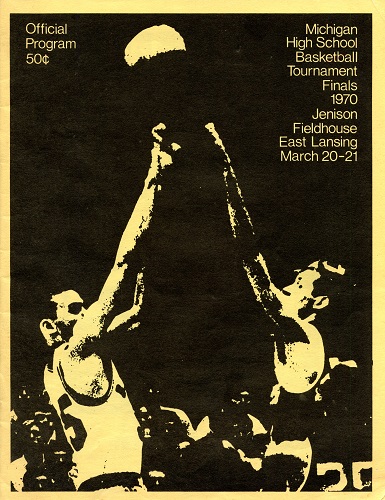 Three of the four Class A semifinalists making the trip to Jenison – Pershing, Midland and Garden City West – were unexpected guests.
“Robinson’s Pershing team and its semifinal opponent, Midland, both qualify as ‘Cinderella’ teams,” wrote John Hill of the State Journal in his tourney preview. The Chemics had also been beaten four times during the regular season. “Midland is a smart, well-disciplined team that doesn’t commit many errors.”
Pershing’s success had been a surprise to everyone. The Doughboys had lost three seniors, including their best player, Paul Seals, to January mid-year graduation. According to Coach Robinson, the current squad was his second team – his bench. The coach recognized the skills of the 15-year-old sophomore, Hawkins: “He WILL be a good ballplayer … but he’s got a long way to go yet and he’s got a lot to learn.”
In Hill’s opinion, the Pontiac Central-Garden City West showdown – the last Semifinal game of the night at Jenison – might be the tournament’s premier contest. “Not only do both bring unblemished records to the game, but each has one of the state’s top players” in Russell and Drewitz.
As it turned out, Pershing completely dominated Midland in their contest as the Chemics were “outshot, outrebounded, and out defensed,” in their 82-71 loss. Only a strong finish saved them from a worse defeat. At game’s end, Pershing had launched 82 shots to Midland’s 68, hitting on 42.7 percent to the Chemics 39.7. The Doughboys ended with a 55-40 rebounding advantage. Hawkins scored 22 points in the opening half, and finished with 31. Harper fouled out, but added 24 points and a game-leading 17 rebounds before his departure.
Robinson, however, wasn’t pleased.
“I wasn’t particularly inspired by the performance,” he said. “Calvin fouled out stupidly. … We’ve worked too long and too hard to make so many silly mistakes. We can’t make those kinds of mistakes tomorrow.”
As predicted, the Central-West matchup was a classic.
“Pontiac Central may indeed be, as a growing number of the ‘experts’ think, the best prep overall basketball team to ply its trade in Michigan since the last of the great Benton Harbor clubs,” stated the State Journal about the Chiefs’ 84-79 victory over Garden City West. “Deadly though they may be, however, the undefeated Chiefs had all they could do Friday to withstand the largely single-handed upset bid of brilliant Garden City West pivotman Rick Drewitz.”
Russell “could do little to slow Drewitz,” who scored 42 points, a Class A Semifinal mark that would hold for 13 years. With multiple ties and lead changes throughout, Garden City trailed by one, 79-78, with 1:40 left to play. But Drewitz – who had scored 15 points in the fourth quarter – picked up his fifth personal with 1:12 remaining, and “Garden City’s hopes went to the bench with him.”
Russell ended with 31 points, but dominated the backboard with 25 rebounds. Many compared the contest to the Dave DeBusschere-Chet Walker, Detroit Austin-Benton Harbor championship game match-up from 1958, won by Austin, 71-68.
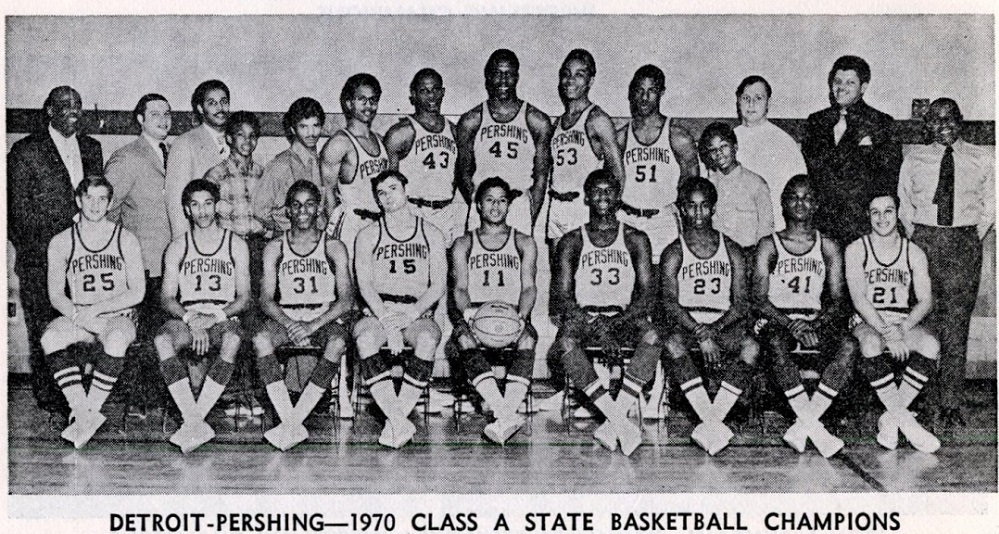 Coach Robinson and his team watched the battle, studying their opponent. The coach was impressed with Pontiac Central.
“They have more height than we do, more speed, more stamina, more poise and they’re an older team,” said Robinson. “But this is one I want.”
Circumstances made Pershing the sentimental favorite, but by all accounts, still the underdog entering the contest.
Storybook Ending
“Pershing High basketball squad staged one of the greatest upsets in Michigan high school tournament history here Saturday night before a steaming, screaming crowd of over 12,000 spectators in Jenison Field house,” exclaimed Schram in the Sunday paper.
“The Doughboys, loser of four games during the regular season, knocked off previously unbeaten Pontiac Central 86-81 in a real shocker.” The Swami, as he was nicknamed, had picked Pontiac to win.
“I know we’re the underdog. … I know few think we can win it,” Robinson had told 500 coaches at the annual banquet of the Michigan High School Coaches Association a couple of hours before tip. “But I’ve got a feeling.” Robinson was in attendance as he was being inducted into the coaches association Hall of Fame.
With the win, Pershing’s team had delivered a beautifully wrapped going away present to the coach.
“In the early going … it looked like the Chiefs would run away with it,” continued Schram. “Pontiac pounded to a 10-4 lead and Robinson called a hasty time out. Robinson sent … Harper to the low post crowding the basket and Harper started a fantastic series of easy layups, turn-around jumpers and tip-ins.” He finished with 24 points.
“Tiny (5-foot-6) but very aggressive guard Phil Paige … got them out front to stay by sparking a 23 point second period with 13 points,” noted the State Journal. The Doughboys’ captain, Paige would finish with 19 on the night.
“Late in the second period, Harper and Darrel Jeter started hitting the boards and Pershing continued to click on its shots,” continued the Free Press. “The Doughboys worked out a six-point lead, 39-33, at halftime.
“The Doughboys maintained the six-point margin in the third quarter, 64-58,” added the Detroit News. “Four times in the final quarter, however, Pontiac slashed Pershing’s lead to two points – at 70-68, 72-70, 74-72 and 76-74. With 2:23 left, Hawkins sank two free throws and … Jeter tipped in a field goal to give Pershing an insurmountable lead … 80-74.”
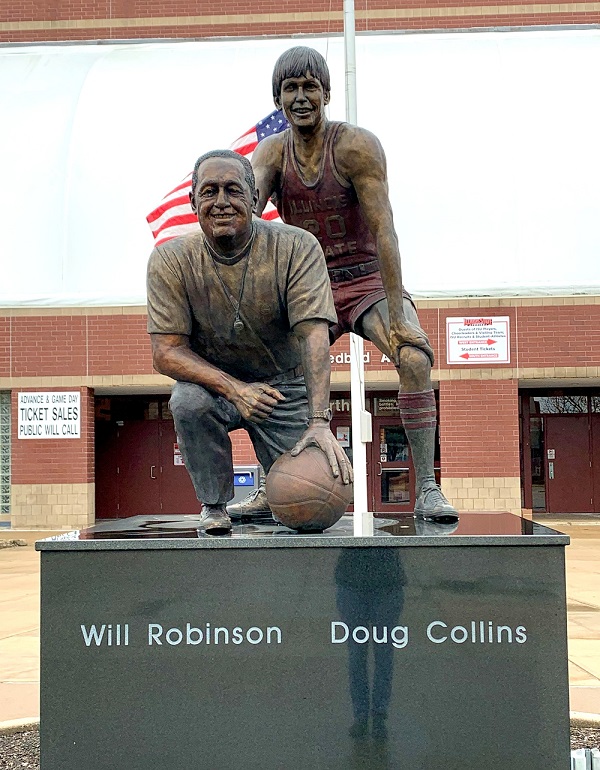 A pair of free throws by Paige and two additional baskets by Hawkins capped the upset.
At the final horn, fans mobbed the team. According to Schram, the celebration “rivaled the famed Lansing Sexton – Hamtramck classic of a decade (previous) when the winning shot dropped in overtime after the buzzer.”
Following the game, Robinson, now ready to start recruiting for the future, pitched Russell for his services:
“You’re going to come down to Illinois and play for me, aren’t you? You’ll be All-American and we’ll win the NCAA.”
Illinois bound
The team chose to celebrate the title at a Big Boy restaurant. Then Robinson departed for Normal, Ill., appearing before the local Jaycees that Monday night.
“I’m glad the opportunity came along,” Robinson said before his departure. “I just wish it had come along in Michigan. I never was offered a college job here.”
Robinson had bid for several college coaching positions in the past, only to be turned down.
“I love this country. I wouldn’t want to live anywhere else in the world, I’m just sorry it has a blind spot.”
 Ron Pesch has taken an active role in researching the history of MHSAA events since 1985 and began writing for MHSAA Finals programs in 1986, adding additional features and "flashbacks" in 1992. He inherited the title of MHSAA historian from the late Dick Kishpaugh following the 1993-94 school year, and resides in Muskegon. Contact him at [email protected] with ideas for historical articles.
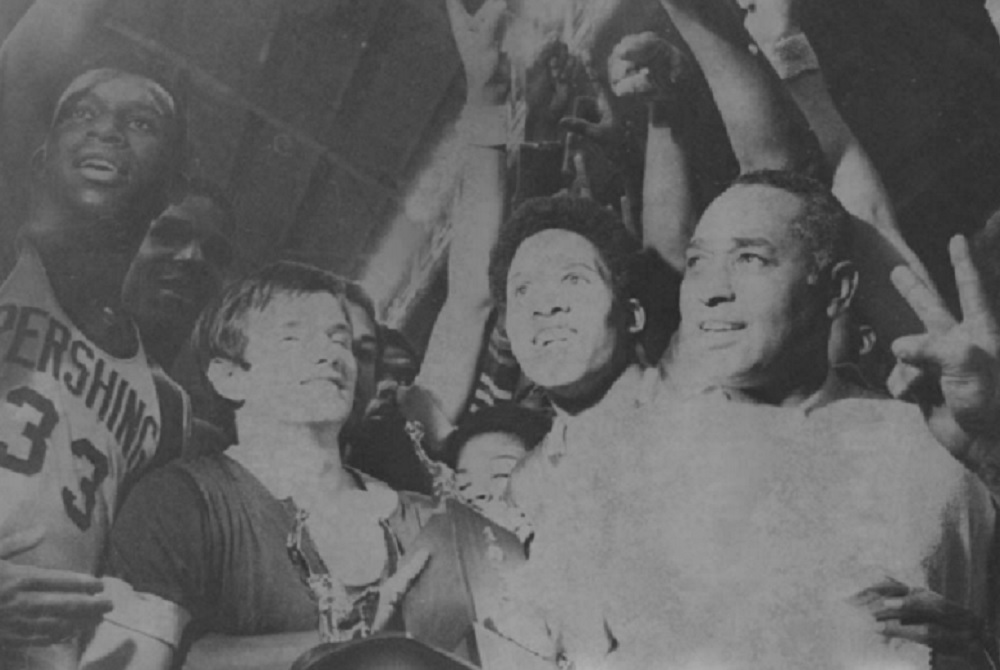
PHOTOS: (Top) Detroit Pershing players and coach Will Robinson celebrate their 1970 Class A championship win. (2) Coach Will Robinson, in 1958 while at Detroit Cass Tech. (3) Detroit King’s George Gervin, who would go on to star in the NBA. (4) Kettering’s Lindsay Hairston, who along with Campy Russell, was among the most sought-after players in the state; he would ultimately take his game to Michigan State. (5) Rick Drewitz of Garden City. The son of a junior high principal, Drewitz chose to play college ball at the University of Kentucky choosing that program over Michigan, Wisconsin, Louisville and Toledo. (6) Considered the top prospect in the nation, Campy Russell received offers from at least 100 schools before selecting University of Michigan. He had narrowed his list to Michigan, Michigan State, Minnesota and Long Beach State. (7) The game program for the final rounds of the 1970 MHSAA Boys Basketball Tournament. (8) The 1970 Detroit Pershing team photo. (9) The Will Robinson-Doug Collins statue outside the north entrance of Illinois State University’s Redbird Arena, unveiled in September 2009. Calvin Harper, Phil Paige, Robert ‘Bubbles’ Hawkins, and Darrel Jeter from Pershing would all follow Robinson to ISU. (Photos collected by Ron Pesch; statue photo by Allison Antink Meyer.)