


Class in Session: A History in Classification
July 24, 2017
By Rob Kaminski
MHSAA benchmarks editor
This is the first part in a series on MHSAA tournament classification, past and present, that will be published over the next two weeks. This series originally ran in this spring's edition of MHSAA benchmarks.
Conversation and discussion at the March 2017 MHSAA Representative Council Meeting leaned heavily toward the subject of 8-Player Football and how to properly balance its tournament with the growing number of schools sponsoring the sport.
While the proposal to split the tournament into two divisions beginning with the 2017 school year was adopted, the MHSAA then faced questions such as when to set the divisions, how to determine qualifiers and where to host the championship games.
The topic continues to create a buzz in Class D schools across both peninsulas, and likely will do into the start of school this fall.
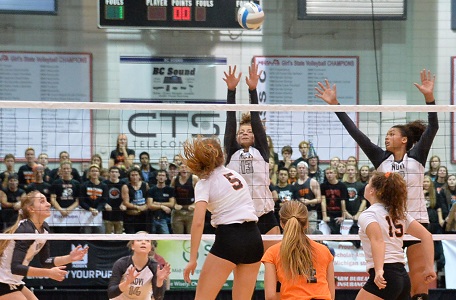
Likewise, the lone holdouts still conducting tournaments by class – MHSAA Boys and Girls Basketball and Girls Volleyball – took center stage at the May Council discussion, and following the 2017-18 school year, class is out for good. Both genders of basketball, and girls volleyball, will move to divisional formats thereafter.
There is much to be decided to be sure; but as those in education are well aware, history is the best teacher.
Fortunately for the sports in flux and for all sports under the governance of the MHSAA, the Association more or less wrote the book on the subject of sport classification. Following is a history lesson, with a little advanced division thrown in.
Class structure
Credited with being the first state with multiple tournament classifications, Michigan’s attention to trends and shifts in philosophy aimed at fair play and equal tournament opportunity can be traced from 80 years ago to the present.
In the earliest years of the MHSAA, there were four classifications for elections and tournaments – Classes A, B, C and D. Classes C and D had far more schools than Classes A and B. For example, 80 years ago (1937), there were only 58 schools in Class A, 94 schools in Class B, 297 schools in Class C and 253 schools in Class D.
Gradually through the years, as Michigan’s major cities spawned suburbs, there was a shift in the other direction to the point 30 years ago (1987) when school size became more balanced: 173 Class A schools, 178 Class B schools, 179 Class C schools and 182 Class D schools.
Up until 1987, the MHSAA published the dividing line between each classification, after which schools submitted their enrollments. Then, for 1988 and thereafter, the MHSAA adopted the plan of gathering all enrollments first and then placing 25 percent of the schools in each of four classes. This completed the equalization of the number of schools in each class for elections.
However, the change for 1988 did nothing to equalize the number of teams actually entered by each class in each sport. And unlike the early years of the Association when there were many more Class C and D teams than A and B teams, there were more Class A and B teams than C and D teams entering MHSAA tournaments decades later.
Moreover, the difference in number of teams entered in the different classifications for a sport continued to increase as many small schools, the fastest growing portion of the MHSAA's membership, sponsor only a few sports, or they sponsor no sports at all but enter into cooperative programs with other schools.
 Because of these differences, Class A or B schools sometimes had to win twice as many games as Class C or D schools to reach the MHSAA Finals in a sport. At times, the larger classifications had District Tournaments, even rat-tail games, and/or a Quarterfinal game, and the smaller classifications did not. Most Class D Districts have had four teams (some only three), while Class A Districts often had seven or eight teams. In Regional levels of individual sports, the number of entries in the larger classification once greatly outnumbered those in the smaller classifications of the tournament for the same sport.
Over the years, these dividing lines between classes escalated gradually, as did the differences in enrollments of largest and small schools in each class. In 1937 the dividing lines were 700, 300 and 100 between Class A and B, B and C, and C and D, respectively. By 1987, the dividing lines were 1,129, 571 and 298, respectively, leading to the current method of collecting enrollments and then setting the classification.
With the pendulum swinging well past center by the late 1980s, coaches associations, MHSAA sport committees, tournament managers and school administrators began discussion and offered proposals to correct what many believed had become a flawed system of MHSAA tournament classification.
At the 1996 MHSAA Update Meetings, ¾ of 858 respondents to that year’s annual survey indicated they favored a system that would divide schools which actually sponsor each sport into two, three or four nearly equal divisions.
Problem solving
At its meeting May 4-6, 1997, the Representative Council defeated a motion that would have adopted in one action a coordinated plan of reclassification for all sports to equalize the number of schools in each tournament for each respective sport. Instead, the Council discussed and voted on each proposal that had been presented from sport committees.
This resulted in the Representative Council adopting four equal divisions for baseball and softball, four equal divisions for boys and girls tennis, four equal divisions for boys soccer and three equal divisions for girls soccer, effective with the 1997-98 school year. Helping in the decision was the success of the 1995-96 MHSAA Wrestling season, which saw the sport move to four divisions for its tournament structure
The Council delayed action on similar proposals for football and boys golf at that time to glean additional input. The same decision was made with respect to a proposal from the Ice Hockey Committee that would have split the Class A schools in two divisions and left the Class B/C/D Tournament unchanged.
“The gist of the move from classes to divisions was to equalize the path to championships for students of all schools, regardless of the size of those schools,” said MHSAA Executive Director Jack Roberts.
While the restructuring accomplished that goal for the majority of competitors, opposition exists now as it did then. The primary argument in opposition to the changes is that, in some sports, it increases the range between largest and smallest schools in the division for smallest schools, even as the range is usually reduced for other divisions.
Larger schools offered a counterpoint.
“The larger schools suggested that while they may have more students, they also attempt to sponsor more sports than the smaller schools, in some cases spreading the enrollment as thin as a much smaller school with fewer sports,” Roberts said.
“Even today, the idea of four equal divisions can be unpopular among some Class D schools which feel especially burdened by the equal division concept,” Roberts said. “There was enough opposition in 1997 that equal divisions were rejected for boys and girls basketball and girls volleyball, and some of that opposition remains.”
The numbers of schools sponsoring each MHSAA tournament are still close to the totals today, with the exception of soccer in both genders, which has enjoyed substantial increases. This spring, 466 girls teams were scheduled to compete in the MHSAA Soccer Tournament, while 473 boys teams will suit up this fall.
Since the beginning of MHSAA divisions in 1996 with wrestling, 147 additional team champions have been crowned and countless individuals have known the thrill of victory due to an extra level of Finals in various sports. Girls soccer has seen the most growth in opportunity, moving from two classes in 1987 to three divisions the following year, and then four divisions in 2000. Boys soccer had enjoyed four classes for two years prior to the new four-division format, and it was the sport of soccer that helped to create a caveat in the nearly equal division movement.
Lower Peninsula boys and girls swimming & diving expanded from two to three divisions in 2008, while boys and girls bowling are the most recent sports to enjoy increased tournament opportunity, adding a fourth division in 2010.
“Fairness is in the eye of the beholder. While having the same number of schools in each division is one kind of fairness, holding in check the enrollment range between the largest and smallest schools in Division 4 is another kind of fairness that is dear to a great number of people,” Roberts said. “Because more schools sponsor basketball and volleyball than other sports, Class D schools would have been least affected by the equal divisions concept in those sports; but that, and ‘tradition,’ did not dissuade the opponents in the 1990s.”
The shift to divisions not only paved the way for student-athletes, but also assisted administrators and schools hosting tournaments. MHSAA tournament mangers looked to equal divisions to more closely equalize the number of schools in District or Regional Tournaments and to better equalize the length of day required for these rounds of tournaments, both for management and participating teams and individuals.
Pinning down an answer
Wrestling became the first MHSAA Tournament to be conducted in nearly equal divisions when team and individual champions were crowned in Divisions 1, 2, 3 and 4 rather than Classes A, B, C/D for the 1996 winter championships.
The movement was well received, as schools saw more opportunity for success: four champions where there once were three at the District, Regional and Final levels, and a smaller range of enrollment between the smallest and largest school in all four tournaments, leading to the impetus for the Fall 1996 Update Meeting Survey of schools regarding similar movement in other sports.
Team champions that year were Holt (D1), Petoskey (D2), Middleville Thornapple Kellogg (D3) and Dundee (D4).
Getting their kicks
When the "equal divisions" concept was approved by the Representative Council for most MHSAA Tournaments for the 1997-98 school year, there was opposition from the smallest schools which, under the equal divisions, are forced to play against larger schools than reside in Class D. Compelling arguments were made – and still are – that an enrollment difference between schools with smaller enrollments (e.g., Class D) is more difficult to overcome in athletic competition than an even larger enrollment difference between schools with larger enrollments (e.g., Class A).
The opposition was most intense in soccer because of the number of students needed to field a team and the physical nature of the sport. As a result, from 2000-01 through 2010-11, soccer operated with a “20-percent modification.” This placed 20 percent of all schools that actually sponsored soccer in Division 4, and the remaining 80 percent were placed equally in Divisions 1, 2 and 3.
At the time the 20 percent modification was adopted, it was also established that soccer would return to four equal divisions when the largest Division 4 soccer school had an enrollment equal to or smaller than the mid point for Class C schools. That occurred in 2010.
Last class on the schedule
In the same volume of “history being the best teacher,” one can also find the adage, “times change.” While the division format was a welcome change in some sports, others were left to hold class without change.
 In the sports of boys and girls basketball, and girls volleyball, the number of schools sponsoring the sports were so close to the overall membership of the MHSAA that divisions were not necessary; the enrollment breakdowns themselves were enough to delineate equal opportunity for tournament success.
That is no longer the case, according to MHSAA membership. The last move from classes to divisions occurred for the 2006-07 school year following Council action. Before this May, that is. Action at the most recent Representative Council meeting, May 2017, called for the shift to divisions for MHSAA Boys and Girls Basketball, and Girls Volleyball, beginning with the 2018-19 season.
“Because the MHSAA Volleyball Committee had requested this change several times a number of years ago, and because the Council felt the change inevitable, there should not be further delay,” Roberts said. “It is an important detail that the Class D maximum has dropped 50 students over the past decade so the objection that much larger schools would be competing in Division 4 isn’t very strong now.”
Using the 2017-18 enrollment figures, just eight Class C schools would be competing in Division 4 for boys basketball, 11 for girls basketball and 14 for girls volleyball.
Good things came of the previous most-recent switches in 2006-07. Competitive Cheer was re-classified from Class A, B and C-D into four equal divisions assisting in the rapid growth of sponsoring schools (approximately 80 schools per division). Alpine skiing was changed from Class A and B-C D to two equal divisions.
At that time, the MHSAA Basketball Committee had recommended to the Council the study of increased classifications, but status quo remained.
Back on the grid
As such, MHSAA Basketball and Volleyball remained the only holdovers of the MHSAA class structure. Discussion resurfaced periodically during the last two decades to bring those tournaments in line with the other MHSAA sports.
Regular-season football-playing schools are separated by class, then are reshuffled by divisions for the playoffs. Football, as we know, underwent a significant postseason facelift in the late 1990s.
While MHSAA Football also remained a class sport through 1998, it had expanded from four to eight classes from 1990-98, becoming the first MHSAA sport to crown more than four team champions. Member schools were asked to consider a pair of options in November of 1997. One called for eight equal divisions, and the second would leave Class D by itself as division 8, and split Class A, B and C schools into seven nearly equal divisions.
After much discussion, retooling, and crunching of formulas, the MHSAA unveiled its revised Football Playoff model that continues to roll today, nearly 20 years later. It was determined that 256 teams would qualify for the tournament based first on a minimum of six wins, then by Playoff Points determined by formula. From there, the field would be divided into eight divisions, with the field being filled out by a nearly equal number of five-win teams in each division as needed to reach 256.
Eight championships would indeed be enough, until football sponsorship among the MHSAA’s smallest schools – some with rich football traditions – began to trend downward. The MHSAA again went to the drawing board, examining the viability of 8-player football. After an experimental year in 2010 without a tournament, the 8-player game was playoff-ready for 2011, with a field of 16 qualifiers embarking on a four-week tournament.
Not only did the 8-player option restore recently canceled programs, but it also created teams in schools which previously had none, and convinced some 11-player schools that this new division was the best path to take.
What did this do for the Class D holdovers staying in the traditional 11-player game? Well, a couple of things, positive and negative. As two and three dozen Class D schools opted for the 8-player game, the remaining 11-player Class D schools at times found themselves in disrupted leagues and had to travel further to complete schedules. They also competed against larger teams in Division 8 of the 11-player MHSAA Football Playoffs.
However, the growth of the 8-player game among the smallest schools also resulted in more Class D schools qualifying for the MHSAA Football Playoffs than ever before. In 2012, an all-time high 44 percent of Class D schools sponsoring football qualified for either the 8-player tournament or Division 8 of the 11-player tournament. That compared to 42.2 percent of Class C schools, 44.9 percent of Class B schools and 41.6 percent of Class A schools which qualified for the 2012 playoffs.
Much is to be determined in the most recent chapter of MHSAA Tournament expansion as the 8-Player Football Playoffs welcome a second division. As the past illustrates, there will be pluses and minuses. History also shows that the MHSAA has received maximum input from its constituents, researched all possibilities, and will find solutions to questions still in the balance before an additional group of athletes hoists a new trophy in November.
Through the Years
A chronology of when which sports moved from Class to Division in the MHSAA.
1995-96: LP Wrestling
1997-98: Baseball, Boys Soccer, Girls Soccer, Softball, LP Girls Tennis, LP Boys Tennis
1998-99: LP Boys Golf, LP Girls Golf
1999-2000: Ice Hockey, LP Boys Track & Field, LP Girls Track & Field
2000-01: LP Boys Cross Country, LP Girls Cross Country, UP Boys Cross Country, UP Girls Cross Country, UP Boys Golf, UP Girls Golf, UP Boys Tennis, UP Girls Tennis, UP Boys Track & Field, UP Girls Track & Field
2002-03: LP Girls Swimming & Diving, LP Boys Swimming & Diving
2005-06: Boys Bowling, Girls Bowling
2006-07: Girls Competitive Cheer, Boys Skiing, Girls Skiing
2018-19: Boys Basketball, Girls Basketball, Girls Volleyball
Note: Boys and Girls Lacrosse has been a divisional sport since it began in during the 2004-05 school year.
Johnson Served as Storyteller, Guardian
By
Geoff Kimmerly
MHSAA.com senior editor
January 5, 2021
Promoting the value – and values – of school-based sports.
No statement more completely, or succinctly, explains the mission of the Michigan High School Athletic Association.
Those words were sparked in the mind of John Johnson, and also might best describe his work for the MHSAA over more than three decades – which concluded with his retirement Dec. 18.
Johnson’s official title for most of his tenure was communications director, by which he designed and delivered the message of the MHSAA’s work. A more suitable title might have been “guardian” – Johnson in 1987 joined the then 62-year-old organization and became keeper and protector of all the MHSAA had been and was becoming under its recently-hired executive director, Jack Roberts.
More than 33 years later, “JJ” has stepped away as the pioneer in his field and having impacted multiple generations of Michigan high school and middle school athletes in ways that will continue. Whether as the coiner of memorable slogans, the voice explaining the nation’s first elaborate sportsmanship effort or detailing the MHSAA’s work for its schools during tougher times, or simply as the narrator passing on some of the good stories the bubble up from every season, Johnson daily worked to keep those who follow school sports in the know.
 “Being the voice, and having to be the face a lot, is something that came with the territory – somebody had to be the storyteller. And while you can be prideful about that, the important thing is still the story,” Johnson said. “I’ve said it a lot: I was the lucky guy who got the job. Because the story was there to be told, the work was there to be done.”
Thousands upon thousands of times over the years, Johnson did that work with enthusiasm and grace. Most visibly, it came in front of a TV or radio microphone, or as quoted in your local newspaper and media nationwide. He has been the drive behind the MHSAA championship games watched annually on TV and online, and the messenger via various campaigns delivering the good news of why school sports are vital for kids and communities.
Serving as that storyteller, Johnson has never been one to tell much of his own. But there is no shortage of storytellers who have benefitted from Johnson’s wisdom and tutelage over the years – and we were enable to enlist a few to paint a more vivid picture as we recount at least a glance of what Johnson has meant to the MHSAA and its schools over these many years.
***
“The measure of all of us is what we leave behind. Those with whom we’ve been in contact. Those we’ve lifted up along the way. And by that measure, we are witnessing the end of a spectacular career. I’ll take away from all the exchanges, the ready smile, the encyclopedic knowledge that JJ possessed and the sense of calm within the frenzy. It was invaluable to those who popped into his world only a few times a year. John Johnson has left very large shoes in East Lansing.”
– John Keating, longtime FOX Sports Detroit anchor and host for many MHSAA Football and Basketball Finals
***
First and 1 of a Kind
Jack Roberts became the fourth full-time executive director of the MHSAA during the summer of 1986. He brought an emphasis on communication, and “communications director” became the first position he created in East Lansing.
Johnson in 1987 became that first communications specialist at the MHSAA, beginning a long last stop during a run in sports that Johnson began as a student at Mount Pleasant Sacred Heart, about an hour’s drive north of Lansing.
Johnson hadn’t played sports at Sacred Heart, but had taken part in just about every other way possible for a student. He was a team manager, statistician, student trainer, and picked up part-time sports writing work at the former Mt. Pleasant Daily Times. He wrote a series while still in high school on the creation of the MHSAA football playoffs, which were set to kick off in 1975, and that series was syndicated among the newspapers in the Daily Times’ chain. As a student, Johnson moved on to Michigan State University where he majored in journalism, and again he was published and syndicated by the Daily Times – this time for a series on how game officials were being trained by state associations, including the MHSAA.
That series foreshadowed the work he would take up a decade later – it closed with a piece on poor spectatorship toward officials. (Coincidentally, the collection of stories had been clipped and saved by the MHSAA executive director at the time, Vern Norris. The file found its way to Roberts, who eventually found out he had just hired the author.)
Also having served as a student assistant in the MSU sports information office, Johnson began his communications career at Albion College in 1978 as an assistant in the college relations office with responsibility for publicity for the college’s 17 athletic teams. (He didn’t graduate from MSU until 1979, but received two days off per week to get back to East Lansing for classes. He also served as a radio voice for Albion High games on the side.) Johnson moved on to brief stints in the news department with WITL Radio in Lansing and as an intern in the Office of Public Affairs at Ferris State University before landing with the Western Michigan University sports information department as an assistant director.
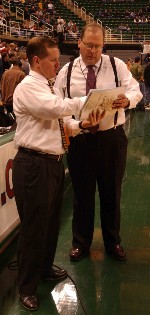
That led to a three-year stint as an assistant sports information director at Indiana University, where his responsibilities included serving as SID for coach Bobby Knight’s men’s basketball program. Johnson also assisted with press operations at the 1984 U.S. Olympic Basketball Trials hosted by IU. Johnson then left Indiana in January 1986 for a promotions position at Michigan Farm Bureau.
Six months later, his eventual journey to the MHSAA accelerated.
Roberts was hired during the summer of 1986, and not long after he asked MSU sports information director Nick Vista who had been his best student assistant of the past decade. The answer: John Johnson.
Johnson and Roberts met multiple times over the next many months, and Roberts made his choice.
“From the first moment I sat down with Jack Roberts, I knew I wanted to be here,” Johnson said. “The way he talked so passionately about high school sports, and the values of high school sports. … I saw the opportunity to take Jack’s vision and run with it.”
The day before the announcement of Johnson’s hire was to be made, Roberts asked Johnson to come with him to Grand Rapids to watch South Christian basketball star Matt Steigenga (later of MSU and the NBA) – but Johnson couldn’t go because his wife Suzie had gone into labor with their first of two children.
But a little more than a month later, Johnson started at the MHSAA on April 1 – and that came with plenty of jokes on its own.
Yet while Johnson had to miss that trip to Grand Rapids, he and the executive director would get plenty of car time together – to the benefit of the MHSAA’s member schools. To introduce themselves to statewide media, Roberts and Johnson did a driving tour to visit all of them, touring their offices, talking to them about MHSAA initiatives and asking how Association staff could better assist the media in its work. Those drives also allowed them to dream up together “the kinds of things that were unveiled over time,” Roberts recalled.
“We talked so much those first 15 years, we could intuit each other’s thinking the last 15 years,” added Roberts, who retired from the MHSAA in 2018. “We didn’t spend nearly as much time together, but we didn’t need to.”
***
“John Johnson has positively influenced so many more people than he knows and more than anyone realizes. It starts with the thousands and thousands of people who have been able to watch high school sports on the web throughout Michigan. Live-streaming of games has really come to the forefront due to the pandemic, but he was on top of this innovation nearly a decade ago when it was just in the early idea stage. He has been the person who orchestrated and led the countless schools across the state who started streaming their games in the past several years.
“JJ has also impacted numerous student journalists who wanted to learn the craft by covering high school games. He has always been SO supportive of these aspiring broadcasters and writers and reporters, affording them the opportunities to cover high school championships on the biggest stages, and treating those students the same as their professional peers. The students got to be on the turf at Ford Field and in the postgame press rooms, even if their school's team wasn't involved in the game! All they had to do was ask for credentials, and he granted them time and time again.
“JJ's influence also touched those of us who work for the MHSAA in a freelance fashion at various championship events. He has helped so many of us become better communicators, announcers, statisticians, and more. He was always willing to provide feedback & opportunities to learn, and he served as our leader who was always accessible morning, noon, and night. He pushed us to be our best every game, just as the athletes were trying to be their best. It's been my pleasure to work for him as a PA announcer for several years now, and I tried to be perfect every single time because I knew he was listening and because I wanted to do well for him.”
– Roger Smith, advisor for Lake Orion High School’s nationally award-winning School Broadcast Program and public address announcer for MHSAA Finals
***
Telling the Story
In Roberts’ eyes, a few campaigns from his and Johnson’s time together stand out most.
• Promoting the Value – and Values of High School Sports. “I came in with “School Sports – the other half of education” but that wasn’t as good,” Roberts said. … (His words) caught our brand much better.”
• Good Sports are Winners. The MHSAA launched a sportsmanship initiative a few years into their tenures that was “unparalleled” nationally, per Roberts’ description. “Before sportsmanship was an 'in thing' to talk about, John and I were talking about it.” Johnson created all of the print and broadcast materials designed to promote improving sportsmanship, and his work helped make Michigan not just the leader but a voice nationally on the topic.
• Safer Than Ever. The campaign, stretching over much of the last decade, explained that high school football – for a variety of reasons – is safer than it has ever been. Johnson worked with the Michigan High School Football Coaches Association to build the messages and promote them at a time when injury fears were regularly headlining media coverage.
 “John made our ideas visible and practical. People would put them together at the league level and school district level,” Roberts said.
“To narrow (his work) down to three is unfair to him because he did a thousand things.”
And in a number of roles. Johnson started as communications director, picking up along the way responsibilities in information technology, marketing, merchandising and more. Everything from daily media questions to maintaining the MHSAA record book (and serving on the National Federation of State High School Associations (NFHS) national record book committee) fell onto Johnson’s desk, and just about any message read at any game by a public address announcer was his work. His final years were as “all things broadcasting” as Johnson served as the MHSAA’s first director of broadcast properties – an all-encompassing title that included all-encompassing responsibilities.
The MHSAA provides video broadcasts of nearly all of its MHSAA Finals – including football and basketball with FOX Sports Detroit – and Johnson has navigated the growth of those opportunities. Same with the MHSAA Network’s audio offerings during championship events, and his voice has been heard weekly during “This Week in High School Sports” which is aired as part of programming by more than 100 radio stations statewide.
The most significant advance under his guidance over the last two decades has been the School Broadcast Program, begun for MHSAA schools during the 2008-09 school year. The MHSAA relied on that knowledge in playing a leading role last decade in the formation of the NFHS Network – the nationwide digital home for live and on-demand high school events – and it’s not unusual for Michigan SBP schools to broadcast upwards of 500 events per week via the network.
“What people don’t necessarily know is John is the pioneer in this field,” MHSAA Executive Director Mark Uyl said. “The way he shaped this job over the last 30 years has been extraordinary – and has become the model for the 49 other states.”
***
“I’m sure that with me, JJ had to do things he never had done with anyone else – I was pregnant three straight schools years. The accommodations for me, even as just a female, it was kinda crazy especially in the 1980s. But when I was pregnant, I couldn’t walk up stairs, and he always would make special concessions for me, (like to) try to find bathrooms for me. There were so many media, and there always had to be exceptions, but he always had to take special care for me, and I’m so thankful for what he did. We laugh about that stuff all the time.
“I remember too, I had a tragedy in my family one year, and I know he was busy at the Finals, but he took me (aside), sat there and cried with me and talked with me. He took time out of his way. He treated me professionally, like everyone else. But as a person, he has such a gift to connect with people.”
– Jane Bos, longtime prep sports editor for the Grand Rapids Press and 2008 recipient of MHSAA Women In Sports Leadership Award
***
More than Scratching the Surface
The work Johnson pioneered at the MHSAA goes on. Formerly a staff of one (with help from valuable volunteers including long-time postseason assistant Walter Dell) now includes a team of employees to handle the media relations, publications, broadcasting, marketing and other messaging needs.
While making the rules for school sports remains the top priority for the MHSAA, telling the story of their importance in students’ lives comes in a close second – and Johnson has written at least the first chapters of the book.
“It needed to be done; the Association had to take bigger steps into the communications world. And thanks to Jack Roberts, it did. I was the lucky guy who landed in the chair,” Johnson said.
But again, that is simply scratching the surface. We’ll end with longtime Detroit Free Press sportswriter Mick McCabe taking a last deep dive.
I first met John Johnson in the late fall of 1977.
He was a student at Michigan State and worked in the sports information office. I was a sports writer for the Detroit Free Press, covering MSU basketball, featuring JJ’s brother, Earvin.
Well, maybe Earvin and JJ weren’t exactly blood relatives, but they were both fun to be around and each had a profound effect on my life.
No, really.
When watching the Spartans back then you knew you were watching someone special, which is why they called him Magic.
 No one ever used the word magic in describing JJ, but he was young and enthusiastic and sociable while he learned the tricks of the trade under the watchful eyes of Fred Stabley Sr. and Nick Vista, the absolute best sports information directors in the country.
That is why I knew JJ would be such a good fit at Albion College, which just so happened to be looking for an SID when JJ was graduating from MSU.
JJ was exactly what Albion needed and did an excellent job and soon JJ’s career was off and running.
Somewhere along the way JJ landed at Indiana University where Bob Knight learned to tolerate JJ. If you’ve ever met Knight and understand his relationship with other human beings, you know that is like saying JJ and Knight were besties.
That was reinforced in the spring of 1984 when I spent almost two weeks in Bloomington covering the U.S. men’s Olympic basketball trials and interacted with JJ on a daily basis.
In the spring of 1987 JJ accepted a job with the Michigan High School Athletic Association. It was a job that hadn’t existed before JJ came riding into town.
Jack Roberts was in his first year as the MHSAA’s executive director and JJ was one of his first hires. He was also one of his best.
JJ was hired as the MHSAA’s first communications director. Before JJ arrived the words “communication” and “MHSAA” had never been used together in the same sentence.
If a member of the media had a question for the MHSAA chances are good it would never be answered.
That changed the minute JJ was hired. If he didn’t know the answer, he got the answer for you. And if you needed to speak with someone about a particular question, JJ got you to that person.
It wasn’t JJ’s job to do our job for us, but the thing we didn’t want was for him or someone else from the MHSAA to get in the way of us doing our job.
Not only didn’t JJ get out of the way for us, he helped us and made our jobs easier with the way he ran communications for the MHSAA.
A few weeks ago, with JJ’s imminent retirement growing closer, someone asked me to describe the worst phone call I received from JJ, one in which he was irate with something negative I had written about the MHSAA.
Certainly, he assumed, over 34 years there had to be many such phone calls.
He was genuinely surprised to learn it never happened. Not even once.
JJ knew that the media has a job to do and his job didn’t require him to complain when something negative about the MHSAA was written. I’m certain it was a lesson he learned from Stabley and Vista, who operated the same way.
As far as I know, the only times JJ ever called a member of the media after a negative story was when the reporter had the facts wrong. His call just pointed out the errors and he left out the tongue lashing.
JJ was the consummate professional in doing his job and he did it better than anyone else.
There is no way I am going to describe JJ’s job performance at the MHSAA as magical, like Earvin’s, but it was pretty darn close.
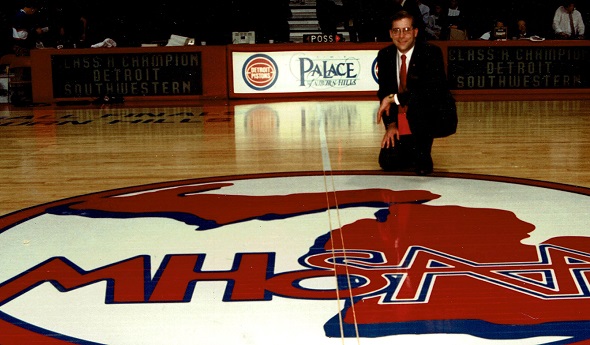
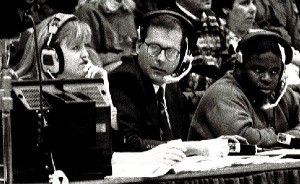
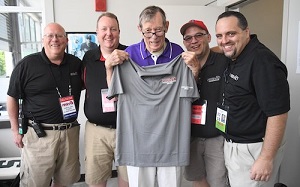
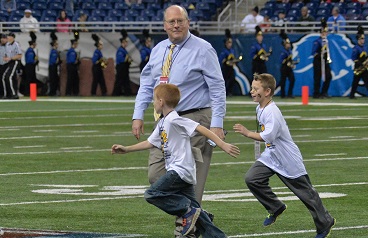
PHOTOS: (Top) MHSAA Communications Director John Johnson kneels at midcourt at The Palace of Auburn Hills in 1990 having designed the floor for that year's Basketball Finals. (2) Johnson, middle, wears the headset during a playoff production. (3) Johnson, right, coordinated media, announcing and stat-keeping among other areas during MHSAA events at the Breslin Center. (4) Johnson, far left, stands with (from left) MHSAA public address announcers Roger Smith, Erik O. Furseth, Tony Coggins and Steve Miller during a Baseball/Softball Finals weekend. (5) Johnson walks the turf at Ford Field during a Football Finals. (Photos from MHSAA archives.)